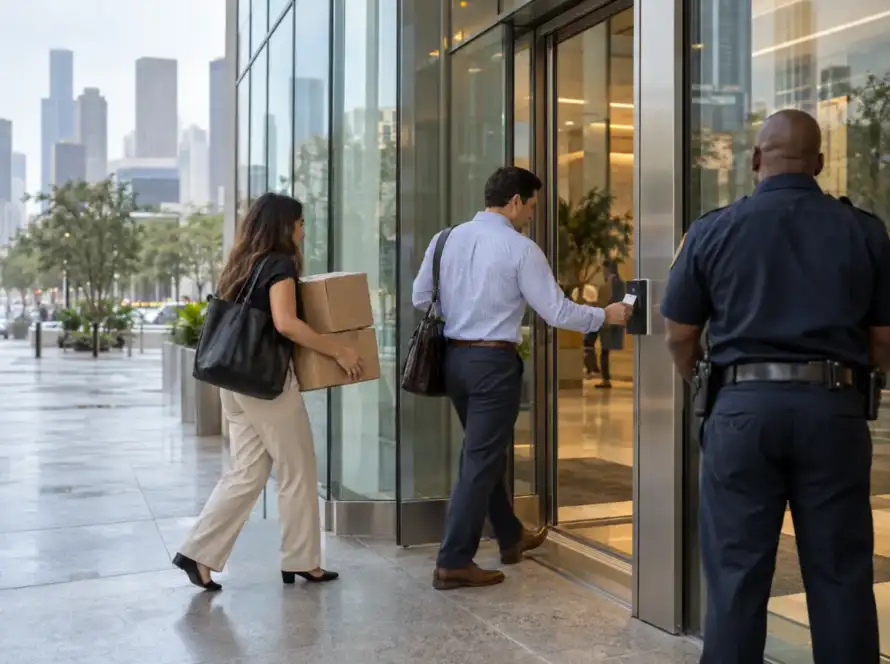

Private security is protection that a business or person pays for directly instead of through taxes. A licensed company supplies officers who watch a specific property, control who comes in, patrol on a set schedule and report what happens, all under a contract with the owner. In Texas, the Department of Public Safety (DPS) licenses those companies and every officer they employ under Occupations Code Chapter 1702.
It matters because police and private officers do different jobs. Police serve everyone in their jurisdiction and usually arrive after someone calls. A private officer is assigned to a single site, during hours the client chooses, and is already there when something starts. Private security is also the larger workforce: the Bureau of Labor Statistics counted 1,294,300 security guard jobs in the U.S. in 2025, compared with 824,200 police and detective jobs.
Short answer: Private security is privately paid, state-licensed protection for a specific property or person. In Texas, unarmed officers hold a non-commissioned license, armed officers hold a commission, and both have about the same arrest and detention authority as any private citizen.

What counts as private security in Texas
Texas regulates private security as a trade that covers more than guards. A DPS Class B license, for a security services contractor, covers alarm, armored car, courier, electronic access, guard and locksmith companies. Class A covers private investigations, and Class C covers both (Occupations Code Section 1702.103).
When a business owner says private security, they usually mean the guard side of that list:
- Static officers who hold a post at a gate, lobby or loading dock.
- Roving officers who walk or drive a patrol route across a large site or between sites.
- Armed officers for posts with a higher risk of violence, such as cash handling.
Our guides to types of security guard services and roving vs static guards show how each one works on a site.
Contract security and in-house security
A company can also hire its own officers. Texas exempts those in-house employees from Chapter 1702 while they work only for that employer on its own business (Section 1702.323). The exemption has limits: an in-house officer who carries a firearm on the job still needs a state commission, and one who deals with the public, wears a uniform or patch marked “security” and performs guard duties falls under the chapter.
Full-time peace officers who work security off duty are also exempt if they meet the conditions in Section 1702.322, which include working as a peace officer an average of at least 32 hours a week.
Private security vs public law enforcement
| Private security officer | Police officer | |
|---|---|---|
| Who pays | The client, under a contract | Taxpayers |
| Who they protect | The client’s property, staff and visitors | Everyone in the jurisdiction |
| Where they work | The assigned site or patrol route | Anywhere in the jurisdiction |
| Arrest authority | Same as a private citizen: a felony or breach of the peace committed in their view | Any offense committed in their view, plus arrest warrants |
| Licensed by | Texas DPS Private Security Program | Texas Commission on Law Enforcement (TCOLE) |
| When they are on scene | On site or on patrol during the posted hours | After a call for service |
The 2 roles work together. A private officer deters, watches, controls access and reports. When a crime happens, the officer calls police, keeps the scene intact and hands over what was recorded. For more detail, see armed security vs police and whether security guards count as law enforcement.
Non-commissioned vs commissioned security officers
Texas has 2 main officer licenses. They differ in training and in whether the officer may carry a gun.
| Non-commissioned security officer | Commissioned security officer | |
|---|---|---|
| Common name | Level II, unarmed | Level III, armed |
| Training | 6-hour Level II course and exam | Level II course, plus a basic course of at least 30 hours that includes in-person handgun and self-defense instruction, and a range qualification |
| Other requirements | Background check and employment with a licensed company | The same, plus a handgun exam and Minnesota Multiphasic Personality Inventory (MMPI) results |
| License term | 2 years | 2 years |
| To renew | No continuing education required | 6 hours of continuing education and a firearm proficiency certificate |
Sources: the Level II course listing, Section 1702.1675 for the 30-hour course, Section 1702.163 for the commission requirements, the DPS license FAQ for the 2-year term and the DPS continuing education chart for renewals.
A commissioned officer may carry a firearm only while on duty or traveling to and from the post, in a uniform that identifies them as a security officer, with the gun in plain view (Section 1702.169). Personal protection officers, the Level IV bodyguard license, add a course of at least 15 hours on top of the commission and must carry concealed when they are out of uniform (Section 1702.206).
In our experience, most commercial posts run on non-commissioned officers, because most of the work is watching, checking access and reporting. Armed posts fit sites that handle cash, hold high-value assets or have a history of violence. For more on the armed side, see armed security guard training requirements in Texas and what disqualifies someone from a Texas guard license.
What a private security officer can and cannot do in Texas
A Texas security officer’s legal authority is close to a private citizen’s. The license allows a person to work in security. It does not add police powers.
What an officer can do:
- Arrest without a warrant for a felony or an offense against the public peace committed in their presence or view, as any person may under Code of Criminal Procedure Article 14.01, then turn the person over to police.
- Detain someone they reasonably believe has stolen or is trying to steal property, in a reasonable manner and for a reasonable time, to investigate who owns it (Civil Practice and Remedies Code Section 124.001).
- Use force to protect a client’s property when the owner has asked them to, within the limits that apply to protecting one’s own property (Penal Code Section 9.43).
- Enforce the owner’s rules: control entry, ask people to leave and run bag checks the owner sets as a condition of entry.
What an officer cannot do:
- Search a person or vehicle without consent. A bag check works because the visitor agrees to it, and someone who refuses can be turned away and the refusal logged.
- Carry a firearm without a commission, or, as a commissioned security officer, carry one concealed or out of uniform.
- Issue citations, serve warrants or act as a peace officer.
Deadly force has its own narrower rules in the Penal Code. Our guides on use of force under Texas law, when a guard can detain someone and lawful bag checks cover each topic in depth.

Why private security is important
Private security fills 4 gaps that public policing cannot cover on a single property. For the goals behind any security program, see the main purpose of security.
Coverage when nobody is there. Police patrol a whole city and answer calls by priority. A posted officer covers a single property during the hours the owner picks, including nights and weekends, when buildings, yards and job sites sit empty and a break-in can go unnoticed until morning.
Earlier detection. An officer on rounds can spot a cut fence, a pried door or a vehicle circling the lot and act while it is still an attempt. A camera can record the same scene, but someone still has to see it and respond. Our comparison of camera-only coverage and on-site officers covers the trade-offs.
A written record. Officers log their rounds and write incident reports. Those records back up police reports and insurance claims, and they settle later disputes about what happened on the property.
Foreseeable-crime liability. In Texas, a property owner can face a negligence claim over a crime against a visitor when the risk was foreseeable. In Timberwalk Apartments, Partners, Inc. v. Cain (1998), the Texas Supreme Court set 5 factors for foreseeability: the proximity, recency, frequency, similarity and publicity of prior crimes on or near the property (summary in Security Management). A site with a history of incidents carries more of that risk, and adding security is a way owners respond to it. This is general information, not legal advice.
When a business usually needs private security
These situations usually lead a business to hire private security:
- The property sits empty after hours, as construction sites, vacant buildings, warehouses and yards do.
- Incidents have already happened on the site or nearby.
- The site holds material that is easy to resell, such as copper wire, tools, equipment or inventory.
- The public comes and goes, as at retail centers, and theft or conflict is common.
- The business handles cash or high-value goods.
- A lender, insurer or lease requires on-site security.
To size the coverage, start with a physical security risk assessment, then see the number of guards a site needs and what a guard costs in Houston.
How to check a private security company in Texas
- Look up the license. Search the company and its officers in the DPS TOPS public search. A guard company needs a Class B or Class C company license, and each officer needs an individual license tied to that company. You can practice on ours: our company license is B07315701.
- Ask for the certificate of insurance. Texas requires a licensed company to carry general liability coverage of at least $100,000 per occurrence for bodily injury and property damage, $50,000 per occurrence for personal injury and $200,000 in aggregate (Section 1702.124). Workers’ compensation is optional for most private employers in Texas, and the Texas Department of Insurance calls employers that opt out non-subscribers, so ask whether the company carries it. Our guide to security company insurance requirements lists the documents to request.
- Match the license to the post. Ask which officers are non-commissioned and which are commissioned, and confirm that an armed post gets a commissioned officer.
- Read the contract. Terms run from weekly to multi-year, depending on the company. Check the notice period, auto-renewal and post orders before signing. Our lists of 9 contract clauses to check and 5 steps to choose a security company go through each one.
- Ask how patrols are proven. GPS guard tour logs and timed incident reports show where an officer was and when. See how to check that patrols happen.
Private security FAQs
Who regulates private security in Texas?
The Texas Department of Public Safety, through its Private Security Program, under Occupations Code Chapter 1702. Companies hold a company license, usually Class B for guard companies, and every officer holds an individual license tied to a licensed employer. Anyone can check both in the TOPS public search.
Do security officers in Texas need a license?
Yes, with 2 main exceptions. Contract officers need a non-commissioned license, or a commission to carry a gun, and must work for a licensed company. In-house officers who work only for their own employer are exempt unless they carry a firearm, or deal with the public in security apparel while doing guard work. Full-time peace officers who meet the conditions in Section 1702.322 are also exempt.
Can private security officers carry guns in Texas?
Only commissioned officers. A commissioned security officer may carry a firearm while on duty or traveling to and from the post, in a uniform that identifies them as security, with the gun in plain view. Personal protection officers, who hold a Level IV license on top of a commission, must carry concealed when out of uniform.
Can private security arrest someone in Texas?
Only the way any private person can. Article 14.01 of the Code of Criminal Procedure allows a warrantless arrest for a felony or an offense against the public peace committed in the person’s presence or view, and Section 124.001 of the Civil Practice and Remedies Code allows a reasonable detention to investigate a suspected theft. After an arrest, the officer turns the person over to police.
How long does a Texas security officer license last?
A new license expires 2 years from the date DPS issues it. Non-commissioned officers renew without continuing education. Commissioned officers and personal protection officers need 6 hours of continuing education and a firearm proficiency certificate to renew.
About this guide
Reliable Guard & Patrol Service, Inc. wrote this guide for property owners and managers in the Houston area. We hold Texas DPS company license B07315701, first issued in 2018, and our leadership has worked in private security for about 20 years. About 150 licensed officers work for us across more than 100 commercial sites in Greater Houston. This page explains Texas private security in general terms. It is not legal advice, and a Texas attorney can answer questions about a specific situation.