Texas sets a floor for security guard company insurance requirements, and it sits lower than most buyers expect. To hold a company license, a Texas security firm has to show general liability coverage of at least $100,000 per occurrence for bodily injury and property damage, $50,000 per occurrence for personal injury, and a $200,000 total aggregate. That is the whole legal requirement.
A firm carrying exactly those limits can call itself licensed and insured, put it on a truck, and clear most vendor onboarding forms in Houston.
Here is what that costs you. If an officer on your site detains the wrong person, the limit that answers that claim can be $50,000. If the firm settled one incident in March, the aggregate behind everything else may be mostly gone by August. Neither number comes up in a sales call. Both are printed on the certificate.
What are security guard company insurance requirements in Texas? Under Texas Occupations Code 1702.124, a licensed security company must carry general liability insurance of at least $100,000 per occurrence for bodily injury and property damage, $50,000 per occurrence for personal injury, and $200,000 in total aggregate. Workers’ compensation and commercial auto are not required by that statute.

What are the security guard company insurance requirements in Texas?
One policy, three numbers, and nothing else. Texas ties the insurance requirement to the company license, not to the risk on your site.
Section 1702.124 has read the same way since it was last amended on September 1, 2019. No company license issues without a certificate of insurance for a general liability policy, countersigned by a Texas-licensed agent. Surplus lines coverage through a resident Texas surplus lines agent also works. The minimum limits are fixed in the statute.
| What the statute covers | Texas minimum |
|---|---|
| Bodily injury and property damage, per occurrence | $100,000 |
| Personal injury, per occurrence | $50,000 |
| Total aggregate, all occurrences | $200,000 |
| Workers’ compensation | Not required by Chapter 1702 |
| Commercial auto | Not required by Chapter 1702 |
| Professional liability (errors and omissions) | Not required by Chapter 1702 |
Read the bottom three rows again. A Texas security company can hold a valid license, pass a state audit, and carry no workers’ compensation and no commercial auto at all. Nothing in the licensing file tells you which it is. You have to ask, and you have to ask for the document.
Why the $200,000 aggregate is smaller than it sounds
The aggregate is not a per-claim number. It is the ceiling on everything the insurer pays in the policy year, and it is shared.
A standard commercial general liability form spells this out. The General Aggregate Limit is the most the insurer will pay for the sum of three things: Coverage A damages outside products and completed operations, all Coverage B damages, and Coverage C medical expenses. One policy period. Every claim, from every client the firm serves.
So a guard company with 40 accounts and a $200,000 aggregate is not offering you $200,000. It is offering you whatever is left after the other 39 sites have had their year. A slip and fall at a shopping center in February, a vehicle claim in May, and a detention complaint in July can eat most of it before your incident happens.
Two questions almost nobody asks a security vendor:
- What is the aggregate on the policy, not just the per-occurrence limit?
- How much of this year’s aggregate has already been paid out or reserved?
The second one is uncomfortable. Ask it anyway. A firm with a clean year answers it in a sentence.
Does general liability cover a wrongful detention claim?
It falls under personal injury coverage, which is the smallest limit in the Texas statute.
A standard commercial general liability form defines personal and advertising injury as injury arising out of a list of offenses. The first one on that list is false arrest, detention or imprisonment. Malicious prosecution is the second. Those are the exact shapes a security guard claim takes.
That matters. The law on when guards can detain someone is the most-litigated part of this work. The Texas floor puts the limit that answers it at $50,000 per occurrence, half the bodily injury limit, for the claim type a guard is most likely to generate.
There is a second trap in the policy language. Liability policies can carry exclusions that matter for armed and physical-contact work, and an assault and battery exclusion is the common one. An exclusion does not show up as a number on a certificate. Ask the vendor’s agent, in writing, which exclusions apply to use of force, and get the answer before an officer starts.
Workers’ compensation is optional in Texas, and that is your problem
Texas is the state where a private employer can legally skip it. The Texas Department of Insurance says so directly: “In Texas private employers can choose whether or not to carry workers’ compensation insurance coverage.”
Every national article on this topic lists workers’ comp as a box to tick. None of them knows that in Texas it is a choice. A guard company here can be fully licensed, fully compliant, and carry none.
Now put an officer on your construction site at 2 a.m. He falls off a stair tower that your subcontractor left open. If his employer carries workers’ compensation, that system handles the injury. If his employer opted out, the injured officer is looking for somewhere to recover, and your property, your GC, and your own policy are all in the picture.
Ask the question. It takes 30 seconds and it is the widest gap on this list between what it costs to ask and what it costs to skip, whether you run construction site security in Houston or a distribution facility. Reliable Guard & Patrol Service carries workers’ compensation on its officers.
Commercial auto: the coverage nobody puts on the checklist
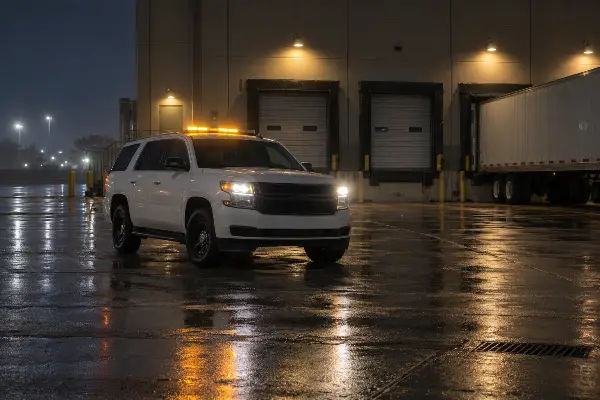
Patrol vehicles drive on your property, and a general liability policy will not answer for them.
Search this topic and you get the same four coverages every time: general liability, professional liability, workers’ comp, firearm liability. Commercial auto is missing from almost every list. Meanwhile the vehicle is doing the work.
Look at how vehicle patrol actually plays out. In 3 of the 5 documented incidents in our own files, a marked patrol vehicle was the thing that ended the problem. A pickup circling a construction site at 2:15 a.m. left when the officer hit the emergency lights. Two individuals at the rear of a vacant commercial building at 1:45 a.m. left before they got the boarded window open, for the same reason. The vehicle is not transportation. It is the deterrent.
Which means it is also on your driveway, in your lot, and next to your equipment for the whole shift. Reliable carries commercial auto. Ask any vendor running security patrol in Houston for that certificate too, and check that the limit is not the state auto minimum.
Is a certificate holder the same as an additional insured?
No, and the difference decides whether you have a claim or just a notification.
Certificate holder means the insurer will tell you if the policy is cancelled. That is close to the whole benefit. It gives you no rights under the policy.
Additional insured means you are covered under the vendor’s policy for liability arising out of their work. If someone sues you over what a guard did, an additional insured endorsement is what lets you tender that defense to the guard company’s insurer instead of your own.
Most certificates that land in a procurement inbox list the client as certificate holder. Buyers read the name in the box and assume coverage. Ask for the endorsement form itself, not just the certificate, and check that the endorsement names you.

How to verify a Texas security company’s license yourself
Texas publishes the license file. You do not have to take anyone’s word for it.
The Texas Online Private Security portal at tops.portal.texas.gov lets anyone search a company or an individual officer. A guard company here holds a Class B license, which is the class covering guard services.
Officer level matters as much as the company license. Under the Texas DPS training rules, Level II is required of non-commissioned officers, and Level III is required of every commissioned officer, meaning every officer who is legally armed. Level III runs a minimum of 45 hours through a licensed Level III training school, and the officer has to demonstrate firearm proficiency within 90 days of the application. At renewal, that officer needs 6 hours of continuing education and another proficiency demonstration inside the same 90-day window.
So there are two verification steps, not one. Confirm the company holds a current Class B license. Then confirm that the specific officers assigned to your site are commissioned, if you are paying for armed security guards in Houston. A company license says nothing about whether the individual standing in your lobby is a Level III commissioned officer or a Level II wearing the same uniform.
What Reliable Guard & Patrol Service carries in 2026
General liability, workers’ compensation, and commercial auto, with the certificate issued the same day you ask for it.
We are licensed by the Texas Department of Public Safety under license B07315701, first issued in 2018. That number is at the bottom of every page on this site. Look it up in TOPS before you call us.
The limits are printed on the certificate, which is the point of this article. We are not going to ask you to trust a sentence on a blog when the document exists and you can have it today. Ask, read the numbers, compare them to the $100,000 and $200,000 floor above, and decide.
A few other things that show up on the paperwork:
- 150 officers across more than 100 active sites in the Houston area, including Downtown, the Medical Center, the Energy Corridor, Katy, Sugar Land, Pearland, Conroe, Spring, Humble, and The Woodlands.
- Officers on GPS guard tour systems, with documented patrol rounds, real-time incident reports, and supervisor check-ins. Documentation is what defends a claim after the fact.
- No long-term contract requirement. Weekly, month to month, short term, or long term, whichever the site needs. The most common thing clients tell us they expected was a year-long lock-in.
- Background checks, drug testing, license verification, references, and an interview on every officer before they are assigned.
We work commercial property: construction sites, warehouses and distribution centers, office buildings, shopping centers, vacant buildings, and stores. We do not take residential, HOA, or event work.
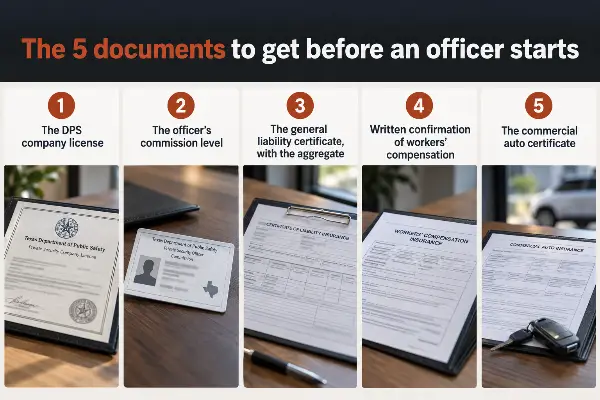
The 5 documents to get before an officer starts
Not questions to ask. Documents to hold.
- The DPS company license. Get the number, then verify it yourself in TOPS. A number that does not resolve, or resolves to a different name, ends the conversation.
- The officer’s commission level. Level III for anyone armed, Level II for anyone not. Ask for it per assigned officer, not per company.
- The general liability certificate, with the aggregate. Read both numbers. Compare them to $100,000 and $200,000. Ask what has already been paid against the aggregate this year.
- Written confirmation of workers’ compensation. In Texas this is a real question, not a formality. Get the carrier name.
- The commercial auto certificate. If a patrol vehicle is coming onto your property, this one belongs in the file.
Add one endorsement request to that stack: ask to be named as an additional insured, and ask for the endorsement form, not just the certificate. Five documents and one endorsement. Any firm that stalls on those has told you something.
Most of what passes for vetting in this market is a phone call and a logo. Picking a security company you can actually check comes down to whether the paperwork arrives, and how fast. When you are ready to hire a security guard company in Houston, start by asking three vendors for those five documents and see who sends them the same day. That is the real test of security guard company insurance requirements, and it takes an afternoon.
This article covers general Texas licensing and insurance rules and is not legal or insurance advice. Policy terms, exclusions, and endorsements vary. Have your broker or counsel review any security services agreement before you sign it.
FAQs
What are the security guard company insurance requirements in Texas?
Texas Occupations Code 1702.124 requires a licensed security company to carry a general liability policy, with minimum limits fixed in the statute for bodily injury and property damage, for personal injury, and for the total aggregate across all occurrences. The statute does not require workers’ compensation, commercial auto, or professional liability. Ask for the certificate and read the limits yourself.
Am I liable if a security guard injures someone on my property?
You can be named in the claim. Depending on the facts, a plaintiff may pursue the guard, the guard company, and the property owner, often on theories like negligent hiring or negligent supervision. Being named as an additional insured on the security company’s policy is what lets you tender that defense to their insurer instead of your own.
Do security guard company insurance requirements in Texas include workers’ compensation?
No. The Texas Department of Insurance states that private employers in Texas can choose whether or not to carry workers’ compensation coverage. That makes it a question worth asking every security vendor in the state, because a company can be fully licensed and carry none.
What is the difference between a certificate holder and an additional insured?
A certificate holder gets notified if the policy is cancelled and has no rights under the policy. An additional insured is covered under the vendor’s policy for liability arising out of the vendor’s work. Ask for the endorsement form that names you, not just the certificate.
Does general liability insurance cover a security guard detaining someone?
Usually under the personal injury portion of the policy. A standard commercial general liability form lists false arrest, detention or imprisonment as the first covered offense under personal and advertising injury. At the Texas statutory floor, that limit is half the bodily injury limit, and it is the smallest of the three minimums set in Occupations Code 1702.124.
What certification does an armed security officer need in Texas?
A Level III commission. Texas DPS requires a minimum of 45 hours of Level III training through a licensed Level III school, plus a firearm proficiency demonstration within 90 days of the application. At renewal the officer needs 6 hours of continuing education and another proficiency demonstration in the same 90-day window.
How do I check that a Houston security company is licensed?
Search the company name or license number in the Texas Online Private Security portal, run by the Texas Department of Public Safety. It returns license status for both companies and individual officers. Reliable Guard & Patrol Service holds Texas DPS license B07315701, issued in 2018.


