

A security guard contract has to do 4 things. Define the work closely enough that an officer can follow it at 3 a.m. Name the license and the insurance the company has to keep current. Say what happens when a shift goes uncovered. And let you out.
Most agreements handle the first and the last one badly, and skip the middle two.
The clause that decides whether the service works is not the hourly rate. It’s the post orders, the attachment that tells the officer what to check, when to check it, and who to call at 2 a.m.
What is a security guard contract? A security guard contract is the written agreement between a property owner and a licensed security company that sets the scope of guard services, staffing, reporting, insurance, billing, and termination terms. In Texas it governs work the state defines as guard services under Occupations Code 1702.108.
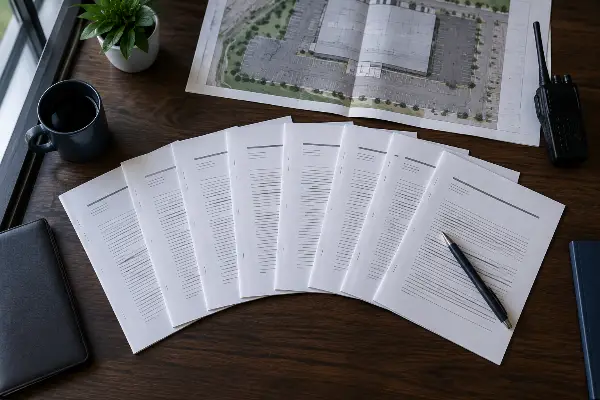
What does a security guard contract have to cover?
Nine clauses carry the weight. Scope of services, post orders, staffing and coverage, licensing, officer qualification, insurance, reporting, term and termination, and billing.
The rest of the document is boilerplate your attorney can read in 10 minutes. These 9 are the ones that change what shows up on your property.
Two of them almost never appear in a first draft. Post orders and coverage continuity are the clauses a security company leaves out, because they are the only 2 that create a measurable obligation. Ask for both in writing before you sign, not after the first missed shift.
Scope of services: Texas already wrote half of this for you
Your scope clause should track what the state says guard work is, then add what your site needs on top.
Texas defines it in Occupations Code 1702.108, which says a company acts as a guard company when it provides watchman, guard, or street patrol service on a contractual basis to prevent entry, larceny, vandalism, abuse, fire, or trespass on private property, to prevent, observe, or detect unauthorized activity, to control or direct the movement of the public only as far as protecting property requires, or to protect an individual from bodily harm.
Read that list against your draft. If your contract says “provide security services at the Premises” and stops, it has told an officer nothing. A vacant building needs door and window checks. Construction site security needs equipment and material counts written into the scope. A warehouse needs dock doors and after-hours vehicle checks. Those belong in the document, and what a security guard can and cannot legally do sets the outer edge of what you can write in.
One line to add: the contract should say the officer’s authority stops where the statute stops. Directing traffic on your lot is guard work. Directing traffic on the public street is not.
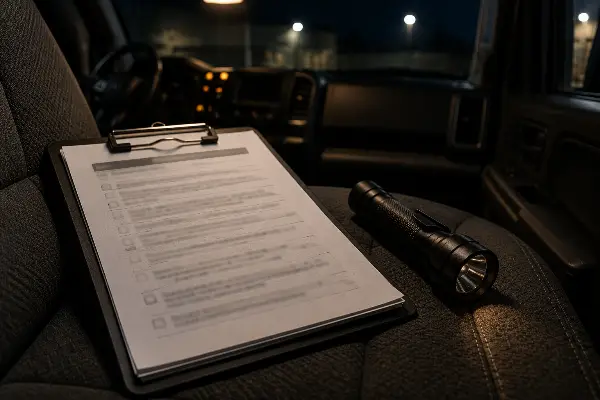
What are post orders, and why does the contract fail without them?
Post orders are the site-specific written instructions an officer follows on your property, and they are the single most useful attachment in the agreement.
A good set names the patrol route, the frequency, the checkpoints, the hours, what gets photographed, who gets called for what, and what an officer does when someone refuses to leave. A bad set is 1 page of general conduct rules that would fit any site in Houston.
Here is why it matters more than the rate you negotiated. At roughly 3:30 a.m. on a construction site, one of our officers found a temporary storage container had been tampered with, then saw someone pulling rolls of copper wire out of it. He called law enforcement, kept eyes on from a safe distance, and fed updates to dispatch until officers arrived and made an arrest. The wire went back to site management.
That stop happened because “check the storage containers on the scheduled round” was an instruction, not a suggestion. Same story at a distribution warehouse at 11:20 p.m., where an officer working a perimeter round found an unauthorized vehicle by the loading docks and a person trying to get into a secured storage area beside the dock doors. Dock doors were on the list. The list is the post orders.
Three things to require in the clause:
- Post orders are attached as an exhibit at signing, not “to be developed.”
- They are reviewed with you at a set interval, and updated in writing when your site changes.
- Officers assigned to the site are trained on them before the first shift, not on the first shift.
If a vendor will not commit to an attached exhibit, you are buying a body in a uniform. Setting how often officers should patrol is part of the same conversation, and it belongs in the exhibit rather than in an email.
Do you have to sign a long-term security guard contract?
No. The annual lock-in is a sales convention, not a legal requirement, and in Houston plenty of guard work runs weekly or month to month.
This is the single most common thing clients tell us they expected and did not get. We write weekly, month to month, short term, and long term terms, whichever the site needs. A construction site with an 11-week framing window should not be signing 12 months of coverage.
A long term does buy you something real: rate stability and a crew that learns your site. So the question is not whether long terms are bad. It’s whether the vendor requires one. A company that only sells 12-month agreements is telling you how it handles churn, not how it handles your property.
Two things to look for in the term clause. First, whether the initial term matches the actual life of the risk. Second, whether the notice period to cancel is symmetrical. If you owe 60 days and they owe 30, that is a drafting choice someone made on purpose.
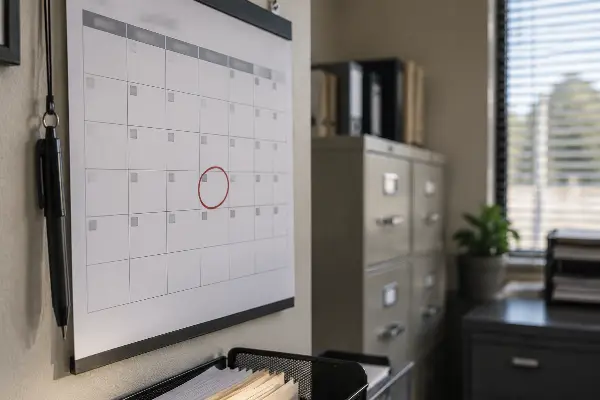
Auto-renewal is riskier in Texas than most buyers assume
Texas gives you no statutory protection against an evergreen clause, so the contract language is the only protection you have.
The Texas State Law Library states it plainly: Texas does not have any laws that regulate auto-renewing contracts. Other states require a vendor to send written notice before a service agreement rolls over. Texas does not. If your agreement renews for another 12 months unless you cancel in a 30-day window 11 months from now, that clause will hold.
So do 3 things at signing. Put the renewal date and the notice deadline in your own calendar the day you sign. Ask for renewal notice as a contract obligation, in writing, since the state will not supply one. And check whether renewal comes with an automatic rate increase, because that is where the second surprise usually sits.

What the licensing clause has to name
The contract should carry the company’s Texas DPS license number on its face, require it to stay current for the whole term, and give you the right to end the agreement if it lapses.
Name the class as well as the number. A Texas guard company holds a Class B security contractor license, and DPS lists guard service as 1 of 6 categories that class can cover, alongside alarm, armored car, courier, electronic access, and locksmith work. “Class B licensed” in a recital is not the same promise as “licensed to run guard services,” and the second is the one you are buying.
There is a second reason the license clause matters, and it comes straight out of the statute. Under Occupations Code 1702.123, a company license holder has to keep the surety bond and certificate of insurance on file with the state at all times, and the commission suspends the license immediately if that lapses. A licensee then has 10 days to prove the coverage is still in effect. So a lapsed insurance policy does not stay an insurance problem. It suspends the license of the company standing on your property, which is why the lapse clause and the termination clause belong in the same paragraph.
The number you write into the agreement should resolve in the state’s public license search at tops.portal.texas.gov before you sign it, not after.
Which officer qualifications belong in the contract?
The qualification clause should state the credential every officer assigned to your site holds, and it should say it post by post.
A company license says nothing about the individual in your lobby. If you are paying for armed security guard service, the contract should say every armed officer assigned holds a current commission. DPS requires a commissioned officer to submit 6 hours of continuing education and a firearm proficiency certificate no more than 90 days old at renewal, and an instructor cannot certify their own proficiency. That is a checkable standard, and a Level III commissioned officer is a different hire from a Level II wearing the same uniform.
Add one sentence about substitutions. If the contract lets the company assign any registered officer at any time, the qualification clause you negotiated applies to nobody in particular.
Insurance: list the policies by name
The insurance clause should list the policies by name, set the limits, and require the certificate before the first shift.
Texas sets a floor for general liability tied to the company license, and it sits lower than most buyers expect. Workers’ compensation is a separate question here, because the Texas Department of Insurance confirms that private employers in Texas can choose whether to carry it at all. We break both of those down, along with the difference between being a certificate holder and an additional insured, in our guide to security guard company insurance requirements in Texas.
For the contract itself, 4 lines are enough:
- General liability, with the limits written into the agreement rather than referenced.
- Workers’ compensation, named explicitly, with the carrier.
- Commercial auto, if a patrol vehicle comes onto your property.
- You named as an additional insured, with the endorsement form attached, rather than listed only as certificate holder.
We issue a certificate of insurance the same day it is requested. That turnaround is worth asking of any vendor, because it tells you how the account will be run.

What happens when a guard does not show up?
The contract should say it in numbers: how fast a replacement arrives, who calls you, and what the credit is for uncovered hours.
Almost no security agreement addresses this, and it is the complaint clients raise more than any other. The reason sits in the labor data. The Bureau of Labor Statistics counts 1,304,000 security guards and gambling surveillance officers employed, projects 1 percent growth from 2025 to 2035, and still expects about 157,200 openings a year across the decade, mostly to replace workers who move to other occupations or leave the workforce. Openings at that level run to roughly 12 percent of total employment every year. Every vendor in this state will have a gap eventually, and the agreement is where you decide whose problem it is.
Four things to write into the coverage clause:
- A named replacement window in hours, not “promptly.”
- Notification to you when a post goes uncovered, by a person, not a portal.
- A credit for hours nobody worked, applied automatically rather than on request.
- Your right to have an officer removed from the site, with a replacement inside a stated number of days and no argument about it.
We staff dedicated account supervisors, so the call about a gap comes from someone who already knows your site rather than from a general dispatch line.
Reporting and proof of service in 2026
The reporting clause should name the artifacts you receive, how fast, and in what format.
This is where the 2026 version of a guard contract differs from a 2016 one. Patrol verification is a solved problem now, and there is no reason for an agreement to be vague about it. Ours specifies GPS guard tour rounds, real-time incident reports, and supervisor check-ins, which means a documented record of where an officer was and when, rather than a signature on a clipboard.
Write the clause so it names 4 things: the daily activity report and when it lands, the incident report and how fast after an event, the patrol record with timestamps, and the retention period. That last one matters if something on your property turns into a claim 8 months later. Reporting is also the part of security patrol service in Houston that separates 2 vendors quoting the same number.
Billing terms worth reading twice
Read the billing clause for what triggers a change, not for the number at the top of it.
Four items to check. What counts as overtime and at what multiple. Which holidays bill at a premium, and which list of holidays the contract uses. Whether the agreement sets a minimum billable shift length at all, since a short special request gets rounded up to it. And whether the company can change the rate mid-term, with how much notice.
Add one more: what happens when you add a second site. Volume language written at signing is cheaper than a renegotiation in month 7.
The 9-clause checklist
Hold your draft against this before it goes to your attorney.
| Clause | A weak version says | Require instead |
|---|---|---|
| Scope of services | “Provide security services at the Premises” | The statutory functions plus your site’s specific duties, with the limit of officer authority stated |
| Post orders | Not mentioned, or “to be developed” | Attached as an exhibit at signing, reviewed on a set interval, officers trained before shift 1 |
| Staffing and coverage | “Company will use reasonable efforts” | Replacement window in hours, notification by a person, automatic credit for uncovered hours, removal on request |
| Licensing | “Company is licensed and insured” | DPS license number and class on the face of the agreement, current for the term, termination right if it lapses |
| Officer qualification | “Guards are trained” | Commission level stated per post, substitution limits, background check and license verification confirmed per assigned officer |
| Insurance | “Company carries adequate insurance” | Policies listed by name with limits, additional insured endorsement attached, certificate before shift 1 |
| Reporting | “Reports available upon request” | Daily activity report, incident report with a deadline, timestamped patrol record, retention period |
| Term and termination | Auto-renews, asymmetric notice | Term matched to the risk, symmetrical notice, renewal notice as an obligation, no automatic rate change on rollover |
| Billing | A single hourly number | Overtime multiple, named holiday list, stated minimum shift length, notice required for a mid-term change |
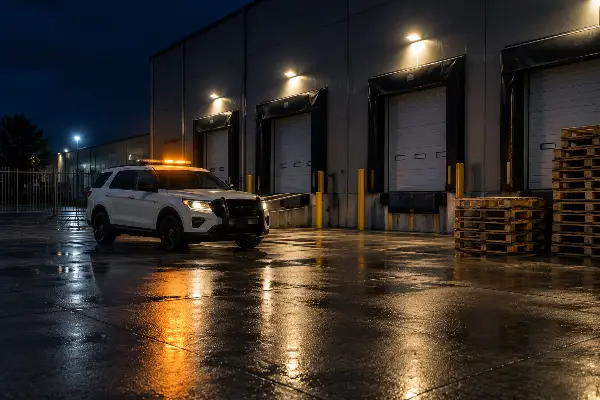
What we put in writing
We are a licensed Houston security guard company operating under Texas DPS license B07315701, first issued in 2018, and that number is on the face of our agreements as well as the bottom of this page.
On the clauses above, here is where we stand. Contract terms run weekly, month to month, short term, or long term, and we do not require a long-term commitment to take an account. Certificates of insurance go out the same day you ask. Officers work GPS guard tour rounds with documented patrol records, real-time incident reports, and supervisor check-ins. Every account gets a dedicated account supervisor rather than a shared dispatch queue.
We take commercial property: construction sites, warehouses and distribution centers, office buildings, shopping centers, vacant buildings, and stores. We do not take residential, HOA, or event work.
If you are still comparing vendors rather than reading a draft, how to choose a security guard company runs the decision end to end, and what to look for in a security company covers the same ground from a different angle. Come back here with a document in hand. A security guard contract is where the sales conversation either becomes an obligation or does not, and the difference shows up the first night something happens on your property. Call us and ask for the post orders template before you ask for the rate.
This article covers general Texas contracting and licensing points and is not legal advice. Terms, remedies, and enforceability vary. Have your attorney review any security services agreement before you sign it.
FAQs
What should be in a security guard contract?
Nine clauses do the work: scope of services, post orders, staffing and coverage, licensing, officer qualification, insurance, reporting, term and termination, and billing. Post orders and coverage continuity are the 2 most often missing from a first draft, and they are the 2 that create measurable obligations you can hold a vendor to.
What are post orders in a security contract?
Post orders are the site-specific written instructions an officer follows on your property: patrol route, frequency, checkpoints, hours, what gets photographed, and who to call for what. Require them attached as an exhibit at signing rather than “to be developed,” and require officers to be trained on them before the first shift.
Do you have to sign a long-term security guard contract?
No. Nothing in Texas law requires a minimum term for guard services. Reliable Guard & Patrol Service writes weekly, month to month, short term, and long term agreements. A vendor that only offers 12-month terms is telling you about its own staffing model, not about what your site needs.
Are auto-renewal clauses legal in Texas?
Yes. The Texas State Law Library states that Texas has no laws regulating auto-renewing contracts, so an evergreen clause in a security agreement will generally hold. Put the renewal date and the cancellation deadline in your calendar at signing, and ask for advance renewal notice as a written contract obligation.
What happens if a security guard does not show up for a shift?
That depends on your coverage clause, which is why it needs numbers in it. Ask for a replacement window in hours, direct notification when a post goes uncovered, and an automatic credit for hours nobody worked. Uncovered shifts are a structural risk in this industry: BLS projects about 157,200 security guard openings a year through 2035, mostly from replacement.
Should a security guard contract name the company’s license number?
Yes, and the license class with it. Require the number to stay current for the term and keep a termination right if it lapses. Under Occupations Code 1702.123, a company’s license is suspended immediately if its bond or insurance certificate is not on file with the state, and the holder has 10 days to prove coverage is still in effect.
How do I verify a Houston security company’s license before signing?
Search the company name or license number in the Texas Online Private Security portal at tops.portal.texas.gov. The DPS company FAQ says the status shown there updates in real time. Confirm the company holds a current Class B license, then confirm the officers assigned to your site hold the commission level the contract promises.


