
Contractor check-in procedures decide who gets past your gate or lobby desk and what leaves with them. On a Houston construction site, office building or warehouse, the security officer matches each contractor to an approved list and checks photo ID. From there, the officer logs the entry, controls badges and keys, and logs the exit and any materials going out.
We control access at construction sites, office buildings, warehouses and retail centers across Houston, with 150 officers on more than 100 sites. Texas changes 2 parts of the job. There’s no statewide license for general contractors, so an officer has no state license to look up for the company running the job. And Texas law makes it a crime to read or store the data encoded on Texas driver’s licenses unless an exception applies. That matters the moment someone suggests an ID scanner at the gate.

What Is A Contractor Check-In Procedure?
A contractor check-in procedure is the written set of steps a security officer follows before a contractor, vendor or delivery driver enters a site. The officer confirms the person is approved for that day and matches a photo ID. Then the officer records the entry, issues a badge or escort, controls keys, and records the exit and anything leaving.
It guards against 2 different losses. One is the wrong person getting in. The other is the right person leaving with something that isn’t theirs, so the exit half of the log matters as much as the entry half.
The procedure only works if someone sends the officer a list. Without one, the officer is guessing. A guess with a line of trucks idling at 7 a.m. turns into a wave-through. Contractor check-in is the daytime side of what access control officers do. The overnight side runs on stricter rules.
Contractor Check-In Procedures, Step By Step
Run the same 6 checks for every contractor, every day, in the same order. Skipping one on a busy morning is how the wrong truck gets waved through.
- Today’s list first. The name has to be on the day’s approved list, work order or delivery schedule from the general contractor or property manager. If it isn’t, the person waits outside while the officer calls the site contact named in the post orders.
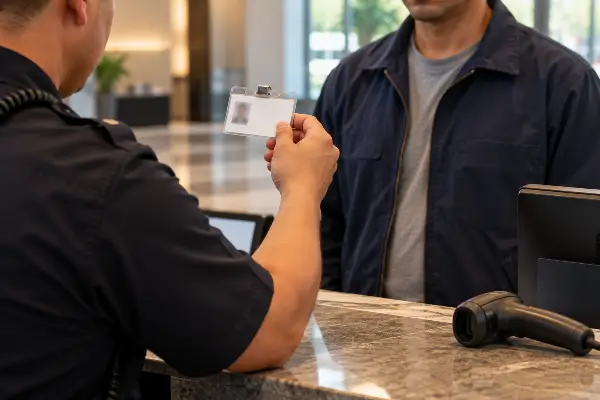
- Photo ID, checked by eye. Compare the face and name on a government photo ID with the person standing there and with the list.
- Company paperwork, only if the post orders ask for it. If the general contractor or property manager requires a certificate of insurance, the list should say “COI on file.” That line is all the officer checks.
- The entry log. Name, company, trade, vehicle plate, time in, work area, who approved the visit and the badge number issued.
- Badge, escort or both. Number the visitor badges and collect them at exit. Electrical rooms, roofs, tenant suites and storage containers get an escort or a fob that expires the same day, never a key the contractor keeps.
- The exit, including what leaves. Log the time out, collect the badge and look at what’s going out. Tools that came in can leave. Wire, fixtures or equipment leaving the site need a material pass signed by the site contact. Don’t look inside a truck bed or gang box without consent. The cleanest consent is a clause in the subcontract, the same approach behind bag checks at a gate.
Say the site rules out loud at step 5, in the language the crew works in. Bureau of Labor Statistics 2025 annual averages put Hispanic or Latino workers at 35.4% of U.S. construction employment. Across all jobs, it’s 20%. That figure tracks ethnicity rather than language, so ask the superintendent what the crew prefers. Our officers speak English and Spanish.
Write all 6 steps into the post orders, so Sunday night’s officer runs the same check as Monday morning’s.
Contractors, Deliveries, Pickups And Inspectors: Who Checks What
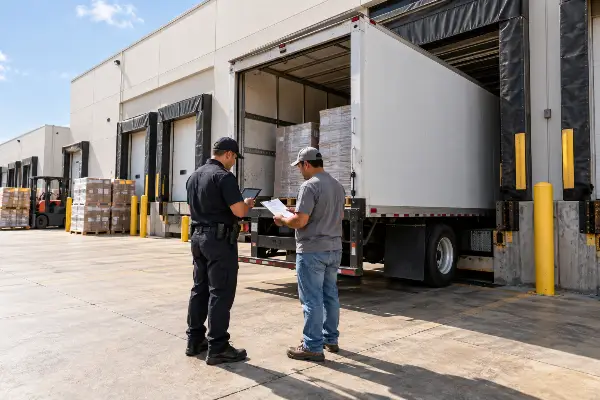
Each arrival type needs its own document and its own approver.
| Arrival | What the officer checks | Who approves entry | What goes in the log |
|---|---|---|---|
| Subcontractor crew | Each name on the day’s approved list, plus photo ID | General contractor’s superintendent or the property manager | Names, company, trade, plate, time in and out, badge numbers |
| Scheduled delivery | Driver ID and a matching delivery on the day’s schedule | Whoever ordered it | Carrier, driver, plate, what was dropped and where |
| Unscheduled delivery | Nothing unloads until someone claims it | Site contact, by phone | Carrier, driver, plate, who approved and when |
| Material or scrap pickup | A signed material pass that matches the load | Site contact | What left, who took it, plate, time |
| After-hours vendor | Name on that night’s access list | The 1 person named in post orders for after-hours approvals | Who called, who approved, time in and out, areas entered |
| OSHA inspector | Agency credentials | Owner, operator or agent in charge, called to the gate | Name, agency, credential number, time, who walked them in |
| City inspector | City ID or credentials | Site contact, called to the gate | Name, department, time, who walked them in |
The OSHA row needs 1 extra line. Federal OSHA rules have the inspector present credentials to the “owner, operator, or agent in charge at the establishment.” So the officer logs the visit and gets the superintendent or property manager to the gate fast. Leave the in-or-out decision to that person.
Does A Security Guard Check A Contractor’s License In Texas?
No. Texas has no statewide license for general contractors, so there’s often no state license to check. Your officer confirms the company is on the approved list, and the general contractor or property manager decides who’s qualified.
The Texas Department of Licensing and Regulation (TDLR) covered this in a Texas Governor’s Office webinar on business licensing. An agency official said there is no statewide licensing requirement for general contractors. TDLR does license electrical and air conditioning contractors. Plumbers get their licenses from a separate agency, the Texas State Board of Plumbing Examiners.
So the common advice to look up the contractor’s license on a state board website doesn’t fit a Texas general contractor. The state doesn’t issue one.
We recommend a clean split. The general contractor or property manager vets each company (license where one exists, insurance, any background rules) and sends the list. Enforcing that list is the officer’s job. If an electrician’s TDLR license matters to you, add a “license verified” column, and the officer checks the column.
Can Security Scan A Contractor’s Driver’s License In Texas?
Only if an exception applies, and the general business exception doesn’t cover storing the data at all. Transportation Code Section 521.126 covers 2 acts: accessing or using the data encoded on a Texas driver’s license, and compiling or maintaining a database of it. Both are crimes unless a listed exception applies.
The penalty is a Class A misdemeanor: up to 1 year in jail and a fine up to $4,000 under Penal Code Section 12.21. The business exception covers using license data to verify a person’s identity or a check at the point of sale. It isn’t clear that reaches a security gate, and it doesn’t cover keeping a database. Ports and maritime facilities have a separate exception that allows a database for security purposes when the facility’s head authorizes it.
Houston has its own example. A 2004 Attorney General opinion looked at a Port of Houston Authority plan. A private guard would run visitors’ licenses through a reader at its gates. The opinion concluded the statute didn’t bar that plan, because Port Authority peace officers would be the ones accessing and using the data. The opinion also said it didn’t reach anyone outside the statute’s exceptions.
So we push back on the common advice to add an ID scanner and let visitor software keep what it reads. For most Houston sites, the safer default is a visual check. Match the face and name on the license to the list, then log the name, company and badge number. If you still want a scanner, get the vendor to state in writing what the system stores and for how long. Then have your attorney confirm which exception covers it before it goes live. This section is general information about Texas statutes, not legal advice.
When A Contractor Isn’t On The List: What Texas Law Lets A Guard Do
The officer can refuse entry and tell the person to leave. Under Penal Code Section 30.05, entering or staying after notice from the owner or “someone with apparent authority to act for the owner” is criminal trespass. Most cases are a Class B misdemeanor. It becomes a Class A if the person carries a deadly weapon or the site is a fully fenced critical infrastructure facility. That list includes refineries, chemical plants, ports, rail switching yards and trucking terminals.
On our after-hours construction posts, a person who isn’t on the list waits outside the fence until someone on the project answers the phone. If the site contact says no, the officer should tell the person to leave. If they stay, the next steps are to call police, keep watching from a safe distance and document everything. Our unarmed post orders put the limit in 1 line: observe, document, notify police and the client contact.
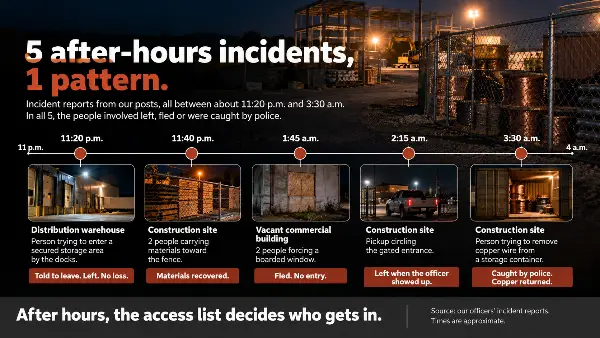
At around 11:20 p.m. at a distribution warehouse on one of our posts, our officer found an unauthorized vehicle near the loading docks. Someone was trying to get into a secured storage area. He called dispatch and the site supervisor, walked over, identified himself and told the person to leave the restricted area. The person left without incident. Police were advised, the report was filed, and a follow-up check found no forced entry, damage or missing inventory.
The steps don’t change if someone says they’re a sub. Holding someone for police is a different decision with tighter rules, and it’s rarely the right move at a gate. It’s the same call unarmed officers face when they handle disruptive behavior.
After-Hours Contractors In 2026: The List Decides
After dark, nobody gets in who isn’t on that night’s access list, and 1 named person approves any change to it. Daytime checks match paperwork. Night checks ask whether anyone should be there at all.
Our own incident reports make the point. Take 5 of them, from 3 construction sites, a vacant commercial building and a distribution warehouse. Every event happened between about 11:20 p.m. and 3:30 a.m., and in all 5 the people involved left, fled or were caught by police.
In 2 of the 5, people were moving materials. At about 11:40 p.m., 2 people carried construction materials toward the perimeter fence. At about 3:30 a.m., someone tried to pull rolls of copper wire out of a temporary storage container. Both times, the materials were recovered.
Before the first night shift, we ask for 3 things: the current access list, a gate and access map, and the name and number of whoever answers at 2 a.m. Anything leaving after hours without a signed pass never gets waved through. It gets documented, and the officer calls the site contact and police. On our construction site security posts, every round lands in a GPS-tracked tour log, and incidents get real-time reports with supervisor check-ins. The entry log shows who came through overnight and who approved them.
Keys, Fobs And Door Codes: Who Holds Them
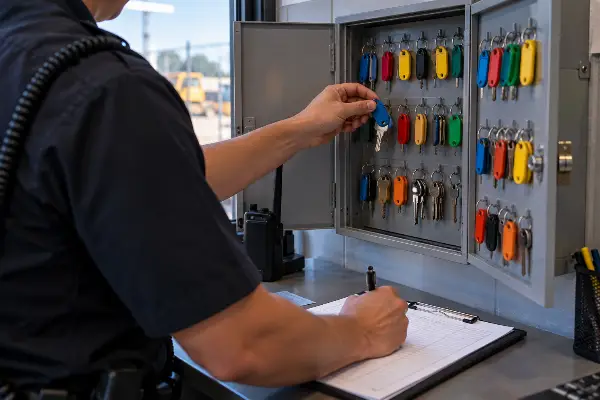
Contractors shouldn’t leave with a key, fob or code they keep. Either the officer or the site contact opens the space, locks it after, and every key that moves gets a line in the log.
At an office building or retail center, issue a fob for the visit and collect it at sign-out. Change the door code when a long job ends. Building security officers at a front desk can run fobs and visitor badges from the same log.
On a build, the keys to the electrical room, the job trailer and the storage containers stay with the officer or the superintendent. The last sub out shouldn’t have them. If nobody can say who has the container keys on a Sunday night, that’s a gap the construction gate guard post should close.
What Should Post Orders Say About Contractors?
Post orders should name the list, the approver, the after-hours contact, what gets logged and where the officer’s authority stops. Anything left unwritten gets decided by whoever is on shift.
- Who sends the daily approved list, and by what time
- The 1 person who can approve after-hours entry, with a phone number that answers at 2 a.m.
- Log fields for entry and exit, including badge numbers and material passes
- Escort zones and key rules
- The escalation limit: observe, document, notify police and the site contact
Attach them to the contract as an exhibit. It’s 1 of the contract clauses worth checking before you sign.
Good contractor check-in procedures are boring on purpose: the same list, the same 6 checks and the same log, day or night. As a Houston security guard company, we write them into the post orders and brief each officer on them before the first shift. Nothing here is legal advice, so have your attorney review any post order that leans on Texas law.
FAQs
What are contractor check-in procedures?
Contractor check-in procedures are the steps a security officer follows before a contractor, vendor or driver gets onto a site. On each arrival, the officer confirms the name is on that day’s approved list and matches a photo ID. After that, the officer logs the entry, issues a badge or escort, and logs the exit and anything leaving.
Do security guards check contractor licenses in Texas?
Usually not. Texas has no statewide license for general contractors, so there’s no state license to look up for the company running the job. TDLR licenses electrical and air conditioning contractors, and a separate state board licenses plumbers. Vetting belongs to the general contractor or property manager, and the officer enforces their approved list.
Can a security guard refuse entry to a contractor in Texas?
Yes. An officer acting for the property owner can refuse entry and tell an unapproved person to leave. Under Texas Penal Code Section 30.05, entering or staying after that notice is criminal trespass, a Class B misdemeanor in most cases. The officer’s next step is a call to police, not a physical removal.
Can a Texas job site scan my driver’s license?
Only if an exception in Texas Transportation Code Section 521.126 applies. Outside those exceptions, accessing or using the data encoded on a Texas driver’s license is a Class A misdemeanor. So is keeping a database of it. A site that scans should be able to tell you which exception it relies on and what its system keeps.
Can a security guard stop an OSHA inspector at the gate?
The officer shouldn’t make that call alone. Federal rules have OSHA inspectors present credentials to the owner, operator or agent in charge of the site. Instead, the officer logs the inspector’s name, agency and credential number and gets the superintendent or property manager to the gate right away.
Do contractor check-in procedures change after hours?
Yes. After dark, contractor check-in procedures run on that night’s access list and 1 named approver. In 5 incident reports from our posts, every event happened between about 11:20 p.m. and 3:30 a.m. In all 5, the people involved left, fled or were caught by police.


