A keycard reader has never stopped a theft. It records one. In five incidents pulled straight from our Houston patrol logs, the thing that stopped the intruder was a person standing at the access point: an officer who watched a pickup circle a construction gate at 2:15 a.m., and another who caught two men hauling materials toward the fence line at 11:40 p.m. That’s the job of an access control security guard. They decide who gets through the gate, the dock, or the lobby door, confirm who belongs there, and step in when someone doesn’t. We staff armed and unarmed officers at access points across the Houston metro, 150 guards on more than 100 sites. Here’s what they handle, when a guard beats a reader, how the Texas armed and unarmed rules work, and how to get started.
What is access control in physical security?
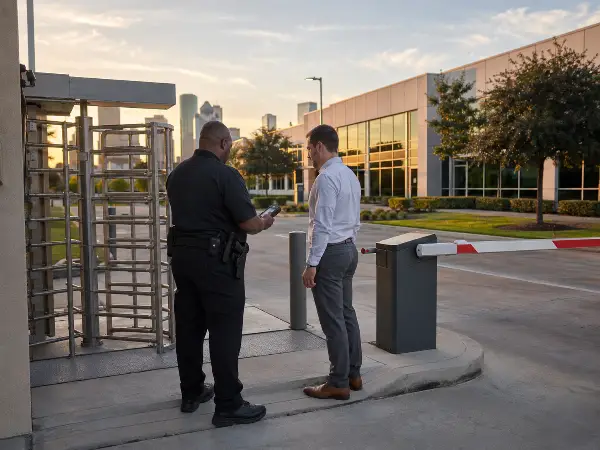
Access control in physical security is the practice of letting authorized people in and keeping everyone else out of a building, site, or restricted area. It joins two things: a way to check identity (a guard, a badge, a code, or a fingerprint) and a way to act on that check (open the gate, deny entry, or respond to a problem). The federal definition of a physical access control system from NIST describes the same two parts, authentication and authorization, at the point of entry.
Here’s the split that most guides blur. Logical access control protects data and networks with passwords and permissions. Physical access control protects doors, gates, and yards. A guard company handles the second kind. When you search “access control,” half the results are about software. This page is about the gate.
What does an access control security guard do?
An access control security guard works the point where people enter and leave, and keeps a record of it. The core duties are the same whether the post is a construction gate or a corporate lobby.
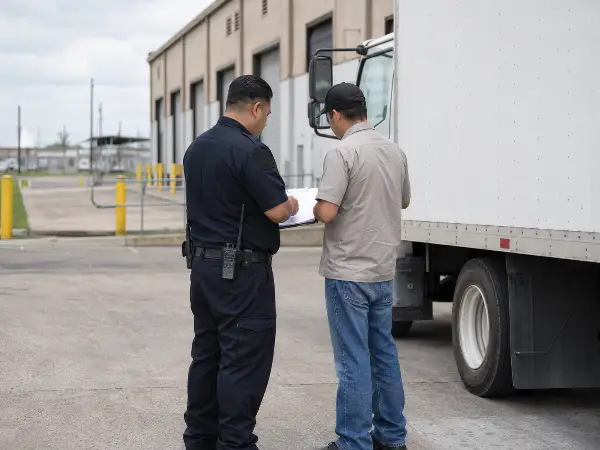
Our officers verify identity before anyone passes, check deliveries and contractor credentials against the day’s schedule, log every entry and exit, patrol the perimeter between arrivals, and respond when something is off. On our sites, those logs aren’t paper. Officers run a GPS guard-tour system that timestamps each checkpoint, so a client can see the dock was walked at 1:00, 2:00, and 3:00 a.m., not just that a shift was booked. Supervisors check in on posts through the night. This is the difference between a guard who says he patrolled and a guard who can prove it.
A reader can do one of these jobs. It can check a credential. It can’t judge that the “electrician” showing up at midnight with no work order doesn’t belong, and it can’t walk the fence line.
The overnight test: what access control stops when no one is watching
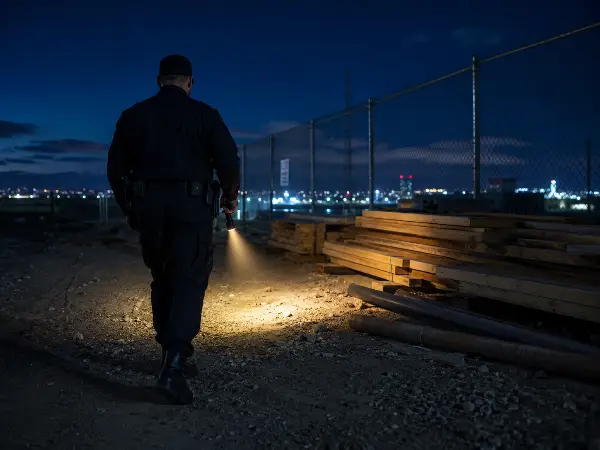
Most access control fails at the exact moment it matters, after hours, because a credential system only records what happened. Here is what a live post does instead. These are real stops from our patrol logs.
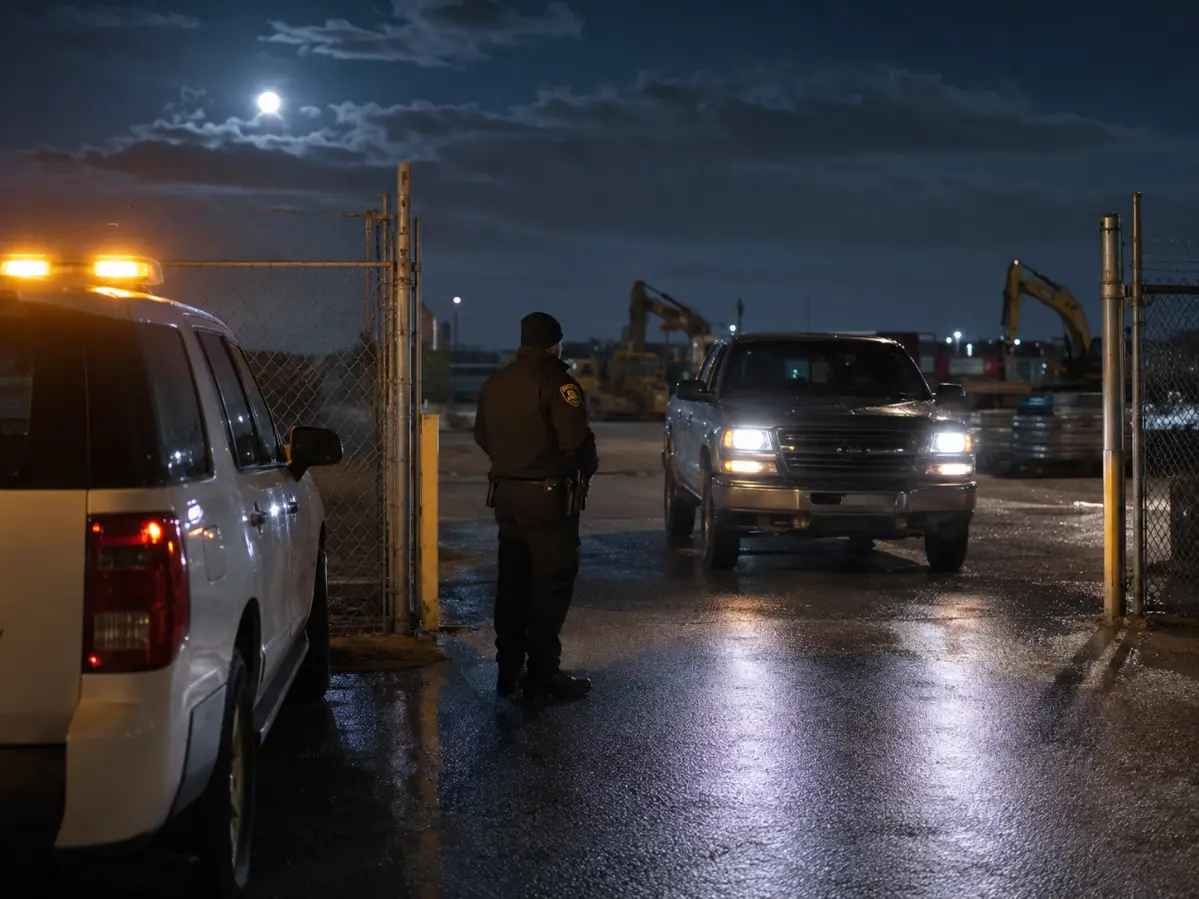
At 2:15 a.m. on a construction site, an officer watched a pickup circle the perimeter, then stop by a gated entrance while the occupants sized up the access points. He hit the patrol vehicle’s lights and moved toward them. The truck left. No entry, no loss.
At 11:40 p.m. on another site, an officer saw two people carrying materials toward the perimeter fence in a dark corner of the yard. He lit the area with a spotlight and called out. They dropped the materials and ran. Everything stayed on site.
At 3:30 a.m., an officer found a storage container tampered with and a man pulling out rolls of copper wire. He called law enforcement, kept eyes on the suspect from a safe distance, and fed updates to dispatch. Responding officers made the arrest. The copper went back to the site.
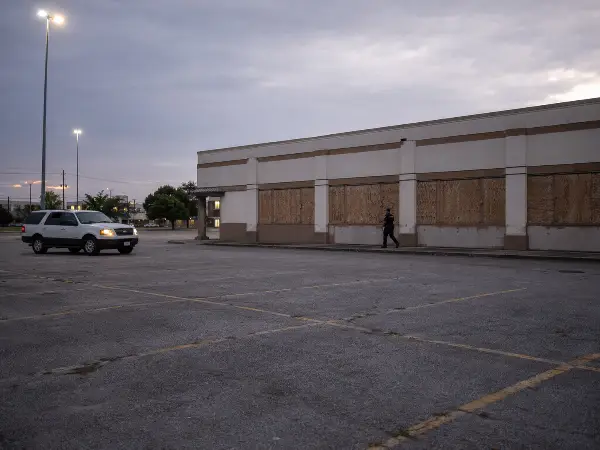
At 1:45 a.m., an officer spotted two people prying at a boarded window on a vacant commercial building. Lights, presence, a call to dispatch, and they fled before getting in. A follow-up walk found a damaged window covering and nothing else.
Every one of these happened between 11 p.m. and 3:30 a.m. That’s the pattern. According to the National Insurance Crime Bureau, which runs a national heavy equipment theft database, most stolen construction equipment is never recovered. So the win isn’t catching the thief later. It’s the truck that leaves at 2:15 because someone was standing there. A badge reader records the break-in. A guard prevents it. That’s the whole argument for what a night guard actually does on a site nobody else is watching.
Do you need a guard, an electronic system, or both?
For most Houston sites the honest answer is: it depends on how much traffic you have and how bad the after-hours risk is. Here’s how the three approaches compare.
| Approach | What it does well | Where it fails | Best fit |
|---|---|---|---|
| Electronic only (keycard, keypad, biometric) | Fast entry for known people, logs every swipe, low ongoing cost | Can’t stop a jumped fence, a tailgater, or a cut lock; only records the breach | Offices with steady daytime staff and low overnight risk |
| Guard only | Judgment, deterrence, response, verifies deliveries and contractors, walks the whole site | Slower for very high entry volume; one post covers one point | Construction sites, vacant buildings, overnight coverage |
| Guard plus electronic (layered) | Reader handles routine entry; the officer handles exceptions, patrols, and response | Higher price than either one alone | Warehouses, retail centers, mixed-traffic sites |
We don’t sell or install readers, cameras, or alarms. So when we tell a client a post beats a panel on their site, there’s nothing in it for us but the post. On a construction yard or a vacant building, a card system is an unwatched door. On a busy warehouse dock, a reader plus a roving officer on patrol usually wins.
Armed or unarmed at the access point? Texas rules, in plain terms
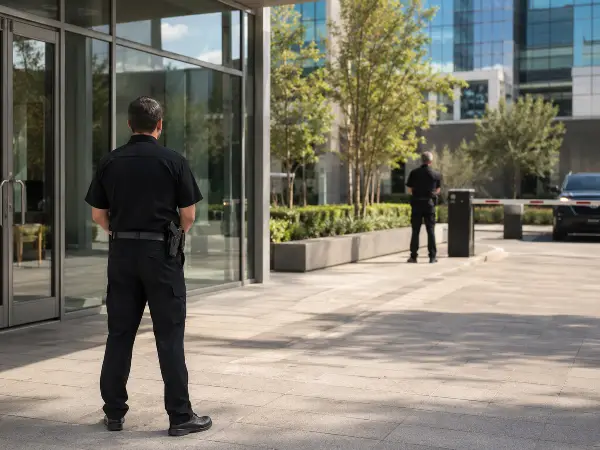
In Texas, the question of an armed or unarmed guard is really a licensing question, and it changes who you can legally post. The state splits security officer licenses into non-commissioned (unarmed) and commissioned (armed) through the Department of Public Safety Private Security program.
An unarmed, non-commissioned officer completes Level II training. An armed, commissioned officer completes Level III training on top of that, a minimum 45-hour course with a firearms qualification, plus continuing education to stay current. We require our armed officers to requalify on the range every two years, run background checks and drug testing on every hire, and verify each license before a guard sets foot on a post.
Our take: most access points don’t need a gun. An unarmed officer with presence, a radio, and a patrol vehicle stops the overnight cases above. We recommend a commissioned Level III officer when there’s cash handling, high-value assets, or a specific threat, not as a default. You can see the trade-offs in our breakdown of armed and unarmed officers.
Access control by site type
The post looks different depending on what you’re protecting. A few of the sites we cover most:
On a construction site, the officer controls the single gate, checks workers and deliveries against the schedule, and patrols the equipment staging area through the night, when nearly all site theft happens.
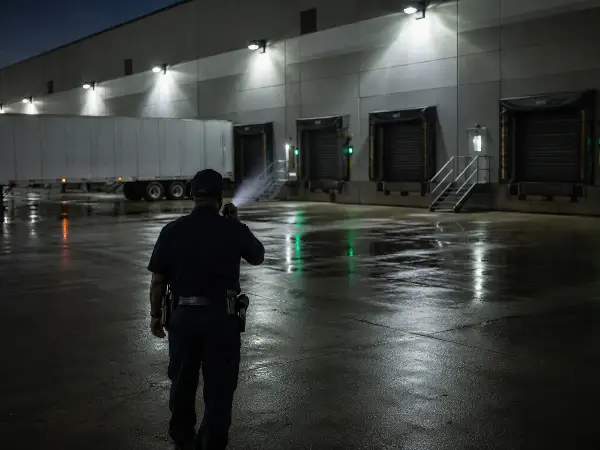
At a warehouse, the risk moves to the loading dock. Officers verify shipments and drivers, watch for after-hours vehicles near the dock doors, and confirm every gate and door is secured on each round. One of our overnight stops was exactly this: an unauthorized vehicle near the docks at 11:20 p.m., an officer who identified himself and cleared the person off the property, no forced entry found.
On a vacant building, there’s no staff to notice anything, so the officer is the whole system. On a retail or shopping-center property, it’s daytime deterrence and after-hours lockup.
What access control security guards cost in Houston (2026)
Straight answer: price depends on four things, and no honest company can quote you a flat rate without them. Armed or unarmed, how many posts, how many hours, and how much risk the site carries. An unarmed daytime lobby post and a 24-hour armed construction detail are different numbers.
Here’s what we can put in writing. We don’t require a long-term contract, which is the single biggest myth we hear. Terms run weekly, month to month, short term, or long term, whatever the site needs. We carry general liability, workers’ compensation, and commercial auto, and we can put coverage in place the same day. Our officers work in English and Spanish, which matters at a Houston access point where you’re verifying contractors and delivery drivers all shift. We start with a call and a free proposal, add a site assessment where it helps, and deploy. A 5.0 rating across 144 Google reviews is the part clients check first.
How to choose an access control guard company
Ask for three things before you sign with any provider of security guard services. Proof the officers are Texas DPS licensed for the post you need, proof of insurance you can verify, and proof of patrols, meaning GPS-timestamped tour data, not a promise. A guard’s legal authority has limits too, so it helps to know what guards can and can’t do before you post one. A company that can’t show you a timestamped round on request is asking you to trust a shift booking.
The real question was never guard versus technology. It’s who is accountable at 2 a.m. A reader answers to no one. An officer answers to a supervisor, a license, and a log. On a Houston construction yard, a warehouse dock, or a building sitting empty overnight, that’s the line between a report you read in the morning and a theft that never happened.
FAQs
What is access control in physical security?
Access control in physical security means letting authorized people in and keeping everyone else out of a building, site, or area. It combines a way to check identity (a guard, badge, code, or fingerprint) with a way to act on it (open the gate, deny entry, or respond). On a guarded site, a security officer performs both at the access point.
What does an access control security guard do?
An access control security guard verifies identity at the gate or door, checks deliveries and contractors against the schedule, logs every entry and exit, patrols between arrivals, and responds to problems. On our sites, officers run a GPS guard-tour system that timestamps each checkpoint, so clients can confirm the property was actually walked overnight.
Do I need a security guard or an electronic access control system?
It depends on traffic and after-hours risk. A keycard system is fine for a daytime office with steady staff, but it only records a breach; it can’t stop a jumped fence or a cut lock. For construction sites, vacant buildings, and overnight coverage, a guard at the access point is what stops the intrusion. Busy warehouses often use both.
Are access control security guards armed or unarmed in Texas?
Both. Texas licenses unarmed (non-commissioned, Level II) and armed (commissioned, Level III) security officers through the Department of Public Safety, with Level III requiring a minimum 45-hour course and a firearms qualification. Most access points do not need an armed officer; we recommend a commissioned guard for cash handling, high-value assets, or a specific threat.
What types of sites use access control security guards?
Access control security guards protect construction sites, warehouses and loading docks, vacant buildings, retail and shopping centers, and office buildings. The need is highest overnight and on sites with no permanent staff, like a construction yard or an empty building, where the officer is the only thing watching the access point.
How fast can you put a guard on site?
Same day in most cases. We carry general liability, workers’ compensation, and commercial auto insurance and can activate coverage the same day, then deploy after a quick site assessment.
How do I know the guard actually patrolled?
Ask for GPS guard-tour data. Our officers log timestamped checkpoints on every round, and supervisors check posts through the night, so you can see exactly when each area was walked instead of trusting a shift booking.


