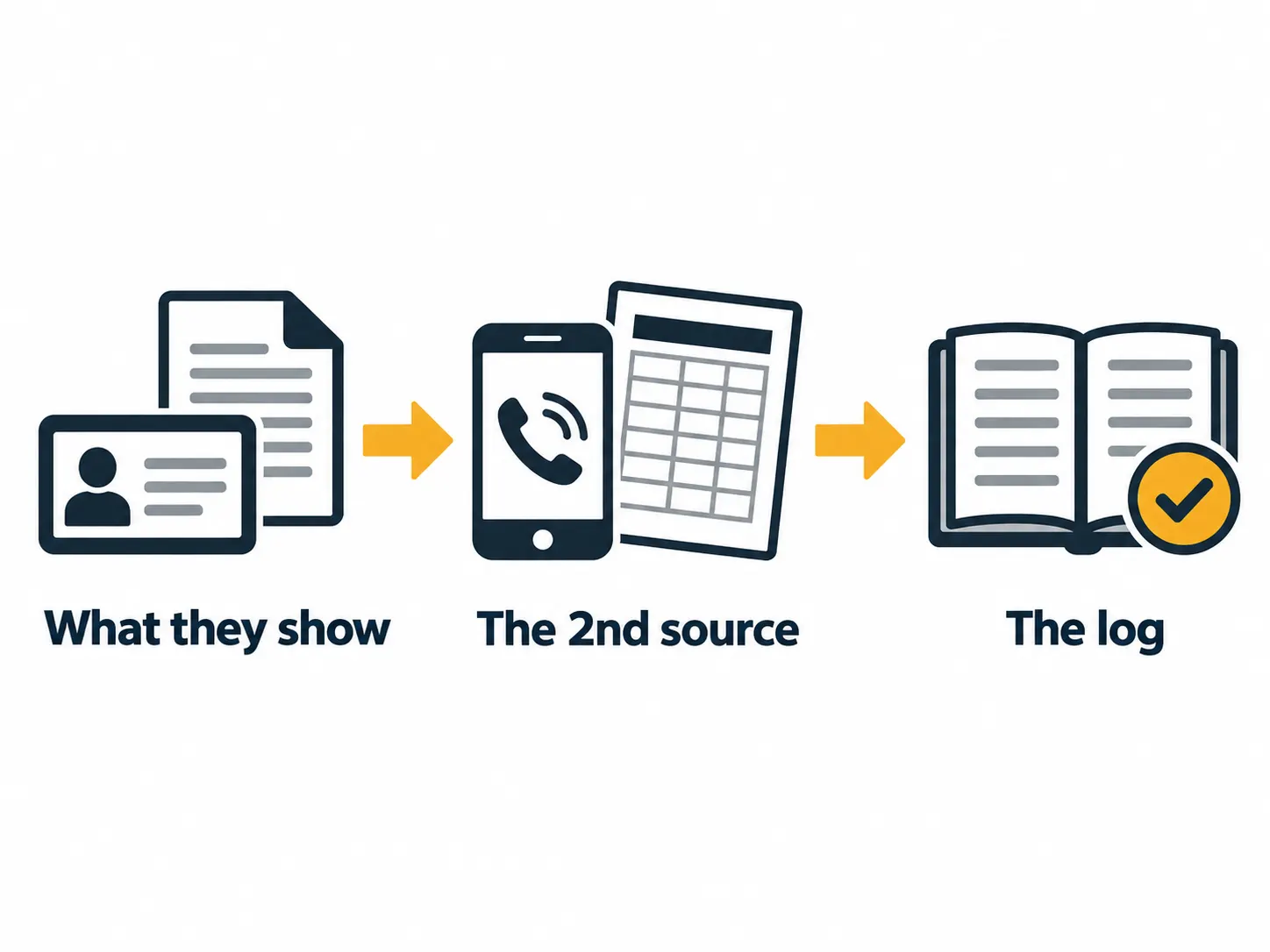
Licensed Reliable Guard & Patrol Service officers work the truck gates, visitor lobbies, employee entrances and dock doors of Houston warehouses. We write 1 rule into the post orders for every door: a driver's license, a badge, a work order or a bill of lading never confirms itself. The officer checks it against a 2nd source the person holding it doesn't control, then logs the decision.
What a warehouse access control guard does
A warehouse access control guard decides who and what crosses your property line, and keeps written proof of each decision. At a Houston warehouse that covers 4 doors: the truck gate, the visitor lobby, the employee entrance, and the dock doors after the last shift clocks out.
An access post fails when the officer looks at a license or a booking number, sees nothing wrong, and lifts the arm. That stops a kid with a bad fake. Identity fraud, the method behind more than half of the latest cargo thefts companies could trace in a 2026 industry survey, is built to pass it.
Reliable Guard & Patrol Service staffs warehouse access control posts across Houston, Katy, Sugar Land, Pearland, Spring, Humble, The Woodlands and Conroe. Unarmed Level II officers run most posts, and armed Level III officers cover high-value sites. In most cases unarmed coverage starts the same day you approve the free written proposal. This page covers the access posts. Our warehouse security guard service covers patrols and the rest of the site.
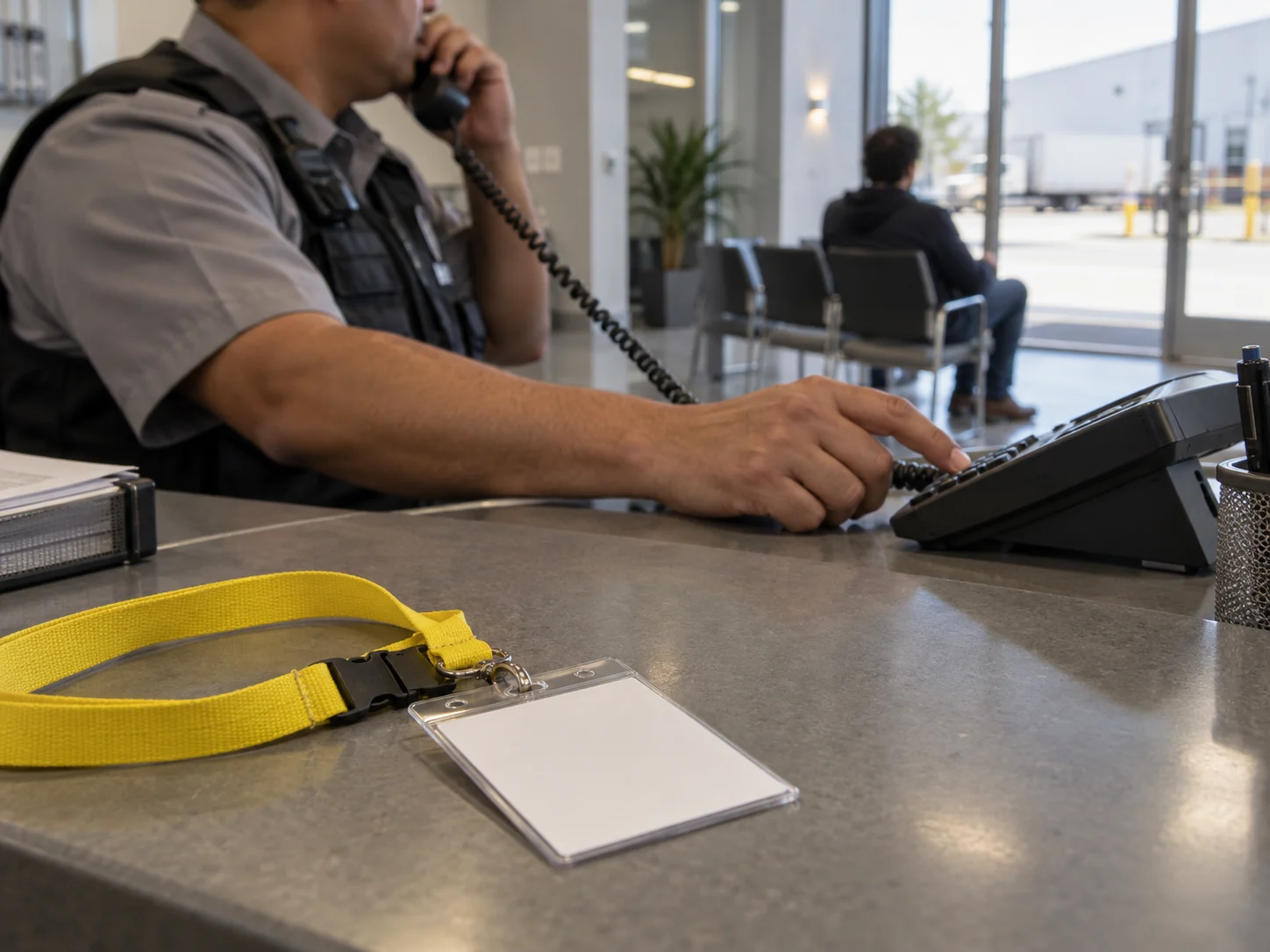
The ID at your gate is the weak point now
Most companies that can trace their latest cargo theft trace it to a fake identity. Tive, a shipment-tracking company, surveyed 442 supply chain, transportation, operations, security and executive leaders across North America, Europe and Latin America for its 2026 cargo theft report. Of those who could name how their latest theft happened, 55% cited identity-based fraud: fictitious pickups, traditional identity schemes, and synthetic or AI-generated identities.
The fake IDs are showing up more often, too. IDScan.net, a company that sells ID verification, reviewed more than 1 million identity checks at North American processing, manufacturing, transport and warehousing sites. Its fraud attempt rate rose from 0.53% in 2023 to 1.66% in 2024 and 2.15% in 2025, about 4 times higher in 2 years, and the 2nd quarter of 2025 was the worst quarter on record. The fraudulent IDs skewed 5 to 1 male, with an average listed age of 46, and Texas was among the states that showed up most often on them.
A glance at the window is the check these schemes are built to pass. The 2nd source does the work.
CALL US FOR SMART SECURITY SOLUTIONS
We Cover Houston, TX, Sugar Land, TX, Pearland, TX, Conroe, TX
The Second-Source Rule: nothing at the gate confirms itself
Every credential that reaches your gate gets checked against a 2nd source the person presenting it doesn’t control. A license and a rate confirmation can both be forged. Faking your dock schedule and the phone number on the carrier’s federal record at the same moment is much harder, and the rule lives in that gap. Here’s how it runs at each door.
Inbound trucks
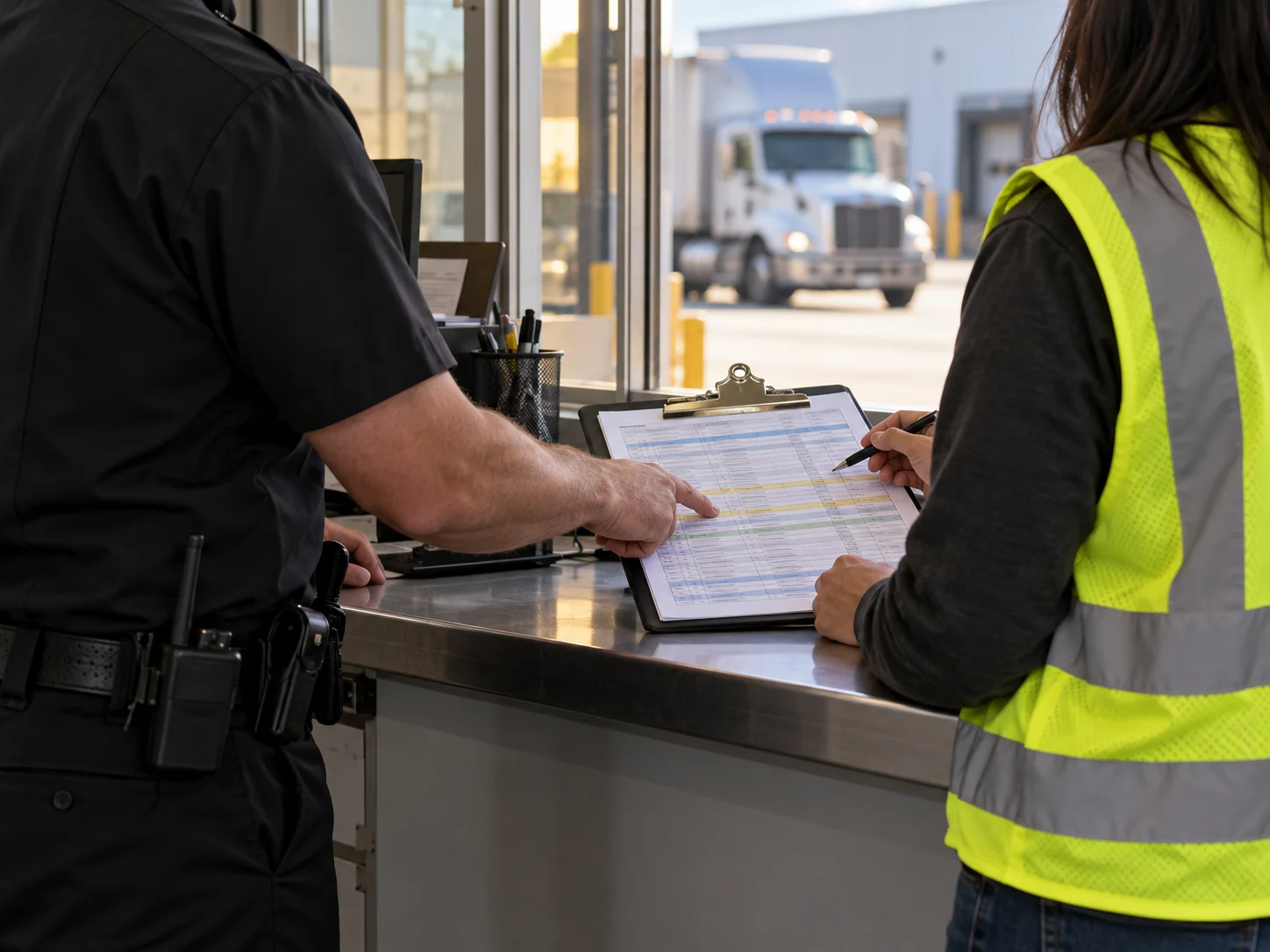
The driver shows a bill of lading, an appointment number and a driver’s license. The officer checks the load against your dock appointment schedule and radios receiving when it isn’t there. Driver, carrier, tractor and trailer numbers, seal number, door and times go in the log. No appointment and no approval from receiving means the truck waits outside the gate.
Outbound pickups
The officer dials the number on the carrier’s federal FMCSA record, never a phone number that came with the paperwork, then checks that the driver, the tractor-trailer and your dispatcher’s booking all line up. The full release check is our Five-Field Pickup Log. Any mismatch, and the load stays on your dock.
Visitors
A visitor shows a government photo ID and names the person they came to see. The officer compares face and name by eye, then reaches the host at the extension in your directory, not at a number the visitor offers. A visitor badge goes on where it stays visible, and the name, ID type, host, badge number and times go in the log. If the host can’t be reached or isn’t expecting anyone, the visitor waits in the lobby.
Contractors and vendors
A technician shows a company ID and a work order. The officer checks it against your open work orders, or calls the vendor’s office at the number on your approved list. No open work order, no entry.
Employees and temps
A badge gets checked twice: against the face wearing it, and against your active roster with same-day removals for anyone who left. The log keeps the exceptions, meaning forgotten badges, removed badges and the person who slips in behind a coworker.
After hours
After close, anyone who shows up is checked against your written after-hours access list, with the on-call manager as the backup. Not on the list, and no manager on the phone, means no entry.
When the officer has to say no
The rule only works when the officer can refuse. On outbound pickups, our officers already hold written authority to stop a release. Put the same authority in the post orders for every door, with the name of the manager who can override a hold on each shift. At 6 a.m., with trucks stacked onto the frontage road, someone will lean on the officer to wave a load through. That call should never be the officer’s alone.
One limit to know before you hire anyone. The officer can only check against a source that exists. If your dock schedule lives in a single dispatcher’s head, the 2nd source is that dispatcher’s cell phone at 3 a.m. Which tells you what to fix first.
Built for the C-TPAT questionnaire your customers send
If you store or move freight for an importer in U.S. Customs and Border Protection’s C-TPAT program, expect a security questionnaire built on CBP’s minimum security criteria, whether or not your company has joined. In November 2025, CBP also announced a C-TPAT pilot for 20 third-party logistics providers, and pilot members must meet the 3PL criteria.
Most of the physical-access questions land on your gate post. These are the criteria behind them, and what the post does for each:
- Criterion 9.4 requires that gates where vehicles and people enter or exit are manned or monitored. An officer covers the gate for the hours you set, and GPS tour records show the patrols in between.
- Criterion 10.1 requires written procedures for granting, changing and removing badges and access devices. The officer works from your active roster and turns away removed badges at the door.
- Criterion 10.2 requires visitors, vendors and service providers to show photo ID on arrival, with a log of each visit. Escorting visitors is a “should” in the same criterion. The officer checks the ID, confirms the host, issues a visible badge and logs the visit.
- Criteria 10.3 and 10.4 require drivers to be positively identified before cargo is received or released, and a cargo pickup log. The officer checks government photo ID against the booking and keeps the pickup log.
- Criterion 7.24 requires procedures to identify, challenge and address unauthorized or unidentified persons. The hold and refusal steps in your post orders answer it.
- Criterion 10.10 requires written work instructions for security guards, with management checking them through audits. We write the post orders for every door in that written form.
Criterion numbers follow CBP’s criteria for importers and for 3PLs, which number them the same way. Security technology, electronic access control included, is a “should” in those criteria (9.7). The identification step is a “must”.
Get Your
Free Armed & Unarmed Security Proposal
Why Houston businesses choose Reliable Guard & Patrol Service
Why Choose Our Armed Guards:
01. Fully Licensed to Carry in the State of Texas
02. Background-Checked and Drug Tested
03. Trained in Firearms Handling and De-Escalation
04. Experienced in High-Risk Property Protection
05. Serving Houston Businesses for Over 20 Years
06. Corporate, Construction, Retail, and Event Coverage
07. 24/7 Coverage Including Holidays
Request your free warehouse access proposal
Name, phone and site ZIP code. We call back with questions about your doors and hours, then send a written proposal.
What every warehouse access post includes
- Written post orders for every door, listing the 2nd source and the log fields
- Written authority to stop an outbound pickup that fails the check
- The gate log emailed daily, or sent on request for any date in the retention window
- GPS-logged patrol rounds, plus incident reports sent as they happen
- A named account supervisor for your site
- Bilingual English and Spanish officers
- An insurance certificate, issued on signing day
Keeping the rule when the officer changes
Contract security replaces most of its workforce every year, so the 2nd-source step has to live in written post orders a new officer can follow on night 1. Annual turnover in the U.S. security industry reached 89% in 2024, against a 66% private-sector average, and has run above that average every year for a decade. The figures come from a July 2026 UC Berkeley Labor Center study of U.S. security guards.
What you can hold us to is whether the step survives a new face at the gate:
- Written post orders for each door, naming the 2nd source, the log fields and the override manager.
- A named account supervisor who knows the site and its standing instructions.
- Supervisor check-ins on the post during shifts.
- GPS guard-tour records, so a skipped round shows up the same night.
What sets the price of a warehouse access post
A warehouse access post is billed by the hour, so your freight schedule sets most of the cost. Count the doors that need an officer, then the hours trucks and people move through each one, then decide whether any post needs an armed officer, billed at a higher hourly rate than unarmed. Those answers go into the free written proposal, along with the hourly rate and the post orders. Our breakdown of what a Houston security guard quote pays for walks through the rate itself.
What we need from you before the 1st shift
The 2nd source has to exist before an officer can check against it. These are the lists we ask for at the site assessment:
- Your dock appointment schedule, emailed each morning, or read-only access to your yard or warehouse system.
- Your approved vendor and contractor list, with each company’s office number as you have it on file.
- An active badge roster, plus same-day notice when an employee or temp leaves.
- The after-hours access list and the on-call manager’s number.
- The person who can override a hold, for each shift.
Setup runs in 4 steps. It starts with a call about your doors, hours and freight. Next comes the free written proposal: who staffs the post, armed or unarmed, which hours, the post orders, and the hourly rate. If the site layout needs a walk-through, we do a site assessment. Then the officers deploy, with your insurance certificate in hand that day. You choose the length: by the week, by the month, or a fixed short or long term.
Frequently Asked Questions
Do your officers check IDs or only write down names?
They check each ID against a 2nd source. A license proves a card exists. The officer then confirms the person belongs on your site, using your dock schedule, a host who answers their own extension, your vendor list, or the phone number on the carrier’s federal FMCSA record. The log shows which source cleared each entry.
Can the officer refuse entry to a driver or visitor?
Yes, when your post orders say so. On outbound pickups, our officers already hold written authority to stop a release. For every other door, the post orders spell out the hold, the call to the override manager named for that shift, and the refusal if the manager doesn’t clear it.
How soon can an officer start?
Usually the same day for unarmed posts, insurance certificate included.
How long does the contract have to run?
As long as you decide. Coverage runs week to week, month to month, or for a fixed term, short or long.
Can the gate officer speak Spanish with drivers?
Yes. Our roster includes bilingual English and Spanish officers, and that counts when the driver at the window, or the crew on the dock, would rather explain a problem in Spanish.
Get an access post quoted for your Houston warehouse
Tell us how many gates and doors need coverage and the hours trucks and people move through them. The free written proposal lists the officer type, the post orders and the hourly rate. Your insurance certificate follows the day you approve it.