
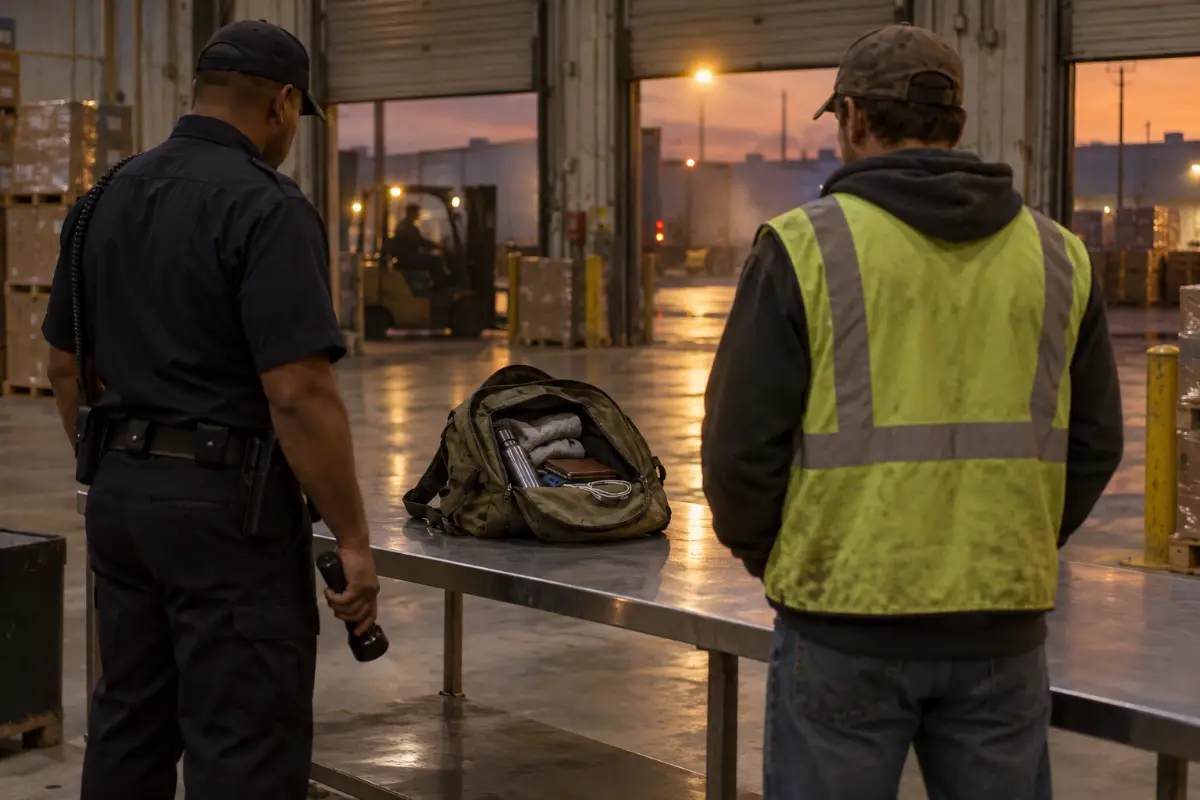
The whole procedure fits in one line. A security guard performing a bag check never touches the bag.
The person carrying it opens it, holds it, and moves the contents with their own hands while the officer looks. That one rule separates a check that holds up from one that ends in a theft accusation, a needlestick, or a wage claim. The page ranking first for this search tells guards the opposite. It says to pull items out and move things around with a baton, then warns 2 sections later that people will accuse you of stealing.
Three things decide whether a bag check stands up: consent, uniformity, and a written record. Everything below is how we run them on Houston warehouses, job sites, and shopping centers.
What is a bag check?
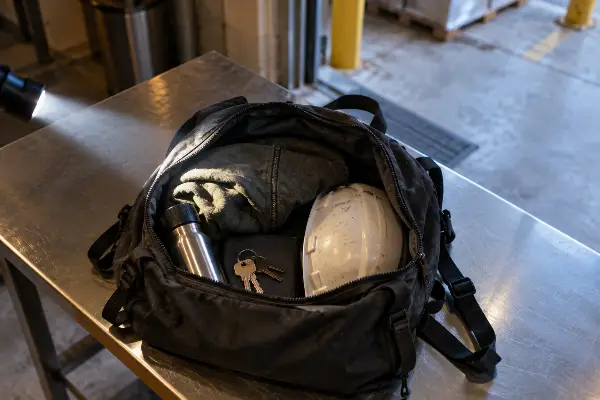
A bag check is a consented visual inspection, not a search.
A bag check is a visual inspection of a bag’s contents, done with the owner’s permission, to confirm nothing prohibited is going into or out of a site. The officer directs and observes. The owner opens and handles. It is not a search in the legal sense, because a private officer cannot search without consent.
That distinction runs through everything else on this page. Take the consent away and you no longer have a bag check. You have a detention, and detention is a different act with different rules.

Can a security guard legally search your bag?
No. A guard can ask, and you can say no. What happens next depends on where you are standing.
A private security officer is not a peace officer. No badge on a uniform grants search authority. What the officer has is the property owner’s right to set conditions on entry. So the real choice at a gate is open the bag or don’t come in. Refusal is not evidence of anything, and it is not grounds to hold someone.
There is one narrow exception in Texas, and it is about theft, not screening. Under Texas Civil Practice and Remedies Code Section 124.001, a person who reasonably believes another has stolen or is attempting to steal property may detain that person “in a reasonable manner and for a reasonable time to investigate ownership of the property.” That is a shopkeeper’s privilege available to any person, not a guard’s search warrant. It requires a reasonable belief tied to something the officer saw. A refused bag check is not that something. We wrote a longer breakdown of what officers can legally do if you want the full picture.
How to perform a bag check as a security guard, step by step
Seven steps, in order, every time. Skipping one is how checks turn into complaints.
- Post the rule before anyone reaches you. A sign at the gate, a line in the employee handbook, a clause in the vendor agreement. Consent given at the moment of the check, with a line of people watching, is the weakest kind. Consent given at hire or at the property line is the kind that holds.
- Set up a table. Waist height, lit, in view of a camera if the site has one. Bags go on the table, not on the ground and not in the officer’s hands.
- Greet the person and ask. Plain words. “I need to look in your bag before you go through. Can you open it for me?” If the person does not speak English, get someone who speaks their language. Consent you cannot confirm is not consent.
- Let them open it and hold it. They unzip every compartment. They spread the contents. They lift the items you point at. Your hands stay off.
- Direct with your voice and a light. “Open that side pocket.” “Lift the jacket.” A flashlight does the work a hand would do, and it does not put your fingers next to anything sharp.
- Watch the person, not just the bag. The line matters as much as the contents. Someone stepping out of the queue, handing a bag to a friend, or drifting toward the fence tells you more than the bag will.
- Log it. Time, name or badge number, what was found, what was done. A check nobody wrote down did not happen when a claim shows up 6 months later.
That log is also what turns access control from a body at a door into a record you can hand to a lawyer, an insurer, or a client.
Why our officers never put a hand in the bag
Hands in the bag creates 3 problems at once, and solves none.
The first is theft accusations. The moment an officer’s hand is inside a bag, the officer’s word is the only thing standing between the company and a claim that something went missing. Keep the owner’s hands on the contents and there is nothing to argue about.
The second is sharps. The article ranking first tells guards to wear thick gloves and move items with a baton. Gloves are not the standard here, and a baton is impact equipment, not a probe. OSHA’s bloodborne pathogens standard says it “applies to all occupational exposure to blood or other potentially infectious materials.” Not healthcare exposure. All of it. The same standard defines contaminated sharps to include needles and broken glass. Say your officers reach into bags at a site where used syringes turn up. That is an employer exposure question with a written plan attached to it. Not a glove tip in a blog post. Our officers carry the protective equipment the post calls for, and the first item on that list is a flashlight.
The third is the weapon problem. A guard filmed rummaging through a woman’s purse with a baton is a client complaint no matter what was in the bag. The video always looks worse than the policy reads.
What happens when someone refuses a bag check?
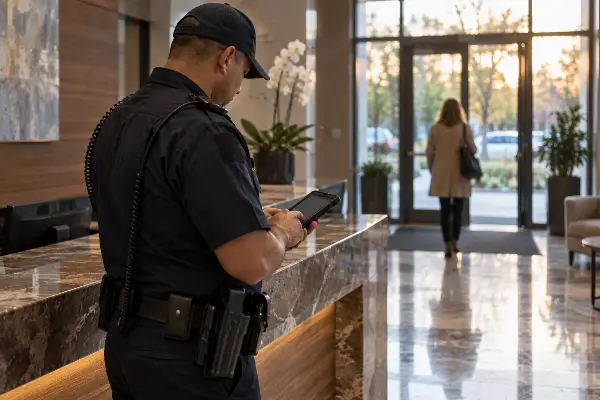
They don’t come in. That is the entire consequence, and the officer’s job is to make it that boring.
At an entrance, refusal means no entry. The officer explains the rule once. Leave the bag or leave the property. Then log the refusal with a time and a description, and move the line. No hands, no blocking, no following someone to their car.
Hold a person because they refused a check and you have stepped from a screening into a detention. Detention without a reasonable belief that a theft occurred is where false imprisonment claims come from. The line between the two is worth reading before you write any policy that mentions it.
One thing this page does not cover is the pat-down. Searching a bag and touching a person are 2 different acts with different rules, and this page only covers the bag.
With an employee, refusal is not a security matter at all. It is a supervisor’s problem. The officer logs it and calls the manager. Discipline, if any, comes from the employer under the employment policy, never from the guard at the door.
Entry screening and employee exit checks are two different jobs
Most guides treat every bag check the same. They are not the same, and the differences are the parts that get companies sued.
| Entry screening | Employee exit check | |
|---|---|---|
| Where it happens | Gate, lobby, dock entrance | Exit door, dock, time clock |
| What consent rests on | A posted condition of entry | A written employment policy signed at hire |
| Who gets checked | Everyone, or a posted rule applied the same way to everyone | Whoever the policy names, selected the same way every time |
| If they refuse | No entry. Nothing else happens. | An employment matter for the manager, not a detention |
| Main exposure | False imprisonment, discrimination claims | Discrimination claims, wage claims, union grievance |
| Who owns the policy | The site or property operator | The employer, not the guard company |
| What the officer does | Observes, logs, denies entry | Observes, logs, calls the manager |
| Where it usually runs | Lobbies, construction gates, retail entrances | Distribution centers, warehouses, stock rooms |
The exit check is the one that costs money when it goes wrong, and it is the one almost nobody writes about.
Do employees get paid for time spent in a bag check?
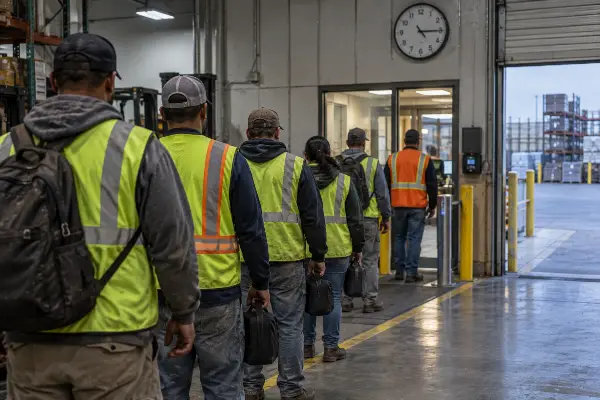
Under federal law, no. Under some state laws, yes. This is the question your policy has to answer before your first check, not after.
In Integrity Staffing v. Busk, 574 U.S. 27, decided December 9, 2014, the Supreme Court held unanimously that “the time that respondents spent waiting to undergo and undergoing security screenings is not compensable under the FLSA.” The facts should sound familiar to anyone running a distribution center. Amazon warehouse workers passed an antitheft checkpoint at the end of every shift, emptied their pockets, and walked through a metal detector. They alleged it took roughly 25 minutes a day.
Six years later the same practice came out the other way in California. In Frlekin v. Apple, decided September 2, 2020, the Ninth Circuit applied an answer from the California Supreme Court and held Apple had to pay for exit search time. The reason: the searches were “required as a practical matter, occur at the workplace, involve a significant degree of control, are imposed primarily for Apple’s benefit, and are enforced through threat of discipline.”
Busk is the federal floor. Some states go further under their own wage rules and California is the clearest example. Before you set an exit check policy, have your employment counsel confirm which rule applies at your site. We run the checks. We do not run your payroll, and no security company should be the one telling you how to code that time.
How to write a bag check policy that holds up
A policy that holds up answers 5 questions in writing before an officer ever stands at a door.
Who gets checked. Everyone, or a defined group, or a random selection. If it is random, it has to be random in practice, not the officer’s judgment about who looks nervous. Judgment-based selection is how a screening program turns into a discrimination claim.
When they consented. At hire, at badge issue, at the gate sign. Name the document.
What the officer may and may not do. Ours says hands off the bag, in writing, so there is no argument later about whether an officer went too far.
What happens on refusal. Different answers for employees, vendors, and visitors. Write all 3.
What gets logged and who keeps it. Retention period included.
How often you check matters too. A 2019 Loss Prevention Research Council study of 18 retailers found two-thirds had an employee package check policy. Among those that did, about 42% checked every time, 33% checked at random, and 17% checked only in stores with high shrink. There is no single right answer in that spread. There is only the one you wrote down and applied the same way to everybody.
What bag checks look like on a Houston site in 2026
On our sites, the bag check is one control inside a pattern, and the pattern is what catches things.
At 11:40 p.m. on a construction site, one of our officers watched 2 people carrying materials toward the perimeter fence in an unlit corner. He put a spotlight on them and challenged them. They dropped the materials and ran. Everything stayed on site, and the inventory check confirmed it.
At 11:20 p.m. at a distribution warehouse, an officer found an unauthorized vehicle parked at the loading docks after hours and a man working at a secured storage area next to the dock doors. The officer identified himself and moved the man off the property. He called dispatch and the site supervisor. Then he walked every dock door, gate, and access point to confirm nothing had been opened.
At 3:30 a.m. on another job site, an officer found a storage container pried open and a man pulling rolls of copper wire out of it. He held observation from a safe distance and fed updates to dispatch until police arrived. The suspect dropped the wire, ran, and was arrested on scene.
Not one of those was a bag check. That is the point. A bag at the gate is the last place material leaves a site, and it is the easiest place to control. Most of what our construction site and warehouse officers stop never reaches a bag at all. If the only thing between your material and the street is a person looking in a backpack, the program is already too thin. Retail works the same way. We walk clients through where guards fit next to a loss prevention team instead of selling one as a replacement for the other.
Commissioned and non-commissioned officers at a screening table
Either. A bag check is not a function that requires a firearm or a commission.
Texas splits security officers into 2 tiers. An unarmed officer holds a Level II non-commissioned registration, which takes a 6 hour course before the application goes to the state. An armed officer holds a Level III commission. The Texas Department of Public Safety requires a minimum of 45 classroom hours for it. Under Texas Occupations Code 1702.301, that commission expires no later than the second anniversary of issue.
Neither tier grants search authority. A Level III commission is about carrying a firearm, not about what an officer may do with your backpack. Anyone who tells you an armed officer can search where an unarmed one cannot is selling you something.
For most bag check posts, unarmed officers are the right call. The job is observation, communication, and paperwork. We staff armed officers where the site risk calls for it, which on our roster is usually cash handling and high-value storage, not a screening table.
Getting bag checks running on your site
We run bag checks as part of standing posts, not as a standalone service.
Reliable Guard & Patrol Service is a Houston security guard company operating under Texas license B07315701, first issued in 2018, with 150 officers across more than 100 Houston-area sites. Our officers work in English and Spanish, which matters more at a screening table than anywhere else on a property, because consent nobody understood is not consent. We staff 24 hours a day including holidays, we can send a certificate of insurance the same day, and we do not require a long-term contract. Terms run weekly, month to month, or longer.
We do not serve events, residential, or HOA properties, and we do not do K-9, alarm response, or fire watch. What we do is put officers on commercial property and document what happens there, including warehouse security posts where the exit check runs every shift. If you want bag checks written into a post order for your warehouse, job site, or shopping center, tell us the site and the hours and we will price it. Bring your policy if you have one. If you do not, the 5 questions above are where we start. Knowing how to perform bag checks as a security guard matters far less than having a written rule the officer can point to.
FAQs
Can a security guard legally search your bag?
No. A private security officer has no search authority and cannot look in your bag without your permission. What they can do is refuse you entry to private property if you decline. The one narrow exception in Texas is Civil Practice and Remedies Code 124.001, which lets any person detain someone they reasonably believe has stolen property “in a reasonable manner and for a reasonable time to investigate ownership.”
How do you perform a bag check as a security guard?
Post the rule in advance, set up a lit table at waist height, ask permission in a language the person understands, and have the owner open the bag and move the contents themselves. Direct with your voice and a flashlight. Watch the line as well as the bag. Log the time, the person, what was found, and what was done.
Should a security guard put their hands inside a bag?
No. Hands in the bag creates a theft accusation the officer cannot disprove and puts fingers next to whatever is in there. OSHA’s bloodborne pathogens standard applies to “all occupational exposure,” not just healthcare work, and defines contaminated sharps to include needles and broken glass. A flashlight does the same job with none of the risk.
Can a security guard detain you for refusing a bag check?
No. Refusal is not grounds for detention. The consequence of refusing at an entrance is that you do not enter. Holding someone without a reasonable belief that a theft occurred is where false imprisonment claims start, and in Texas that reasonable belief has to be tied to something the officer observed, not to the refusal itself.
Do employees have to be paid for time spent in a bag check?
Under federal law, no. In Integrity Staffing Solutions v. Busk, 574 U.S. 27, the Supreme Court held unanimously in December 2014 that time spent waiting for and undergoing security screenings is not compensable under the FLSA, in a case involving Amazon warehouse workers who alleged roughly 25 minutes a day. Some states go further under their own wage rules, and California requires payment after Frlekin v. Apple. Check with your employment counsel before you set the policy.
Do you need a commissioned officer to perform bag checks in Texas?
No. A Level II non-commissioned officer can run bag checks. The Level II registration takes a 6 hour course, while a Level III commission requires a minimum of 45 classroom hours through the Texas Department of Public Safety and covers carrying a firearm, not search authority. Neither tier can search without consent.
How long should a bag check take?
Long enough to see every compartment, which on an open bag is usually a matter of seconds. The number that matters is the queue, not the individual check. In the Busk case, warehouse workers alleged the end-of-shift screening cost them about 25 minutes a day. If your line is backing up, add a table and an officer rather than telling officers to go faster.


