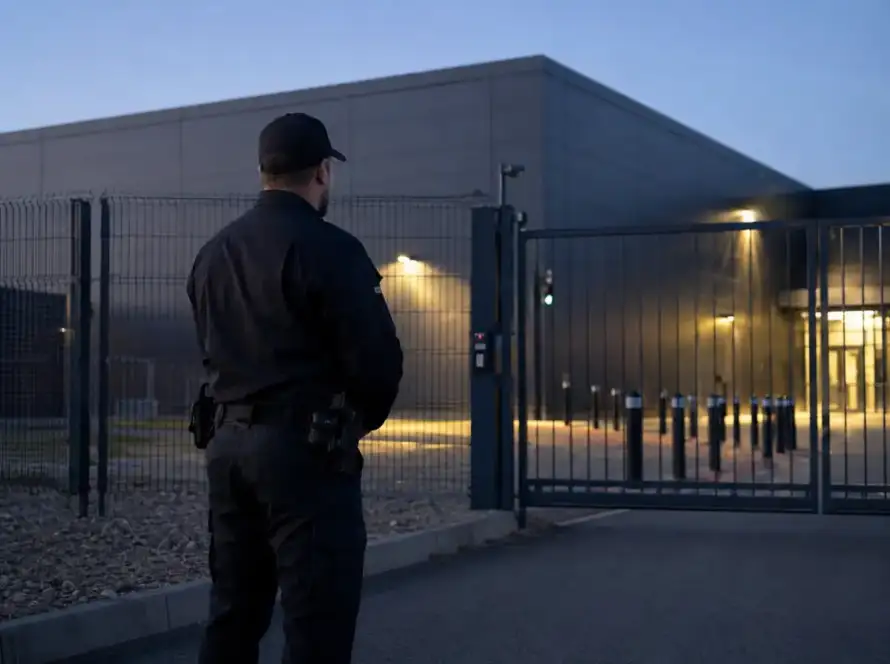
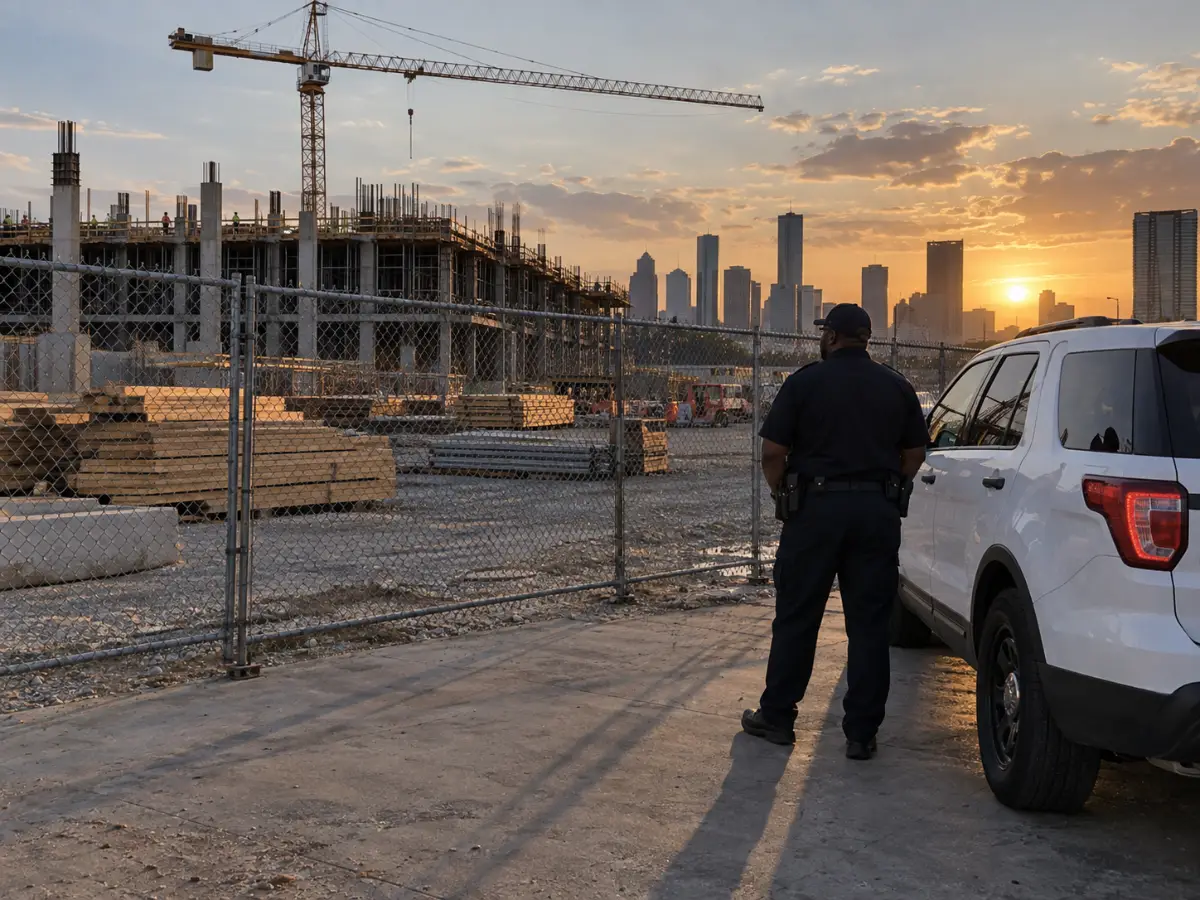
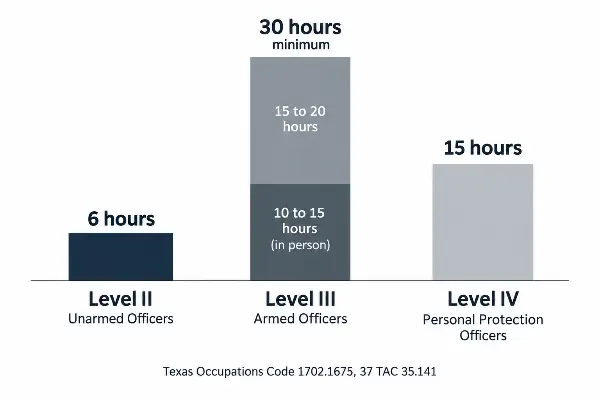
The armed security guard training requirements in Texas start, and mostly end, at 30 hours. That is the minimum basic course a commissioned security officer completes before carrying a firearm on your property, and 10 to 15 of those hours have to be in-person instruction covering handgun proficiency, weapons law, deadly force law, nonviolent dispute resolution and self-defense tactics, under Texas Occupations Code Section 1702.1675. At renewal, the officer adds 6 hours of continuing education and files a firearms proficiency certificate.
No CPR. No first aid. No drug test. No psychological exam. None of those sit in the state minimum.
So if you’re comparing guard companies for a warehouse, a job site or a shopping center, the state requirement tells you almost nothing about who shows up. What a company adds on top of the floor tells you everything, and most buyers never ask.
What are the armed security guard training requirements in Texas?
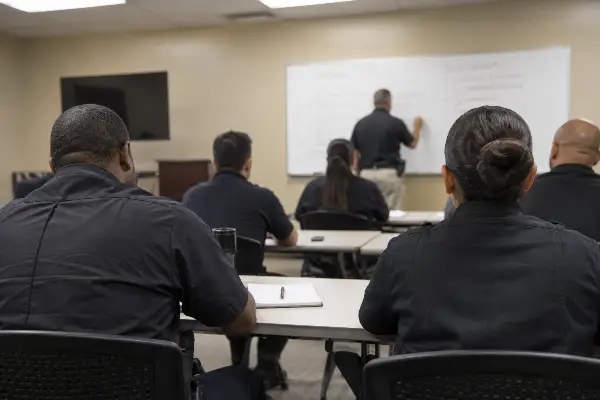
In Texas, an armed security guard is a commissioned security officer who has completed the Level III training course, a minimum of 30 hours under Occupations Code 1702.1675, including 10 to 15 in-person hours on handgun proficiency and self-defense plus a live range qualification with a 9mm or .38 caliber handgun.
Everything else people assume is in there is not. The statute lists what the hours must cover: general security officer training, classroom instruction on handgun proficiency and self-defense, and range instruction where the officer demonstrates safe and proficient use of the handgun. The classroom block has to include weapons laws, the law on deadly force, handgun use and safety, nonviolent dispute resolution, and secure handgun storage.
That last item surprises people. A meaningful share of the required armed curriculum is about not shooting.
The 2026 Texas training clock, hour by hour
Here is the whole legal clock for a Texas security officer, unarmed and armed, current as of 2026.
| Requirement | Hours | Who it applies to | Source |
|---|---|---|---|
| Level II, non-commissioned course | 6 hours | Unarmed officers | TEEX course SAP201 |
| Level III, commissioned basic course | 30 hours minimum | Armed officers | Occupations Code 1702.1675 |
| Of that, in-person handgun and self-defense instruction | 10 to 15 hours | Armed officers | Occupations Code 1702.1675 |
| Range qualification | included in the course | Armed officers | Occupations Code 1702.1675 |
| Level IV, personal protection officer | 15 classroom hours minimum | Personal protection officers | 37 TAC 35.141 |
| Continuing education at renewal | 6 hours | Commissioned and personal protection officers | 37 TAC 35.161(g) |
| Firearms proficiency certificate | filed with the renewal application | Commissioned officers | 37 TAC 35.161 |
Read the first 2 rows together. An unarmed officer in Texas completes a 6-hour course. An armed officer completes 30. The gap between “watches your gate” and “carries a firearm at your gate” is 24 hours of instruction.
That is the floor, not the ceiling. Approved schools run longer courses, and companies can require more. Nothing in state law makes them.
The training certificate is also only 1 piece of it. The commission comes from the Texas Department of Public Safety. DPS reviews the application, runs the criminal history check, and issues the pocket card the officer carries. A guard company cannot commission its own officers. It also cannot put someone to work armed on a training certificate while the application sits in the queue. Who qualifies runs on a separate track from who gets trained, and what disqualifies an applicant is where most of them fail.
Level II vs Level III: what the difference means on your property
A Level II officer is non-commissioned and unarmed. A Level III officer holds a security officer commission from the Texas Department of Public Safety and may carry a firearm on duty. The commission is tied to the officer and to the licensed company that employs them. An officer cannot take it freelance to a side job.
| Requirement | Level II, non-commissioned | Level III, commissioned |
|---|---|---|
| Armed | No | Yes |
| Minimum course | 6 hours | 30 hours |
| In-person firearm and self-defense hours | none | 10 to 15 |
| Range qualification | no | yes |
| Continuing education at renewal | not required under 35.161(g) | 6 hours |
| Firearms proficiency at renewal | not applicable | certificate required |
| Pocket card carried | on duty | on duty and traveling to and from assignment |
The pocket card rule in the last row is worth knowing. Most of the confusion about armed guards starts there. 37 TAC 35.82 requires commissioned officers to carry the card on duty and while traveling to and from the place of assignment. The commission is not a personal carry permit. It does not follow the officer off the clock.
Firearm type is set on the commission, not left to the officer. Texas categorizes a commission as SA for any handgun, NSA for handguns that are not semi-automatic, or STG for shotgun, and rifles are limited to licensed or honorably retired Texas peace officers under 37 TAC 35.7. The commission, not the officer’s preference, sets the firearms an officer carries on your site. When you’re weighing armed officers against unarmed coverage, that category is a fair question to ask.
What the state does not require
This is the part the rest of the internet skips, and it is the part that should shape your decision.
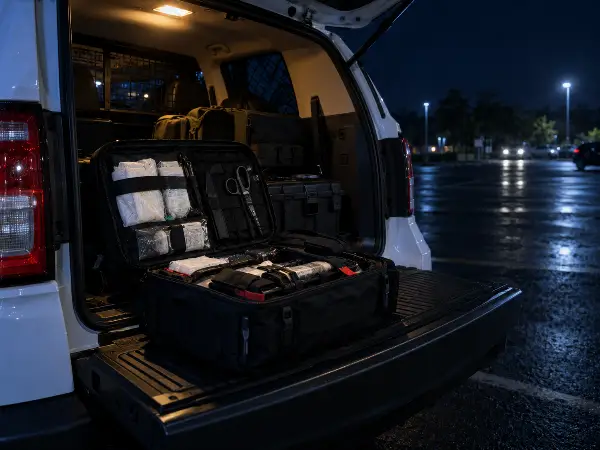
Not required by Texas for a security officer commission:
- CPR or first aid certification. Nothing in the commissioned officer requirements mandates it. Plenty of national blog posts say otherwise. They are describing other states, or nothing at all.
- Drug testing. Not a state condition of the commission.
- Psychological or personality screening. It does not appear in the Private Security rules covering training and officer standards. Some states do require it. Texas puts its screening weight on criminal history and the application process instead.
- De-escalation hours beyond the required block. Nonviolent dispute resolution sits inside the 10 to 15 hour classroom requirement. There is no separate annual requirement on top.
- Site-specific training. Nothing requires that an officer be trained on your property, your access points, your contractors or your alarm procedures before their first shift.
That last one causes more problems than the first 4 combined. An officer can meet every Texas rule and still spend night 1 on your site not knowing which gate gets chained at 18:00.
Background screening happens at the application stage through DPS. That is where criminal history is checked, not in the course.
Thirty hours to carry a gun, 1,000 hours to cut hair
Here is the comparison nobody in this industry wants to print.
Texas requires a minimum of 30 hours of training before a commissioned security officer carries a firearm on a job site. The same state requires 1,000 hours of instruction at a licensed school before it will issue a cosmetology operator license.
Both numbers are real, both come from Texas agencies, and the gap is 33 to 1.
I’m not saying the cosmetology number is wrong. I’m saying the security number is a floor, and buying at the floor is the real risk. The gun is not the variable. The standard behind it is.
The counterweight: hours are a weak measure of anything. A 30-hour officer whose reports get read every morning will beat a better-trained officer nobody checks on. Hours tell you what a company had to do. Supervision and records tell you what it chose to do. Ask about both. Weigh the second one more.
How often do armed guards have to retrain?
A commissioned officer completes 6 hours of continuing education at renewal, delivered as the renewal portion of the Level III course, and submits a firearms proficiency certificate with the renewal application under 37 TAC 35.161. Renewal runs on a 2-year cycle.
Say that plainly: after the initial course, Texas asks for 6 hours every 2 years.
For an unarmed officer, 35.161(g) puts the continuing education requirement on commissioned and personal protection officers, not on non-commissioned registrations.
Our own officers requalify on the 2-year cycle, armed officers complete firearm proficiency training on the same cycle, and Level II officers hold the non-commissioned registration current. That matches the state cadence rather than beating it, and I’d rather say so than imply a number we don’t run.
Where we go past the state is the screening and the supervision, covered next.
What we require on top of the state minimum
Reliable Guard & Patrol Service operates under Texas DPS license B07315701 with about 150 officers across more than 100 sites in the Houston area. Every officer we place clears 4 requirements the state does not impose:
- Background check, on top of the DPS application screening.
- Drug testing.
- License verification, checked against DPS records rather than taken from a photo of a card.
- References and a standards interview before assignment.
Armed officers take the requalification training every 2 years and complete firearm proficiency training on the same cycle. Unarmed officers hold current Level II registration.
Then there is the part that matters after hire. We run a GPS guard tour system, so patrol rounds are logged rather than claimed, incident reports come in real time, and supervisors run check-ins on shift. Ask whether an officer walked the north fence at 02:00 and the answer is a record, not a conversation. That is the same reporting trail behind our construction site coverage, and it works the same way on a warehouse dock or a shopping center lot.
Every account gets a named supervisor, not a rotating dispatcher. We also don’t run random drive-by patrols. An officer is posted to your site or they are not. That is a different product from a mobile patrol that drives a route past a list of properties and drops a timestamp at each stop. The 2 get quoted as if they were the same thing. Check which one you are actually being sold. Officers work in English and Spanish. On a Houston job site that is part of the job, not a line in a brochure.
Does the training show up at 2 a.m.?
That is the only test that counts, so here are 3 nights from our own log.
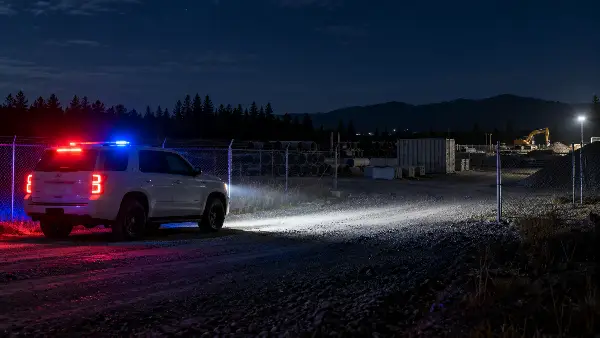
02:15, construction site. An officer on perimeter patrol watched a pickup circle the site, stop near a gated entrance, and sit while the occupants looked over access points. He hit the patrol vehicle’s emergency lights, moved in, and made himself visible. The truck left. He logged the vehicle description and notified site management. Nothing was taken, and nobody was touched.
23:40, construction site. An officer saw 2 people carrying materials toward the perimeter fence in a dark section of the site. He moved in, put a spotlight on the area, and challenged them out loud. They dropped the materials and ran. He secured the area, recovered the materials, and called law enforcement and site management. An inventory check confirmed nothing left the property.
03:30, construction site. An officer found a temporary storage container tampered with, then saw an individual pulling rolls of copper wire out of it. He called law enforcement, watched from a safe distance, and fed updates to dispatch until officers arrived. The suspect dropped the wire, ran, and was arrested. The copper went back to site management.
Read what ended all 3: lights, a spotlight, distance, a radio, and a report. Not a firearm. The 10 to 15 in-person hours Texas requires spend real time on weapons law, deadly force law and dispute resolution. This is what that looks like when it works. An armed officer’s day-to-day duties are mostly observation and documentation, which is exactly why the skills behind the role matter more than the hardware.
What to check before you sign a guard contract
Four training questions, and what a real answer sounds like.
“Is the officer assigned to my site Level II or Level III?” A real answer names the level for that post, not for the company. Plenty of firms quote an armed rate and staff it with whoever is free.
“When does that officer’s commission renew, and when did they last file firearm proficiency?” A firm running a GPS tour system and a renewal calendar can answer in a minute. One that cannot just told you something.
“What do you require that the state doesn’t?” If the answer is a list of adjectives instead of a list of checks, keep looking. Ours is 4 items long and every one of them is a document.
“Who trains the officer on my site specifically, and when?” Nothing in Texas law covers this, so the answer is up to the vendor.
For the wider version of this conversation, including licensing and insurance, our guide on what to ask before you hire a guard company covers the rest.
The armed security guard training requirements in Texas are a floor, and a low one. We’re a Houston security guard company that clears it and then keeps going, with 24/7 coverage, no holiday closures, and contracts that run weekly, monthly or long term because we don’t require a long-term commitment to start. Call us and ask the 4 questions above. We’ll answer them on the phone.
This article describes Texas licensing and training rules as the state publishes them. It is not legal advice. Check current rules with the Texas Department of Public Safety private security training rules before making a compliance decision.
FAQs
How many hours of training does an armed security guard need in Texas?
A minimum of 30 hours. Texas Occupations Code 1702.1675 sets the Level III commissioned officer basic course at 30 hours or more, and requires that 10 to 15 of those hours be in-person instruction on handgun proficiency and self-defense. The course also includes range instruction where the officer demonstrates safe use of a 9mm or .38 caliber handgun.
What is the difference between a commissioned and non-commissioned security officer?
A non-commissioned, or Level II, officer works unarmed and completes a 6-hour course. A commissioned, or Level III, officer holds a security officer commission from the Texas Department of Public Safety, completes at least 30 hours, and may carry a firearm while on duty for the licensed company that employs them.
Do armed security guards need CPR or first aid certification in Texas?
Not under state law. Texas does not require CPR or first aid certification for a security officer commission. Any medical training an officer carries comes from the guard company’s own standard, so ask your provider directly rather than assuming it is covered.
Does Texas require a psychological exam for armed security guards?
No psychological or personality screening appears in the Texas training and officer standards rules for a security officer commission. Texas screens through criminal history and the DPS application process instead. Individual companies may add their own screening, and many do.
How often do armed security guards have to retrain?
Every 2 years at renewal. A commissioned officer completes 6 hours of continuing education, delivered as the renewal portion of the Level III course, and files a firearms proficiency certificate with the renewal application under 37 TAC 35.161.
Are the armed security guard training requirements enough?
They are a floor. Texas sets 30 hours for an armed officer and 1,000 hours of instruction for a cosmetology operator license, which is a fair measure of how low the security floor sits. The number that matters is what the guard company requires on top of it, and whether it can show you records rather than claims.
Can an armed guard carry a firearm off my property?
The commission authorizes carry on duty for the employing licensed company. Under 37 TAC 35.82, a commissioned officer carries the pocket card on duty and while traveling to and from the place of assignment. It is not a personal carry permit and it does not extend to personal time.