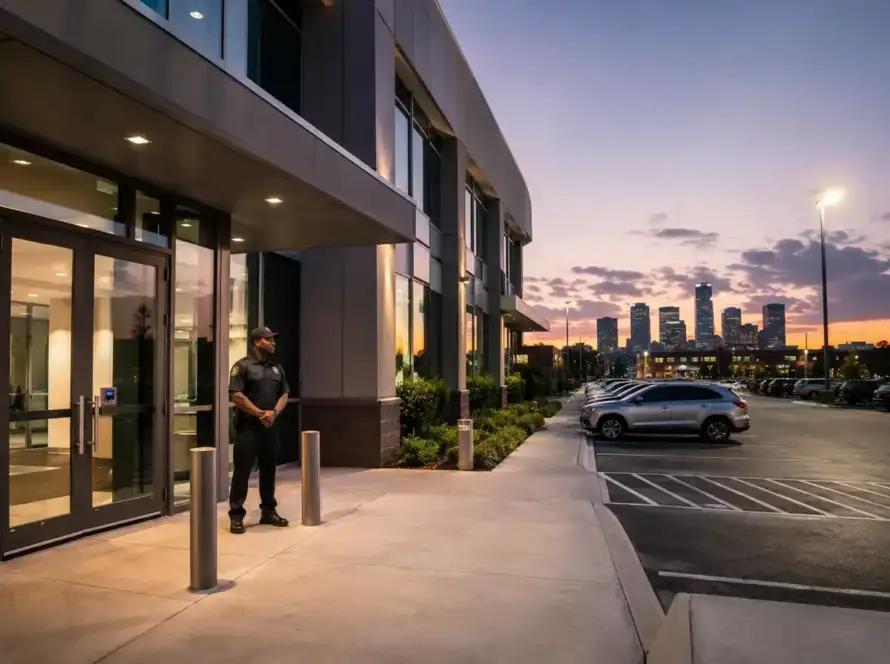

Choose a security guard company in 5 steps, in this order: name what you’re trying to stop, match the officer type to it, verify the license and insurance yourself, walk the property with the vendor, then compare quotes on staffing and supervision instead of the hourly rate.
Most buyers run that backwards. They collect 3 rates, take the middle one, and find out what they bought at 2 a.m. on a Saturday.
The step almost nobody runs is the second one. A warehouse dock, a boarded-up retail building and an active construction site need different officers doing different things on different schedules. A vendor who quotes all 3 the same way hasn’t looked at your property.
What is a security guard company? A security guard company is a state-licensed contractor that supplies trained officers to patrol private property, control access to it, watch it, and document what happens on it. Texas licenses these firms under Occupations Code Chapter 1702 as Class B security services contractors, and every officer they assign carries an individual state registration.

How do you choose a security guard company?
Run the 5 steps in sequence: define the risk, match the officer, check the credentials, walk the site, compare the quotes.
Order matters more than the list does. Each step cuts the field down, and the cheapest one to run is the first. Skip it and you spend the rest of the process comparing numbers that describe different things.
The whole sequence takes about a week. Two afternoons of it are yours; the rest is waiting on documents.
Start with the risk, not the service
Write down what you’re trying to stop before you call anyone. That answer decides which officer you need and what they do all night.
“Security” isn’t one product. On a construction site the loss is copper, tools, and fuel, and it happens between midnight and 4 a.m. In a distribution warehouse it’s inventory and dock access during shift changes. In a vacant building it’s squatters, stripped wire, and fire.
Fire belongs on that list more than most buyers expect, and it’s written into the statute. Under Occupations Code 1702.108, guard work in Texas covers preventing entry, larceny, vandalism, abuse, fire, or trespass on private property. Fire sits in the same sentence as theft. The scale is worth knowing: the U.S. Fire Administration counted an annual average of 108,500 nonresidential building fires between 2017 and 2019, causing about $2.8 billion in property loss and 1,125 injuries a year.
So the first question isn’t “how much per hour.” It’s “what does this property lose, when, and through which opening.” A vendor who can’t answer that after a walkthrough is quoting a body in a uniform.

What type of security guard does your property need?
Match the officer to the property, not to the budget. The 5 property types below cover most commercial work in Houston, and each one changes what the officer does on shift.
| Property type | Coverage that fits | What the officer works through | What it’s there to stop |
|---|---|---|---|
| Construction site | Unarmed on foot or vehicle patrol, overnight and weekends | Perimeter and fence line, gates, material lay-down areas, storage containers, fuel and equipment | Equipment and material theft, copper theft, trespass, vandalism, project delay |
| Warehouse or distribution center | Unarmed, with access control at shift change | Loading docks, dock doors, gates, delivery and shipment verification, employee and visitor access | Inventory and cargo theft, dock losses, unauthorized after-hours access |
| Vacant commercial building | Unarmed patrol, randomized round times | Doors, windows, boarded openings, roof access, utility and meter areas, property condition | Squatters, copper stripping, arson, illegal dumping, liability claims |
| Office or commercial building | Unarmed at the lobby or post, armed where cash or sensitive areas are involved | Access points, visitor verification, after-hours entry, incident response | Unauthorized access, theft, loitering, workplace incidents |
| Shopping center or retail | Unarmed visible presence, armed for cash handling | Parking areas, storefronts, common areas, customer activity | Shoplifting, organized retail crime, disputes, vandalism, disorderly conduct |
The armed decision is separate from the property decision. Armed coverage is for cash handling, high-value assets, and sites with a history of violent incidents, and in Texas it takes a commissioned officer rather than an unarmed registration. Our post on what a Level III commissioned officer is covers that credential, and what a security guard can and can’t legally do sets the outer edge of what any officer can be asked to do, armed or not. The full range of posts we staff maps onto the table above.
Here’s what matching looks like when it works. At about 11:40 p.m. on a construction site, one of our officers saw 2 people carrying materials toward the perimeter fence in a poorly lit stretch of the property. He moved to the location, put a spotlight on them, and challenged them out loud. They dropped the materials and ran. He secured the area, recovered everything, and called law enforcement and site management. An inventory check confirmed nothing left the site.
That stop happened because the post was built around a fence line and a lay-down yard, with a vehicle and a spotlight, on a schedule that put an officer there at 11:40 p.m. A lobby post with the same officer would have missed it. So would a drive-by an hour later. The same logic drives how we staff construction site security in Houston, where the risk window and the fence line decide the schedule.
The 20 minutes of checking that ends most conversations
Ask for the license number and the certificate of insurance, then check the license yourself. It takes about 20 minutes and it removes more vendors than any interview will.
Texas publishes the license file. Search a company or an individual officer at tops.portal.texas.gov, free, no phone call. A guard company here holds a Class B license, which the Texas Department of Public Safety defines as covering alarm, armored car, courier, electronic access, guard, and locksmith services. That’s worth reading twice, because a Class B number by itself doesn’t prove the holder runs guards. Ask which of those 6 lines of business they run in house.
Insurance is the part most buyers wave through, and Texas leaves more room there than almost anyone expects. The limits, the aggregate problem, and the gap between a certificate holder and an additional insured are all in security guard company insurance requirements in Texas. Ask for the draft agreement in the same email, and read the clauses that decide what happens when a shift goes uncovered, which are covered in the 9 clauses to check in a security guard contract.

What are the red flags when hiring a security company?
Six of them, and the first one is arithmetic.
A rate that can’t carry the wage. The Bureau of Labor Statistics puts the median pay for security guards at $18.29 an hour, or $38,050 a year, as of May 2025. A bill rate has to cover that wage plus payroll taxes, workers’ compensation, general liability, supervision, uniforms, vehicles, and margin. When a quote lands close to the officer’s own wage, the money is coming out of one of those lines. Usually it comes out of pay, which decides who takes the post, or out of insurance, which decides what happens after an incident. A low bid isn’t a better deal on the same officer. It’s a different officer.
No license number in the proposal. A licensed company knows its number and has no reason to withhold it. A polished website and a high review count show a company invests in marketing, and the license file is the only part of the picture a third party wrote. Ours is at the bottom of every page on this site.
Post orders described as something to write later. If the site-specific instructions don’t exist at signing, the officer’s first shift is an improvisation.
No named supervisor. Ask who the officer reports to and whether that person visits the site. A dispatch number is not supervision.
Selling you a service they don’t run. Plenty of firms quote K-9, alarm response, fire watch, and parking enforcement as bolt-ons and then subcontract them. Ask what’s done in house. We don’t offer any of those 4, and we say so rather than brokering them.
A 12-month agreement presented as the only option. It’s a sales convention, not a legal requirement, and it’s the thing clients tell us most often they expected.

Walk the site before you sign
Make the vendor walk your property at the hour the coverage will run, not at 2 p.m. on a Tuesday.
A daylight walkthrough shows you a parking lot. An 11 p.m. walkthrough shows you which lights are out, which gate doesn’t latch, where the fence line is low, and which corner nobody can see from the street. That’s the same information the person you’re trying to keep out already has.
Our own sequence runs first call, then a written proposal, then a site assessment where the property calls for one, then deployment. Four things are worth making any vendor do on that walk:
- Name the openings they’d cover and the ones they’d leave, and say why.
- Say where the officer stands, drives, or sits, hour by hour, and how patrol frequency gets set for your site.
- Point at the lighting, gates, and camera gaps they’d want fixed. A vendor who finds nothing wasn’t looking.
- Tell you what they’d do differently if you cut the hours by 20 percent. The answer shows whether the plan was designed or priced.
Do you need a dedicated post or a mobile patrol?
Decide which one you’re buying, because the 2 models solve different problems and get quoted against each other as though they don’t.
A dedicated post puts an officer on your property for the whole shift. A mobile patrol runs a vehicle along a nightly route and stops at your site long enough to drive the lot and check the doors. The route model costs less per night and can be the right call for a low-risk site with a long vacancy. It’s the wrong call when your loss window is the 4 hours nobody is there.
We staff dedicated posts and we don’t sell one-off random patrols, because a stranger driving through once a night protects the invoice more than the property. If continuous coverage is what your site needs, security patrol service in Houston is the version we run.

Comparing 3 quotes in 2026 without getting fooled by the rate
Line the quotes up on what’s staffed and supervised, not on the hourly number. Three quotes that look 8 percent apart on rate are often 40 percent apart on what shows up.
| What to compare | What you’re comparing underneath | The question that settles it |
|---|---|---|
| Hourly rate | Officer pay, insurance, and supervision, bundled into one number | What does the officer on my site earn per hour? |
| Coverage hours | Whether the risk window is covered or the budget is | Which hours are unstaffed, and what happens in them? |
| Officer type | An unarmed registration or a commission, and the liability that goes with it | Is every armed officer assigned to me commissioned right now? |
| Supervision | A named person or a call center | Who is my supervisor, and how often do they visit the site? |
| Coverage continuity | Whether a no-show is your problem or theirs | What does the contract say happens when a post goes uncovered? |
| Reporting | A clipboard or a timestamped record | What do I receive after a shift, and how quickly after an incident? |
| Contract term | Flexibility or a lock-in | What’s the shortest term you’ll write? |
That fifth row is the one that bites. This is a high-turnover field by structure: BLS counts 1,304,000 people working as security guards and gambling surveillance officers and projects about 157,200 openings a year through 2035, mostly to replace people leaving. Every vendor will have a gap eventually. The quote that tells you what happens during one is worth more than the quote that comes in 8 percent lower.
What Reliable Guard & Patrol Service answers on the record
We’re licensed by the Texas Department of Public Safety under license B07315701, first issued in 2018. Look it up in TOPS before you call us.
We field 150 officers across more than 100 active sites, from Downtown and the Medical Center out through the Energy Corridor, Katy, Sugar Land, Pearland, Conroe, Spring, Humble, and The Woodlands. We run 24/7 with no holiday closures, in English and Spanish, and every account gets a dedicated account supervisor. Certificates of insurance go out the same day you ask, and we carry general liability, workers’ compensation, and commercial auto.
Contract terms run weekly, month to month, short term, or long term. We don’t require a long-term commitment to take an account.
Every officer clears a background check, drug testing, license verification, reference checks, and an interview before assignment. Officers work GPS guard tour rounds with documented patrol records, real-time incident reports, and supervisor check-ins. More of that history is on our about us page.
We work commercial property: construction sites, warehouses and distribution centers, office buildings, shopping centers, vacant buildings, and stores. We don’t take residential, HOA, or event work, and we don’t offer K-9, alarm response, parking enforcement, or fire watch.
Knowing how to choose a security guard company is mostly a matter of doing the first 2 steps before the last 3. Name the risk, match the officer, then let the paperwork and the walkthrough sort the field. For a second read on the traits worth weighing, what to look for in a security company covers the ground from a different angle. When you’re ready, ask a Houston security guard company to walk your property at the hour the coverage would run, and see who says something you didn’t already know.
FAQs
How do you choose a security guard company?
Run 5 steps in order: name the risk on your property, match the officer type to that risk, verify the license and insurance yourself, walk the site with the vendor at the hour coverage will run, then compare quotes on staffing and supervision rather than the hourly rate. The second step is the one most buyers skip, and it’s the one that decides whether the officer is in the right place at the right time.
How do I know which type of security guard my property needs?
Start from what the property loses and when. A construction site needs perimeter and lay-down coverage overnight, a warehouse needs dock and access control around shift change, a vacant building needs randomized rounds on doors, windows and roof access, and a shopping center needs visible presence in the parking areas. Texas defines guard work broadly enough to cover entry, theft, vandalism, fire and trespass, so the property decides the post, not the job title.
What are the red flags when hiring a security guard company?
A bid that can’t cover the officer’s own wage, no license number in the proposal, post orders described as something to write later, no named supervisor who visits the site, services quoted that the company subcontracts, and a 12-month agreement offered as the only option. Any one of those is worth a direct question before you move on.
What should a security company do during a site walkthrough?
Four things. Name the openings they’d cover and the ones they’d leave, describe where the officer is hour by hour, point at the lighting and gate problems they’d want fixed, and tell you what changes if you cut the hours. Insist on doing the walk at the hour the coverage would run, because a daylight visit hides the gaps that matter.
What’s the difference between a dedicated guard post and a mobile patrol?
A dedicated post keeps an officer on your property for the whole shift. A mobile patrol covers a route of sites in one night and stops at yours long enough to drive the lot and check the doors. The route model costs less per night and suits a low-risk long vacancy. It’s the wrong choice when your loss window is one specific stretch of the night.
Do I need armed or unarmed security guards?
Unarmed coverage handles most commercial property: construction sites, warehouses, vacant buildings, and office lobbies. Armed coverage is for cash handling, high-value assets, and sites with a history of violent incidents. In Texas an armed officer holds a commission, which is a separate credential from an unarmed registration, so ask for it per assigned officer rather than per company.