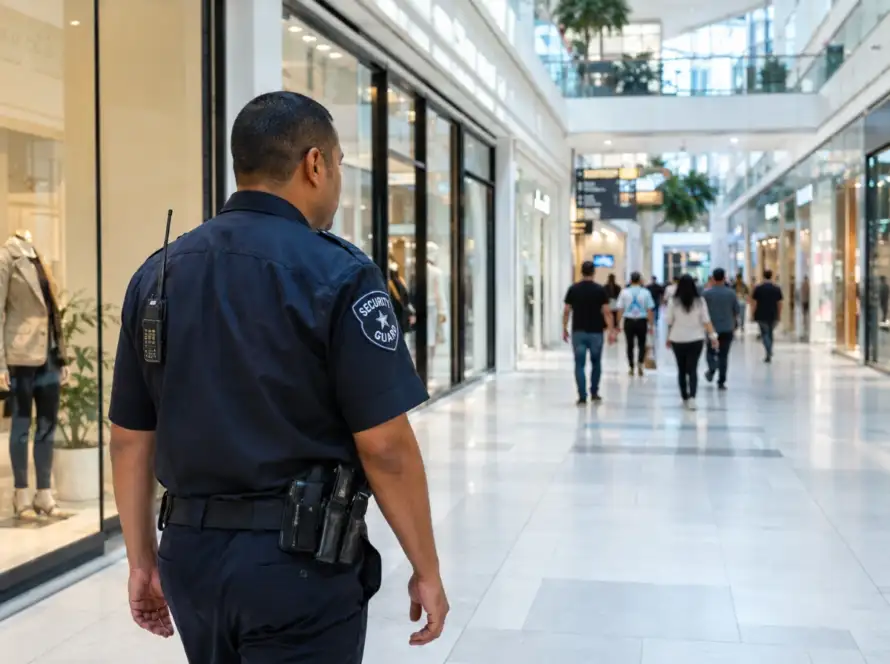
No, security guards are not law enforcement. They’re private citizens hired to protect specific properties, people, and assets. They don’t carry a badge issued by any government agency, they don’t take a sworn oath of office, and they don’t have jurisdiction beyond the property line of whoever hired them. Police officers are government employees with broad legal authority. Security guards are contracted professionals with very specific, property-level responsibilities.
Security guards are privately employed professionals who protect designated properties and people on behalf of a business or individual. They have no sworn law enforcement authority, no qualified immunity, and no jurisdiction outside the property they’re assigned to. In most states, their legal powers are limited to citizens’ arrest for felonies observed in progress, and even that varies by state. The U.S. security services industry is worth roughly $49.1 billion in 2026, employing over 1.27 million guards nationwide, according to Bureau of Labor Statistics data.
I’ve watched this confusion play out for years. A uniformed guard with a duty belt and an earpiece looks like a police officer to most people. And that gap between perception and reality is where problems start. Clients overestimate what guards can do, the public treats them like cops, and guards themselves sometimes blur the line because nobody explains the boundaries clearly.
This article breaks down the real differences. We’re not covering off-duty police moonlighting as security (that’s a different animal) or federal protective services. This is about private security guards and why they don’t belong in the same category as law enforcement.
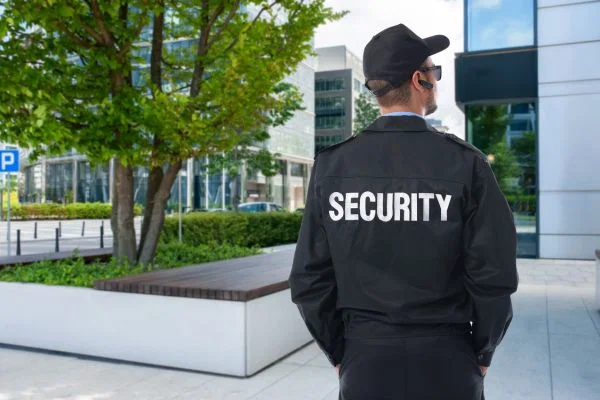
What Does a Security Guard Actually Do?
A security guard’s job is prevention, not enforcement. They’re there to stop problems before police ever need to get involved.
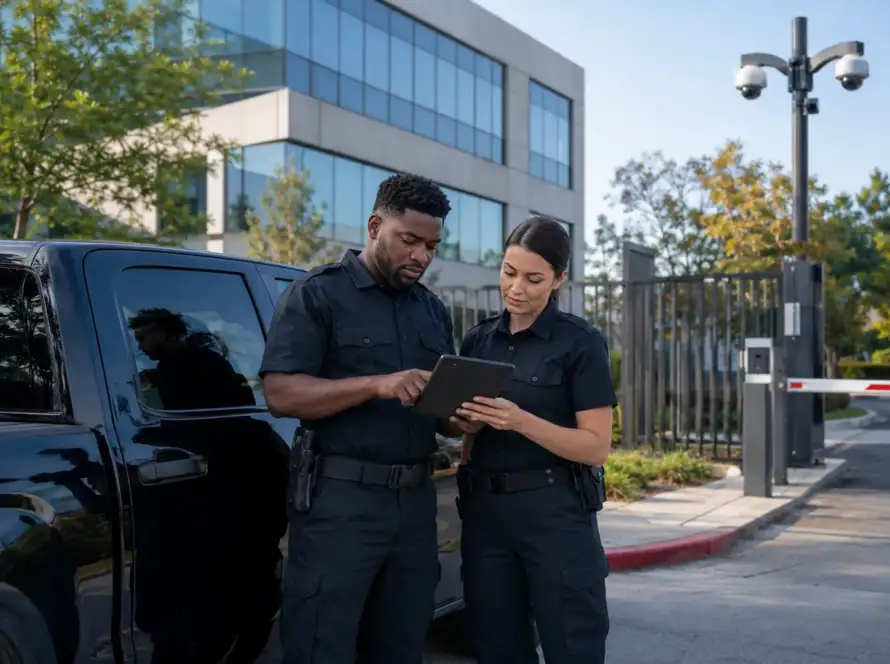
On a typical shift, that means monitoring surveillance cameras, walking patrol routes, controlling who gets in and out of a building, checking credentials, and writing incident reports. If something does go wrong (a trespasser, a theft in progress, a medical emergency), the guard’s job is to observe, report, and call law enforcement. Not to chase, arrest, or interrogate.
In Texas, guards are licensed through the Texas Department of Public Safety under different levels. A Level II non-commissioned officer handles observation and reporting. A Level III commissioned officer can carry a firearm, but the legal authority is still nothing close to police officer. I’ve seen businesses assume that hiring an armed guard means getting police-level protection. It doesn’t, and that assumption has led to lawsuits.
Guards also do a lot of customer service. At hotels, office buildings, retail stores, and event venues, they’re often the first person a visitor talks to. That’s a side of the job that gets overlooked.

What Do Law Enforcement Officers Do Differently?
Police officers, sheriffs, and detectives are sworn government employees. They complete hundreds of hours of POST (Peace Officer Standards and Training) academy training. They have the legal authority to arrest, investigate crimes, carry firearms, use force within department policy, and operate anywhere within their jurisdiction.
Here’s the key distinction that matters: jurisdiction. A police officer’s authority covers an entire city, county, or state, depending on their agency. A security guard’s authority ends at the property line. Period. There is no gray area here.
Law enforcement officers also carry qualified immunity in many situations, meaning they’re partially shielded from personal liability when acting in their official capacity. Security guards get no such protection. If a guard oversteps their authority, the guard and the company that hired them can both face lawsuits.
According to BLS data updated in August 2025, the median pay for security guards sits at $38,370 per year. The median for police and detectives is over $74,000. That pay gap reflects the massive difference in training requirements, legal powers, and risk.
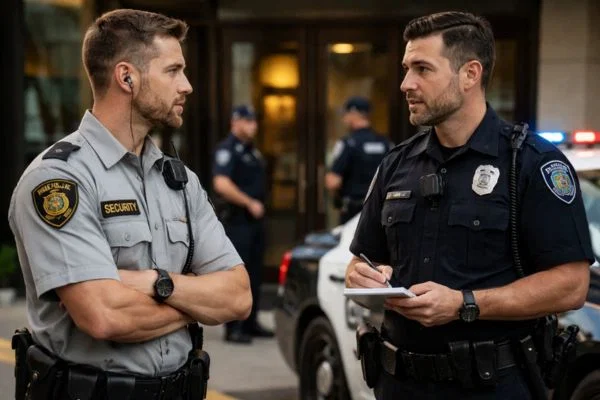
How Do Security Guard Powers Compare to Police Authority?
This is where most people get confused, so here’s a direct comparison.
| Security Guards | Law Enforcement Officers | |
| Employer | Private companies or property owners | Government (city, county, state, federal) |
| Jurisdiction | Specific property only | Entire city, county, or state |
| Arrest authority | Citizen’s arrest for felonies (varies by state) | Full arrest powers for any criminal offense |
| Use of force | Limited to self-defense or protecting others from immediate harm | Authorized per department policy, including lethal force |
| Firearms | Only with a state-issued armed permit and employer authorization | Standard issue with academy training |
| Training required | 8–40 hours, depending on state, plus armed permit if applicable | Hundreds of hours at the POST academy |
| Qualified immunity | None | Yes, in many circumstances |
| Average pay (2024) | $38,370/year | $74,000+/year |
That table should settle most arguments. But I’ll add one more thing: security guards can’t write tickets, can’t pull you over, can’t conduct criminal investigations, and can’t execute search warrants. They’re civilians with a uniform and a job to do on someone else’s property.
Can Security Guards Work Alongside Police?
Yes, and it happens constantly. The relationship works best when both sides understand their lane.
During large events, guards typically handle crowd management and access control while police handle criminal enforcement and emergency response. At retail locations, guards monitor for theft and relay information to police for actual arrests. On commercial properties, guards provide surveillance footage and eyewitness accounts that help officers respond faster when they arrive.
I’ve seen this partnership work beautifully at Houston venues where guards manage the perimeter, and police stay on standby for anything that escalates. The guard is the early warning system. The officer is the response. Trying to make a guard do both is where things break down.
The best security companies make this relationship a feature, not an afterthought. Working with a team that understands how security integrates with local law enforcement is the difference between a plan and a liability.
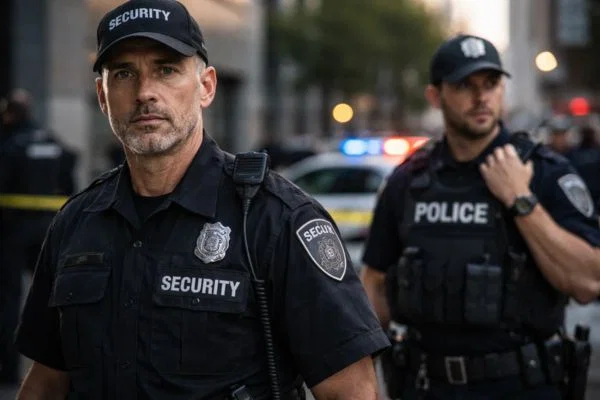
Why Do People Confuse Security Guards with Police?
Three reasons, and the industry is partly responsible for all of them.
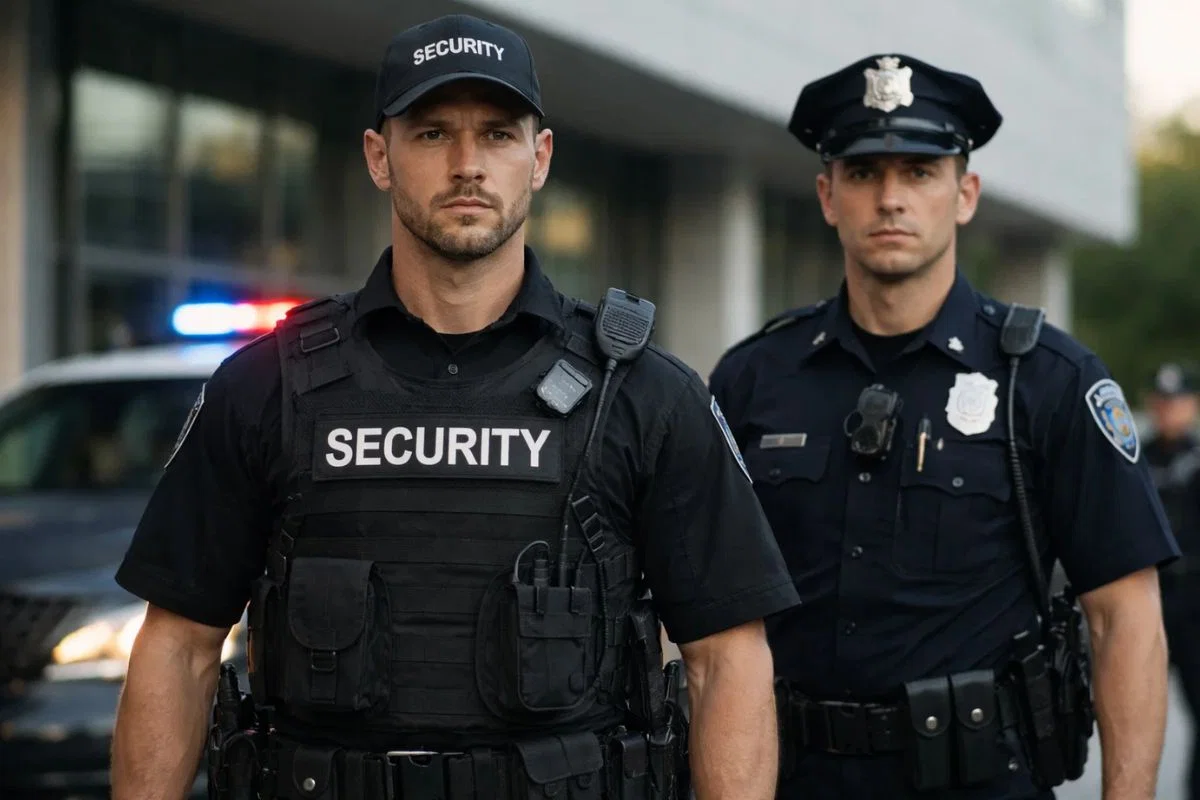
First, uniforms. Some security companies deliberately design uniforms that look like police gear. Badges, patches, duty belts, earpieces. To the average person walking into a building, the visual cues scream “law enforcement.” That’s by design, because the deterrent effect works better when people think they’re looking at a cop.
Second, overlap in duties. Both guards and police respond to disturbances, patrol areas, and interact with the public during emergencies. The actions look similar from the outside, even though the legal authority behind those actions is completely different.
Third (and this is the contrarian take most security companies won’t give you), the industry markets itself poorly. I’ve seen guard company websites that use phrases like “law enforcement-level protection” and “police-grade security.” That language creates expectations guards can’t legally meet. And when a client believes they hired the equivalent of a cop, they skip the policies and contracts that would’ve protected them. The result is guards overstepping their authority and businesses facing wrongful detention claims that can easily run $10,000 or more.
How Much Does It Cost to Hire a Security Guard vs. Off-Duty Police?
Cost is usually what drives the decision, so here are real numbers.
Unarmed security guards cost between $25 and $40 per hour nationally. Armed guards run $40 to $75+ per hour. Executive or personal protection details can hit $60 to $120 per hour, according to multiple 2025 industry pricing reports.
Off-duty police officers hired for private security typically charge $50 to $120+ per hour. They bring full arrest powers and sworn authority, but availability is limited, and you’re paying a premium for those legal powers.
For most small businesses in Houston, an unarmed or armed guard is the right fit. You’re paying for prevention and deterrence, not investigation and prosecution. If your business genuinely needs someone with arrest powers on-site, you’re looking at a very different risk profile (and budget) than most commercial properties.

When Should You Hire a Guard Instead of Calling the Police?
Simple framework: guards protect your property day-to-day. Police respond to crimes.
If you need someone monitoring your warehouse overnight, controlling access to your office building, or managing crowds at a private event, you need a professional security guard. If someone breaks into your building, assaults an employee, or you discover evidence of a crime, you call 911.
The mistake I see most often is businesses trying to stretch a guard’s role into police territory. They want the guard to detain shoplifters beyond legal limits, to physically remove trespassers who resist, or to “handle it” when things get violent. That’s not what guards are trained or authorized to do. And when it goes wrong, the business pays, not the guard.
The Bureau of Labor Statistics projects roughly 162,300 annual job openings for security guards through 2034, almost all from turnover. The industry isn’t shrinking. But the expectations placed on guards need to match the legal reality of the role.
Frequently Asked Questions
Can a security guard actually arrest me?
In most states, a guard can perform a citizen’s arrest only if they directly witness a felony in progress. This is not the same as a police arrest. The guard must turn you over to law enforcement immediately. In Texas, guards can detain suspected shoplifters for a limited time, but cannot formally charge anyone.
Do security guards have the same powers as police officers?
No. Guards have no sworn oath, no qualified immunity, and no jurisdiction beyond the specific property they’re assigned to. Police officers complete POST academy training (often 600+ hours) and carry full legal authority. Guards complete 8–40 hours of training depending on the state.
Is it cheaper to hire security guards or off-duty police?
Guards cost $25–$75 per hour, depending on whether they’re armed. Off-duty police run $50–$120+ per hour. Guards are more cost-effective for routine protection, but they lack arrest powers. For businesses spending $2,000–$5,000 monthly on security, an armed guard from a reputable company covers most risk profiles.
What training do security guards need compared to law enforcement?
It varies wildly by state. Texas requires Level II guards to complete a DPS-approved training course, while Level III (armed) guards need additional firearms training. Compare that to police officers who go through a full academy lasting 6–9 months.
Why do some security guards carry guns if they’re not police?
Because state law allows it with proper licensing. In Texas, a Level III commissioned officer can carry a firearm after completing required firearms training and obtaining a DPS commission. California made clarifications in 2025 around how armed guards can transport loaded firearms to and from work. Each state sets its own rules.
Are security guards considered law enforcement for insurance purposes?
No. Guards are classified as private employees. Security companies carry their own commercial liability insurance, which is separate from any government indemnification police receive.
Why is security guard turnover so high if the job is similar to policing?
Because the job isn’t similar to policing, despite public perception. Guards earn a median of $38,370 per year, face the same confrontational situations without the legal protections police carry, and deal with constant public misconceptions about their role.