Most event planners don’t think about armed security until something goes wrong. By then, it’s too late.
An armed security guard is a licensed professional who carries a firearm while protecting people, property, and high-value assets at gatherings. Hiring armed security guard services for one for your event costs between $35 and $100 per hour, depending on the guard’s experience level and your location, according to 2025 industry rate guides. Armed guards go through firearms qualification, threat assessment training, and (in Texas) a Level III armed commission before they can legally work your event.
Not every event needs an armed presence. A company picnic or a small indoor reception probably doesn’t. But if your event involves VIPs, large crowds, high-value items, or a venue in a rough part of town, the math changes fast. I’ve worked with event organizers who assumed unarmed security was “good enough” and ended up dealing with incidents that cost them six figures in liability alone.
This article covers the six clearest warning signs that your event needs armed protection, what it actually costs, and the questions you should be asking any security company before you sign a contract. It won’t cover executive protection details for personal travel or residential security setups.
What Does an Armed Security Guard Actually Do at Events?
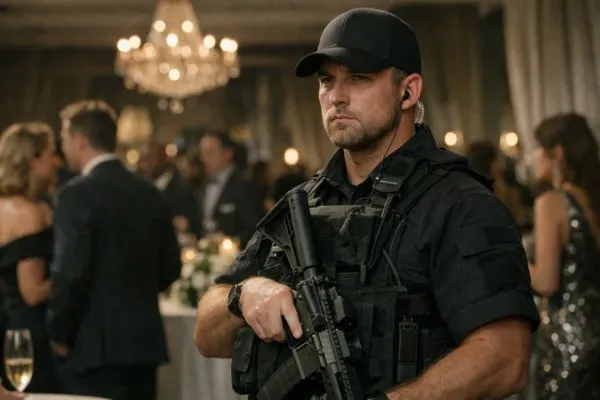
An armed security guard does more than stand around with a visible holster. Their job starts before the event opens and continues until the last person leaves.
Pre-event, they walk the venue to identify blind spots, entry and exit bottlenecks, and areas where crowds could compress. During the event, they monitor access points, watch for behavioral red flags, and coordinate with the rest of the security team (and local law enforcement, if needed). If a situation escalates beyond what verbal de-escalation can handle, they’re trained and legally authorized to use force.
Here’s what most people get wrong about armed event security. They assume the gun is the point. It’s not. The gun is the last resort. The real value is the training behind it: threat recognition, crowd reading, split-second decision-making under pressure. An armed guard with poor de-escalation skills is a liability, not an asset. I’ve seen this play out firsthand. One poorly trained guard at a Houston corporate event almost created a bigger problem than the one they were hired to prevent.
The skill set a quality security officer brings includes communication, situational awareness, and physical fitness, on top of firearms proficiency.
How Much Does an Armed Security Guard Cost for an Event?
This is the question everyone wants answered, so let’s get into real numbers.
National armed guard rates in 2025 break down into three tiers:
| Tier | Hourly Rate | What You Get |
| Budget | $25–$40/hr | Basic licensed armed guard, standard events |
| Mid-range | $40–$60/hr | Specialized training, crowd management experience |
| High-end | $60–$100+/hr | Ex-military or law enforcement, executive protection level |
For comparison, unarmed security runs $15–$40 per hour. So armed protection costs roughly 50–200% more, depending on who you hire. A mid-size event (think a 300-person corporate gala or wedding reception) with two armed guards for 10 hours lands somewhere between $800 and $2,000.
Regional pricing matters too. Texas averages around $27 per hour for general event security, while California pushes closer to $35 per hour as a baseline, and that number goes higher in practice because of stricter BSIS licensing requirements. New York pays around $32 per hour. These figures come from the Big Guys Agency 2025 Event Security Cost Guide and cross-referenced 2026 rate updates.
One thing I’ll push back on: the idea that armed security is “too expensive” for most events. If your event has even one serious incident, the legal exposure dwarfs whatever you would have spent on guards. Lawsuits from injuries at under-secured events routinely clear seven figures. The security budget is cheap insurance.
Does Your Event Have VIPs or High-Profile Guests?
If your event includes executives, public figures, politicians, or anyone with name recognition, you need trained protection specialists on site.
High-profile guests draw attention. Sometimes that attention comes from people with bad intentions. Targeted threats, stalking, and protest activity all spike when someone famous or controversial is on the guest list. An unarmed guard can observe and report, but they can’t intervene with force if someone rushes the stage or approaches a VIP aggressively.
The BLS reports that roughly 1,272,400 security guards were employed in the U.S. in 2024. But only a fraction of those hold the firearms licensing and specialized training needed for VIP event work. Don’t assume every company offering “armed guards” actually has personnel qualified for high-profile protection. Ask for event-specific references.
Actually, here’s a better way to frame the VIP question. Don’t ask, “Does my guest need armed security?” Ask “What happens if something goes wrong, and we don’t have it?” If the answer makes your stomach drop, you have your answer.
Is Your Event Large, Outdoors, or in an Open Venue?
Big crowds in open spaces are hard to control. Full stop.
A 200-person seated dinner in a hotel ballroom with two entrances is a manageable security environment. A 2,000-person outdoor festival with multiple entry points, open perimeters, and limited physical barriers is a completely different situation. The CISA venue security guide specifically addresses risk assessment for events in open and semi-open spaces, and the guidance is clear: the fewer physical controls you have, the more you need trained personnel to fill the gap.
Industry professionals generally recommend one security guard per 100 attendees as a starting point. For events above 500 people, armed guards should be part of that mix. Anything over 1,000 in an outdoor setting without armed personnel is a gamble most insurance carriers won’t look kindly on.
Music festivals, trade expos, and outdoor product launches are the events where I see organizers consistently underestimate their security needs. They budget for a couple of unarmed guards at the front gate and assume cameras will cover the rest. Cameras record problems. They don’t stop them.
Are Valuable Assets, Cash, or High-End Merchandise Involved?
Jewelry expos. Art auctions. Events with significant cash handling. Product launches featuring unreleased tech. If your event puts expensive items on display or involves moving large sums of money, you’re a target.
Armed guards serve as both a visible deterrent and a rapid-response option. Someone thinking about stealing a $50,000 piece of jewelry is going to reconsider when they see an armed security guard posted near the display case. Unarmed security can call the police, but response times in Houston average several minutes. A lot can happen in that window.
Transporting high-value items to and from the venue adds another layer of risk. Armored vehicle services with armed personnel are standard for moving cash, jewelry, or sensitive documents. If your event handles anything worth more than $10,000 in one place, armed security isn’t a luxury. It’s a cost of doing business.
Could Your Event Attract Protests or Controversy?
Political rallies, corporate shareholder meetings, and industry conferences involve polarizing topics. These all carry an elevated risk of protest activity, counter-protests, or verbal confrontations that can escalate into violence.
The SIA and ASIS International joint report on the global security market (published February 2024) noted that physical security services remain the backbone of risk mitigation at high-traffic venues. What the report doesn’t say (but practitioners know) is that the fastest escalations happen when opposing groups show up at the same location and security isn’t trained to create buffer zones.
Armed security personnel in these situations aren’t there to intimidate protestors. They’re there to keep everyone safe, including the protestors. A trained armed guard can establish sight lines, control choke points, and intervene before a shoving match becomes something worse.
If your event involves any topic that generates heated online commentary, proper pre-event security planning should include social media monitoring and threat profiling well before the doors open.
Is Your Venue in a High-Crime Area?
Location matters more than most event planners realize.
A beautiful downtown venue in a neighborhood with elevated crime rates creates a disconnect. Your guests see chandeliers and catering. The security team sees blind alleys, poor street lighting, and a parking garage three blocks away with no coverage.
Before signing a venue contract, research the area’s crime statistics. In Houston, crime rates vary dramatically between neighborhoods. An event in Montrose has a different risk profile than one in the Medical Center or the East End. Your event security team should conduct a site survey that includes the surrounding blocks, not just the building itself.
If the venue has had previous security incidents (ask them directly), or if it’s in an area where property crime or violent crime exceeds city averages, armed guards should be part of your plan. Period.
What If Your Current Security Setup Isn’t Enough?
Bag checks, ID verification, and CCTV cameras are baseline measures. They’re good. But they’re not sufficient for high-risk events.
Here’s the contrarian take that most security companies won’t tell you: the biggest mistake isn’t skipping armed security. It’s hiring the cheapest armed security you can find. Industry practitioners on professional forums consistently report that low-bid security companies cut corners on training, carry minimal insurance, and staff events with guards who’ve never worked a crowd bigger than 50 people. If something goes wrong and your guard isn’t properly licensed or insured, the liability falls on you.
Before hiring any armed security company, ask these questions (almost nobody does):
- What is your specific liability insurance coverage amount for armed incidents?
- How many events of similar size and type have your guards worked in the past 12 months?
- What de-escalation and mental health crisis training do your armed officers receive beyond firearms qualification?
- Can you provide proof of current state licensing for every guard assigned to my event?
The Bureau of Labor Statistics reports that guard wages have stayed flat at around $17–$18.46 per hour nationally for over a decade. That wage pressure means high turnover, and high turnover means less experienced guards at your event. Companies that pay above market and invest in ongoing training produce better outcomes. You get what you pay for.
Armed vs. Unarmed Security: A Side-by-Side Comparison
Not sure where your event falls? This comparison, based on 2025 rate data, breaks it down:
| Factor | Armed Security | Unarmed Security |
| Threat response | Lethal force capability | Observe and report only |
| Visual deterrent | Strong (visible firearm) | Moderate (uniform presence) |
| Licensing required | State armed commission (e.g., TX Level III) | Basic guard license |
| Best for | VIPs, large crowds, high-value assets, high-crime areas | Low-risk indoor events, access control, crowd flow |
| Insurance impact | Higher premiums, stricter coverage scrutiny | Standard liability |
One common piece of advice that’s wrong: “Just hire unarmed security. It’s fine for most events.” For truly low-risk situations, yes. But unarmed guards in many states can’t legally intervene with force. If your event faces a real threat, an unarmed guard’s only option is to call 911 and wait. That gap between “call” and “response” is where bad things happen.
Working with a marketing partner who understands your industry can help you communicate your security capabilities to potential clients before they even ask.
The Bottom Line on Armed Event Security in 2026
The U.S. security services industry hit $47.8 billion in 2023 and is projected to reach $49.1 billion in 2026, according to Statista and IBISWorld. The market is massive because the demand is real.
If you’re planning an event and even one of these six signs applies to your situation, get a quote for armed security. Don’t guess. Don’t assume unarmed is “probably fine.” And don’t hire the lowest bidder without checking their licensing, insurance, and training records first.
The cost of getting it right is a line item in your event budget. The cost of getting it wrong can end careers, trigger lawsuits, and put people in danger.
FAQs
How much does an armed security guard cost for an event in 2026?
National rates for an armed security guard at events run $25–$100+ per hour, depending on experience level. Budget-tier guards with basic licensing charge $25–$40 per hour. Mid-range guards with specialized event training fall between $40–$60 per hour. Ex-military or executive protection level guards start at $60 per hour and go up from there. A mid-size event with two armed guards for a full day typically costs $800–$2,000.
Is it legal to have armed security guards at a private event?
Yes, armed security is legal at private events in all 50 states as long as the guards hold valid state-issued armed commissions. In Texas, that means a Level III armed security officer license with a handgun proficiency exam. California requires BSIS licensing plus a firearms add-on. Venue policies and local ordinances may add restrictions on open carry, so always confirm with the venue before booking.
What’s the difference between armed and unarmed event security?
Armed security guards carry firearms and can use force to stop threats. Unarmed guards observe, report, and de-escalate. Armed protection costs 50–200% more ($35–$100/hr vs. $15–$40/hr unarmed) and requires additional state licensing. For low-risk indoor events, unarmed is usually fine. For events with VIPs, large crowds, high-value items, or locations in high-crime areas, armed guards provide a level of protection that unarmed personnel can’t match.
How do I vet an armed security guard company before hiring?
Ask for proof of current state licensing for every guard assigned to your event. Demand liability insurance documentation showing at least $1 million in coverage per incident. Request references from events similar to yours in size and type. Ask specifically about de-escalation training, mental health crisis response training, and how many events their assigned guards have worked in the past year.
Can armed security guards make event guests uncomfortable?
They can, and that’s a valid concern. Clear communication helps. Inform attendees about the security measures in advance, explain that guards are there for everyone’s safety, and consider using plainclothes armed personnel who blend into the crowd while maintaining the same level of protection.
How many armed security guards do I need for my event?
The general industry benchmark is one guard per 100 attendees as a minimum. For events with over 500 people, armed guards should be part of the security mix. Events over 1,000 in outdoor or semi-open venues should have multiple armed positions covering entry points, perimeters, and VIP areas.
What happens if an armed guard discharges a weapon at my event?
This is a worst-case scenario, but it matters. If a guard discharges a firearm, the event becomes a crime scene. Local law enforcement takes over. The security company’s insurance, licensing status, and training documentation will be scrutinized. If the guard was properly licensed and acting within the law, the company’s liability insurance should cover the response.


