
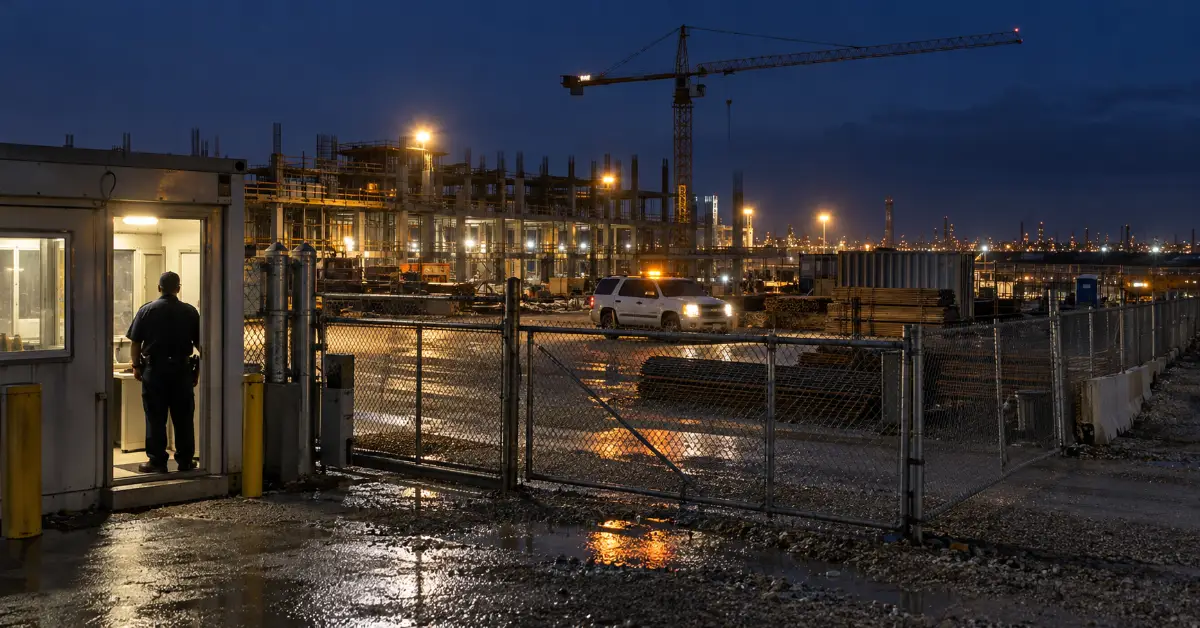
Roving vs static guards is a choice about 2 things: where your risk sits, and when your property sits empty. Put a static post where people and trucks have to be checked while you’re open. Put a rover on any area that has to be covered while nobody’s there.
There’s a 3rd option that gets sold under the roving label, the mobile patrol, and it costs less because your site gets stops instead of a shift. Know which of the 3 you’re being quoted before you compare prices.
What’s the difference between roving and static guards? A static guard holds 1 fixed point, such as a gate, a lobby, or a loading dock, for the whole shift. A roving guard is posted to the property for the same shift but patrols it on foot or by vehicle. A mobile patrol splits 1 officer across 2 or more properties a night.
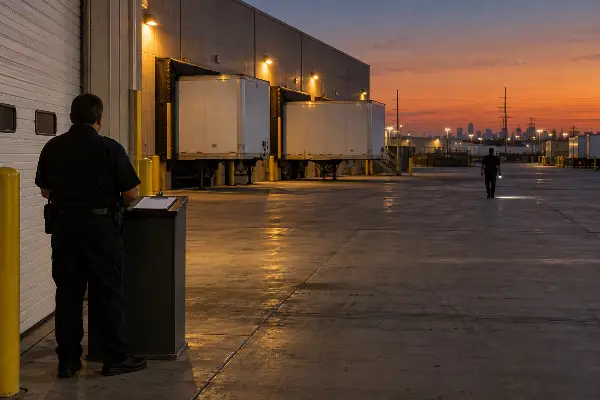
Roving vs static guards, side by side
Both keep an officer on your property from the start of the shift to the end. What changes is what that officer watches: 1 point, or a whole area. The mobile patrol puts an officer on your property only while the car is parked there.
Government contract post orders make the same split. The District of Columbia’s Department of General Services publishes sample post orders for contract security that say “A post can either be ‘Fixed’ or ‘Roving.'” They list an access control point, an information desk, and a building’s loading dock as fixed posts. A roving post, they say, may call for foot patrols of “multiple floors, a large area, or an entire facility.” The orders have no category for a car that drives past.
| Static post | On-site rover | Multi-site mobile patrol | |
|---|---|---|---|
| Officer on your property | The whole shift | The whole shift | Only during stops |
| On a 12-hour night | 12 hours at 1 spot | 12 hours across the site | 1 hour, if the route stops 4 times for 15 minutes (example) |
| What it watches | 1 point: a gate, a lobby desk, a dock door | An area: a fence line, a yard, every side of a building | A check: doors locked, lot clear |
| What it misses | Anything out of sight of the post | The spot it left behind on its round | Everything between stops |
| What drives the bill | Officer-hours | Officer-hours, plus a vehicle if it drives | A share of 1 officer and 1 vehicle |
| Fits | A point where people and trucks get checked | An empty site at night | A site where a check is enough |
When does a site need a rover on it?
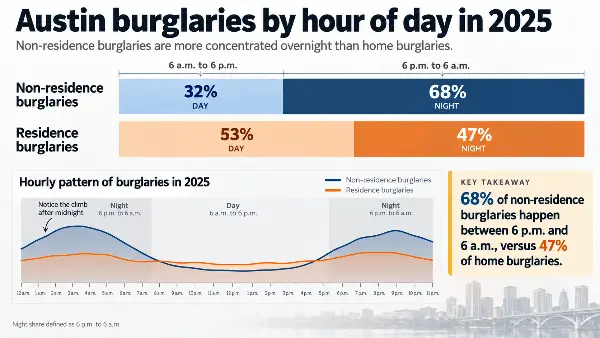
When it sits empty, and for most commercial property that’s after dark. In Austin’s 2025 police reports, the busiest stretch for non-residence burglary ran from midnight to 6 a.m.
We counted the Austin Police Department’s public crime reports, which record the hour and the type of location on every report. Austin police recorded 1,461 non-residence burglaries that happened in 2025. Going by the time on each report, 992 of them, 68 percent, happened between 6 p.m. and 6 a.m. And 745, 51 percent, happened between midnight and 6 a.m., when almost nothing is open.
| Austin, 2025 | Burglary reports | 6 p.m. to 6 a.m. | Midnight to 6 a.m. |
|---|---|---|---|
| All non-residence locations | 1,461 | 68% | 51% |
| Commercial and office buildings | 470 | 67% | 49% |
| Construction sites | 132 | 55% | 28% |
| Residences | 1,263 | 47% | 24% |
Police reports often stamp an unknown time as midnight or noon, so we checked. 89 of the 1,461 carry a time of exactly 12:00 a.m., and 44 carry exactly 12:00 p.m. Take both out and the night share is still 68 percent.
The FBI’s numbers lean the same way. Its 2019 offense analysis counts burglaries by location and time of day across 13,848 reporting agencies. By our math, 55.6 percent of nonresidential burglaries with a known time happened between 6 p.m. and 6 a.m., against 40.2 percent for homes. Our guide to the physical security risk assessment shows why a walkthrough at 10 a.m. misses that split.
Construction sites run on a different clock. The most common hour on Austin’s construction-site reports was 5 p.m., with 19 of 132, about when crews leave. Our read: a theft found at 7 a.m. tends to get reported with the last time anyone saw the site locked. Either way, the risk window opens when the crew drives off.
Is a roving guard cheaper than a static guard?
Not per hour. A rover and a static officer do the same job on the same wage line, so what lowers a bill is buying fewer hours on site.
The Bureau of Labor Statistics files both under 1 occupation. “Some guards are assigned a stationary position from which they monitor alarms or surveillance cameras,” its occupational handbook says. “Other guards are assigned a patrol area where they conduct security checks.” It publishes 1 median wage for security guards, with no separate line for the ones who walk.
Nothing in that data says a rover earns less. Driving rounds do add to the bill: the car, gas, and commercial auto coverage.
The model that costs less is the route. 1 officer and 1 car are shared across a list of properties, so each client pays for part of a shift and gets part of one. On a 12-hour night, a route that stops at your site 4 times for 15 minutes puts an officer there for 1 hour. The other 11 hours are the ones the Austin and FBI numbers point at.
That’s the trade the “roving is cheaper” line skips. Sometimes it’s a fair trade. A locked, empty site with nothing a thief could haul off between stops may only need a check.
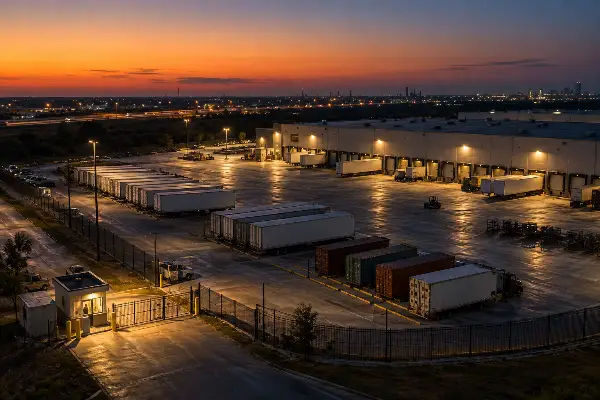
How to choose a post, a rover, or both in 2026
Ask 2 questions: whether the risk is a point or an area, and whether it peaks while you’re open or while you’re empty. The answers put each risk on your property in 1 of 4 boxes.
| While you’re open | While you’re empty | |
|---|---|---|
| The risk is a point: a gate, a lobby, a dock door | Static post | Rover, with that point as a checkpoint on every round |
| The risk is an area: a fence line, a yard, every side of a building | Rover, plus a post where people get checked in | Rover |
A point during open hours is access control. Someone has to check IDs, log deliveries, and say no, and that’s a static post. An area during empty hours is the opposite. Nobody comes and goes, so there’s nobody to check in, and trouble can arrive from any side. That’s a rover.
A warehouse sits in 2 boxes over a single day: a point while trucks check in, an area after close. So a post by day and a rover by night is a common build.
Where our overnight incidents started
Mostly away from the gate. Of the 5 incident write-ups we keep on file, only 1 started at a gate. In all 5, the officer who caught it was posted to that 1 site for the whole shift.
The gate case was a pickup that circled a job site at 2:15 a.m. and stopped near a gated entrance. The other 4 started at a poorly lit stretch of perimeter fence, a storage container inside a job site, a boarded window by a vacant building’s rear entrance, and a storage area beside a warehouse’s dock doors. In 4 of the 5, the gate case included, the officer was on a patrol round when it happened.
A fixed post watches 1 spot. A rover’s round passes every spot like those on its site.
Which one fits your property type?
Vacant buildings need a rover. Construction sites, warehouses, office buildings, and shopping centers usually need a post while people come and go and a rover once they leave.

Construction sites
Run a gate post while crews and deliveries come through, then switch to a rover. The risk is spread across a fence line, a laydown yard, storage containers, and equipment, and no single post sees all of it. Start the rover when the site empties, not at midnight.
Warehouses and distribution centers
Post an officer at the dock or the gate while trucks, drivers, and staff come and go, because someone has to verify shipments and check access. After close, the dock becomes 1 checkpoint on a rover’s round, along with the yard, the trailer lot, and the fence line. Write both halves into the post orders.
Vacant buildings
A rover, because no one needs checking in and a vacant building can be entered from any side: doors, boarded windows, roof hatches, meter rooms. Copper and squatters are the usual problems. A route that checks the doors 4 times a night leaves the building alone between stops.
Office buildings and shopping centers
Station an officer at the lobby or main entrance while the doors are open, where visitors and tenants need a person to talk to. Austin’s 2025 reports put 67 percent of commercial and office building burglaries between 6 p.m. and 6 a.m. So the back of the property, the loading zones, and the parking areas need rounds after close.
Can you run a post and a rover on the same site?
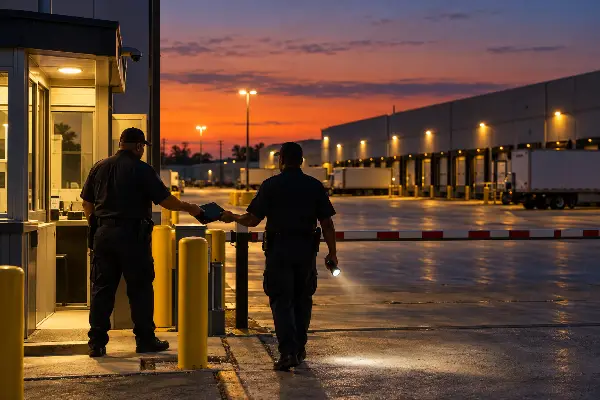
Yes, and busy sites need both: a post where people come and go, and a rover for everything the post can’t see.
A distribution warehouse might run a gate post through shift change and a rover on the yard and dock doors at the same time. The day post and the night rover can be 1 officer whose post orders switch from the gate to rounds at close, or 2 officers whose shifts overlap at the handoff.
Headcount is a separate question, and our staffing guide breaks it down by property type.
Does Texas license roving and static guards differently?
No. Texas licenses the company and the officer, and whether the officer stands or walks is set by the post orders.
Under Occupations Code Section 1702.108, a guard company is one that provides “a private watchman, guard, or street patrol service” on a contract basis. Standing watch and patrolling share 1 sentence and 1 license.
The officer’s credential works the same way. A fixed post or a round can be staffed with unarmed security guards or with armed officers. An armed officer also holds a security officer commission, which the statute says “entitles a security officer to carry a firearm.” Ask for the commission by name for each armed officer assigned to you. Our notes on armed security guard training requirements cover what it takes.
How do you know a rover covered the whole site?
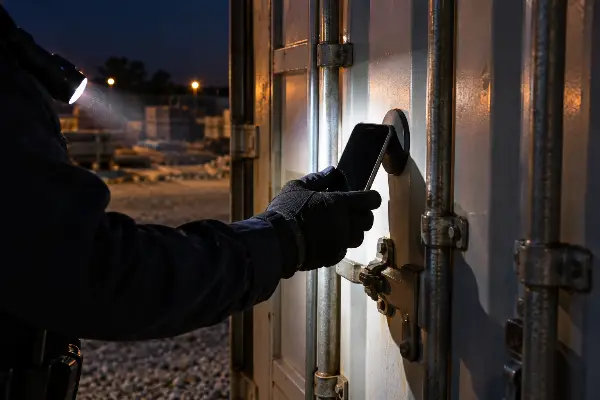
From the checkpoint log, because a rover you can’t verify is a line on an invoice.
Put the checkpoints at the spots where break-ins start. On a job site, that’s the dark stretches of fence line, the storage containers, and the laydown yard. At a building, it’s the rear doors, the boarded windows, and the dock. 4 of our 5 incident write-ups started at spots like those.
A round that scans only the gate and the front door proves the officer walked the easy half. What a usable log has to show is in our guide to checking that guards patrolled.
What we staff in Houston
Officers who stay on 1 property all shift, at a fixed point or on rounds. We don’t run multi-site routes.
Our security guard services cover construction sites, warehouses, office buildings, shopping centers, stores, and vacant buildings across Houston, and a shift can start at any hour on any day of the year. Rovers work on foot or in a vehicle, depending on the site, and their rounds are logged on a GPS guard tour system. Officers work in English and Spanish, and each account has its own supervisor. Terms start at 1 week, and nothing locks you into a year. Our company license with the Texas DPS is B07315701.
Roving vs static guards is an easy call once you split out the route and know your own empty hours. Tell us what goes missing and when the property sits empty, and Reliable Guard & Patrol Service will build the coverage around it. The proposal is free.
FAQs
Is a roving patrol the same as a mobile patrol?
No. A rover stays on 1 property for the whole shift and patrols it. A mobile patrol shares 1 officer and 1 vehicle among a route of properties, so each site gets short stops. For example, a route with 4 stops of 15 minutes puts an officer on site for 1 hour of a 12-hour night.
Roving vs static guards: which is better for a construction site?
Usually a rover once the crew leaves, plus a gate post during working hours if deliveries need to be checked in. Construction risk is spread across a fence line, a laydown yard, containers, and equipment, which no single post can see. In Austin’s 2025 police reports, 5 p.m. was the most common time listed for construction-site burglaries. We read that as the last time anyone saw the site locked.
What hours should a roving guard cover?
The hours the property sits empty, starting when the last person leaves. Austin police reports for 2025 put 68 percent of non-residence burglaries between 6 p.m. and 6 a.m., and 51 percent between midnight and 6 a.m. Clock the rover out at midnight and you miss the busiest stretch.
Should a roving guard patrol on foot or in a vehicle?
Match it to the ground. A vehicle covers a long fence line, a big yard, or a spread-out lot faster, and its lights reach corners a flashlight won’t. Foot rounds fit docks, hallways, and doors, where the officer needs to check locks by hand. Big sites usually mix both in the same round.
Can a roving guard be armed in Texas?
Yes. In Texas the credential attaches to the officer, and the post type doesn’t change it, so a static post or a rover can be armed or unarmed. An armed officer needs a security officer commission, the credential that lets an officer carry a firearm on duty. Ask for the commission by name for each armed officer assigned to your site.
Roving vs static guards: can a site use both?
Yes, and busy sites usually should. A common build is a post at the gate or dock while people and trucks come and go, plus a rover on the fence line and yard after the post closes. The post decides who gets in, and the rover covers the rest: 4 of our 5 incident write-ups started somewhere other than a gate.