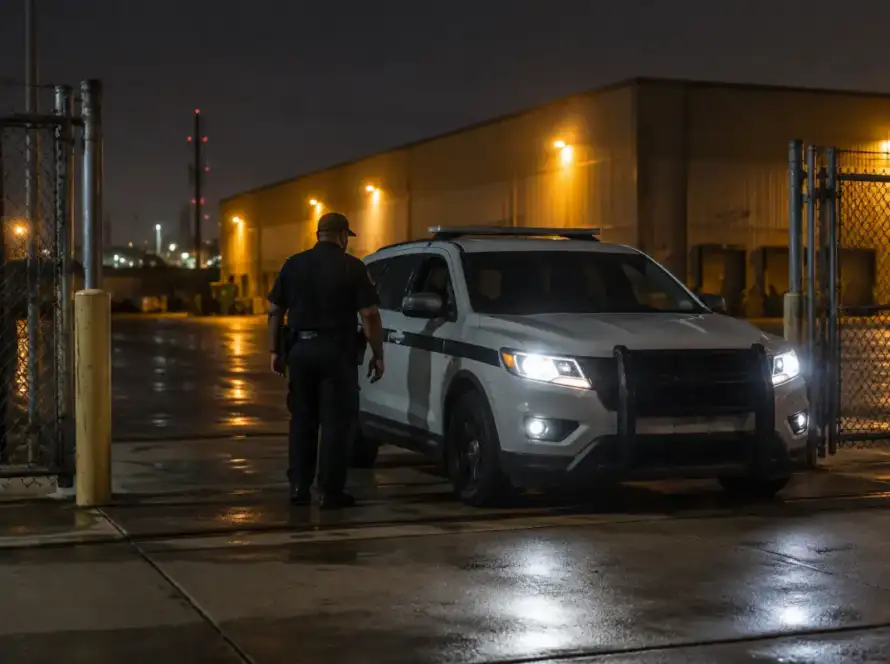
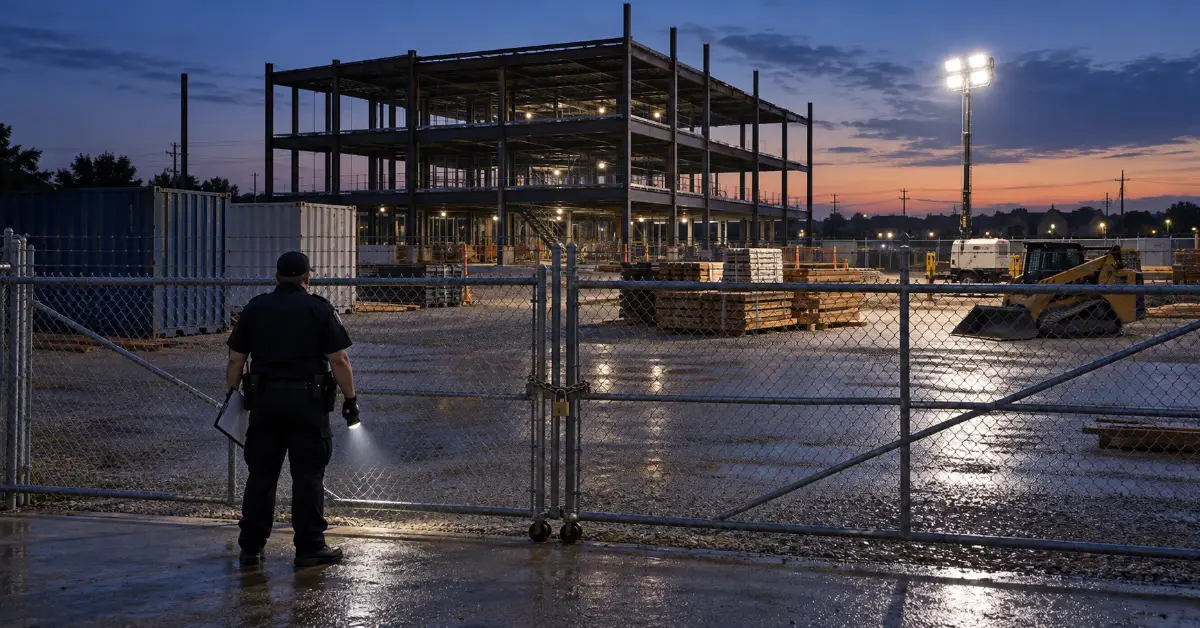
A construction site security checklist has 2 jobs. It should change when the build changes, and it should give the night officer what they need before the gate closes. Most lists online stop at “lock the gate.” On a job site, that’s when the exposure starts.
Houston has more reason than most cities to plan for the night. In the 2014 Equipment Theft Report from the National Insurance Crime Bureau (NICB) and the National Equipment Register, Houston had 201 reported equipment thefts, more than any other U.S. city. Only 23% of stolen equipment nationwide was recovered that year.
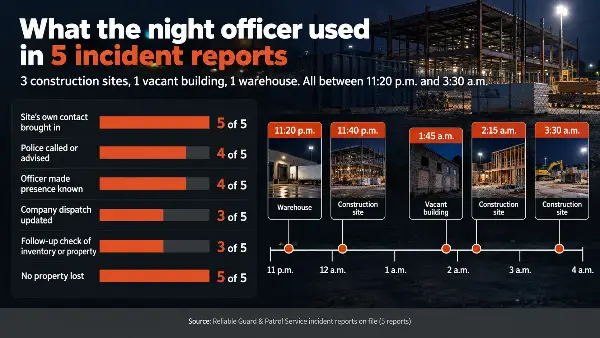
Our own incident reports add the timing. All 5 that we keep on file happened between 11:20 p.m. and 3:30 a.m.
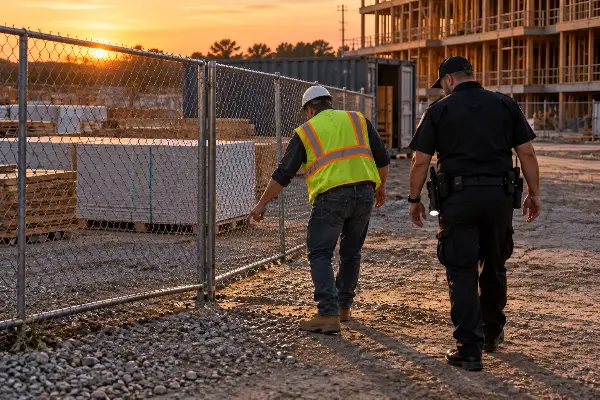
What Is A Construction Site Security Checklist?
A construction site security checklist is a written list of the physical, procedural and staffing checks that keep tools, materials and equipment on a job site after the crew leaves. A useful one changes with each phase, because a site with a slab and a skid steer holds different targets than one stacked with copper spools and boxed appliances.
The checklists most contractors find are a single flat list of 11 to 32 items. That works on the first night. By the time the electrician’s copper arrives, that list is still checking the fence while the real target sits in a container nobody counted.
Treat it as a working document. Update it the day a new phase starts, run the lockup section every night, and fill in the handoff sheet before each shift.
The 2026 Checklist, Phase By Phase
Add checks when new targets arrive on site. Each phase brings different equipment and materials, so the list should grow at the same moments.
Thieves pick targets on purpose. NICB’s report found that value and mobility decide which equipment gets stolen. Large excavators are valuable but seldom taken because they’re hard to move, while backhoes and skid steers are easier to haul and make up a bigger share of thefts.
| Phase | What shows up on site | Add to the checklist |
|---|---|---|
| Site prep and clearing | Dozers, skid steers, excavators, fuel and light towers | Fence and gate up before the first machine arrives. Machines parked together inside the fence with keys pulled. Fuel caps locked. Serial and PIN numbers photographed. |
| Foundation and underground | Rebar, forms, pumps, generators and compressors | Small equipment chained or locked in a container every night. Container doors facing the lit side of the site. |
| Structure and dry-in | Lumber or steel, lifts, ladders, nail guns and cordless tools | Ladders down and locked so nobody climbs the building after hours. Lifts parked inside the fence with keys pulled. Cordless tools counted into the container at close. |
| MEP rough-in | Copper wire spools, copper pipe, conduit, switchgear and HVAC units | Copper locked in a container away from the fence. Spools marked and counted every night. Deliveries timed close to install so copper doesn’t sit over a weekend. |
| Finishes | Appliances, fixtures, cabinets, flooring, and doors and windows waiting to be hung | Patrol route moves inside the building. Rooms holding boxed appliances locked. Key and code log kept current. A last-person-out walk of every floor. |
| Punch and turnover | Finished interiors, fewer people on site, owner property | A written date when lockup duty passes to the owner. Codes changed and keys counted at turnover. |
Re-run the list the day a phase changes. A calendar reminder won’t catch the afternoon the copper shows up. For the property itself, our day-and-night walkthrough covers fencing, lights and access points in more depth.
The same phases decide when to add a night officer. Sites often run weekends-only through foundation, and MEP rough-in is the phase where overnight construction site security usually runs 7 nights.
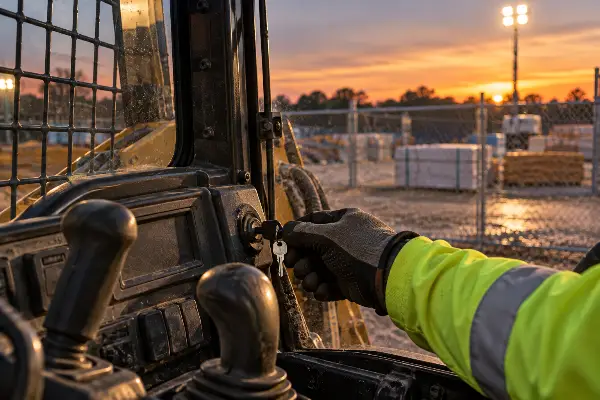
The Nightly Lockup List
Run the same close every night, in the same order, and write down who did it and when. This part is the crew’s job. On our construction posts, the officer then runs a 9-point last-truck-out check on arrival, before the first round.
Fences and signs do legal work in Texas. Under Penal Code Section 30.05, fencing obviously designed to keep intruders out, or a posted sign likely to be seen saying entry is forbidden, counts as notice. Notice is part of what makes an after-hours visitor a trespasser.
- Main gate chained and padlocked, not left on the latch. Side and delivery gates checked by hand.
- Fence line walked from the inside after the last delivery, gaps fixed tonight, and pallets stacked against the fence moved.
- Machines parked together inside the fence, keys pulled, none against the fence line.
- Containers locked with copper, tools and fuel cans inside, and the count written on the log.
- Lights on where materials sit as well as at the gate.
- Trespass signs readable at every entrance under the lights you have at night.
- Handoff sheet filled in and given to the officer, with the last person out logged by name and time.
That’s 7 checks. Skip one and the officer inherits a gap nobody told them about.
What Does The Night Officer Need From The Superintendent?
A short written handoff: who answers the phone after midnight, where the valuables sit tonight, what changed today, and what’s dangerous to walk into in the dark. In all 5 of our incident reports, the officer relied on at least 1 item on this list.
A post order covers the standing rules, such as rounds, gate handling and who gets in after hours. The handoff covers today.
| Handoff item | Why the officer needs it |
|---|---|
| A site contact who answers after midnight, with a cell number | Someone has to confirm what belongs on site and decide next steps. The site’s own contact was brought in on all 5 of our incident reports. |
| A backup contact in case the first one doesn’t answer | A 3 a.m. call can go to voicemail. Dispatch was updated in 3 of the 5 reports while the officer kept watch, and dispatch needs a second number to try. |
| The street address, the gate police should use, and which agency covers the site | Police were called or advised in 4 of the 5 reports. A site outside city limits may fall to a county sheriff or constable instead of city police. |
| Where high-value materials sit tonight | In 3 of the 5 reports, the target was a storage container, materials carried toward the fence, or a storage area by a loading dock. |
| Today’s count or photos of copper, tools and staged materials | Without a baseline, nobody can say whether anything left. In 3 of the 5 reports, the night ended with a check of the inventory or the property. |
| Deliveries or crews expected after hours | So a 4 a.m. concrete crew or an early delivery isn’t treated as a break-in. |
| Open trenches, holes, unguarded edges and dark stairwells | The officer walks the site in the dark. A hazard that’s obvious at noon isn’t at 2 a.m. |
| Dark spots and lights on timers | The officer adjusts the route and checks those spots more often. |
| Keys, gate codes and who else holds them | Every extra key holder is someone the officer can’t rule out. |
Keep it to 1 page. Tape a copy inside the gate box or the trailer door, and replace it when anything on it changes. The officer’s side of the handoff is the patrol log, and you should be able to read it the next morning. We explain what a real patrol log shows and how to check yours.
What 5 Incident Reports Show
The counts in that table come from the 5 incident write-ups we keep on file: 3 from construction sites, 1 from a vacant commercial building and 1 from a distribution warehouse. Each happened between 11:20 p.m. and 3:30 a.m., and no property was lost in any of them. We’ve written up 3 of those nights in full.
In 4, the officer ended it by being seen. That meant patrol vehicle emergency lights in 2, a spotlight and a verbal challenge in 1, and in 1 the officer identified himself and told the person to leave.
In the 5th, at 3:30 a.m., the officer found copper being pulled from a storage container, called police, watched from a safe distance and kept dispatch updated. Police made the arrest, and the copper went back to site management.
None of the 5 called for force. Every step the officers took is within what an unarmed security officer can do in Texas.
OSHA’s Lighting Rule Stops When The Crew Leaves
A site can meet OSHA’s lighting rule and still sit dark at 2 a.m. The rule is written for crews at work, and it ends when they leave.
OSHA’s construction standard, 29 CFR 1926.56, sets minimum light levels “while any work is in progress.”
| Area | OSHA minimum while work is in progress |
|---|---|
| General construction area lighting | 5 foot-candles |
| Excavation and waste areas, access ways, active storage areas, loading platforms, refueling and field maintenance areas | 3 foot-candles |
| Plant and shop areas, such as batch plants and carpenter shops | 10 foot-candles |
When the last crew clocks out, none of those numbers apply. At least 1 checklist online cites an OSHA figure as its lighting target, and quotes the wrong one. Either way, OSHA’s numbers are a safety floor for people at work. They say nothing about the fence line after midnight.
Light does work after dark, and there’s experimental evidence for it. In a randomized experiment in New York City, temporary street lights were assigned at random to 40 public housing developments. Researchers writing in the Journal of Quantitative Criminology found sizable drops in nighttime outdoor index crimes where more lighting went in. Arrests fell too, which the authors say points to deterrence as the most likely reason crime dropped.
One of our 5 reports fits that pattern. It began with 2 people carrying materials toward the fence in a poorly lit area of the site, and the officer’s spotlight and a verbal challenge ended it.
Aim light at what thieves want: containers, staging areas and the stretch of fence nearest the road, as well as the gate. Walk the site after dark once a week with the lights on their night settings. Log every dead fixture on the handoff sheet so the officer knows where tonight’s dark spots are.
How Do You Protect Copper On A Job Site?
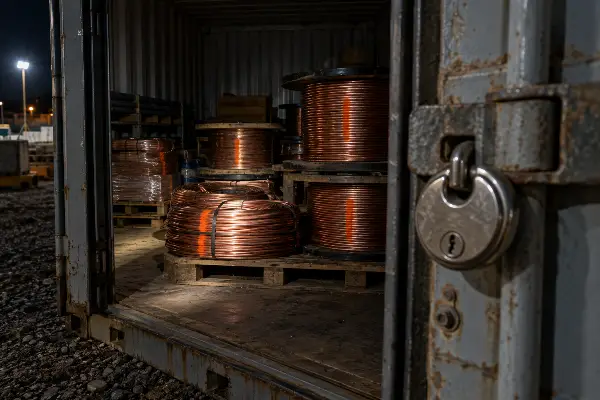
Keep it locked, counted, marked and away from the fence, and report every attempt. Texas law is tougher on copper theft than on most theft. Under Penal Code Section 31.03, stealing copper, brass, bronze or aluminum worth less than $20,000 is a state jail felony, while most other theft under $2,500 is a misdemeanor.
Copper arrives at MEP rough-in, and it packs a lot of scrap value into rolls 1 worker can carry.
Store it in a locked steel container with a puck lock, rather than a trailer bed or on pallets by the fence. Point the container doors toward the lights and the patrol route. Paint-mark or tag every spool so recovered wire can be tied back to your site, and photograph the count at close.
When copper has to sit over a weekend, put an officer on those nights. We staff construction site security guards weekends-only or 7 nights, on weekly or month-to-month terms.
If an attempt happens, give police the count, the photos and the time window from your patrol log. A written count from close and a timestamped patrol log give an investigator far more than “some wire is missing.”
Before The Gate Closes Tonight
Print the phase table for the site binder, fill in the handoff sheet before the officer arrives, and update both the day the work changes.
We’ve been licensed in Texas since 2018, and you can look up License B07315701 in Texas DPS’s TOPS database before you call. Our 150 officers cover more than 100 sites.
If you’d like a second set of eyes on your construction site security checklist, call Reliable Guard & Patrol Service at (713) 783-1344. We’ll send a free proposal, and for some sites we walk the property first.
FAQs
What should be on a construction site security checklist?
Perimeter and gates, lighting, locked storage, equipment records and the people who check them, plus items that change with each build phase. NICB’s 2014 Equipment Theft Report found that most thefts come from work sites with little or no security, so the checks have to run every night. Add a written handoff so the night officer knows what’s on site.
How often should you update a construction site security checklist?
Update it the day a new phase starts or new materials arrive, and run the lockup section every night. NICB lists delays in discovering thefts as a reason only 23% of stolen equipment was recovered in 2014. A nightly count catches a loss while it can still be traced.
What time do construction site thefts usually happen?
In our records, at night. All 5 incident reports Reliable Guard & Patrol Service keeps on file happened between 11:20 p.m. and 3:30 a.m. That’s a small sample, but it’s the window the handoff sheet and a fence-line patrol need to cover.
Does OSHA require lighting on a construction site at night?
Only while work is in progress. Under 29 CFR 1926.56, general construction area lighting must reach at least 5 foot-candles while crews are working. Active storage areas and access ways need at least 3. Once everyone leaves, the rule no longer applies, so security lighting is up to the contractor or owner.
Is stealing copper from a construction site a felony in Texas?
Yes. Texas Penal Code Section 31.03 makes theft of copper, brass, bronze or aluminum a state jail felony even at amounts that would be a misdemeanor for most other property. Larger amounts can carry higher felony grades.
What should a night security officer get from the site superintendent?
A contact who answers after midnight, a backup contact, where high-value materials sit, the day’s counts, any after-hours deliveries, site hazards, and the keys and gate codes. In all 5 of our incident reports, the officer brought in the site’s own contact, and police were called or advised in 4.
How do you check if a Texas security company is licensed?
Search the company name or license number in the Texas Online Private Security (TOPS) database run by DPS, which also lists individual officers. Reliable Guard & Patrol Service holds License B07315701. Add that search to your construction site security checklist before the first night.