
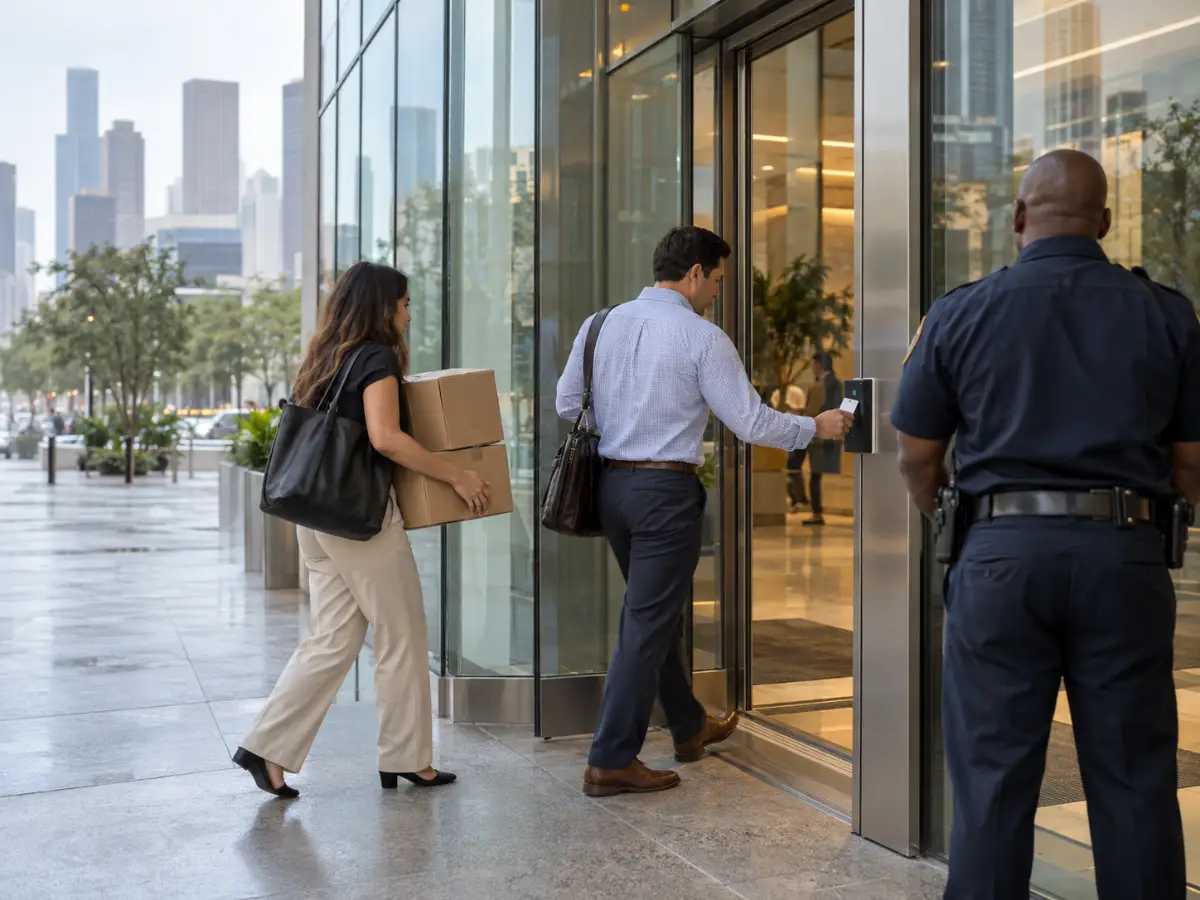
Tailgating security is how a property stops an unauthorized person from following someone with access through a controlled door or gate. It rests on 3 layers: a written rule for who may enter, a barrier that allows 1 entry per credential, and a person who acts the moment the barrier fails.
Most advice stops at badges and turnstiles. In Texas, the layer that decides what happens next is legal notice. Under Texas Penal Code 30.05, entry without consent becomes criminal trespass when the person had notice that entry was forbidden, or was told to leave and stayed. So calling the police comes third. Signs at every entrance come first. A clear instruction from an officer comes second.
We post licensed officers at doors, lobbies, and gates on more than 100 sites around Houston, and every stop they make goes into a GPS-timestamped incident report.

Tailgating Vs Piggybacking: What Each Looks Like At The Door
Tailgating is when someone without access slips in behind a person who has it, and the badge holder doesn’t notice. Piggybacking is the same entry with the badge holder’s help, like holding the door for a stranger carrying boxes.
The cover stories repeat. Security guidance on the UK government’s security.gov.uk site names someone posing as a coworker on a work call, a person struggling with a heavy box, and a fake maintenance worker in a hi-vis jacket or hard hat. On a Houston job site, that last disguise is the dress code.
For a property manager, both terms lead to the same problem: an unverified person inside. In the deter, detect, delay, and respond model behind the 4 types of security, a tailgate skips the delay layer, because the door was already open.
The damage isn’t only physical. A laptop left logged in or an open server closet is often 1 hallway from the lobby.
Why Do Employees Hold The Door For Tailgaters?
Holding a door feels polite, and it saves both people effort. Research suggests the habit runs deeper than manners.
In a 2011 door-holding study published in Psychological Science, Penn State researchers filmed people at a university building door. People held the door longer when 2 people followed than when 1 did, and followers sped up once they saw it held. The researchers describe door holding as an unspoken deal to save effort.
That’s why a tailgater who hurries toward a closing door so often gets in. The employee isn’t careless. They’re keeping the deal.
So training needs a script. In September 2025, UC Davis Health told its staff to politely ask anyone following them without badging to “badge in separately.” The line we teach is shorter:
“This door is badge-only. Reception can check you in.”
Scripts like that are the part of security awareness training that shows up at the door. Employees decline politely and report it. The officer handles the rest.
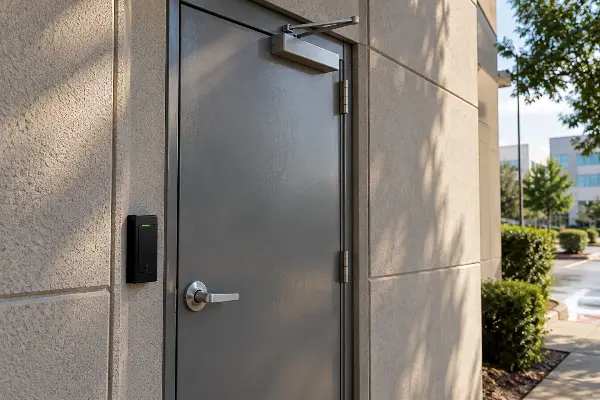
Is Tailgating Trespassing In Texas?
Following someone in isn’t criminal trespass by itself. Texas law makes it trespass when the person had notice that entry was forbidden, or got notice to leave and stayed.
The statute lists 5 kinds of notice, and 3 of them fit a commercial site:
- An oral or written message from the owner or someone with apparent authority to act for the owner. That’s where your officer comes in.
- Fencing or another enclosure that’s obviously built to keep intruders out.
- Signs on the property or at a building entrance that intruders are likely to see, saying entry is forbidden.
The other 2, purple paint marks and growing crops, belong on rural land. Criminal trespass is a Class B misdemeanor in most cases. Under Penal Code 12.22, that means up to 180 days in jail, a fine up to $2,000, or both.
Notice changes what the same entry means:
| What happened at the door | Notice under 30.05? | What it means | Officer’s next step |
|---|---|---|---|
| Someone slips in behind a badge holder; no sign, and nobody spoke to them | Not yet clear | Trespass may not be complete | Tell them to leave, then log it |
| A sign at the entrance forbids entry without authorization | Yes, by sign | Entry may already be trespass | Tell them to leave, log it, note the sign |
| Someone walks through a fenced site’s gate behind a truck | Yes, by fence | Entry may already be trespass | Tell them to leave, log the vehicle |
| Told to leave, and they leave | Yes, notice to leave | They complied | Log it and close it out |
| Told to leave, and they stay | Yes, and they ignored it | The elements of criminal trespass can be met | Call HPD, or 911 for threats or violence |
This is general information about Texas law, not legal advice. Police, prosecutors, and courts decide individual cases.
What HPD’s Business Trespass Affidavit Adds
Houston police can enforce trespass for you when nobody from the property is on site. The Houston Police Department’s Business Trespass Affidavit, in effect since January 21, 2021, lets officers tell non-patrons to leave or face arrest under Penal Code 30.05 when no owner or agent is there.
The form requires “No Trespassing” signs at every likely entrance, a notarized signature, and filing at the nearest HPD station. Note the order HPD uses: signs first, enforcement second.
For a tailgater who won’t leave but isn’t threatening anyone, call HPD’s non-emergency line at (713) 884-3131. Threats or violence go to 911. Sites in Sugar Land, Pearland, Conroe, and other cities outside Houston fall under their own police departments.

Fenced Sites And Freight Yards Carry A Higher Charge
A fence built to keep intruders out counts as notice under 30.05. So a car that follows a truck through a fenced construction gate has entered with notice.
Freight sites raise the stakes. A fully fenced trucking terminal, rail switching yard, port, or other freight transportation facility is a critical infrastructure facility under Texas law. Trespass there is a Class A misdemeanor instead of Class B.
What Can A Security Guard Legally Do About A Tailgater?
A Texas security officer can deny entry, tell the person to leave, write it up, and call police if they refuse. Officers have no police powers, so a door plan should never depend on holding anyone.
Texas defines guard company work in Occupations Code 1702.108 as preventing entry and trespass on private property, including directing people and vehicles to protect it. Arrest is narrower. Under Article 14.01 of the Code of Criminal Procedure, any person, officers included, can arrest without a warrant only for a felony or “an offense against the public peace” they witness. Most trespass is a Class B misdemeanor. So we build door plans on notice, reports, and police.
Force is a separate question, and Texas use-of-force rules draw that line tightly. Most door posts call for an unarmed, non-commissioned officer. Armed posts need a commissioned officer with Level III training, a course of at least 45 hours under Texas DPS rules.
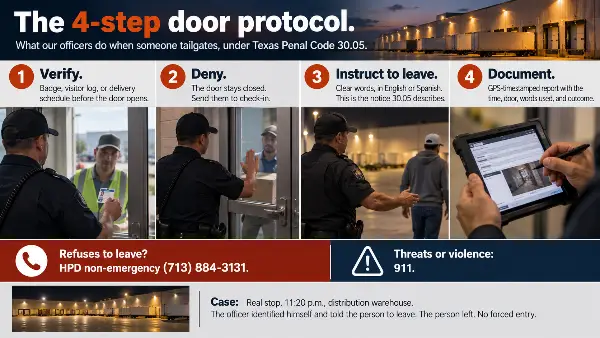
Our officers run the same 4 steps at every door, gate, and dock.
Step 1: Verify Before The Door Opens
Check the badge, the visitor log, or the delivery schedule before anyone passes. In a lobby, that means a badge or a check-in, not a story about a badge left at home.
Step 2: Deny Entry And Point To Check-In
The door stays closed, and the person gets a place to go: reception, the gate shack, or the site office. The officer doesn’t argue or block anyone. A visitor with a real reason walks to check-in.

Step 3: Give A Clear Instruction To Leave
If the person is already inside, the officer says who they are and tells them to leave in plain words: “This is a restricted area. You need to leave through the main entrance.” Our officers say it in Spanish too: “Esta es un área restringida. Tiene que salir por la entrada principal.” That instruction is the oral notice Penal Code 30.05 describes.
One night at 11:20, at a distribution warehouse we cover, this step did the whole job. Our officer saw a car parked by the docks after hours and a person trying to get into a secured storage area by the dock doors. He let dispatch and the site supervisor know, walked over, identified himself, and told the person to leave the restricted section. The person left without trouble. Police were advised, and a walk-through afterward showed no forced entry and nothing missing.
Step 4: Document Every Attempt
Write it up even when nothing happens. A tailgating report should capture:
- The date, time, and exact door or gate
- A description of the person or vehicle, with the plate number
- What the person said, plus the officer’s exact words and language
- The outcome (left, refused, or police called) and any police report number
- Whether a sign was posted, and which camera caught it
Our officers log each checkpoint on a GPS guard-tour system and file incident reports in real time. That record turns 3 quiet tailgates at the same side door into a decision about a lock, a closer, or a post. Write each report for the stranger who reads incident reports when a claim is filed.
How Do You Stop Vehicles From Tailgating Through A Gate?
Allow 1 vehicle per gate cycle, and post someone where they can see the gap between bumpers. A gate arm opens for the first vehicle, and the second rides through unless a person stops it.
The gate rules worth writing into post orders are plain:
- Every vehicle stops, including the third truck in a contractor convoy.
- The officer stands where the rear bumper is visible, which usually means outside the booth.
- Log each plate, company, driver, and time in and out, and match deliveries to the day’s schedule.
- Watch garage exit lanes, where people on foot walk in against traffic.
Gate control sits at the center of construction site security, where the gate officer is the only check between the road and the equipment yard. On a fenced site, that second vehicle entered with notice, so an instruction to leave carries weight.
After hours, the threat shifts from tailgating to probing. We’ve had a pickup circle a job site at 2:15 a.m., then idle at the gate while the people inside sized it up. Our officer’s patrol lights ended that visit.
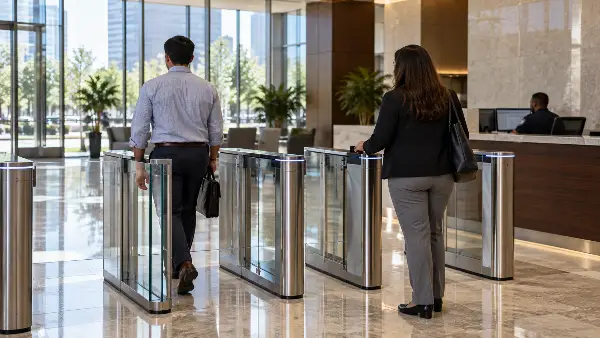
Tailgating Security Measures In 2026: What Each One Stops And Misses
Every control stops one type of tailgate and misses another. The setups that hold up pair a barrier with a person who responds, because hardware limits entries but can’t give notice, judge a story, or call police.
| Measure | What it stops | What beats it | Who acts when it fails |
|---|---|---|---|
| Badge reader on a standard door | Entry without a credential | A held door, or 2 people on 1 swipe | Nobody, unless someone reports it |
| Door-held and forced-door alarms | Doors left open past the timer, pried doors | A tailgate that clears inside the timer | Whoever watches the alarm panel |
| Camera at the entrance | Nothing in the moment; it records faces and times | Any entry nobody watches live | A reviewer, after the fact |
| Optical turnstile | A second person on 1 credential at lobby lanes | A side door with no turnstile, or jumping the lane | The lobby officer or front desk |
| Access control vestibule | More than 1 person through 2 interlocked doors | Slow throughput that pushes people to other doors | Built in, plus a responder |
| Lobby or reception officer | Cover stories and unbadged visitors | Coverage is 1 entrance per post | The officer, on the spot |
| Gate officer with a vehicle log | A second vehicle on 1 gate cycle, unscheduled trucks | Coverage is 1 gate per post | The officer, on the spot |
Federal programs treat vestibules as their own control: NIST SP 800-53 Revision 5 lists them as PE-3(8). Few sites act on what they know, though. In a 2019 survey of more than 185 security end users and advisors by Boon Edam, a maker of security entrances, 77% rated guards and barriers effective against tailgating. Only 18% of end users had either in place.
A lobby officer covers the last column, and that judgment at the desk is what you’re buying with building security guard services. After dark, the balance tips further toward people, since access control security guards can stop an entry that a reader only records.
How Do You Measure Tailgating At Your Own Door?
Count the people who walk through 1 door for 1 hour, then compare that count to the badge reads for the same hour. The gap is your tailgating number.
Most sites never run this check. In the same Boon Edam survey, 74% of end users said they don’t track tailgating, while 71% believed they were vulnerable to it. All it takes is a tally counter and the access log:
- Pick your busiest badge door and 1 side door people use as a shortcut.
- Pick the peak hour: shift start, lunch return, or shift change.
- Stand out of the way and count everyone who walks through.
- Pull the access log for the same 60 minutes and count the reads at that door.
- Subtract the reads from the head count, and check the door-held alarms for that hour too.
- Repeat monthly, and after any change to staffing or door hardware.
Run it as part of a physical security risk assessment, and the numbers show which door needs a person and which needs a closer that works.
Putting Tailgating Security In Place At A Houston Site
Start with a walk of every door and gate. Then write post orders that say who may enter, how notice is given, and what gets reported. Signs go up before the first shift.
A first call gets you a free proposal, and some sites also get an on-site assessment before we deploy. Your certificate of insurance can go out the same day. Contracts can be weekly or month to month, and none of them lock you in long term. As a Houston security guard company, we hold Texas DPS company license B07315701 and staff 150 licensed officers across more than 100 sites, in English and Spanish.
Tailgating security in Texas works in a fixed order: signs at every entrance, a trained instruction to leave, a report for every attempt, and a police call when someone refuses.
FAQs
What is tailgating security?
Tailgating security is how a property stops unauthorized people from following someone with access through a controlled door or gate. It pairs an entry rule and a barrier with a person who acts when the barrier fails. In Texas, it also means posting entrance signs, because trespass under Penal Code 30.05 depends on notice.
Is tailgating illegal in Texas?
Following someone in becomes criminal trespass under Texas Penal Code 30.05 when the person had notice that entry was forbidden, or was told to leave and stayed. Notice can be an entrance sign, a fence, or an instruction from the owner or someone acting for them. It’s usually a Class B misdemeanor, and Class A at a fully fenced trucking terminal or other freight facility.
Can a security guard stop a tailgater in Texas?
Yes, by denying entry, telling the person to leave, writing it up, and calling police if they refuse. Guards have no police powers, and Article 14.01 of the Code of Criminal Procedure limits warrantless arrest by any person to felonies and offenses against the public peace committed in view. Most door posts call for an unarmed, non-commissioned officer.
What is the difference between tailgating and piggybacking?
Tailgating happens when an unauthorized person slips in behind someone who doesn’t notice. Piggybacking happens when the authorized person knowingly lets them in, often to be polite. Both put an unverified person inside, so the fix is the same: 1 credential per entry and someone ready to act.
How do you stop tailgating at a vehicle gate?
Allow 1 vehicle per gate cycle and post an officer where they can see the gap between bumpers. Log every plate, company, and driver, and match deliveries to the day’s schedule. On a fenced site, the fence counts as notice under Texas Penal Code 30.05.
How do you know if tailgating happens at your building?
Count everyone who walks through 1 door for 1 hour, then compare that number to the badge reads for the same hour. The difference is your tailgating count. In a 2019 Boon Edam survey, 74% of end users said they don’t track tailgating at all.
Does tailgating security equipment replace a security guard?
No. Tailgating security equipment like badge readers and turnstiles limits entries, but it can’t judge a cover story, give a trespass warning, or call police. In a 2019 Boon Edam survey, 77% of respondents rated guards and barriers effective against tailgating, while 18% of end users had either in place.