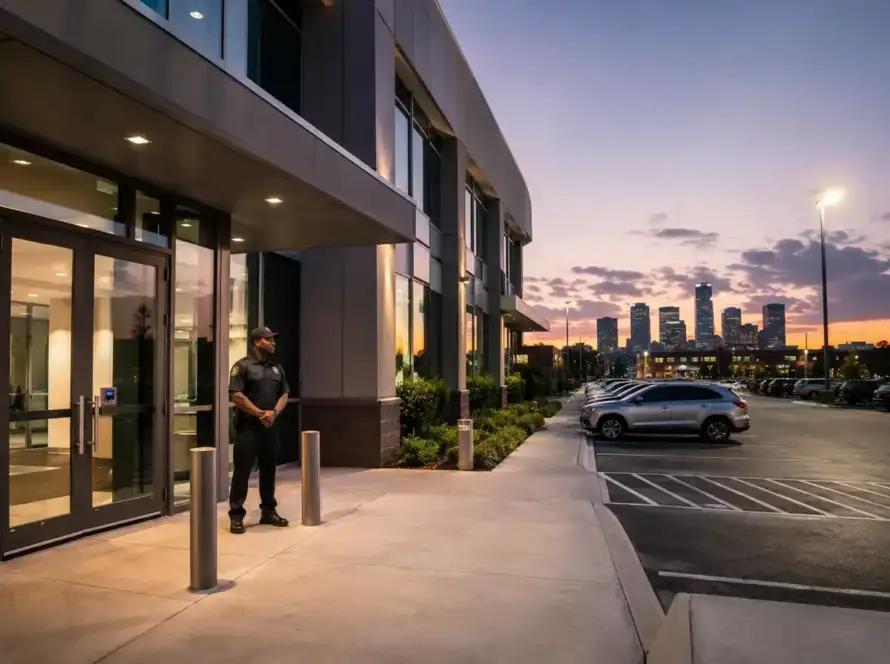

Office building security services in Houston protect tenants in 2 ways. Officers decide who gets past the lobby, and they walk the floors and garage after hours. Every shift also leaves a written record, and that record can protect your reputation or work against it. Say a crime hurts someone in a Texas building and they sue. Courts then weigh 5 factors to decide whether the owner should have seen it coming. One is how much publicity earlier incidents got.
We run 150 licensed officers across more than 100 Houston commercial sites. The office posts that hold up best keep the wrong people off tenant floors. They also leave a record of what the owner knew and what was done about it.
Office building security services are licensed officers posted at an office property. They control who enters, patrol the floors, stairwells and parking, respond to incidents and document each shift. In Texas, the company needs a Class B or Class C company license from the Department of Public Safety. Every officer also needs an individual license tied to a licensed company.

The 4 Office Posts And The Record Each One Leaves
An office building can staff up to 4 kinds of posts. Each stops a different problem and leaves a different record, and you can buy any mix of them.
| Post | When it usually runs | What it stops | What it records |
|---|---|---|---|
| Lobby desk | Business hours | Strangers walking onto tenant floors, people slipping in behind a badge holder | Visitor names, who they came to see, times in and out |
| After-hours access | Evenings, weekends and holidays | Entry by anyone without access, doors late workers leave open | After-hours entries, door and stairwell checks |
| Vendor and crew control | Whenever cleaning or contractor crews are inside, often at night | Crews in suites they weren’t sent to | Crew names, sign-in and sign-out times |
| Garage and perimeter rounds | Dusk to dawn, or around the clock | Car break-ins, loitering, people sleeping in stairwells | GPS-stamped checkpoints on every round |
Compare bids on that last column. Ask each company for a sample week of its officers’ records. That sample tells you more than the hourly rate does. Our building security guard services can run any of the 4 posts, alone or together.
How Do Guards Protect Tenants In A Multi-Tenant Building?
Guards protect tenants by stopping strangers before they reach a tenant’s door. They also cover the hours when nobody is at the desk. In a shared building, 1 weak door exposes every company inside.
Strangers Are The Lobby’s Job
Strangers commit a big share of violence at work. A Bureau of Justice Statistics report on workplace violence covered 2015 to 2019. It estimated 1.3 million nonfatal violent crimes at work each year, and strangers committed 47% of them.
A lobby officer’s first job is asking every stranger who they’re here to see. That question stops a stranger before they reach a tenant’s suite. It also catches the person trying to follow a badge holder through the turnstile. Most office lobbies don’t need a firearm for that work. An unarmed officer who checks every visitor covers the risk that walks in the front door.

108 Hours A Week With No One At The Desk
A weekday desk staffed from 7 a.m. to 7 p.m. covers 60 of the week’s 168 hours, about 36%. The other 108 hours are when a forced door on an empty floor can sit unnoticed until morning.
The 5 incident reports we publish as proof of our work all happened after 11 p.m. The earliest came at 11:20 p.m. and the latest at 3:30 a.m., at construction sites, a warehouse and a vacant commercial building. None was in an occupied office tower, but every one fell in hours a weekday lobby desk sits empty. You can see our incident write-ups laid out by time.
After-hours coverage at an office building usually means an officer who locks down the lobby. Then the officer walks the stairwells and garage on a set route. Our post on commercial building security goes deeper on the overnight side.
Why Your Building’s Reputation Is A Legal Question In Texas
In Texas, earlier crimes on or near your property can decide whether the next one was foreseeable. So can how widely people heard about them. That turns reputation from a leasing problem into a liability problem.
The test traces back to the Texas Supreme Court’s 1998 Timberwalk decision. A federal appeals court applied it in 2016 and listed the 5 factors courts weigh. They compare a new crime with earlier ones on proximity, publicity, recency, frequency and similarity.
Publicity is the factor that ties your reputation to your liability. In the Timberwalk opinion’s words, publicity “helps determine whether a landowner knew or should have known of a foreseeable danger.” An incident tenants emailed management about is hard to claim you missed. So is one that made the local news.
That’s why an incident log you can produce does more for your reputation than a uniform at the front desk. The log cuts both ways, though. A log full of problems nobody answered shows a known risk. A log that pairs each problem with what was done about it shows an owner who acted. We’re a security company, so treat this as background. Ask your attorney about any specific claim.

What Should You Tell Tenants After An Incident?
Send affected tenants a short written notice built from the officer’s incident report. Say what happened and what changes because of it. A factual notice from management beats the version tenants piece together in the elevator.
Incident reports from our officers arrive in real time, so your property manager can have the facts the same night. Each part of the notice should trace back to a document.
| Part of the notice | Pull it from |
|---|---|
| What happened, where and when | The officer’s incident report |
| What was done right away | The incident report and the dispatch log |
| What changes now | Your updated post orders |
Leave out names and anything police asked you to hold back. Then file a copy of the notice with the report, so the record shows how you handled it.
Can Your Security Records Run Out Before A Lawsuit Does?
Yes, if your vendor keeps only what Texas requires. The state minimum is 2 years. An injured person also generally gets 2 years to file suit, so the 2 clocks can run out at nearly the same time.
Texas Administrative Code §35.112 sets the minimum for licensed security companies. It covers contracts, the paperwork that shows the work was done, and timesheets or scheduling records. Those 2 years count from whichever comes last, the day the work was done or the day the contract ended. The rule never mentions incident reports by name.
The statute of limitations for personal injury is Civil Practice and Remedies Code §16.003. It generally gives an injured person 2 years from the day the claim accrues to file suit. For an injured minor, the 2 years don’t start until age 18. Formal discovery usually starts after the suit is filed. Say your contract ended soon after an incident and the suit arrives near the 2-year mark. A vendor that keeps only the minimum may have nothing left to hand over.
Ask for each incident report the day it’s written and keep your own copy. Then write a retention period your attorney is comfortable with into the contract terms.
Our officers log every round on a GPS guard tour system, backed by supervisor check-ins. That’s what patrol verification looks like in practice. It’s a timestamped record of where the officer was and what they found.

Office Building Security Services In Houston: Where To Start In 2026
Map the unstaffed hours first, then check the people and the records before you sign. Price comes last.
Pick the posts from the table above that cover those hours. Then run the company and every officer assigned to your lobby through the state’s public license search. An officer’s license has to be tied to a licensed company, so a valid company license doesn’t vouch for the person at your desk.
Texas licenses armed officers separately. A commissioned officer has passed Level III training and a test that includes a firearms course of fire. Most office posts don’t call for one. A building with cash handling or a known threat might.
Price follows the hours you cover and the officer type. Our Houston cost breakdown walks through the wage data and the 24/7 staffing math. Contracts can be as short as a week, and none of them lock you into a long term. Insurance paperwork for your vendor file is a same-day request.
If you manage a Houston office building, list the hours nobody is at the desk. Then find out where tonight’s incident report would land. Those 2 answers show which office building security services you’re missing. Reliable Guard & Patrol Service holds Texas DPS license B07315701, active since 2018. We staff posts in English and Spanish. Send us your building’s hours and floors, and we’ll put a free written proposal in front of you.
FAQs
What do office building security services include?
Office building security services usually cover a lobby desk, after-hours access, crew control and garage or perimeter rounds. Each post should leave a record, such as visitor logs, after-hours entries and GPS-stamped patrol checkpoints. In Texas, the company needs a Class B or Class C license from the Department of Public Safety. Every officer also needs an individual license.
Does publicity about past incidents matter if a tenant sues in Texas?
It can. Texas courts weigh 5 factors from the 1998 Timberwalk decision, and publicity is one of them, along with proximity, recency, frequency and similarity. The court said publicity helps show whether an owner knew or should have known of the danger, so ask your attorney about any specific claim.
Can security records run out before an injury claim does in Texas?
They can. Texas Administrative Code §35.112 makes licensed security companies keep contracts, proof of the work and scheduling records for 2 years. The 2 years count from whichever comes last, the service date or the contract’s end. Injury suits can generally be filed up to 2 years after a claim accrues, and later for minors, so keep your own copies of incident reports.
What hours should office building security services cover in Houston?
Cover the hours nobody is at the desk first. A desk staffed 7 a.m. to 7 p.m. on weekdays leaves 108 of the week’s 168 hours with no one there. The usual fix is an evening and weekend post, or overnight rounds of the garage and stairwells.
Who keeps track of cleaning and contractor crews after hours?
In a building with a vendor and crew post, the security officer signs crews in and out, confirms which suites they’re cleared for and notes the times. That log answers the first question after something goes missing from a tenant’s suite: who was inside after hours.
What should a property manager tell tenants after a security incident?
Tell affected tenants what happened and what changes because of it. Base every line on the officer’s incident report. Send the notice as soon as you have the report, and leave out names and anything police asked you to hold back.