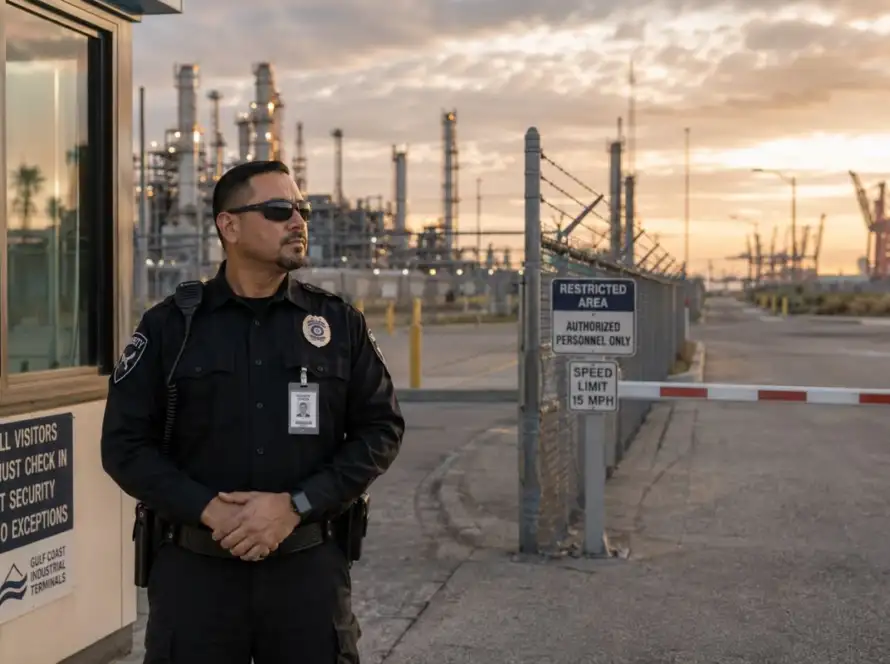
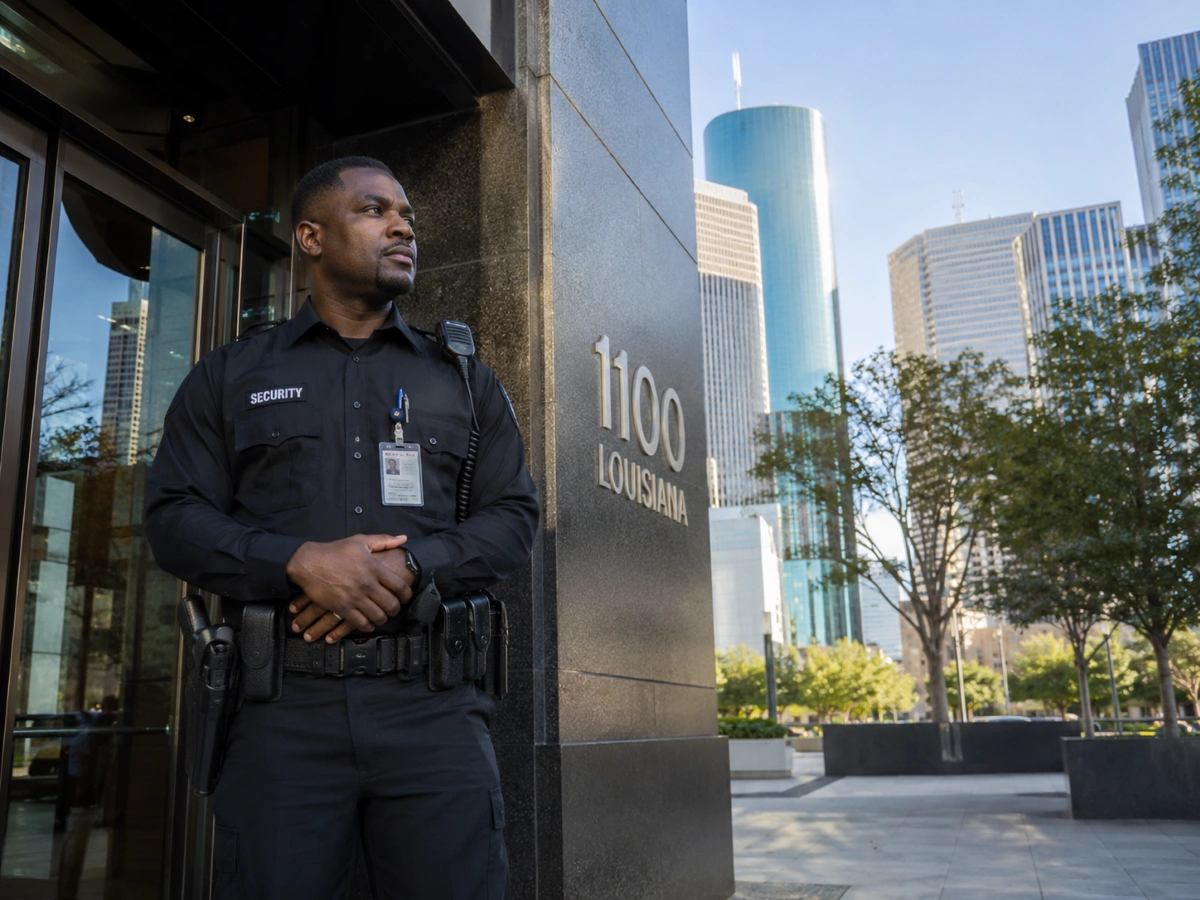
Armed security guards and police officers both carry firearms, wear uniforms, and respond to threats. That’s where most of the similarities end. Police hold government authority to enforce laws, make arrests, and investigate crimes anywhere in their jurisdiction. Armed security guards work under private contracts, and their authority stops at the property line. If you’re a business owner in Houston trying to figure out which one you actually need on-site, this distinction matters more than most people realize.
Armed security vs. police comes down to three things: legal power, who pays them, and how fast they show up. Police are publicly funded and serve entire communities. Armed guards are privately hired and assigned to protect a specific location, asset, or person. According to the Bureau of Labor Statistics, roughly 1.27 million security guard jobs existed in 2024, compared to about 826,800 police and detective positions. The private security industry is bigger than most people think.
How Does Legal Authority Differ Between Armed Guards and Police?
Police officers get their authority from the state. They can arrest suspects, conduct searches with probable cause, issue citations, and use force during law enforcement operations. That authority covers both public streets and private property when a crime is in progress.
Armed security guards don’t have any of that. Their authority is limited to the property they’re contracted to protect. They can observe, report, and in most states, perform a citizen’s detention until police arrive. That’s it. They can’t run investigations, execute search warrants, or pull someone over on a public road. I’ve seen business owners assume their armed security team has police-level powers. They don’t. And misunderstanding that line creates liability problems fast.
One more thing people miss: police officers carry qualified immunity, which gives them legal protection when they make split-second decisions on duty. Private security guards have zero immunity. If a guard uses force incorrectly, they face personal criminal charges and the security company faces a lawsuit. That difference alone changes how guards are trained to respond.
Training Requirements: Police Academy vs. Security Licensing
Police academy training typically runs six months or longer. It covers criminal law, constitutional rights, firearms proficiency, defensive tactics, emergency driving, and crisis intervention. After the academy, new officers complete months of supervised field training before working solo. The BLS reports a median salary of $77,270 for police and detectives, which reflects that training investment.
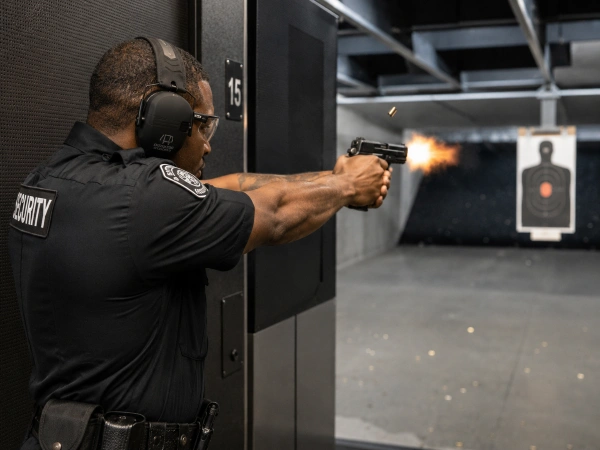
Armed security guard training is shorter and varies wildly by state. In Texas, a Level III (armed) security officer must complete a state-approved firearms course and hold a valid commission from the Texas Department of Public Safety. The total training can be as little as 40 hours. Some states require even less. The median wage for security guards nationally sits around $38,370 per year ($18.46/hour), and armed guards earn a premium above that.
Here’s where I’d push back on the industry’s talking points. A lot of security companies market their guards as “highly trained professionals” without specifying what that means. Ask any provider three questions before signing a contract: How many hours of firearms training does each guard complete annually? What’s your de-escalation curriculum? And what’s your policy when a guard reaches the legal limits of their authority? If they can’t answer those clearly, keep looking.
What Do Armed Security Guards Actually Do vs. Police?
Police respond to 911 calls, investigate crimes, make arrests, testify in court, and patrol public areas. Their scope covers everything from traffic violations to homicide cases.
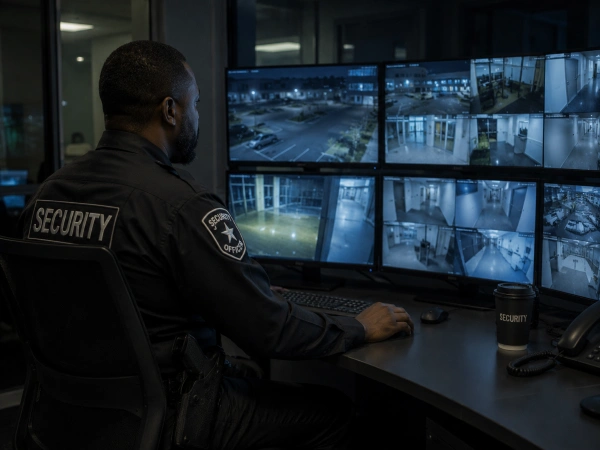
Armed guards do something fundamentally different. They’re posted at a fixed location to deter crime before it starts. They monitor access points, check credentials, watch surveillance feeds, and respond to disturbances on their assigned property. Some work corporate lobbies in business attire. Others wear tactical gear at construction sites or large events. The role flexes based on the client’s risk profile.
Why Response Time Matters More Than You Think
This is the biggest practical advantage armed security has over police. Average police response times in major U.S. cities run anywhere from 7 to 12 minutes for priority calls. In Houston, it can stretch longer depending on the precinct and call volume. For non-emergency calls, you could be waiting 30 minutes or more.
An armed security guard who’s already standing in your lobby? Response time is zero. They’re there when the threat walks in. That’s not a replacement for the police. It covers the gap between when an incident starts and when officers arrive. I’ve watched property managers spend months debating whether to hire guards, then change their mind after one break-in costs them $20,000 in losses and insurance hikes.
What Weapons and Equipment Can Armed Guards Carry?
Police officers carry standardized loadouts: service pistol, taser, baton, pepper spray, handcuffs, body camera, and radio connected to dispatch. Patrol vehicles carry additional gear like first aid kits and sometimes tactical equipment.
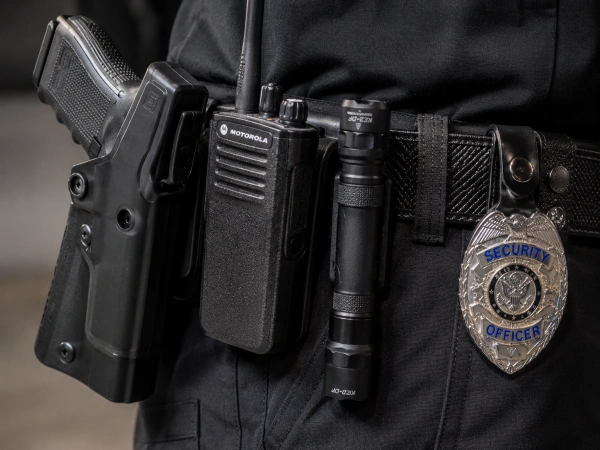
Armed guards carry only what their state license and employer policy allow. In Texas, that’s typically a sidearm (most commonly a 9mm or .40 caliber handgun), flashlight, radio, and sometimes a bullet-resistant vest. Guards don’t have access to police databases, NCIC lookups, or dispatch systems. Their communication network runs through the security company, not law enforcement.
Use of Force and Legal Liability
Police follow a use-of-force continuum defined by department policy and case law. They can use deadly force when they reasonably believe there’s an imminent threat of death or serious bodily harm. Every use-of-force incident triggers internal review.
Armed guards face a higher legal bar. They’re civilians. Any force they use gets judged by civilian self-defense standards, not law enforcement standards. Shooting someone without clear legal justification doesn’t just end their career. It puts them in a criminal courtroom. That’s why reputable security firms invest heavily in de-escalation training and strict use-of-force policies. The liability exposure is real. One bad incident can generate hundreds of thousands in legal fees and settlements.
Who Oversees Police vs. Private Security?
Police departments answer to city or county government, internal affairs divisions, civilian oversight boards, and state law. If an officer crosses a line, there’s a public accountability process (however imperfect).
Private security oversight is thinner. Guards answer to their employer, the client’s site policies, and the state licensing board. In Texas, that’s the Texas Department of Public Safety’s Private Security Bureau. If a guard violates policy, the company can fire them. If they violate state law, their commission gets revoked. But there’s no internal affairs unit reviewing every incident. Clients who work with a team that understands their industry know to ask about oversight processes before signing any security contract.
Armed Guards Don’t Replace Police. They Fill the Gap.
This is the part most articles on this topic get wrong. They frame armed security vs. police as an either/or decision. It’s not. Police serve the public. Guards serve a specific client. The U.S. private security industry hit $49.8 billion in 2025 according to IBISWorld and ASIS International research, and it keeps growing because businesses need on-site protection that police departments aren’t staffed to provide.
Think about it this way. Houston PD handles a metro area of over 2.3 million people. They’re triaging calls constantly. Your warehouse, hotel, or retail location isn’t their top priority unless someone is actively in danger. That’s exactly why security guard companies in Houston stay busy. An armed guard makes your property someone’s top priority every shift.
Cost Comparison: Armed Security vs. Police (2026)
| Category | Armed Security Guard | Police Officer |
| Median annual wage | ~$38,370 (BLS, unarmed baseline) | $77,270 (BLS) |
| Client hourly rate | $40–$75/hour (armed) | N/A (taxpayer funded) |
| Training length | 40+ hours (state dependent) | 6+ months academy + field |
| Legal authority | Property-only, citizen’s detention | Full arrest, search, investigation |
| Qualified immunity | No | Yes |
| Response to your site | Immediate (already on-site) | 7–12+ minutes average |
Armed guard rates in Houston typically fall in the $45–$65/hour range depending on experience and assignment risk level. Executive protection and high-risk contracts push past $75/hour.
Get Armed Security in Houston That Knows the Difference
Knowing the line between armed security and police isn’t just a legal question. It’s a hiring question. The right security provider trains guards to operate precisely within their authority, not above it and not below it. They staff your site with licensed, insured professionals who understand that their job is deterrence and rapid on-site response, not law enforcement.
If you’re looking for armed security guard services in Houston that take training, licensing, and accountability seriously, start the conversation now. The gap between armed security vs. police doesn’t have to be a weakness. With the right team in place, it’s your first line of defense.
FAQs
Can armed security guards arrest people like police officers?
No. Armed security guards don’t have arrest powers. In most states, including Texas, they can perform a citizen’s detention, which means holding a suspect on the property until police arrive. Police officers have full arrest authority backed by state law. This is one of the biggest differences between armed security vs. police, and it affects how guards are trained to handle confrontations.
Is armed security better than calling the police?
They serve different purposes. Armed security provides immediate on-site presence and deterrence. Police bring full legal authority but respond from off-site, with average response times of 7–12 minutes in major cities. Most security professionals recommend having armed guards on-site AND calling police when an incident escalates. One doesn’t replace the other.
What training do armed security guards in Texas receive?
Texas requires armed (Level III) security officers to complete a state-approved training program that includes firearms qualification, legal authority education, and use-of-force instruction. The minimum is roughly 40 hours, though reputable firms exceed that with ongoing training. By comparison, Texas police academy programs run approximately 1,280 hours over 6+ months.
Do armed security guards have the same legal protections as police?
No. Police officers benefit from qualified immunity, which protects them from personal lawsuits when acting within the scope of their duties. Armed security guards operate as private civilians. If a guard uses force improperly, they face personal criminal liability and the security company faces civil lawsuits. This is why liability insurance and strict use-of-force policies are so important when hiring armed security vs. police.
When should a business hire armed security instead of relying on police?
Businesses should consider armed security when they need a constant on-site presence that police can’t provide. High-value assets, locations with repeat theft or vandalism, large events, and properties in high-crime areas all benefit from armed guards. If your annual losses from security incidents exceed $15,000–$20,000, armed security often pays for itself within the first year.