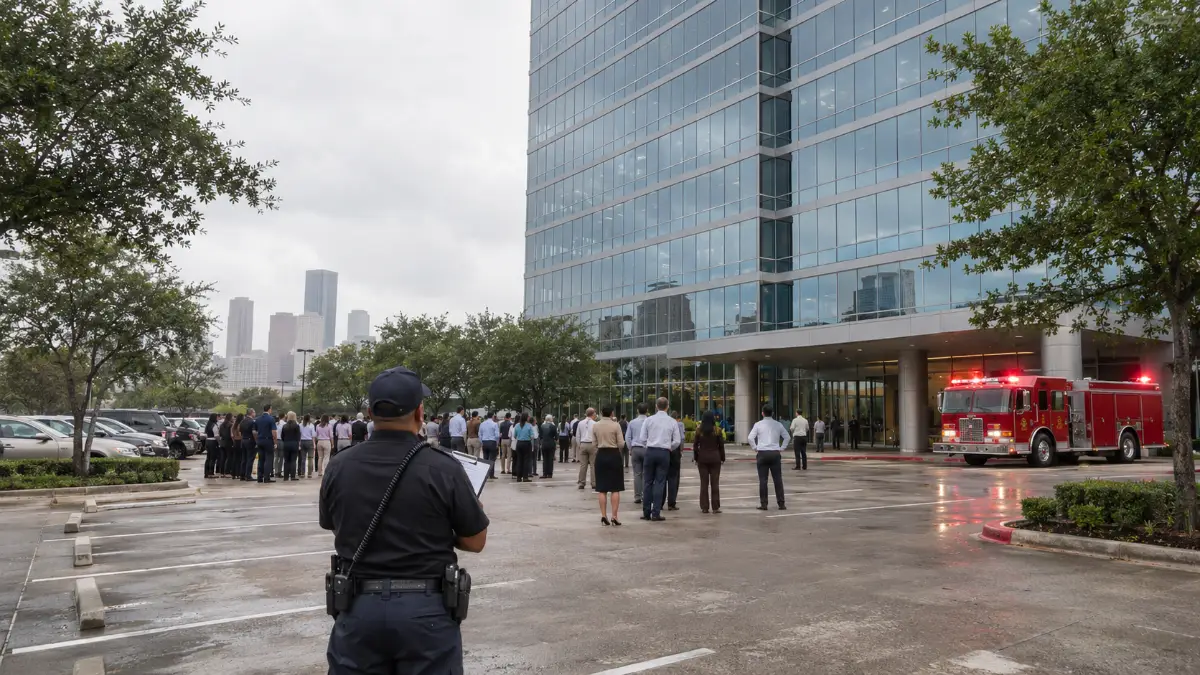
Emergency evacuation procedures are the written steps that get everyone out of a building and accounted for. They also keep people out until the fire department says it’s safe. In Houston, 2 sets of rules shape them. OSHA’s plan rule lists 6 things your plan must cover, and it never requires a drill. Houston’s fire code does. Any building with floors more than 75 feet up has to hold a fire drill at least every 6 months, and every occupant takes part.
We post officers at office buildings, warehouses, construction sites and shopping centers across Houston, 24 hours a day. When an alarm sounds, your lobby or gate officer holds the sign-in log for every visitor, contractor and driver inside. OSHA’s rule doesn’t say what that officer should do with it.
What Are Emergency Evacuation Procedures?
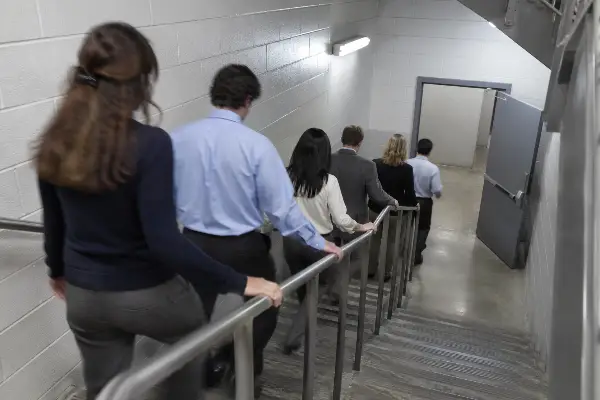
Emergency evacuation procedures are a building’s written instructions for getting people out during a fire, gas leak or other emergency. They say who reports it, which exit each area uses and where people gather. They also cover how everyone gets counted, who helps people who can’t use the stairs and who decides when it’s safe to go back in.
They’re the evacuation part of the emergency action plan, which belongs to the employer or building owner.
The 6 Things OSHA’s Plan Rule Requires
OSHA’s emergency action plan rule, 29 CFR 1910.38, requires a written plan with 6 parts. It also calls for an alarm, trained helpers and a review with each employee. An employer with 10 or fewer employees can share the plan out loud instead.
The 6 parts:
- How to report a fire or other emergency
- How to evacuate, including the type of evacuation and the exit route for each area
- What employees who stay to shut down operations do before they leave
- How every employee gets accounted for afterward
- Who handles rescue and medical duties
- The name or job title of the person to ask about the plan
The alarm needs a different signal for each purpose. Reviews happen when the plan is written, when an employee starts, when their duties change and when the plan changes. Construction sites follow 29 CFR 1926.35, which lists the same 6 parts.
Does OSHA Require Evacuation Drills?
No. The rule never uses the word “drill,” and neither does the construction version. OSHA’s own planning guide, Publication 3088, says “it is a good idea to hold practice drills as often as necessary.” That’s advice. A business can follow OSHA’s rule to the letter and never run one.

Houston’s Fire Drill Rule: Every 6 Months Above 75 Feet
Every high-rise in Houston has to hold a fire drill at least every 6 months, with all occupants taking part. Houston counts a building as a high-rise when it has floors more than 75 feet above the lowest level of fire department vehicle access.
Houston’s fire code, the 2021 International Fire Code with city amendments, sends high-rise plans to the Houston Fire Department’s own standards. The fire drill standard sets the 6-month rule. The high-rise standard sets who runs the plan. That’s a Fire Safety Director acting for the owner and, in office buildings, certified fire wardens on every floor. Both took effect January 1, 2024. Mid-rise buildings with an atrium drill every 6 months too.
The drill standard also covers the paperwork:
- Email the HFD dispatcher at least 2 days before a high-rise drill.
- Call your alarm monitoring company at least 15 minutes before and tell them not to call the fire department. If HFD gets called anyway, the standard treats it as a false alarm.
- Keep a written record on site. It lists the date and time, who ran the drill and how long the building took to empty.
Below 75 feet, the drill standard sets no fixed schedule for offices, warehouses or stores without an atrium. The fire code official can still require drills in any building, so ask your fire inspector.
| Requirement | OSHA plan rule (29 CFR 1910.38) | Houston high-rise standards (HFD 07 and 08) |
|---|---|---|
| Written plan | Required, or shared out loud with 10 or fewer employees | An approved Fire Safety Plan for every high-rise |
| Evacuation drills | Not required | At least every 6 months, all occupants |
| Who runs it | Employees the employer picks and trains | A Fire Safety Director plus certified fire wardens |
| Warden count | Guidance: about 1 per 20 employees | 1 per tenancy per floor, 1 per 7,500 square feet in larger tenancies, at least 2 per floor |
| Security staff | Not named | Named among the staff who must be trained |
| Notice before a drill | Not addressed | Email to HFD at least 2 days ahead |
Fire Wardens: OSHA’s Ratio Vs Houston’s Rule
OSHA’s guidance and Houston’s high-rise standard count wardens differently, and on a big floor the 2 numbers don’t match.
OSHA’s evacuation guidance says, “Generally, one warden for every 20 employees should be adequate.” Houston’s standard is binding: “A Fire Warden shall be provided for each tenancy on each floor.” A tenancy over 7,500 square feet gets a warden for each 7,500 square feet “or part thereof.” Every floor needs at least 2, and warden certificates last 5 years.
Take a 20,000-square-foot floor with 1 tenant and 100 staff. OSHA’s guidance points to 5 wardens. Houston’s rule requires 3, because 20,000 divided by 7,500 rounds up to 3. If your headcount runs higher than the floor space suggests, staff to the bigger number.
Add 1 more person to the training list. Houston’s standard names security personnel among the staff who must learn the plan. On our building security guard services posts, that’s the officer at your lobby desk.
What Does A Security Officer Do During An Evacuation?
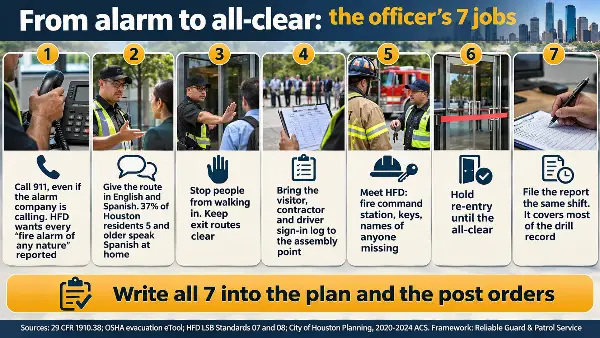
The officer on post has 7 jobs between the alarm and the all-clear. OSHA’s rule doesn’t assign them to anyone, so write them into your plan and the officer’s post orders.
OSHA’s planning guide tells employers who share a worksite to coordinate their plans, and your security company is one of them.
- Call 911, even if the alarm company is calling too. Houston’s high-rise standard wants the fire department told about every fire and every “fire alarm of any nature.”
- Give the route in English and Spanish. “Use the east stairs. Don’t use the elevator.” / “Usen la escalera este. No usen el elevador.” In Houston, 37% of residents age 5 and older speak Spanish at home, according to the city’s planning department. Our officers give directions in both.
- Stop people from walking in. Hold the front door or gate against new arrivals. Keep exit routes clear of carts, pallets and parked vehicles.
- Bring the sign-in log to the assembly point. OSHA’s guidance says to “Establish a method for accounting for non-employees such as suppliers and customers.” HR’s roster misses them. The log in our contractor check-in procedures records each person’s name, company, time in and work area.
- Meet the fire department with what it needs. Tell the first crew where the fire command station is and hand over keys. Give the names and last known locations of anyone who hasn’t checked in.
- Hold re-entry. Nobody goes back in for a purse or a laptop until the fire department gives the all-clear.
- Write it up the same shift. Our officers already file real-time incident reports, and the GPS tour system stamps every round. That report covers most of Houston’s drill record: the time, who ran it and how long the building took to empty.
Elevators And People Who Can’t Use The Stairs
Occupants take the stairs. In a Houston high-rise, elevators serving the fire floor come out of public service and go to the fire department.
So the standard has each high-rise keep a Mobility Impaired List. It holds the name, impairment and work location of anyone who may not get out alone. When there’s evidence of fire, these occupants should move, or be moved, near the exit stairwell farthest from the fire. Wardens confirm they got there.
Put the person who tells the arriving crew that location in the plan, by name or by post.
When Should You Shelter In Place Instead?
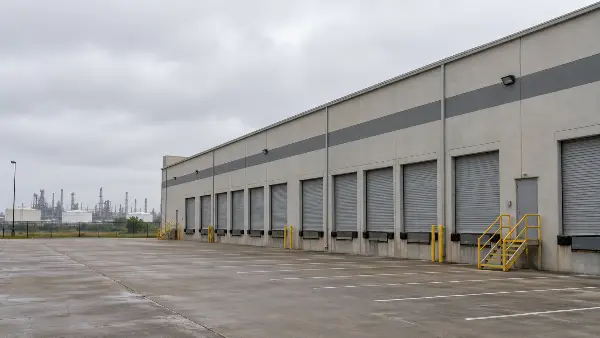
Shelter in place when officials order it, or when going outside is more dangerous than staying in, as during a chemical release. Your plan needs both responses. The officer’s job flips from moving people out to keeping them in.
On October 10, 2024, a hydrogen sulfide release at a Deer Park refinery killed 2 contract workers. The U.S. Chemical Safety Board’s report on that release says Deer Park and Pasadena issued shelter-in-place orders that stayed in effect for “several hours.”
A warehouse security guard post near the Ship Channel should drill it: doors shut, nobody walking out until the order lifts.
After Hours, The Officer May Be The Whole Plan
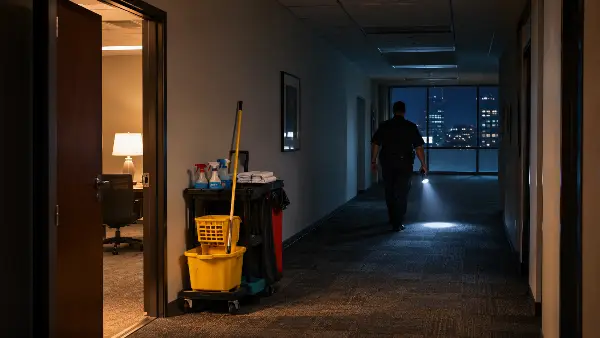
After the tenants go home, the officer may be the only person in the building who has read the evacuation plan. Name that officer in it.
OSHA’s guidance plans for wardens who are “available at all times during working hours.” Cleaning crews, late workers and contractors are still inside after those hours. The crew log at the desk is often the only record of who’s there. Our 5 published overnight incident reports were all intrusions or theft, and our post on security guard emergency response covers them.
A fire alarm or sprinkler system that’s out of service is a question for the Houston Fire Marshal’s Office. Fire watch is its own service, and it isn’t one we offer.
Emergency Evacuation Procedures For Houston Buildings In 2026: Where To Start
Start with 3 answers: your building’s height, who counts the people HR doesn’t know about, and who meets the fire department at the door.
If your building is over 75 feet, the Fire Safety Director, the wardens and a 6-month drill calendar come first. For the other 2, put your security officer in the plan and the plan in the officer’s post orders.
If you’re rewriting your emergency evacuation procedures, send Reliable Guard & Patrol Service your building’s floors, hours and current plan. We’ll send back a free written proposal: officers in English and Spanish, GPS-logged rounds and a named account supervisor. We operate under Texas DPS license B07315701.
FAQs
What are emergency evacuation procedures?
Emergency evacuation procedures are a building’s written steps for getting everyone out during a fire, gas leak or other emergency. They cover reporting, exit routes, the assembly point, headcounts, help for people who can’t use the stairs and re-entry. In Houston, high-rise plans also have to follow the fire department’s own standards.
Does OSHA require evacuation drills?
No. OSHA’s emergency action plan rule, 29 CFR 1910.38, requires a plan, an alarm, trained helpers and employee reviews. It never requires a drill. In Houston, the fire department’s drill standard requires high-rise buildings to drill at least every 6 months.
How often do Houston high-rise buildings have to hold fire drills?
At least every 6 months, with all occupants taking part. Houston counts a building as a high-rise when it has floors more than 75 feet above the lowest level of fire department vehicle access. The fire department’s dispatcher gets an email at least 2 days before each drill.
How many fire wardens does a Houston office building need?
In a Houston high-rise, each tenancy on each floor needs a fire warden. A larger tenancy needs 1 for every 7,500 square feet, and every floor needs at least 2. Warden certificates last 5 years. OSHA’s guidance suggests 1 warden for every 20 employees.
What should emergency evacuation procedures say about the security officer?
They should list the officer’s jobs, and the officer’s post orders should repeat them. The officer calls 911 and gives directions in English and Spanish. Then the officer stops people from coming in and brings the sign-in log to the assembly point. Last, the officer meets the fire department and holds re-entry until the all-clear.
When should a Houston business shelter in place instead of evacuating?
Shelter in place when officials order it, or when going outside is more dangerous than staying in, as during a chemical release. On October 10, 2024, a hydrogen sulfide release at a Deer Park refinery led Deer Park and Pasadena to issue shelter-in-place orders. The U.S. Chemical Safety Board says they stayed in effect for “several hours.”