
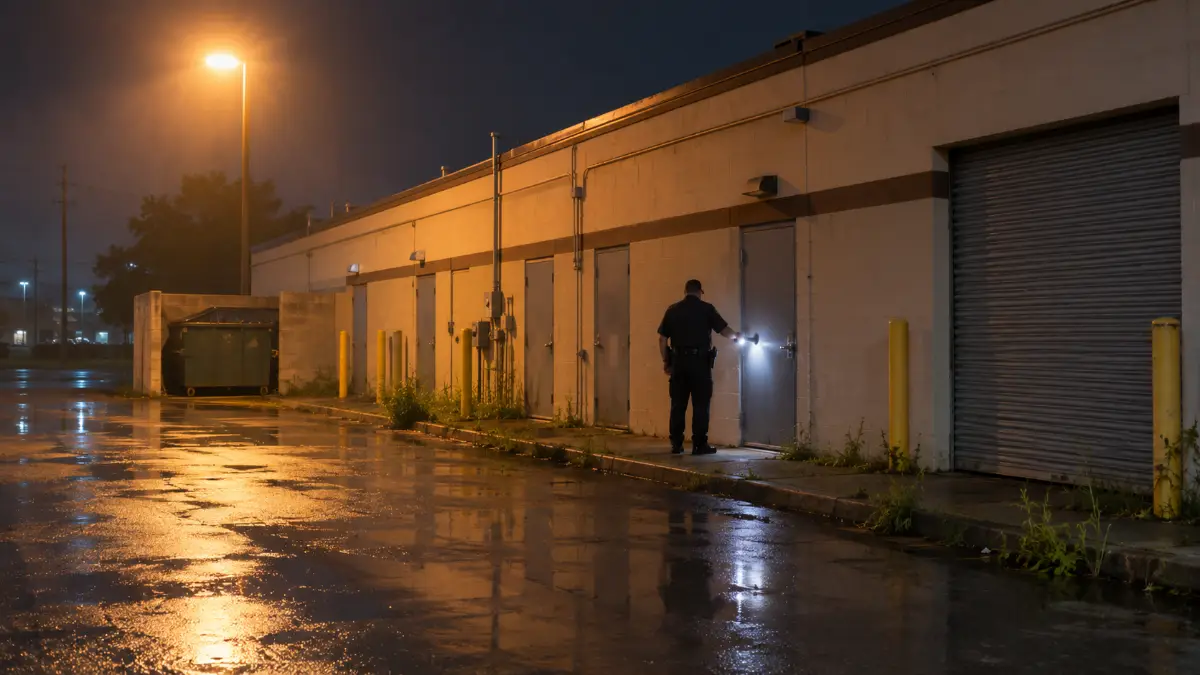
If you’re working out how to prevent squatters in an empty shop, office or warehouse, start before the last tenant leaves. Put legal notice in place, check the building at night, and keep a record of every check. In Texas, that notice starts with No Trespassing signs at every entrance and someone with the authority to order people out. Inside Houston, it also means a trespass affidavit on file with the police.
Most squatter advice online is written for houses, and it doesn’t carry over to commercial property. We patrol empty commercial buildings across Houston at night.
What Does Squatter Prevention Mean For A Commercial Building?
Squatter prevention for a commercial building is the work of keeping a vacant store, office building or warehouse from being entered and lived in. It combines legal notice that entry is forbidden, openings that stay shut and night checks with a written record. It also needs a plan for the first hour after someone is found inside.
A squatter isn’t the same as a former tenant. Someone who stays after a lease ends is holding over, and Texas treats that as an eviction case. A squatter got in without anyone’s permission, so the first tool is trespass law.
Why House Advice Misses Empty Commercial Buildings
Squatter advice is built for houses, and houses get broken into in daylight. Commercial buildings get broken into at night. In the FBI’s 2019 burglary table, 59.8% of residential burglaries with a known time happened during the day. At nonresidential buildings, 55.6% of those with a known time happened at night.
So a weekly daytime walk-through, the usual advice for an empty house, checks a commercial building at the hours it’s less likely to be entered. The other house tips run into the same wall:
| House tip | Why it misses on a commercial building | Do this instead |
|---|---|---|
| Make it look lived-in | The “For Lease” sign tells everyone the space is empty | Make it look watched: signs, locked openings, logged rounds |
| Ask a neighbor to keep an eye out | Office parks and retail strips empty out after closing | Put a patrol on the property after dark |
| Stop by 1 or 2 times a week | In 2019 FBI data, 55.6% of nonresidential burglaries with a known time were at night | Check at night, at times that change |
| Shut off the utilities | The same water and power can run the sprinkler and fire alarm | Keep fire protection on unless the fire code official approves |
A commercial building can’t fake being occupied. The “For Lease” sign, the broker’s listing and the property’s online marketing exist to tell people the space is open. So the plan has to defend the vacancy instead of hiding it.
Houston’s fire code is built on the International Fire Code. That model code requires fire alarm and sprinkler systems in a vacant building to stay in working order unless the fire code official approves otherwise. Check with the Houston Fire Marshal’s Office before anything gets shut off.
Put Legal Notice In Place Before The Building Empties
In Texas, entering a building only becomes criminal trespass once the person has notice that entry is forbidden. Set up that notice before the last day of occupancy.
Under Texas Penal Code 30.05, notice can come from a sign at the entrance to the building or from fencing built to keep intruders out. It can also be a spoken or written warning from the owner or “someone with apparent authority to act for the owner.”
Are No Trespassing Signs Enough In Texas?
Signs give legal notice. They don’t lock a door or tell you someone got in. Post them at each door, gate and loading dock someone could use, including the back. HPD’s business trespass affidavit asks for signs “at all places reasonably anticipated to be used as an entrance.”
File The HPD Trespass Affidavit
Inside Houston city limits, HPD’s business trespass affidavit authorizes police to enforce trespass laws on the owner’s behalf, and the form lists no expiration date. HPD wants a new one when the information on it changes, so redo it if the manager or contact number changes at move-out. Who signs it and where it’s filed are covered in our post on stopping tailgaters in Texas.
Give Someone The Authority To Order People Out
A sign can’t tell anyone to leave. Write down who can: the owner, the property manager and the guard company acting for them. When our officers find someone on a vacant property, they identify themselves, tell the person to leave in English or Spanish, and log the time.
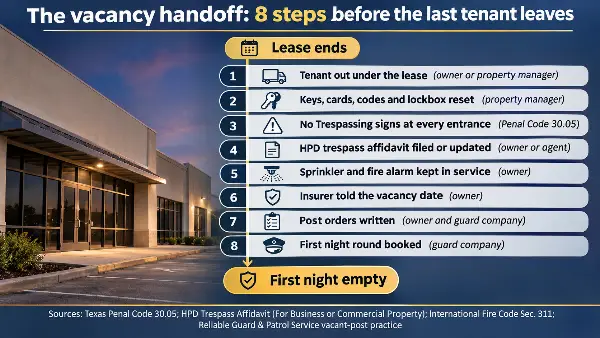
The Vacancy Handoff: 8 Steps Before The Last Tenant Leaves
A move-out leaves gaps: keys nobody collected, a lockbox code every vendor knows, an alarm that still calls the old manager. Close them with a checklist that puts a name on every step.
| Step | Who handles it | Why it matters |
|---|---|---|
| 1. Confirm the last tenant has left under the lease | Owner or property manager | A holdover goes to eviction court, not trespass |
| 2. Collect keys, cards and codes, and change the lockbox code | Property manager | Old codes open doors without anyone forcing them |
| 3. Post No Trespassing signs at every entrance | Property manager | Gives notice under Penal Code 30.05 |
| 4. File or update the HPD trespass affidavit | Owner or authorized agent | Lets HPD act when nobody is on site |
| 5. Keep the sprinkler and fire alarm in service | Owner | Required unless the fire code official approves |
| 6. Tell the insurer the date the building emptied | Owner | The standard commercial form cuts coverage after 60 days vacant |
| 7. Write post orders for the vacancy | Owner and guard company | Says who may enter and who can order people out |
| 8. Book the first night round before the last day | Guard company | No dark night between the tenant and the patrol |
When Should Someone Check An Empty Building?
At night, at times that change, with a record of every opening checked. A night round can catch the first attempt instead of finding the damage later.
On our night routes, rounds don’t follow a fixed clock, and more of them land between midnight and dawn. Officers check doors and windows on every round. They scan GPS checkpoints along the way, so the log shows where they were and when. A round should cover:
- Roll-up and dock doors
- Rear service doors
- Ground-floor windows, boarded or not
- Roof hatches, ladders and skylights
- Meter rooms and electrical closets
- Fence lines and gates
The signs that someone is living inside are small:
- A padlock or chain the owner didn’t install
- Cardboard or fabric over a window
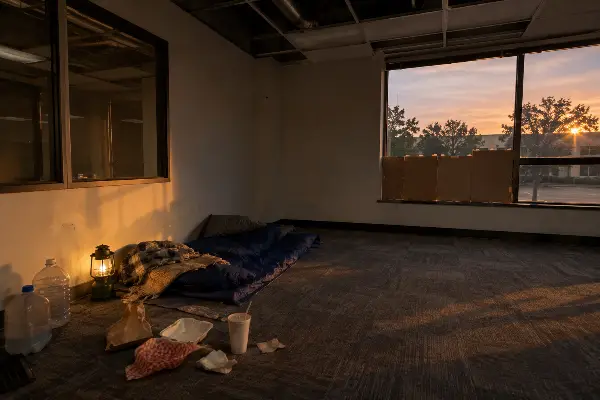
- Bedding, food wrappers or water jugs
- An extension cord run from an outside outlet
- The same car parked overnight more than once
How often depends on the building’s openings, contents and history.
Do Squatters Have Rights In Texas?
Not quickly. Under Texas adverse possession law, the shortest claim takes 3 years of open, continuous possession, and it needs title papers. With a registered deed and the taxes paid, the clock runs 5 years. With no papers, it runs 10. A lawsuit to recover the property stops it.
Those clocks never get near a building someone checks every week. The loss comes sooner: stripped wiring, fire, and a court case if someone produces papers. The U.S. Fire Administration’s guidance on vacant and abandoned buildings says it in 1 sentence: “Keeping unauthorized occupants out of vacant and abandoned buildings is key to preventing fires.”
What To Do If Someone Is Already Living Inside
Don’t go in and don’t confront anyone. Call the police and note what you can see from a safe spot. Let the law sort out anyone who claims a right to be there.
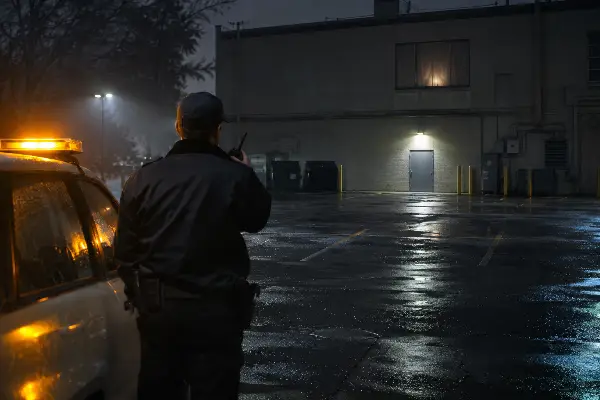
Our officers do the same on a night round. They call dispatch and police, then keep watch from a safe distance with the patrol vehicle’s lights on the area. Times, descriptions and plates go into the report.
Texas’s 2025 squatter law, SB 1333, gives owners of residential property a fast track: a sworn complaint, then a sheriff or constable orders the occupant out. It doesn’t reach a vacant shop, office suite or warehouse. For the commercial route and the insurance and permit deadlines a vacancy starts, see our guide to vacant building security.
On commercial property, a person who stays after notice can face a criminal trespass charge. If they claim a right to be there, the owner’s route is an eviction suit in the local justice court. Under SB 38, cases filed since January 1, 2026 go to trial 10 to 21 days after filing.
Penal Code 32.56 makes a fake lease or deed, shown to get in or stay, a Class A misdemeanor on any type of property. Have the officer write down any papers someone shows.
Don’t count on a guard to make an arrest. In Texas, a guard’s arrest power is a private citizen’s: a felony or an offense against the public peace, committed in the guard’s presence or view. Criminal trespass is normally a Class B misdemeanor, and the same limit decides when guards can detain you.
How To Prevent Squatters With Night Patrols In 2026
Match the coverage to the building and the calendar. A small retail bay may need a patrol route. A warehouse with copper still in the walls may need an officer on site all night.
Our officers patrol on foot or by vehicle, and we staff posts 24/7. Contracts run weekly or month to month, so coverage can stop the week a new tenant signs. Vacant buildings are part of our building security guard services. Our Houston security guard services cover Downtown and the Medical Center out to Katy, Pearland and The Woodlands.
If you’re planning how to prevent squatters at a building that’s about to empty, send us the move-out date and a list of its entrances. Reliable Guard & Patrol Service will send back a free written proposal for night coverage. Our company license with Texas DPS is B07315701.
FAQs
How do you prevent squatters in a vacant commercial building?
Put legal notice in place before the last tenant leaves, then check the building at night. In Texas, that means No Trespassing signs at every entrance under Penal Code 30.05. Inside Houston, add a trespass affidavit on file with HPD. FBI data for 2019 put 55.6% of nonresidential burglaries with a known time at night.
Do No Trespassing signs stop squatters in Texas?
Signs don’t lock a door, but they do count as legal notice. Texas Penal Code 30.05 treats a sign at a building’s entrance saying entry is forbidden as notice. After that, an uninvited entry can be criminal trespass.
How often should you check a vacant commercial building to prevent squatters?
No single schedule fits every building, but the hour matters as much as the count. The FBI’s 2019 figures put 55.6% of nonresidential burglaries with a known time at night, against 40.2% for residential ones. Check after dark, vary the times and keep a log of every round.
Do squatters have rights in Texas?
Not quickly. Texas adverse possession takes 3 years with title papers, 5 years with a registered deed and taxes paid, and 10 years otherwise. A lawsuit to recover the property stops the clock. The bigger risk for a commercial owner is damage before anyone notices.
Is it a crime to use a fake lease to stay in a building in Texas?
Yes. Penal Code 32.56, in force since September 1, 2025, covers it. Presenting a false lease or deed to get into or stay on real property is a Class A misdemeanor, commercial buildings included. If someone shows papers, write down what they showed and let the police or a court decide.
Can a security guard remove squatters in Texas?
A guard can tell people to leave on the owner’s behalf, write down what happened and call the police, but shouldn’t force anyone out. Texas gives guards a private citizen’s arrest power only, and criminal trespass is normally a Class B misdemeanor.


