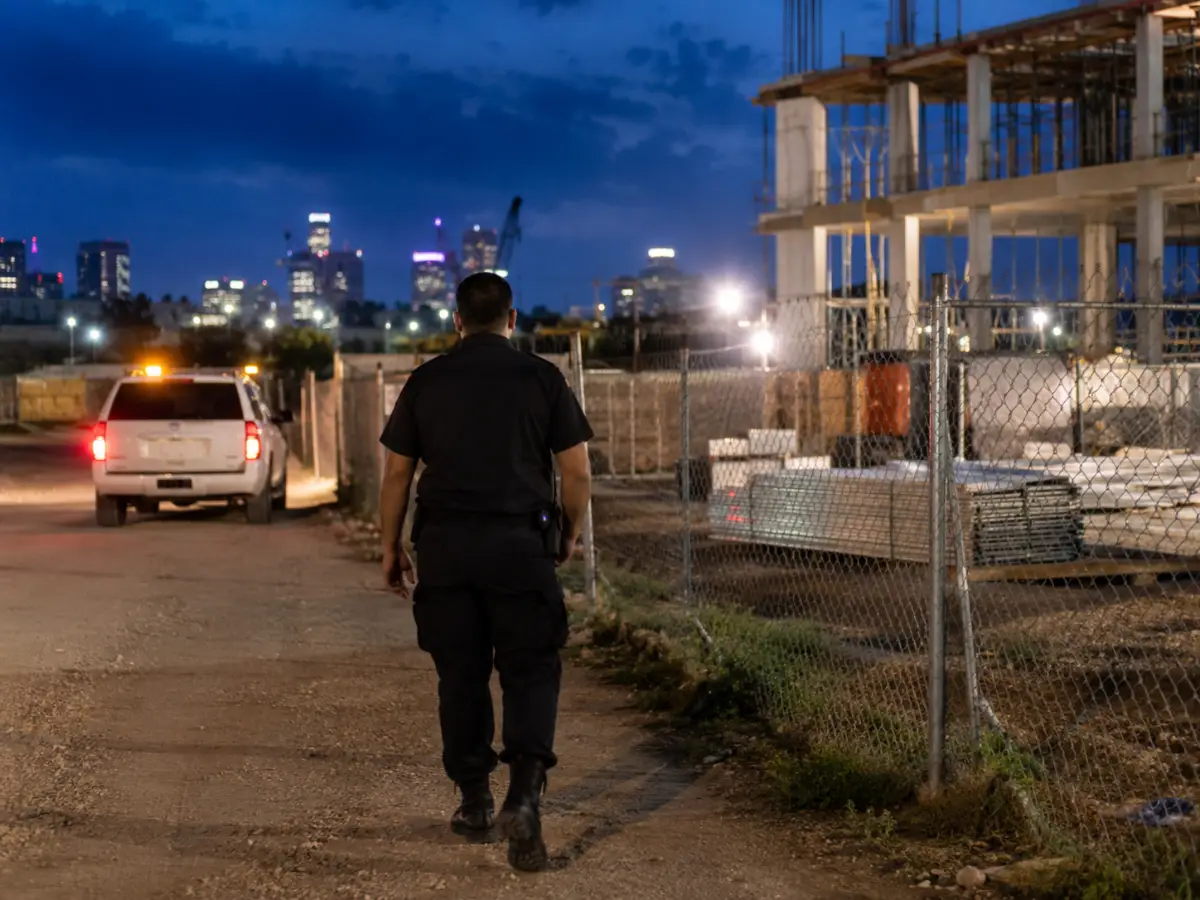
Most emergency-response advice for security guards reads the same way. Assess, call 911, evacuate, give first aid. That fits a crowded office tower. It misses what actually goes wrong at a construction yard, a warehouse, or a vacant building at 2 a.m. There, the emergency is almost never a fire or a heart attack. It’s someone cutting a fence or prying a boarded window. Security guard emergency response, done right for these sites, is built around stopping intrusion and theft, then documenting it well enough to hold up with police and your insurer. In five incidents our Houston officers logged, every one happened between 11:20 p.m. and 3:30 a.m. Every one was a theft or break-in attempt. Not one needed a shot fired. That’s the response that actually prevents losses, and it’s the job we’re hired to do.
Security guard emergency response is the trained process an officer follows when something goes wrong on a protected property: assess the threat fast, move people to safety, call 911, secure and control the scene, give first aid if certified, then write a detailed incident report for the client and law enforcement. Speed and documentation decide the outcome.
We post armed and unarmed officers at Houston commercial sites every night, so what follows is the work, not theory.
What counts as an emergency at a commercial or construction site?
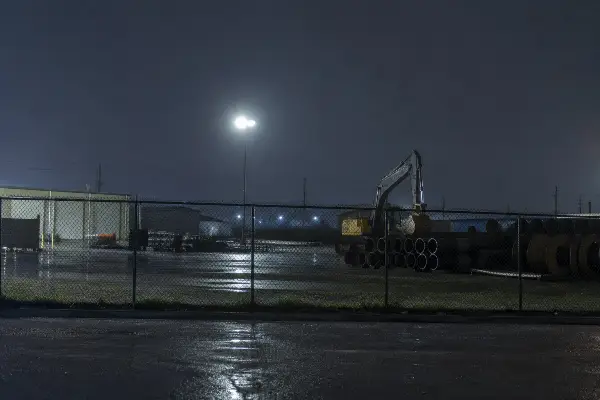
At these properties, most emergencies are security events, not medical or fire ones. After-hours intrusion, theft of materials and equipment, copper stripping, trespassing, and vandalism make up most of what an officer handles overnight.
The scale is real. In the National Insurance Crime Bureau’s heavy-equipment theft report, 11,625 machines were stolen in a single year, Texas ranked among the hardest-hit states, and fewer than a quarter were ever recovered. Once equipment or copper leaves the site, it rarely comes back. So the response that counts is the one that stops the theft before it clears the fence line.
Medical and fire emergencies still happen, and our officers train for both. But running a vacant building like it’s an office tower is how sites get hit. Good construction site security matches the plan to the threat: perimeter control, lighting, unpredictable patrol times, and fast contact with police.
The first sixty seconds of an incident
The first minute sets the outcome. Our officers work a simple sequence, whether the trigger is a tripped alarm, a suspicious vehicle, or a sound at the fence.
- Assess from cover. Read what’s happening and how many people are involved, without becoming a target.
- Make presence known when it’s safe. Emergency lights, a spotlight, a spoken challenge. Most intruders leave the second they know they’ve been seen.
- Call it in. 911 for a crime in progress, plus the site supervisor and our dispatch.
- Protect people first. Move anyone on site away from the threat.
- Hold the scene, not the suspect. Observe from a safe distance and feed live updates to police.
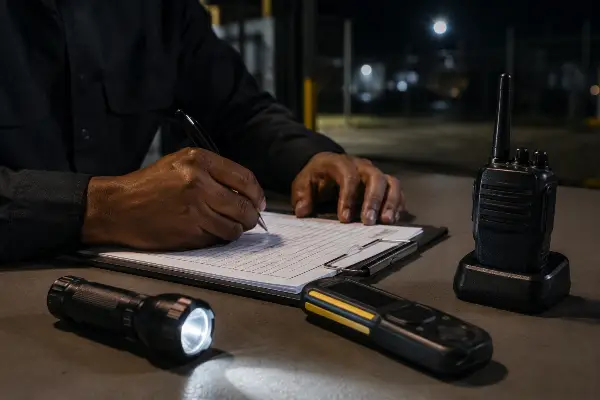
- Document everything. Time, descriptions, vehicle plates, and every action taken.
Because our officers carry GPS guard-tour devices and file real-time incident reports, that timeline is logged as it happens, not pieced together the next morning. And notice what’s not on the list: confronting or chasing. A guard who tackles a suspect trades a property crime for a lawsuit or an injury. Presence and documentation stop more losses than force does.
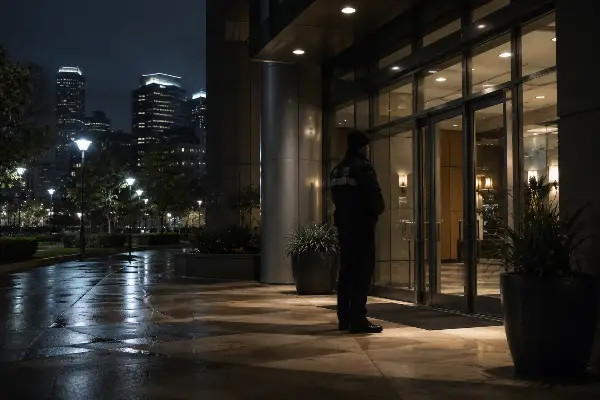
How does an armed officer’s response differ from an unarmed officer’s?
The difference isn’t attitude. It’s what the law allows each officer to do, and what the site actually needs. An unarmed, non-commissioned officer deters, observes, reports, and detains only when the law clearly allows it. An armed, commissioned officer does all of that and carries a firearm for sites with a credible violent or high-value threat.
| Situation | Unarmed (non-commissioned) | Armed (commissioned) |
|---|---|---|
| After-hours trespasser | Hit the lights, challenge, call police, log it | Same; firearm stays holstered unless a life is threatened |
| Theft in progress | Deter and observe from a distance, guide police in | Same, with added deterrent presence |
| Violent or armed intruder | Withdraw to safety, call 911, protect people | May use force; deadly force only against an imminent threat of serious injury or death |
| Cash or high-value assets | Often not the right fit on its own | Standard choice for banks, jewelry, and large payroll sites |
| Medical or fire | First aid or CPR if certified, call 911, guide responders | Same |
Most Houston commercial and construction sites are served well by unarmed coverage backed by fast police contact. Cash-heavy operations, high-value assets, or a site with a history of violence are where a commissioned officer is worth it. We staff armed officers too and match the level to the risk, not to a sales quota. In Texas terms, that means Level II training for unarmed officers and a Level III commission plus firearm-proficiency requalification for armed ones.
What can a security guard legally do during an emergency in Texas?
In Texas, a security officer’s authority is close to a private citizen’s, with training and a state license on top. They can detain, not arrest. They can use reasonable force to protect people and property, but deadly force only against an imminent threat of serious bodily injury or death.
Private security in Texas is licensed and regulated by the Texas Department of Public Safety under Occupations Code Chapter 1702. An officer may detain someone they witnessed committing a crime, or have probable cause to believe did, and only for a reasonable time until police arrive. Hold someone too long, or put hands on without cause, and a detention turns into a false-imprisonment claim. Use of force is governed by Texas Penal Code Chapter 9, which permits the minimum force a situation requires and nothing beyond it.
That’s why we train officers to observe and report first. Every officer we deploy clears a background check, drug test, license verification, an in-person interview, and reference checks before a shift. An officer who oversteps that authority creates liability for the property owner, not just for us, so we keep the limits tight and the paperwork tighter.
Five real incidents, and what they teach
Here’s what emergency response looks like across our Houston security guard services. These are five incidents our officers documented, with client names and exact addresses kept private.
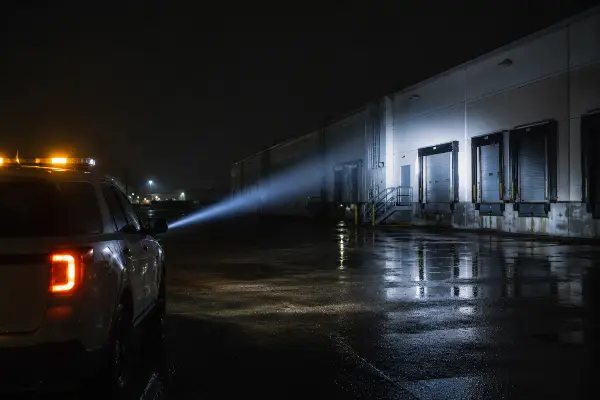
2:15 a.m., construction site. A pickup kept circling the perimeter, then stopped near a gated entrance while the people inside studied the access points. Our officer switched on the patrol vehicle’s emergency lights and moved in. The truck was gone within seconds. He logged the description and called site management. Nothing was taken.
11:40 p.m., a different yard. Two people were already hauling materials toward the fence in a dark corner of the site. The officer lit the area with a spotlight and called out. They dropped the load and ran. He recovered the materials and looped in police and the site manager.
3:30 a.m., a copper job. On a scheduled round, our officer found a storage container tampered with and a man pulling out rolls of copper wire. This one didn’t end in a scare-off. He called police, kept eyes on from a safe distance, and fed dispatch live updates until officers arrived and made the arrest. The copper went back to the site.
1:45 a.m., a vacant commercial building. Two people were trying to force a boarded-up window at the rear. The officer called dispatch and police and lit up the patrol vehicle. They ran before they got inside. The only damage was to the window covering.
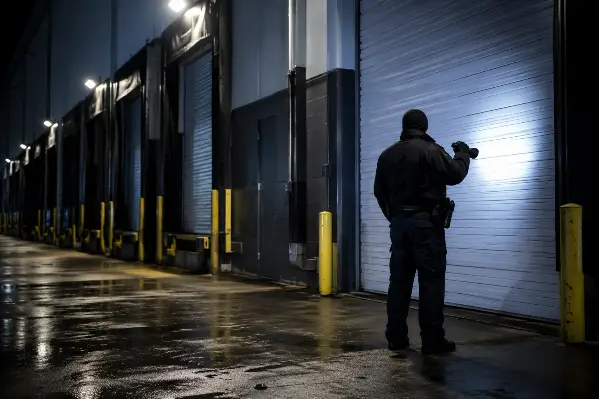
11:20 p.m., a distribution warehouse. An unfamiliar vehicle sat near the loading docks after hours while someone tried a secured storage area. The officer contacted dispatch and the site supervisor, identified himself, and told the man to leave. He complied and left. A dock check confirmed nothing was forced or missing.
Four of the five ended before anything was stolen. The fifth ended in an arrest with the property recovered. None involved a weapon. That’s the pattern across the 100-plus sites we cover: visible presence and fast, documented response prevent most of the loss.
Response time, and what happens after the incident
We provide same-day response, and we don’t run random drive-bys. Every site gets documented patrol rounds on varied timing, GPS-tracked, with supervisor check-ins.
After an incident, the officer files a written report the same shift: timeline, descriptions, photos where appropriate, and every action taken. That report goes to you, and when a crime occurred, to police. It’s what your insurer will ask for, and it’s why real-time reporting matters more than most buyers expect. A report written at 3:35 a.m. beats one rebuilt from memory at 9.
For a warehouse security client, that means dock checks and access logs. For construction, it’s material counts and gate control. The tools stay the same: GPS guard-tour devices, real-time reports, and a dedicated account supervisor who knows your site by name.
What Houston sites should expect from security guard emergency response in 2026
You should expect coverage that matches your risk, contracts that don’t trap you, and proof the company can do the work.
The biggest myth we hear is that guard coverage means a long-term contract. It doesn’t, at least not with us. We run month-to-month, weekly, short-term, and long-term, whatever the site needs. Insurance is same-day, with general liability, workers’ compensation, and commercial auto in place.
If you manage a construction site, warehouse, vacant building, or retail center in the Houston area and you want emergency response that stops losses instead of just recording them, get a free proposal and a site walk, or call (713) 783-1344. That’s where good security guard emergency response begins: knowing your property before the emergency, not during it.
FAQs
What is security guard emergency response?
Security guard emergency response is the process an officer follows when an incident happens on a protected property: assess the threat, protect people, call 911, secure the scene, and document everything in a written report. At commercial and industrial sites, that response is aimed most often at intrusion and theft, not fire or medical events.
What does a security guard do during a break-in at a commercial site?
The officer makes their presence known with lights or a spotlight, calls 911 and the site supervisor, and observes from a safe distance while guiding police in. They don’t chase or confront. In five incidents our Houston officers documented, four ended before anything was stolen, and the fifth ended in an arrest with the property recovered.
Can a security guard detain someone in Texas?
Yes, within limits. A Texas security officer can detain a person they witnessed committing a crime, or have probable cause to believe committed one, and only for a reasonable time until police arrive. They can’t arrest or charge anyone; that authority stays with law enforcement.
Do armed and unarmed guards respond to emergencies differently?
Yes. Both deter, observe, report, and call police. An armed, commissioned officer can also use force when the law allows, with deadly force reserved for an imminent threat of serious injury or death. Most commercial and construction sites are covered well by unarmed officers; cash-heavy or high-value sites are where an armed officer fits.
How fast can a security guard emergency response team reach an incident?
An officer already posted on your site responds in the moment, which is the point of on-site coverage. For new sites, we provide same-day response and can deploy quickly. Every patrol is GPS-tracked with documented rounds and supervisor check-ins.
Are security guards trained in first aid and CPR?
Officers certified in first aid and CPR provide care until EMS arrives. That said, at vacant buildings, construction sites, and warehouses, the majority of after-hours emergencies are security events like intrusion and theft rather than medical ones.
Does emergency guard coverage require a long-term contract?
No. We run month-to-month, weekly, short-term, and long-term coverage, whatever the site needs, with same-day insurance. The idea that guard service always locks you into a long contract is the most common myth we correct.


