Reliable Guard & Patrol Service staffs Houston-area refinery posts with Texas-licensed security officers. We cover contractor and main gates, TWIC and plant badge checks, perimeter rounds and added gate posts for turnarounds, all under Texas DPS company license B07315701.
Federal Vetting At Your Gate Depends On Who Regulates Your Site
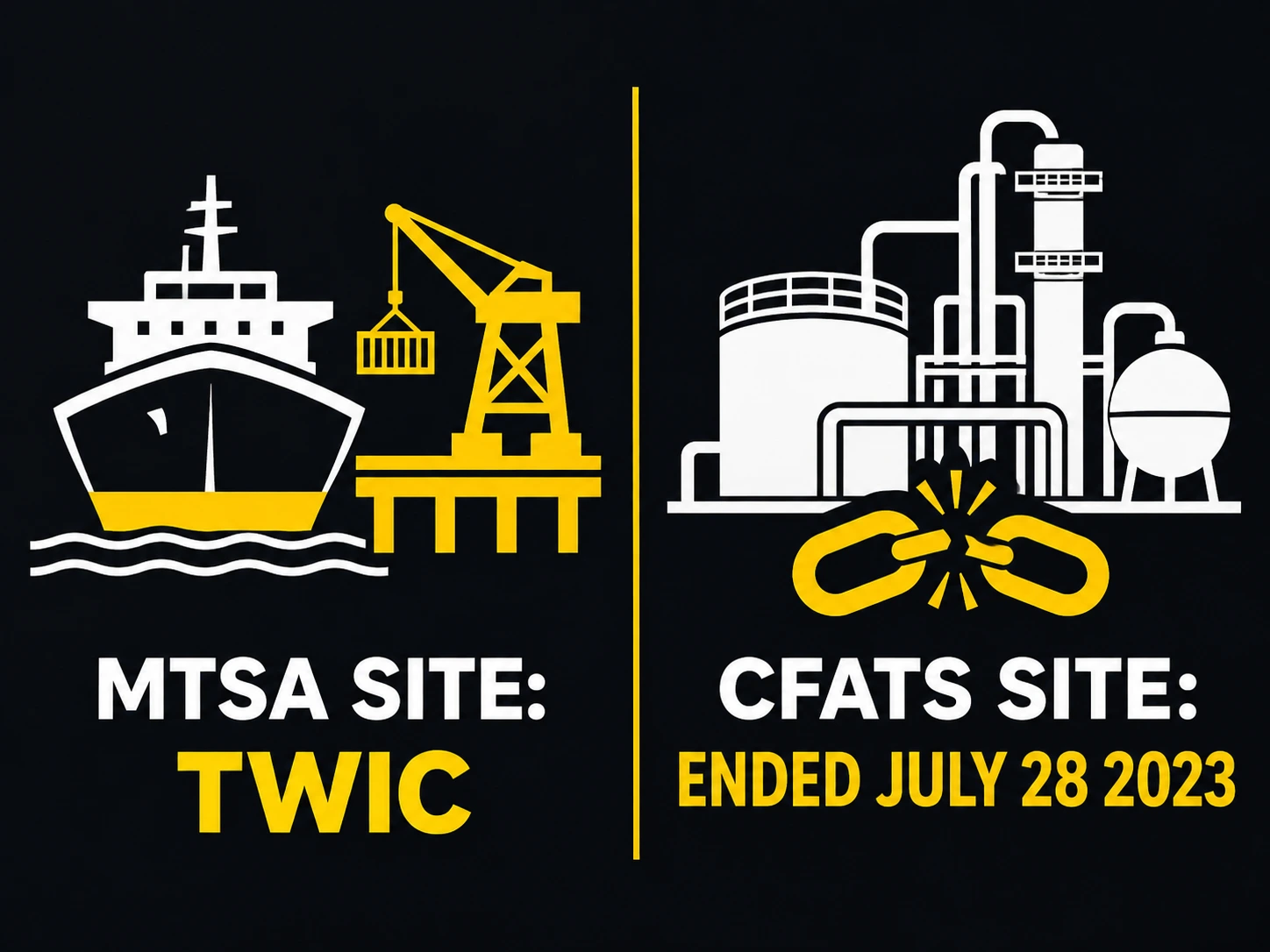
Federal vetting for the people at a Houston refinery gate comes from 1 of 2 programs, and only 1 of them still runs. Congress kept them apart: the Chemical Facility Anti-Terrorism Standards (CFATS) law excluded every facility covered by the Maritime Transportation Security Act, or MTSA (6 U.S.C. 621(4)). A refinery dock with a Coast Guard-approved facility security plan answers to TWIC rules. An inland chemical unit could answer to CFATS. Large complexes can carry both, and your facility security officer knows where the line runs.
If your site sat under CFATS, its federal vetting ended when CFATS authority expired on July 28, 2023. At that point its Personnel Surety Program was vetting about 500,000 people on a continuous basis against the government’s terrorist screening data. In its reply to GAO, DHS said that screening had turned up 13 people who were on the Terrorist Screening Database. A GAO report published September 8, 2026 found that nothing has replaced the program and that private facilities can’t check the watchlist on their own. By the same report, CISA staff assigned to chemical-sector work fell from 214 in fiscal 2024 to 52 in fiscal 2025. GAO recommended a voluntary vetting option. DHS did not concur.
No private gate can run a watchlist check. What’s left is your plant’s own screening program and how carefully your gate checks the credentials people carry.
If your site is MTSA-regulated, your federal layer is the TWIC. TSA runs a fingerprint-based criminal history check and an intelligence check before it issues a card (49 CFR 1572.21), then keeps vetting cardholders for criminal history, immigration status and ties to terrorism. That layer still works. Its weak point is the card check at your gate. What changes at an MTSA gate when the Coast Guard raises the MARSEC level is on our page about industrial security guards in Houston.
If neither program ever applied, your site never had a federal vetting layer. Your gate and your plant’s screening program were always the whole check.
If a security proposal promises “CFATS-compliant officers,” ask what that means after July 28, 2023. No CFATS program has been enforceable since.

A Visual TWIC Check Can't Tell You A Card Was Canceled
A TWIC that TSA has canceled looks the same as a valid one. Only an electronic reader or a lookup against TSA’s Canceled Card List catches it, and federal rules don’t require either at a chemical-cargo facility before May 8, 2029.
GAO’s July 2026 review of the TWIC program shows how the gap works.
- TSA adds a card to the Canceled Card List when the holder fails recurrent vetting or reports the card lost or stolen. Readers check the list automatically, and TSA updates it daily.
- Only facilities that must use readers have to check the list, and today that means facilities that receive large passenger vessels, such as cruise terminals. Everyone else may check it by hand, matching the 8-digit number on each card against a spreadsheet, which port security committee members told GAO can be subject to error.
- An official on one of those committees described a worker whose own TWIC landed on the Canceled Card List. He came to work on his father’s.
- The Coast Guard’s own inspectors have checked TWICs by eye since a July 2024 TSA server change left their handheld readers obsolete.
- TWIC problems made up 38% of the 216 facility violations Coast Guard inspectors recorded from fiscal 2019 through 2024. The most common TWIC-related deficiency, 227 of 888, was a facility failing to make sure its personnel with security duties were qualified for them (33 CFR 105.210).
That last finding is about the people at your gate. If they work for a security vendor, closing the gap is the vendor’s job, and checking it is yours.
Don’t plan around a reader mandate. 33 CFR 105.253 puts facilities that handle Certain Dangerous Cargoes in bulk into the reader group starting May 8, 2029, a requirement GAO says has slid from 2018. The Coast Guard’s regulatory agenda also lists a proposal to drop it for facilities that transfer those cargoes to or from vessels (RIN 1625-AD04). If you want electronic checks at your gate, that is your decision to make now.
The Valid-Today Check: 4 Questions Before Anyone Enters Unescorted
The Valid-Today Check is 4 questions a gate officer answers before anyone enters a refinery unescorted: is the TWIC live, is the holder the person on it, is the plant badge active today, and is the orientation current. Every credential at your gate was valid on the day it was issued. These questions ask about today.
- Is the TWIC live? Where your site has readers, the reader answers. Where it doesn’t, someone checks the card number against TSA’s Canceled Card List when the plant badge is issued, and again on a schedule your facility security officer sets. The expiration date printed on the card answers a different question.
- Is the holder the person on it? Photo to face, on every entry, including the 6 a.m. rush. A card-only read passes a valid card in the wrong hands, and this question doesn’t.
- Is the plant badge active today? The badge reader says yes, and the badge office’s deactivation list for the day doesn’t say no. Terminations, failed random tests and lapsed orientations reach the gate through that list or not at all.
- Is the orientation current? Safety Essentials or its annual Enhancer inside the last 365 days, or the window your site sets, plus your site’s own orientation. HASC and ISTC both stopped teaching Basic Orientation Plus on January 1, 2025, so check any contractor packet that still names it.
Fail any question and the person waits outside the gate or enters with a named escort. The officer logs which question failed and who approved the escort. Nobody gets waved through for today only.
CALL US FOR SMART SECURITY SOLUTIONS
We Cover Houston, TX, Sugar Land, TX, Pearland, TX, Conroe, TX
Your PSM Program Already Gives The Gate A Job
OSHA’s Process Safety Management standard requires a refinery to control the entrance, presence and exit of contract employers and contract employees in its covered process areas (29 CFR 1910.119(h)(2)(iv)). If security officers run your gates, they carry part of that duty, and the post orders should say how.
The same paragraph requires the refinery to explain the applicable parts of its emergency action plan to contract employers (1910.119(h)(2)(iii)). Before the first solo shift, a gate officer needs 4 answers from that plan:
- where each muster point is and which crews report to it
- what each alarm tone means
- how a shelter-in-place order reaches the gate
- which lane stays open for emergency vehicles, and who holds the key to that gate
PSM’s contractor rules cover maintenance, repair, turnaround, major renovation and specialty work on or adjacent to a covered process, and they leave out incidental services such as janitorial and delivery work (1910.119(h)(1)). Ask your PSM coordinator which side your security contract falls on. If your site treats it as covered work, the orientation rules below apply to the officers too.
Get Your
Free Armed & Unarmed Security Proposal
Why Houston businesses choose Reliable Guard & Patrol Service
Why Choose Our Armed Guards:
01. Fully Licensed to Carry in the State of Texas
02. Background-Checked and Drug Tested
03. Trained in Firearms Handling and De-Escalation
04. Experienced in High-Risk Property Protection
05. Serving Houston Businesses for Over 20 Years
06. Corporate, Construction, Retail, and Event Coverage
07. 24/7 Coverage Including Holidays
What Gets A Contractor Through A Houston Refinery Gate In 2026
A contractor needs up to 4 credentials to get through a Houston refinery gate in 2026: a TWIC where the site is MTSA-regulated, the plant’s drug and background clearance, a current Safety Essentials record, and the site’s own orientation. The orientation requirement changed on January 1, 2025. Check that your contractor packets changed with it.
TWIC
Federal rules require one for unescorted access inside an MTSA secure area. TSA’s advice is to apply at least 60 days before the card is needed. Some applications take longer than 45 days, and TSA doesn’t offer expedited delivery.
Drug And Background Screening
Your plant’s program, on your plant’s rules. Our own hiring screen runs before yours: every officer clears our background and drug checks, a license check, an interview and reference calls. A TWIC involves no drug test, and a Texas security officer license doesn’t stand in for your plant’s screen unless the plant says it does.
Safety Essentials
On January 1, 2025, the Health and Safety Council (HASC, formerly the Houston Area Safety Council) stopped teaching Basic Orientation Plus, and so did the Industrial Safety Training Council (ISTC). Both now teach Safety Essentials as their only PSM contractor orientation.
At HASC, the base course runs 3 hours and costs $35. The annual refresher, Safety Essentials Enhancer, runs 90 minutes, costs $25 and is open to anyone who passed Safety Essentials within the previous 4 years. HASC lists a 1-year expiration for both.
In July 2024, the chair of the East Harris County Manufacturers Association’s best practices committee said its executive board recommends that all member companies use Safety Essentials starting January 1, 2025.
Your Site Orientation
Your plant’s own course, on your plant’s schedule. Build its hours into the first week of any new post.
If a security vendor’s onboarding packet still sends officers to Basic Orientation Plus, ask when it was last revised.
Turnarounds: Start The Gate Plan 60 Days Out
A turnaround can more than triple the number of people working inside a refinery’s fence. Start the gate plan at least 60 days before the first contractor arrives, because that’s TSA’s planning lead time for a new TWIC.
In a 2007 analysis of refinery outages, the U.S. Energy Information Administration wrote that as many as 1,500 to 2,000 skilled contractor workers may come on site for a turnaround, and that staff more than tripling is not unusual. Refiners plan turnarounds on major fuel production units every 3 to 5 years, and a unit can stay offline for weeks to months.
Do the gate arithmetic before the first bus pulls in. Say 1,800 contractors badge in between 5:30 and 6:30 a.m. That’s 30 people a minute. If a full Valid-Today Check takes 10 seconds, 1 lane clears 6 people a minute, so the morning rush needs 5 staffed lanes. Swap in your own headcount and your own check time. The lane count is what you’re staffing, and the evening exit runs the same math in reverse.
Use 1 vendor for the base post and the turnaround posts. Officers who already know your gate brief the added officers on it, and 1 account supervisor answers for the whole roster.
Refinery Work We Don't Take
Rule us out early if your request is one of these 3.
- Fire watch. On a covered process, hot work needs a permit, and the permit has to document that the fire prevention rules in 29 CFR 1910.252(a) are in place before work starts (1910.119(k)). Those rules require fire watchers wherever welding or cutting could start more than a minor fire, and under 4 more listed conditions. That duty belongs to whoever issues the permit. We don’t staff it.
- Detection dogs. We don’t run K-9 teams. If your turnaround plan puts a dog at the gate, book a K-9 provider.
- Multi-state contracts. If you need 1 contract across refineries in 4 states, you need a national firm. We work the Houston area.
A peace officer at the gate is a separate request we can fill. We place off-duty officers through our company license, and our page on off-duty police officers for security in Houston covers the department rules that come with them.
Frequently Asked Questions
Is CFATS still in effect for Houston refineries?
No. CFATS authority expired on July 28, 2023, and Congress had not renewed it as of November 2026. In September 2026, GAO reported that nothing has replaced its worker vetting. Refineries that fall under the Maritime Transportation Security Act were never under CFATS, and their federal vetting runs through the TWIC.
Do refinery gates have to read TWICs electronically?
Not before May 8, 2029, for facilities that handle Certain Dangerous Cargoes in bulk (33 CFR 105.253), and the Coast Guard’s agenda lists a proposal to drop that requirement for facilities that transfer those cargoes to or from vessels. Until a reader rule applies to your site, visual inspection is allowed and checking TSA’s Canceled Card List is voluntary.
Does a TWIC replace our drug and background screening?
No. TSA’s assessment covers criminal history, immigration status and ties to terrorism, and it includes no drug test. Your plant’s program sets the drug panel and the background rules.
Is Basic Orientation Plus still accepted?
HASC and ISTC stopped teaching it on January 1, 2025 and teach Safety Essentials in its place. Whether your site still honors an older Basic Orientation Plus record is your site’s call, so check before a crew shows up with one.
Get A Refinery Post Quoted
Send the site, the gate count, the shifts and any turnaround dates. The written proposal that comes back names the officer type, each officer's TWIC status and the rate. Sign it, and your certificate of insurance arrives the same day.