Reliable Guard & Patrol Service puts Texas-licensed security officers, unarmed or armed, on Houston industrial property: warehouses and distribution buildings, construction and expansion sites, and industrial buildings that sit empty. Every post runs under Texas DPS company license B07315701, from a roster of about 150 officers. Most unarmed posts start the same day, and an agreement can run for as little as 1 week.
Industrial property we staff in Houston
We cover 3 kinds of industrial property, and each one loses money at a different point. Freight walks out through the dock. Equipment and wire leave through a gate somebody left open. An empty building loses its copper from the inside, a room at a time, and nobody notices for weeks.
Freight docks and inventory aisles
The officer watches the loading docks, checks shipments and deliveries against the paperwork, decides who gets through the employee and visitor doors, and walks the inventory aisles between gate duties. That post goes after cargo and inventory theft, theft by insiders and losses at the dock doors. Dock-heavy operations have their own page on warehouse security guards in Houston, and all of our Houston security services are listed on one page.
Construction and expansion sites
During work hours the officer holds the gate and checks crews and deliveries in. After the crews go home, the post becomes rounds of the equipment rows and material stacks. Tools, rented machines, spools of wire and after-hours trespass are what these posts are built around, and our page on construction site security guards in Houston covers active job sites in depth.
Empty industrial buildings
Every round tests each door and window, looks for signs of forced entry and records the condition of the building, and the officer reports leaks, damage and safety problems to the owner. Empty buildings draw squatters, copper stripping, vandalism, arson and illegal dumping, and a building with no one checking it can lose its wiring long before anyone sees the damage from the street.
Copper theft on Houston industrial sites in 2026
Scrap copper pays more in Houston this year, and HPD says more of it is being stolen. Sgt. Bob Carson, who leads HPD’s metal theft division, told ABC13 on October 13, 2026 that Houston scrap yards are paying over $5 a pound for copper, up from $4.20 to $4.50 a pound at the same point last year. He said cases are running ahead of 2025, that much of the theft targets communication wire, and that his division has 2 detectives who spend all day at the scrap yards.
Cargo theft data for the U.S. and Canada leans the same way. Verisk CargoNet logged 677 supply chain thefts in the second quarter of 2026, 26% fewer than a year earlier, yet losses climbed to $304.6 million from $135.7 million. Metal thefts rose from 54 to 80, and copper stayed the most targeted metal.
On industrial property, copper sits in places nobody inventories: yard lighting circuits, temporary power on an expansion, grounding runs, a spool left in a storage container over the weekend, and the wiring inside a building no one has walked through in a month.
Texas charges this as a felony. Theft of copper, aluminum, bronze or brass worth less than $20,000 is a state jail felony under Penal Code 31.03(e)(4)(F). For offenses since September 1, 2025, Senate Bill 1646 also moves the charge up 1 category when copper or brass is taken from a critical infrastructure facility, or from equipment or communication wires connected to one, fenced or not (Penal Code 31.03(f-2)). Whether your site fits the definition in Penal Code 31.01(15) is a question for your attorney.
A charge holds up better with a record behind it, and our officers log every round by GPS and file incident reports in real time. One of them, checking a Houston construction site at 3:30 a.m., came on a tampered-with storage container and someone removing copper wire rolls. The officer phoned police, watched from a safe distance and kept dispatch posted until units pulled in. Responding officers made the arrest, and site management got the wire back.
CALL US FOR SMART SECURITY SOLUTIONS
We Cover Houston, TX, Sugar Land, TX, Pearland, TX, Conroe, TX
The Industrial Gate Matrix: 5 checks for every industrial post
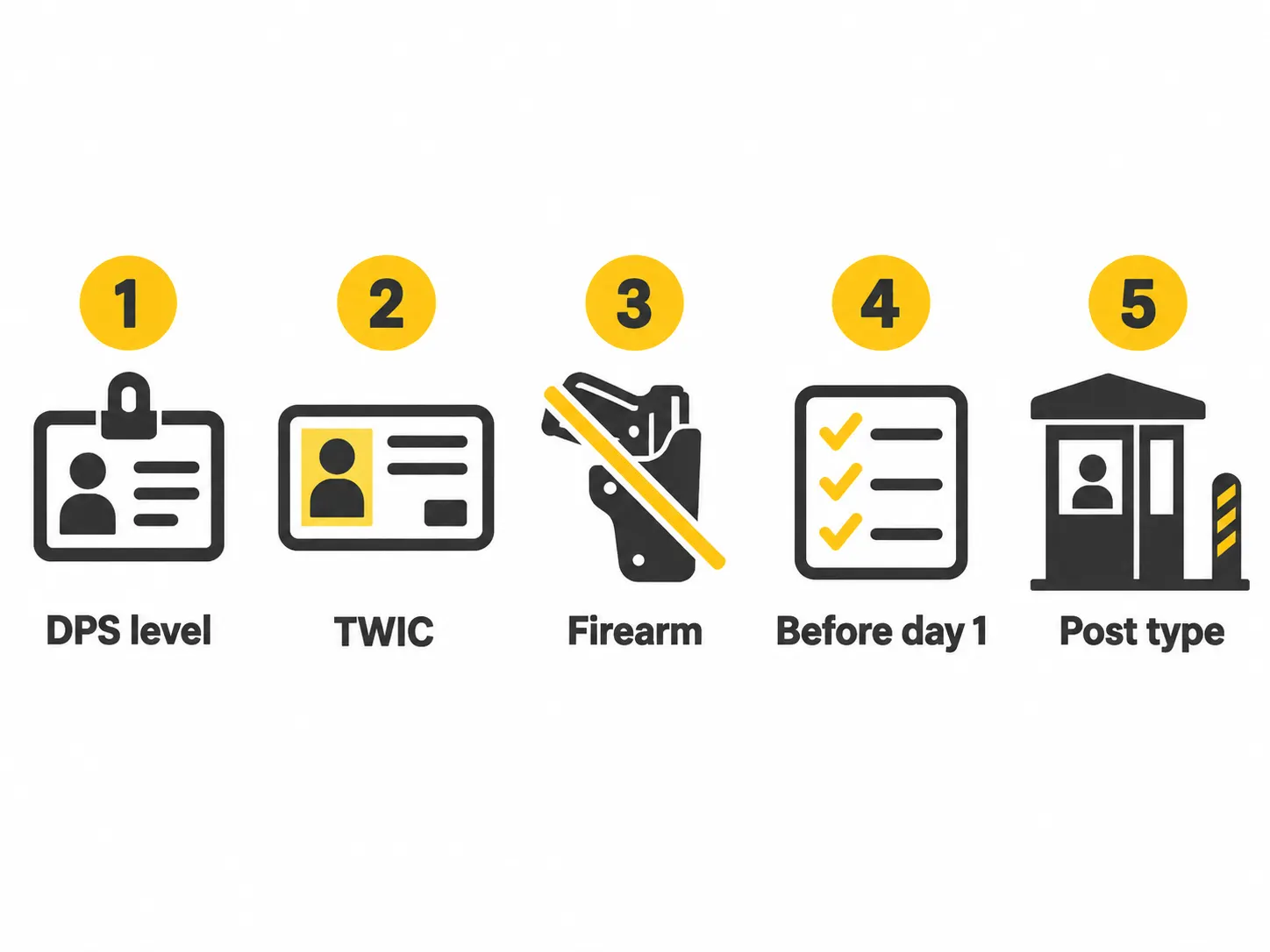
5 checks decide how an industrial post in Houston gets staffed: the officer’s DPS registration, whether the post needs a TWIC (the federal Transportation Worker Identification Credential), whether a firearm is allowed, what has to be in place before the first shift, and which kind of post fits. We call the combination the Industrial Gate Matrix. Find your site below, and if it fits 2 descriptions, the stricter one wins.
Warehouse or yard off port property
A Level II officer for an unarmed post, a Level III commission for an armed one. No TWIC. A firearm is allowed with the commission and the owner’s approval. Before the first shift: written post orders, a site map with every gate marked and an after-hours call list. The usual fit is a gate or dock post plus GPS-logged rounds.
Construction or expansion site
Level II or Level III. A TWIC only if the work sits inside an MTSA secure area, such as an expansion at a waterfront terminal. The owner decides on firearms, and at an operating facility the site rules bind every contractor, security included. Before the first shift, the officer clears any badge or safety orientation the owner requires. The usual fit is gate control during work hours and overnight rounds of the equipment and material yards.
Empty industrial building
Level II. No TWIC. An armed officer is rarely worth the rate on an empty building. Before the first shift: keys, a documented baseline of the building’s condition and the alarm company’s contact, since our officers don’t respond to alarm calls. The usual fit is patrol rounds that test doors and windows and look for signs of entry.
Post inside an MTSA facility's secure area
Level II or Level III, plus a TWIC for every officer who needs unescorted access. Federal rules define a secure area as the part of a facility where the operator controls access under a Coast Guard approved security plan (33 CFR 101.105), and that plan and the facility’s own rules decide on firearms. Before the first shift, each officer’s TWIC status is confirmed and the plan’s MARSEC procedures go into the post orders. The usual fit is an access control point run to the facility security plan.
Port Houston facility
Level II, unarmed. A TWIC for unescorted access to restricted areas, and entry also turns on business need and Port approval. Firearms are not permitted, concealed or open. Random vehicle screenings run at every entry point, and refusing one means no entry. The only post that fits is an unarmed one.
Get Your
Free Armed & Unarmed Security Proposal
Why Houston businesses choose Reliable Guard & Patrol Service
Why Choose Our Armed Guards:
01. Fully Licensed to Carry in the State of Texas
02. Background-Checked and Drug Tested
03. Trained in Firearms Handling and De-Escalation
04. Experienced in High-Risk Property Protection
05. Serving Houston Businesses for Over 20 Years
06. Corporate, Construction, Retail, and Event Coverage
07. 24/7 Coverage Including Holidays
Ship Channel posts: TWIC, the port's firearm rule and the security district
On the Ship Channel, a federal credential and the facility’s security plan decide who works the gate. A Texas DPS license makes an officer legal to hire. It does not open a secure area.
TWIC
The Maritime Transportation Security Act requires a TWIC for workers who need access to secure areas of regulated maritime facilities and vessels, and TSA issues the card (TSA TWIC program). At Port Houston, anyone entering a secure-restricted area without one has to be escorted by an approved TWIC escort, and holding a card still doesn’t guarantee entry: access depends on business need, approval and the TWIC. An officer who needs an escort can’t hold a post alone, so the credential gets settled before the schedule does. Tell us on the first call if any post sits inside a secure area, and we confirm each officer’s eligibility before we quote.
Port Houston's firearm rule
Port Houston’s facility security plans took effect on January 1, 2016, and under them neither concealed nor open carry of firearms is permitted in Port Houston facilities, including buildings, docks and other secured or restricted areas. An armed officer at a Port Houston facility is a line item you can’t use, so we price those posts unarmed from the start. Private terminals and plants along the channel set their own rules in their own security plans.
The Houston Ship Channel Security District
Industrial facilities inside the Houston Ship Channel Security District already pay into channel security. Harris County Commissioners Court created the district in 2009 under House Bill 3011, which the governor signed in 2007, and its main source of money is assessments on facilities inside its boundaries. Residential property and most retail businesses and utilities are left out of the definition of a facility.
According to an April 2025 district presentation, the district put up the 25% local cost match on $75.8 million in Port Security Grant Program projects over 13 years. The money bought radar, sonar and security sensors, night vision and motion detection equipment, video analysis software, wireless and fiber communications, and marked patrol boats and cars. The district also funds 2 intelligence analysts through the Texas DPS Joint Crime Intelligence Center, and it offers members courses such as Facility Security Officer, MTSA, cyber awareness, active shooter and IED awareness.
All of that watches the waterway and the corridor. Your contractor gate at 5:45 a.m. and your yard at 3 a.m. still need an officer. For the east side of the corridor, see our page on security guards in Pasadena.

MARSEC levels: what changes at an MTSA gate
An MTSA facility can be required to change its security posture within 12 hours, and that can change how many officers you need. The Maritime Security (MARSEC) level is set by the Coast Guard Commandant, and a Captain of the Port can raise it for a port (33 CFR 101.200). When the level goes up, the facility must have the added measures from its approved security plan in place within 12 hours and report compliance or noncompliance to the Captain of the Port (33 CFR 105.230).
Level 1 is the everyday floor. Under 33 CFR 105.255, the facility screens people, bags, personal effects and vehicles at the rate its plan sets, checks the identity and reason for entry of anyone without a TWIC, and identifies the access points that must be secured or attended.
Level 2 measures can include more frequent and detailed screening, extra personnel guarding access points and patrolling the perimeter, closing some gates, and turning away visitors who don’t have a verified destination.
Level 3 measures can include screening every person and bag, admitting only those responding to the incident, suspending access or cargo operations, and stepping up patrols inside the facility.
Extra officers at the gates and on the fence line appear in the regulation itself as a Level 2 measure. Put your Level 2 headcount in writing before the first shift, so the 12-hour clock starts with a plan instead of a phone tree.
Armed or unarmed on industrial property
Default to unarmed on industrial property. Arm a post when the owner allows firearms and the site carries a risk an unarmed officer can’t answer, such as cash on site or a documented threat. A Texas security officer needs a Level III commission to carry a firearm on duty, and 2 kinds of site take the choice away: Port Houston facilities, where firearms aren’t permitted, and MTSA facilities whose security plans set their own rules. Requalification and renewal for commissioned officers are covered on our page about armed security guards in Houston.
What sets the price of an industrial post
5 inputs set the rate for an industrial post, and the free written proposal gives you that rate before you commit:
- A Level III commission costs more to train, insure and keep current than a Level II registration.
- Posts inside a secure area need officers who hold a TWIC.
- A post staffed 24 hours a day, 7 days a week, costs more than a nights-and-weekends post.
- Owner requirements before the first shift, such as a safety orientation or badging, add hours to the job.
- A fixed post at 1 gate and patrol rounds across a large yard price differently.
For Houston guard wage data and the math behind 24/7 staffing, read our breakdown of what a Houston security guard costs.
How an industrial post starts
Most unarmed industrial posts start the same day. It runs in this order: a first call, a free written proposal, a site assessment where the layout calls for one, then deployment. Insurance on every post includes general liability and workers’ compensation, plus commercial auto. Approve the proposal, and the insurance certificate follows that same day.
Terms follow the job. A 3-week project gets a 3-week agreement, and a long build can sign a long-term agreement or stay month to month. Each account gets its own account supervisor. Each shift leaves a record: GPS logs of every round, incident reports filed as events happen, and supervisor check-ins.
Frequently Asked Questions
Do your officers need a TWIC for my site?
Only if a post sits inside the secure area of an MTSA-regulated facility or a restricted area at a Port Houston facility. Everywhere else, the officer’s Texas DPS registration meets the state requirement. Tell us on the first call, and we confirm officer eligibility before we quote.
Can an armed officer work at a Port Houston facility?
No. Port Houston’s facility security plans, in effect since January 1, 2016, permit neither concealed nor open carry of firearms in Port Houston facilities. Plan those posts as unarmed from the start.
What happens at my gate if the MARSEC level goes up?
The facility has 12 hours to put its higher-level measures in place (33 CFR 105.230), and Level 2 measures can include extra personnel at access points and on perimeter patrol (33 CFR 105.255). Settle the Level 2 officer count on paper before day 1.
What can delay the first shift on an industrial site?
3 things, and the site controls each one: a TWIC requirement, an owner’s badging process and a required safety orientation. When none of them applies, an unarmed officer can usually be on the post the day you call.
Can I book an industrial post for a short project?
Yes. Long-term contracts aren’t required. Weekly and month-to-month terms are both available, along with fixed terms that end when the project does.
Get an industrial post quoted
Send the site address, what's on the property and the hours you need covered. Back comes a written proposal listing the officer type, the post orders and the rate. Approve it, and the insurance certificate arrives that day.