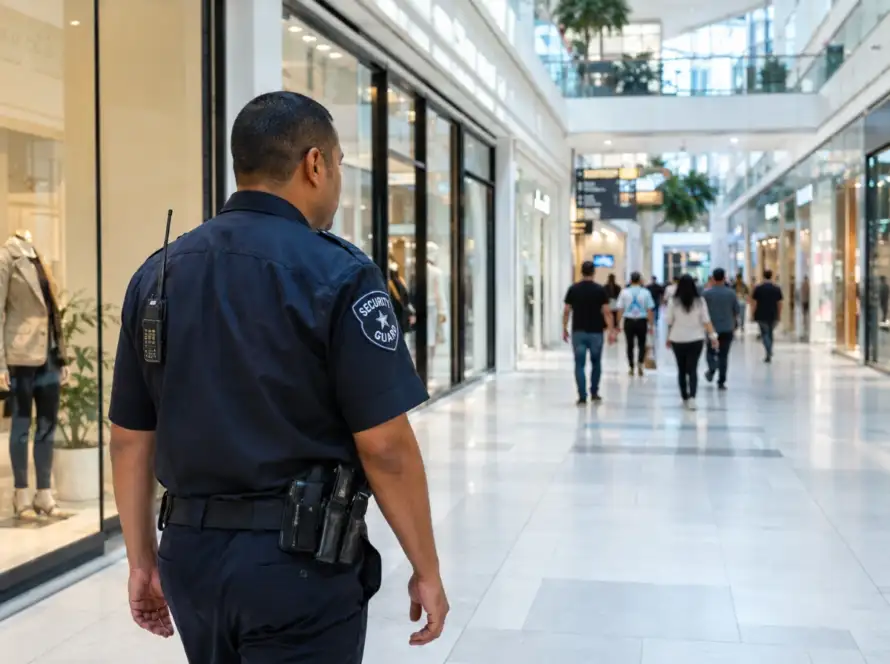
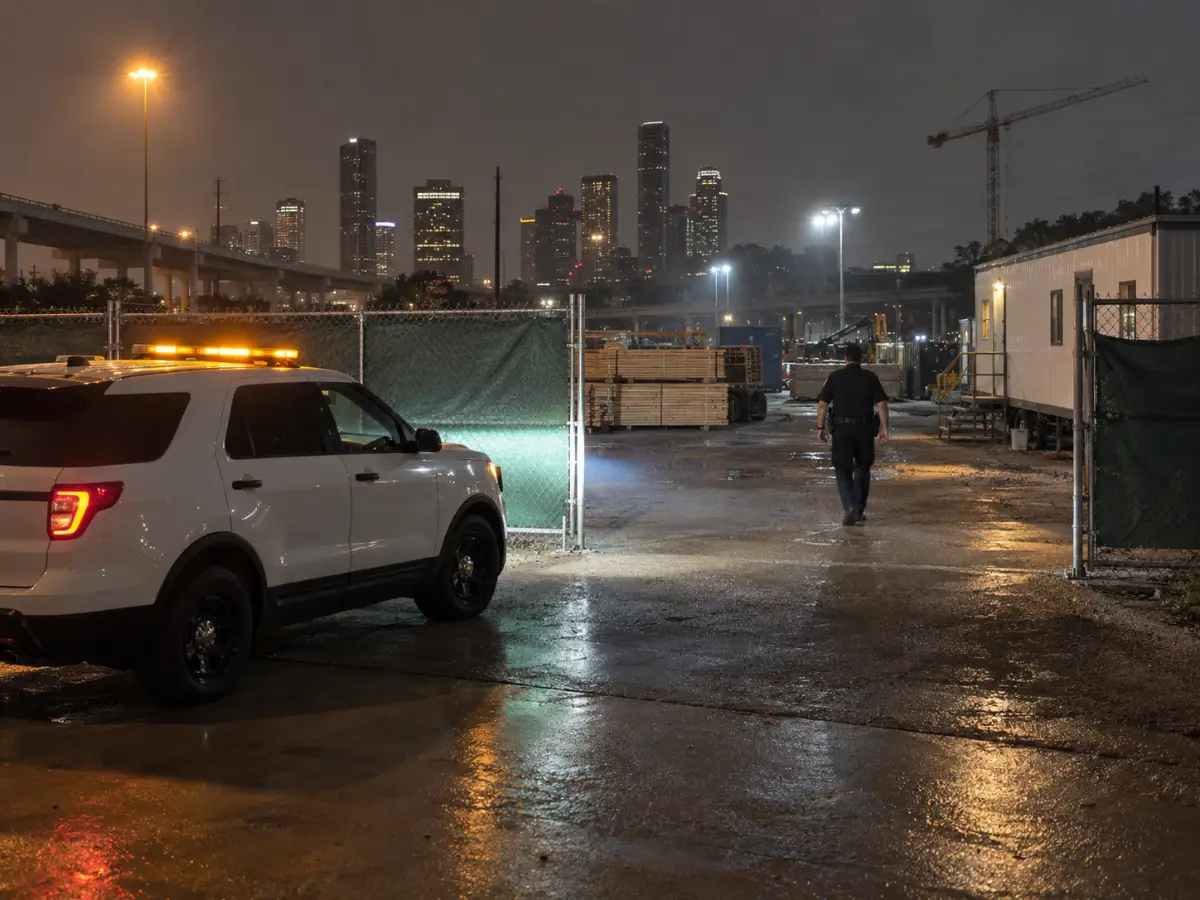
Houston spent $3.5 million on gunshot detection. A Houston Chronicle review of nearly 4,400 alerts found fewer than 5% led to an arrest, and more than 80% never produced an incident report. In May 2024 the mayor called the program a gimmick.
So here’s the short answer for a property owner. Gunshot detection tells you a shot was fired and roughly where. That’s it. It doesn’t stop the shot, it doesn’t put anyone on your property, and the peer-reviewed evidence says it doesn’t reduce crime. What it does well is shave time off a 911 dispatch. If nobody is already on your site, that saved time still ends with you waiting for a patrol car.
We don’t sell sensors. We put officers on Houston commercial property. We’ve spent enough nights on construction sites and loading docks to know where the tech helps and where it just makes paperwork.
What is gunshot detection?
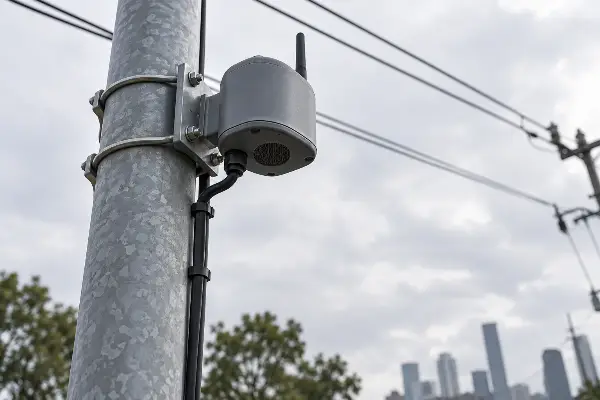
Gunshot detection is a sensor network that listens for gunfire and reports it.
Gunshot detection is a network of fixed sensors. They pick up the pressure wave and muzzle blast of a firearm discharge. Software filters that signal against other loud noises, then sends a located alert to dispatch. Most municipal systems are acoustic. Vendors market newer ones as energy-based, but the sensing is still pressure-wave measurement.
The category sits on the federal Authorized Equipment List as 14SW-01-ASTN, which is how cities pay for it with homeland security grant money. That listing is worth knowing if someone tells you a system is federally approved. Being grant-eligible isn’t the same as being proven.
Does gunshot detection reduce crime?
No. The best available evidence says it doesn’t.
In February 2026, Jessica Huff, Brenna Dunlap and Roderick Pearson published a systematic review in the American Journal of Criminal Justice. It covered every study they could find on the technology. They pooled 44 effect sizes from 8 studies. The result was a rate ratio of 1.02 with a confidence interval running from 0.90 to 1.16, which in plain terms means no measurable effect either way. Their conclusion: the technology “will not reduce crime on its own.”
The same review found the thing it does do. In Kansas City, alerts got a police response 93 seconds faster than a 911 call. In Las Vegas, about 3% of alerts ended in an arrest.
That’s the honest trade. You’re buying 93 seconds, not a safer property.
What Houston’s $3.5 million program actually bought
Houston ran gunshot detection under a $3.5 million contract and got very little back on paper.
The city put ShotSpotter into several neighborhoods on a 5 year deal. A Houston Chronicle analysis of nearly 4,400 alerts found fewer than 5% resulted in an arrest. More than 80% of alerts never produced an incident report at all. Council members spent 2023 asking the police department for evaluation data that hadn’t been produced.
On May 28, 2024, Mayor John Whitmire said it plainly at a budget workshop: “I think it’s a gimmick. A feel-good program. Most law enforcement officers do not support ShotSpotter. I don’t support it.”
Chicago’s numbers ran the same direction, and the sample there is much larger. The Chicago Office of Inspector General reviewed 50,176 alerts from January 2020 through May 2021. Just 9.1% turned up evidence of a gun-related crime. Only 2.1% connected to a documented investigatory stop.
None of that means the sensors failed to hear gunshots. It means most gunshots don’t leave anything for an officer to find 12 minutes later.
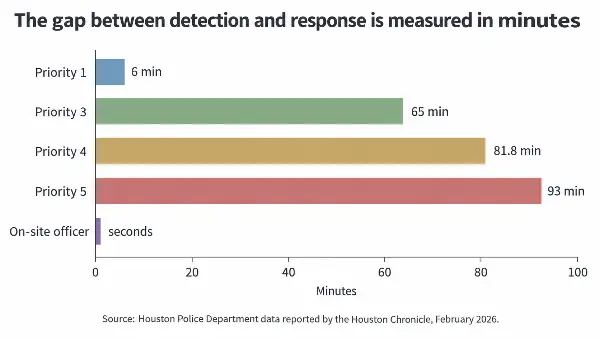
The gap between detection and response is measured in minutes
Detection shortens the time you find out. It does nothing to the time somebody arrives.
Houston Police Department data reported by the Houston Chronicle in February 2026 shows the size of that second gap. In 2025, top priority calls averaged 6 minutes. Priority 3 calls averaged 65 minutes, priority 4 averaged 81.8 minutes, and priority 5 averaged 93 minutes. Those lower tiers improved 14% year over year, and a data scientist who reviewed the numbers attributed the improvement to fewer calls rather than more officers.
Shots fired gets dispatched fast. Almost nothing else on a commercial property does. A trespasser at your fence line at 2 a.m. is not a priority 1 call.
That’s the arithmetic that decides whether detection is worth anything to you. A sensor that alerts in 5 seconds still leaves you waiting for the drive. An officer standing 200 feet away closes that distance while the alert is still rendering.
Gunshot detection vs an officer already on site
Neither one replaces the other. They do different jobs, and only one of them shows up.
What each layer actually does
| Job | Gunshot detection | On-site officer |
|---|---|---|
| Detects a firearm discharge | Yes, within seconds | Yes, if within earshot |
| Detects theft, trespass, vandalism | No | Yes, the majority of what we log |
| Locates the event | Yes, approximately | Yes, and can walk to it |
| Physically responds | No | Yes, in seconds |
| Deters before anything happens | No | Yes, a marked vehicle and lights turn people around |
| Identifies caliber or weapon type | Vendor claim, not independently verified | Reports what the officer observed |
| Produces a written incident record | Alert log only | Full report, photos, timestamps |
| Works when the network is down | No | Yes |
| Reduces crime in published studies | No measurable effect | Not studied at this level |

Where gunshot detection earns its place
There are 3 situations where we’d tell a client the sensors are worth the money.
The first is a large open site where a person can’t hear across it. A rail yard, a tank farm, a several-hundred-acre industrial property. Coverage geometry is the whole argument there.
The second is a site where the alert triggers something automatic and useful, like a lockdown on interior doors or a camera slewing to the zone. The alert has to do work, not just ring.
The third is a campus with its own dispatch and its own officers standing by. Detection plus an internal responder is a real chain. Detection wired to a 911 queue is a notification service.
Where it fails on a commercial property
Gunshot detection misses almost everything that actually happens to Houston commercial sites.
Look at what our officers log. Copper wire pulled from a storage container. Materials carried toward a fence line. A pickup truck circling a gated entrance at 2 a.m. Two people prying at a boarded window on a vacant building. A vehicle parked at a loading dock after hours. Not one of those events makes a sound a gunshot sensor is built to detect.
Nationally, the underlying problem is shrinking too. Pew Research reported in April 2026 that firearm homicides fell for a third straight year. CDC figures put the drop at 17,927 in 2023 to 15,364 in 2024, down 27% from the 2021 peak. Gun violence is real and it is also getting less common. Theft on job sites is not.
If your losses are equipment, copper, cargo, and after-hours entry, a gunshot sensor is the wrong purchase. It’s built for a category of event that probably isn’t the one costing you money.
What does an armed officer in Texas actually do when shots are fired?
They report, they take cover, they protect people, and they call police. They don’t take over.
Texas splits security officers into 2 tiers. An unarmed officer holds a Level II registration. An armed officer carries a firearm under a Level III commission, which the Texas Department of Public Safety requires a minimum of 45 classroom hours to obtain. Neither tier is a peace officer. Our officers have no arrest powers beyond what any private citizen has, and any use of force is judged under the Texas Penal Code, not police standards.
The firearm side isn’t a one-time test either. Under Texas Occupations Code 1702.301, a security officer commission expires no later than 2 years after it’s issued. Section 1702.309 then requires the officer to re-demonstrate handgun proficiency within the 90 days before each renewal, plus 6 hours of continuing education. That proficiency exam has a written part and a live-fire part, and only a department-approved instructor can give it.
What that means on a real site: the officer’s first job when shots are fired is to get people to cover and get accurate information to 911 fast. Location, direction, description, how many. A trained officer on your property is a better source than a sensor, because the officer can also tell dispatch who is hurt and where the exits are.
Every armed officer we deploy meets that requalification cycle. Before anyone stands a post, we run background checks, drug testing, license verification, and reference checks. If you want the difference spelled out, we wrote a longer piece on armed security versus police.
Does Reliable Guard sell gunshot detection?
No. We don’t install or sell sensors of any kind, and we’d rather say so than sell you something we don’t run.
What we run is people. 150 licensed officers across more than 100 sites in the Houston area, under Texas license B07315701, first issued in 2018. Our officers work construction sites, warehouses, commercial buildings, vacant properties, and shopping centers. We don’t do events, K-9, alarm response, fire watch, or residential.
If you already have detection hardware and want a responder attached to it, that’s a conversation worth having. We’ve been the response layer under other people’s cameras plenty of times. We just won’t pretend the box is the security.
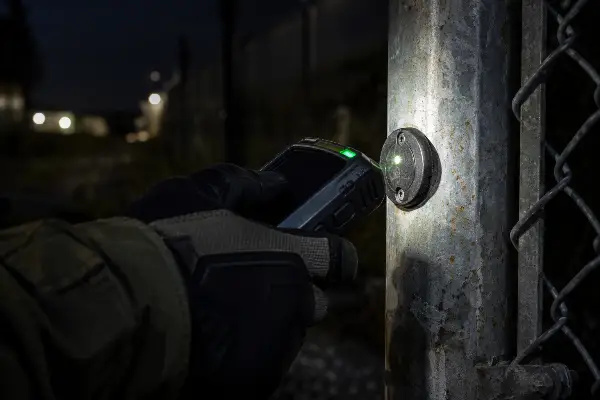
How we cover Houston commercial sites in 2026
Our officers carry a GPS guard tour system that timestamps every checkpoint on every round.
That means the patrol record exists whether or not anything happened. Supervisors run check-ins. Incident reports go out in real time, not the next morning. If you want to see what a night on your property looked like, you can.
Here’s what that produces in practice. At 2:15 a.m. on a construction site, an officer watched a pickup circle the gate and stop near an entrance, hit the vehicle’s emergency lights, and the truck left. At 11:40 p.m., an officer spotted two people carrying materials toward the fence in an unlit corner, put a spotlight on them, and they dropped everything and ran. At 3:30 a.m., an officer found a storage container pried open and a man pulling copper wire out of it. He held observation from a safe distance while police rolled. The suspect was arrested on scene. At 1:45 a.m. at a vacant commercial building, an officer interrupted two people working on a boarded window before they got in. At 11:20 p.m. at a distribution warehouse, an officer found an unauthorized vehicle at the loading docks and moved the driver off the property.
Five incidents. Five times the detection and the response were the same person, in the same motion, with no alert queue in between.
FAQs
What is gunshot detection technology?
Gunshot detection technology is a network of fixed sensors that detect a firearm discharge, filter it from other loud noises, and send a located alert to police dispatch. Most municipal systems are acoustic. The category is listed on the federal Authorized Equipment List as 14SW-01-ASTN, which makes it eligible for homeland security grant funding.
Does gunshot detection actually work?
It detects gunfire, but it doesn’t reduce crime. A February 2026 systematic review in the American Journal of Criminal Justice pooled 44 effect sizes from 8 studies and found no significant relationship between the technology and crime rates. The same review found alerts produced a police response 93 seconds faster than 911 calls in Kansas City.
What happened with ShotSpotter in Houston?
Houston ran a multi-year ShotSpotter contract across several neighborhoods. A Houston Chronicle analysis of nearly 4,400 alerts found fewer than 5% led to an arrest, and more than 80% never generated an incident report. Mayor John Whitmire called the program a gimmick at a budget workshop on May 28, 2024 and said he wanted to end the contract.
Is gunshot detection worth it for a private business?
For most Houston commercial properties, no. The events that cost these sites money are theft, trespass, vandalism, and after-hours entry, and a gunshot sensor detects none of them. It can make sense on very large open sites, or where the alert triggers a lockdown or camera, or where an on-site team is standing by to respond.
Can gunshot detection tell you what kind of gun was fired?
Some vendors claim caliber or weapon-type identification. That claim is not independently validated in published research, and the largest operator in the market does not make it. Treat it as a spec to verify in writing, not a proven capability.
How long does it take police to respond in Houston?
Houston Police Department data reported in February 2026 shows top priority calls averaged 6 minutes in 2025. Priority 3 calls averaged 65 minutes, priority 4 averaged 81.8 minutes, and priority 5 averaged 93 minutes. Most property crime calls fall into the lower tiers.
How fast can you put officers on a Houston site?
We respond same day and can provide a certificate of insurance the same day. We don’t require a long-term contract. Terms run weekly, month to month, or longer depending on what the site needs.