
Security guard post orders are the written instructions for 1 post on 1 property. They cover the hours, the rounds, who gets in, what gets reported, who to call and the limits of the officer’s authority. In Texas, they carry more weight than most buyers expect. The state course for an unarmed officer runs 6 hours and never mentions your site. A new hire can be working within 48 hours of a complete license application. On night 1, the post orders are most of what that officer knows about your property.
We staff more than 100 Houston-area sites with about 150 officers. Every incident report in our files, 5 of them, falls between 11:20 p.m. and 3:30 a.m. Those are the hours the post orders work alone.
What Are Security Guard Post Orders?
Post orders are a site’s standing instructions for its security officer. They set the post, the hours and the route. They say who may enter, what gets logged, what gets called in right away and who gets called first. A federal best practice calls them “operational instructions for a security post.” Every site gets its own set.
They sit between 2 other documents. General orders are a guard company’s conduct rules for every post it staffs. A shift handoff covers what changed today, like a late delivery or a dead light. Post orders hold the rules for your site, and they change only when the site does. Our construction site security checklist shows what belongs on a nightly handoff.
What A New Texas Officer Brings To Night 1
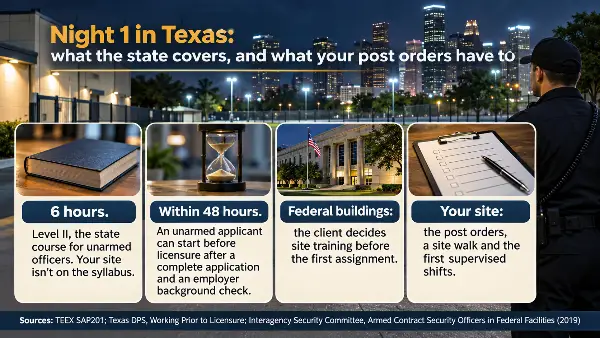
For an unarmed officer, a 6-hour state course and a background check. The license itself may still be in process. None of it covers your property.
- Training. Level II is the state course for unarmed officers. It runs 6 hours, and TEEX, a Texas A&M University System agency, offers it as an online course. It covers the officer’s role, the legal side of security work, communication and emergencies. Your gates, your contractors and your call list aren’t part of it.
- Start date. Texas DPS lets a new applicant work unarmed before licensure. That can happen once DPS marks the application substantially complete. It can also happen 48 hours after a complete application with fees and fingerprints, if DPS hasn’t answered. Either way, the employer has to check criminal history and the sex offender registry first. No one works armed before licensure.
- Turnover. The Bureau of Labor Statistics projects about 157,200 openings a year for security guards and gambling surveillance officers through 2035. Most will replace workers who change jobs or leave the workforce. Over a long contract, plan on meeting new officers.
Before an officer works one of our sites, we confirm an active DPS license at the level your post needs. We also run a background check and a drug test, interview the officer and check references. That’s screening. Site training still comes from the post orders, a walk of the property and the first supervised shifts.
Your Guard Company Drafts Them. You Should Own Them.
Let the guard company write the first draft. Then read it, correct it and sign it before the first shift.
Federal buildings go further. The Interagency Security Committee’s best practice for contract officers covers armed guards in federal facilities, and it puts site training on the client. It says “the government shall determine site-specific training necessary for any newly hired” officers “before their first assignment.” The government also checks that the training happened before an officer stands post. A Department of Commerce guard services statement of work, posted on GSA’s website, puts it in 1 line: “The Government will provide the Contractor with Post Orders.”
Private contracts can run the other way. The guard company writes the post orders and files them, and the client never reads them. “Site-specific post orders” is a standard line in guard company marketing, ours included. Reading yours is how you find out what they say.
On our accounts, the account supervisor writes the post orders and walks every new officer through them before their first shift on your site. You should still read every line. You know the gate the concrete trucks use at 5 a.m., the person who answers at 2 a.m. and the doors that stay locked during business hours. We don’t, until you tell us. Sign the final copy and attach it to the agreement as an exhibit, a step we cover in our guide to security guard contract clauses.
What Security Guard Post Orders Should Cover In 2026
Good post orders have 8 parts, and you supply about half of what goes in them.
| Part | What it tells the officer | Who supplies it |
|---|---|---|
| 1. Post basics | Address, post location, hours, armed or unarmed, uniform | Both. You set the hours; we staff the level |
| 2. Contacts and call order | Who answers at 2 a.m., a backup, and the police agency for the address | You |
| 3. Access | Who gets in, the after-hours list, deliveries and contractors | You send the list; we enforce it |
| 4. Rounds and checkpoints | The route, how often, and where the GPS checkpoints sit | We propose; you approve |
| 5. Emergencies | Fire, medical, severe weather and the evacuation meeting point | Your emergency plan; we write the officer’s part |
| 6. Reporting | What gets logged, what gets called in right away, and who gets the report | Both |
| 7. Authority limits | How far the officer can go when a person refuses to leave | We write it from Texas law; you sign off |
| 8. Keys, codes and equipment | Who holds keys, alarm codes and radios | You |
If a part is blank, the officer fills it in at 2 a.m.
Can Post Orders Give A Guard More Authority?
No. A post order can tell a Texas guard what to do. It can’t add a power the law doesn’t give.
A guard’s arrest power in Texas is the same as any private citizen’s. Texas Code of Criminal Procedure Article 14.01 lets any person arrest without a warrant, but only for a felony or an offense against the public peace. It has to happen in their presence or view. The power to arrest for any offense belongs to peace officers. An armed security officer doesn’t get more. Under Occupations Code 1702.002, a commission is the authorization to carry a firearm. It doesn’t add arrest power. There’s 1 narrow addition when theft is suspected. Under Civil Practice and Remedies Code 124.001, a person who reasonably believes someone stole or is trying to steal property may detain them. The detention has to be reasonable in manner and time, and only long enough to check who owns the property.
So a post order that says “detain,” “remove” or “apprehend” needs its legal basis written next to it, or the line comes out. For our unarmed officers, the written limit reads “observe, document, notify police and the client contact.”
That line matters most for new hires who used to be police officers. They know arrest procedure. On your post, they hold a citizen’s authority, and the post orders should say so in writing.
Your Site’s First 30 Days With A New Officer
Use the first month to test the post orders against your site, along with the officer.
| When | What you do |
|---|---|
| Before night 1 | Sign the post orders. Send the access list, a gate map and a contact who answers at 2 a.m. Some sites also get a walk-through with us first. |
| Night 1 | Ask the officer 3 questions the post orders should answer: Who do you call first? What do you do if someone won’t leave? Which checkpoint comes after the gate? Then run our first-shift checks. |
| Week 1 | Read the GPS tour log and every exception. A missed checkpoint is a question about the post orders as much as the officer. |
| Day 30 | Mark up what the post orders got wrong, and sign the revised copy. |
If the officer can’t answer from the page, the page is the problem.
How Often Should Post Orders Change?
Rewrite them when the site changes. The 2019 federal best practice cited above sets no review interval, and a calendar date won’t catch the afternoon a new gate opens.
Update them the day any of these change:
- The layout: a gate, a fence line, a tenant or a build phase
- A name or number on the call list
- The hours, or whether the post is armed
- An incident the post orders didn’t cover
Daily details, like tonight’s late delivery, go on the handoff instead.
Old versions matter, too. Texas rule 37 TAC 35.112 makes a licensed company keep its contracts for 2 years. The same rule covers “related documentation reflecting the actual provision of the regulated service.” The post orders say what the service is, and the round logs show it happened. You can ask for both.
If you’ve never read your security guard post orders, ask for them this week. If you’re comparing companies, ask each one for a sample post order with the proposal. Call Reliable Guard & Patrol Service for a free proposal, and ask to see our post orders template with it. Our Texas DPS license number is B07315701.
FAQs
What are security guard post orders?
Security guard post orders are the written instructions for 1 security post at 1 property. They cover the hours, rounds and checkpoints, who may enter, what gets reported, the call order and the limits of the officer’s authority. The client and the guard company should both sign them before the first shift.
Who writes security guard post orders?
The guard company usually drafts them, but the client should own them. A 2019 Interagency Security Committee best practice has the government decide site training for new armed contract guards in federal buildings. Read, correct and sign yours before night 1.
What is the difference between post orders and general orders?
General orders are a guard company’s conduct rules for every post it staffs. Post orders are the standing instructions for 1 site, such as its gates, rounds and call list. The nightly handoff covers what changed today, like a late delivery.
How much training does a new security guard have in Texas?
An unarmed officer takes Level II, a 6-hour state course. It covers the officer’s role, the law, communication and emergencies. Texas DPS can let a new applicant work unarmed within 48 hours of a complete application, after a background check. Training on your site comes from the post orders and the guard company.
Can post orders tell a security guard to detain someone in Texas?
Only where Texas law already allows it. Under Code of Criminal Procedure Article 14.01, a guard can arrest only the way any citizen can. That means a felony or an offense against the public peace, seen by the guard. A suspected theft can also allow a short, reasonable detention to check who owns the property.
How often should post orders be updated?
Whenever the site changes, such as a new gate, tenant, build phase, contact or set of hours. Update them after any incident they didn’t cover, too. The 2019 federal best practice for contract guards sets no review interval. Daily changes go on the shift handoff.