Warehouse access control decides who and what gets into each part of a warehouse: the yard, the dock, the main floor and the high-value cage. It checks a badge, a PIN or a license plate against a list, then logs the result. That handles strangers well. It can’t flag a truck that matches the list, because the person posing as the carrier is the one who put it there.
That gap is where cargo theft is holding steady in 2026. Verisk CargoNet counted 378 cargo theft events in the second quarter of 2026, down from 488 a year earlier. Fictitious pickups, where someone posing as the booked carrier drives off with the load, barely moved: 158, down from 165.
We post licensed officers at Houston warehouses and distribution centers. Readers, cameras and alarms aren’t something we sell or install. Before a trailer leaves the dock, our officers check the carrier against its federal FMCSA record, so we wrote this from the gate.
What Is Warehouse Access Control?
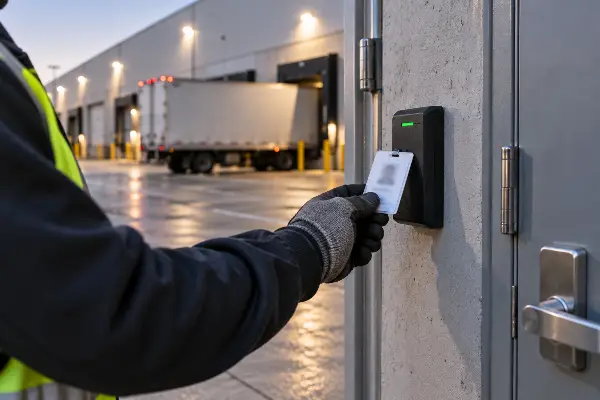
Warehouse access control is the system of credentials, zones and checkpoints that decides who can enter a warehouse and which areas each person or vehicle can reach once inside. It combines hardware such as badge readers and gate controllers with rules about who gets access, for how long, and who checks the exceptions.
Every setup has 3 working parts. The credential says who you are: a badge, a phone, a PIN or a plate on file. The zone says where that credential works and during which hours. The record logs every swipe, every denial and every door held open too long.
A 4th part sits outside the hardware. Somebody has to read the exceptions and act on them. If nobody owns that job, the log turns into a tidy history of what went wrong. That 4th part is the one we staff. It’s the same split we draw for offices, job sites and vacant buildings when we post access control security guards.
How Should You Zone A Warehouse?
Split the building into 4 zones by what’s at risk: the yard and gate, the dock, the main floor and the high-value cage. Each zone gets its own credential rules, and each one fails in its own way.
| Zone | Who belongs there | Typical credential | Where it breaks | What our officers check |
|---|---|---|---|---|
| Yard and gate | Employees, booked carriers, approved visitors | Gate code, plate reader, gate booth | A truck that matches a booking made by someone posing as the carrier | The carrier on its FMCSA record, the driver, the equipment and the seal |
| Dock | Dock crew; drivers in the driver area only | Badge on the dock office door | Dock doors left open; drivers walking onto the floor | Dock doors and gates on every round; shipments and deliveries |
| Main floor | Employees on the current shift | Badge limited to shift hours | Tailgating at shift change | Employee and visitor access at the entrance |
| High-value cage | Named supervisors | Badge plus PIN or fingerprint | Shared PINs; the door propped open during a count | Inventory areas on patrol rounds |
Zones only hold if the doors between them stay shut. A reader on the cage door doesn’t help when someone props the door open with a pallet jack during a cycle count. The log will show 1 clean swipe and nothing else.
A federal rule limits how hard you can lock the inside. OSHA’s exit route standard, 29 CFR 1910.36(d)(1), says employees must be able to open an exit route door from the inside at all times. They can’t need keys, tools or special knowledge to do it. A panic bar that locks only from the outside is allowed on exit discharge doors. The next paragraph of the rule bars any device or alarm that could restrict emergency use of the exit if it fails.
So lock the cage and the dock office hard. Put door-open alerts and patrol checks on the exit doors.
Where Anti-Passback Stops Working
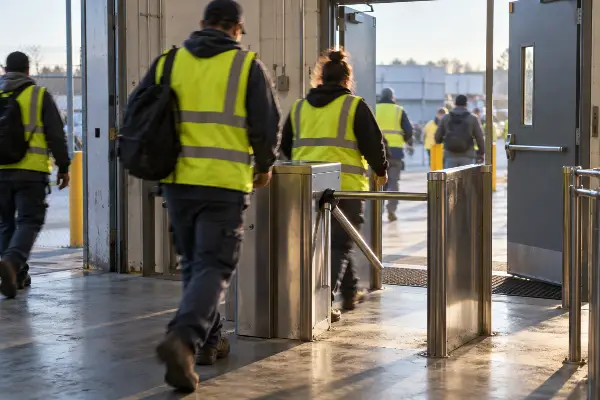
Anti-passback blocks a badge from entering a zone twice without exiting in between. That stops a worker from passing a badge back through a gate to a second person. It does nothing about the second person walking in right behind the first.
That’s tailgating. In a warehouse it’s hardest to stop at shift change, when a full shift funnels through the same door and nobody wants to let it close on a coworker. The reader logs 1 entry either way. A turnstile catches the second person. So does an officer standing at that door.
Temp Workers, Contractors And Drivers Need Badges That Expire
Give every non-employee a credential with an end date. Shut off a departing employee’s badge the same day they leave. In warehousing, that’s steady work.
The Bureau of Labor Statistics put total separations in transportation, warehousing and utilities at an average of 4.0% of employment per month in 2025. The figure across all industries was 3.3%. That’s about 1 in 25 workers leaving in a typical month, and each departure is a badge somebody has to turn off.
Tie contractor access to the work order. An HVAC technician booked for a 4-hour repair gets a credential that dies when the window closes, and it opens the mechanical room only.
Keep drivers in a driver area with its own door and restroom, so their access stops at the dock office. A driver who needs the floor gets an escort.
Put the badge on the exit checklist. The shutoff should happen before the person reaches the parking lot, and it shouldn’t depend on a supervisor remembering on a Friday afternoon.
What Badge Readers Can’t See After Hours
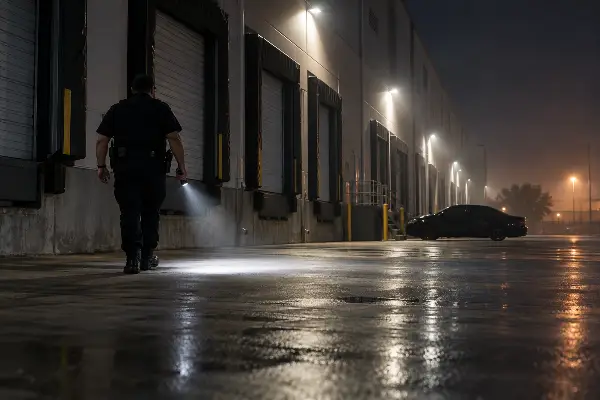
A badge reader only knows about the people who touch it. It can’t see someone standing on the dock apron, a door that never latched or a car idling by the fence. And it has no way to judge what an alarm means.
That played out on one of our posts. At about 11:20 p.m., our officer on a perimeter round at a distribution warehouse found an unauthorized vehicle parked near the loading docks after closing. A person was trying to get into a secured storage area beside the dock doors.
The officer called dispatch, notified the site supervisor and kept watch. Then he identified himself and told the person to leave the restricted area. The person left without incident, local police were advised, and a report went on file.
The follow-up check found the dock doors, gates and entry points all still secure, with no sign of forced entry and no missing inventory. The hardware did its job, and none of it knew anyone was there. The record of that night exists because someone was walking the dock and wrote it down.
When alerts and officers are tied together, a forced dock door can bring up the closest camera feed and alert the officer on duty. That’s the setup behind integrated security systems, and it only works if the officer is on site when the alert fires. We don’t run alarm response, so our officer is already on your post, working a GPS-logged round. Ask any vendor for the round data. A real patrol log shows each checkpoint with a time stamp.
Can A Plate Reader Stop Cargo Theft In 2026?
A plate reader tied to the gate keeps unknown vehicles out. It won’t stop a fictitious pickup, because in that scheme the truck matches the booking. The reader confirms the plate on file. When the booking came from someone posing as the carrier, the plate on file is theirs.
CargoNet’s second-quarter numbers show which kind of theft is holding up.
| Verisk CargoNet, second quarter | 2025 | 2026 | Change |
|---|---|---|---|
| Cargo theft events | 488 | 378 | Down 23% |
| Fictitious pickups | 165 | 158 | Down 4% |
| Estimated losses | $135.7 million | $304.6 million | More than doubled |
Theft events fell. The type that beats a gate on paperwork mostly held. CargoNet’s report says physical thefts of loaded equipment fell, especially in California and Texas. In both states, schemes built on business email compromise or shipment misdirection “remained comparatively stable.”
Texas counts are falling too. CargoNet logged 80 incidents in the state in the first quarter of 2026, down from 102 a year earlier. It said the opportunistic theft long typical of the Dallas-Fort Worth and Houston corridors appears to be giving ground to more focused operations elsewhere. If physical theft keeps falling while the paperwork schemes hold steady, those schemes become a bigger share of what a Houston gate faces.
How A Fictitious Pickup Gets Through The Gate
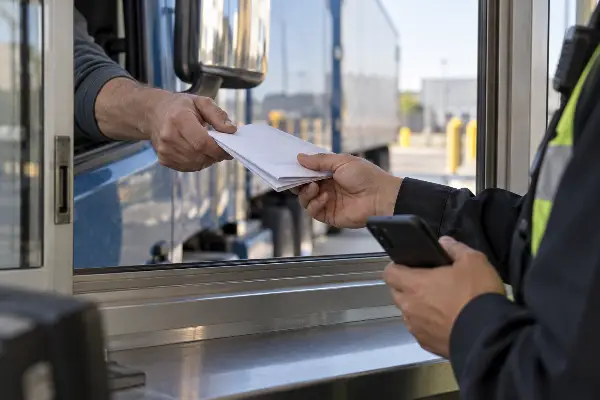
The scheme starts before the truck shows up. CargoNet’s first-quarter 2026 analysis says criminal networks “have largely settled on impersonating legitimate motor carriers and logistics brokers.” It adds that some groups buy real trucking companies through social media and online marketplaces.
A broker tenders the load to what looks like a real carrier. The appointment is real. The driver arrives on time with paperwork that matches, so every automated check at the gate passes.
FMCSA addressed the numbers behind those carriers in a March 19, 2026 bulletin. A USDOT number “belongs to the same legal person forever and may not be sold, transferred, rented, or leased,” the agency wrote. It also said it will inactivate a number used by anyone other than the legal person it was assigned to. A plate reader can’t see who owns the number painted on the door.
The Gate Check For Fictitious Pickups
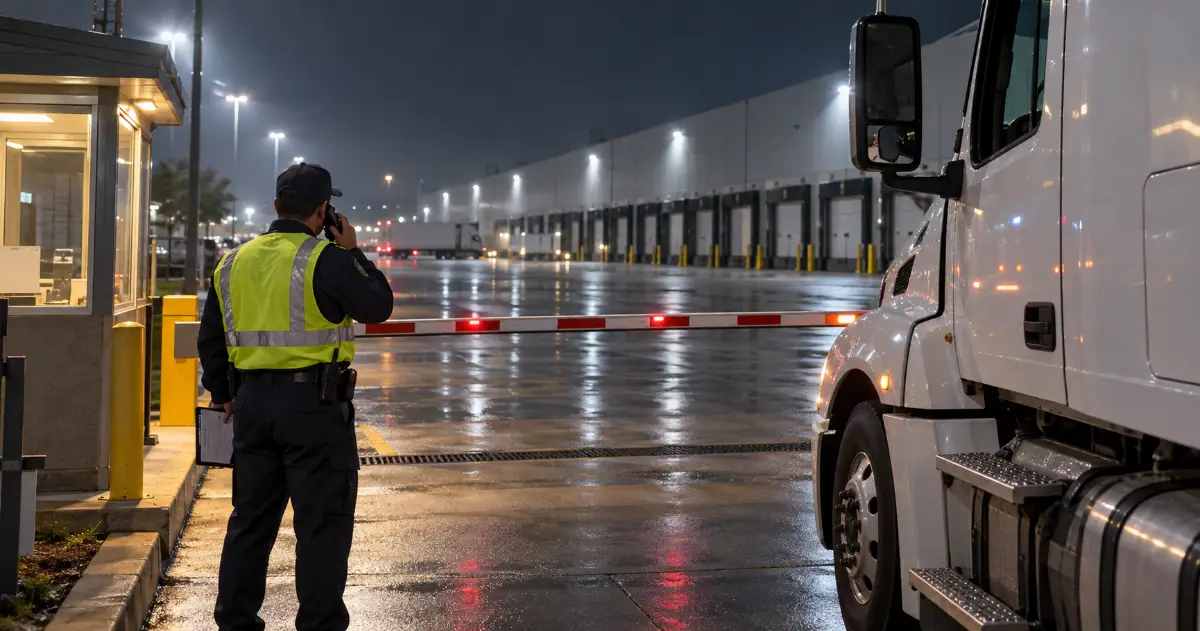
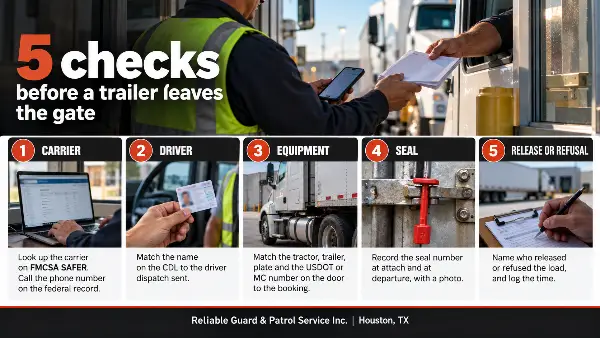
Verify the carrier at the source before the trailer moves. Our officers look the carrier up on FMCSA’s SAFER Company Snapshot and call the phone number listed there. SAFER defines that number as the company’s telephone at its principal place of business. A number printed on the paperwork came from whoever printed the paperwork.
That callback is 1 of 5 checks our officers log before a release: the carrier, the driver, the equipment, the seal, and a named release or refusal with the time. We spell out each field, and the written authority to refuse that backs it up, for our logistics facility security posts.
The callback adds a phone call to every release. It’s also the one step in the process that goes around the paperwork and reaches the carrier itself. Gate and dock verification is usually unarmed work: a phone, a log, written refusal authority and an officer who will hold a truck while the dock backs up. Our unarmed security officers work in English and Spanish, which helps at a Houston gate where drivers and dock crews don’t always share a first language.
Badge Reader, Plate Reader Or Officer: What Each One Checks
Use the system for volume and the officer for exceptions. The table shows which layer catches which problem on a warehouse night.
| Situation | Badge reader | Plate reader | Officer on post |
|---|---|---|---|
| A stranger tries a door with no badge | Denies entry and logs it | Not involved | Sees it and challenges the person |
| A second person walks in behind a valid badge | Logs 1 entry | Not involved | Catches it when posted at that door |
| A former employee’s badge is still active | Opens the door | Not involved | Can’t tell without a current roster |
| A truck arrives on a booking made under a borrowed carrier identity | Not involved | Matches the plate on file | Calls the carrier at the number on its FMCSA record |
| A dock door is left open after the last shift | Sends a door-held alert, if one is set up | Not involved | Finds it on a round and closes it |
| Someone on foot near the dock after hours | Nothing, unless they touch a reader | Nothing | Finds them on a round |
| A full record of every entry, every hour | Yes | Yes, for vehicles | Only what goes in the log |
A system alone can be enough. A small building with daytime-only shipping, low-value stock and no night activity may not need a post at all, and we’ll tell you so. When the risk is a truck at the gate or a person on the dock after dark, the exceptions are the job. That’s how we build a warehouse security guard post.
A warehouse access control plan works when it covers the cage, the floor and the yard, and when someone covers the exceptions it can’t see. We’re a Houston security guard company with Texas DPS license B07315701 and 150 officers on more than 100 sites. Contracts run weekly or month to month, and a certificate of insurance can be issued the same day. Call (713) 783-1344 for a free proposal. Where the layout calls for it, we’ll walk your gate and dock before the first shift.
FAQs
What is the difference between warehouse access control and a security guard?
An access control system checks credentials and records every entry, every hour. A security guard handles what the system can’t judge: a second person behind a valid badge, a dock door left open, or a truck whose paperwork matches a booking made by an impersonator. Most warehouses with night shipping or high-value stock use both, with the system handling volume and the officer handling exceptions.
What does anti-passback do in a warehouse?
Anti-passback stops a badge from entering the same zone twice without exiting first. That blocks a person from passing a badge back to a second person. It doesn’t stop tailgating, where the second person walks in right behind the first, so shift change still needs a turnstile or an officer at the door.
How fast should a former employee’s badge be turned off?
The same day, before the person leaves the property. The Bureau of Labor Statistics put total separations in transportation, warehousing and utilities at an average of 4.0% of employment per month in 2025, so badge shutoffs are routine work. Put the shutoff on the exit checklist so it doesn’t depend on someone remembering.
Can a warehouse lock its exit doors to stop theft?
Not from the inside. OSHA’s exit route rule, 29 CFR 1910.36(d)(1), says employees must be able to open an exit route door from the inside at all times without keys, tools or special knowledge. A panic bar that locks only from the outside is allowed on exit discharge doors. Lock the high-value cage and the dock office instead, and cover exit doors with door-open alerts and patrol rounds.
Is cargo theft going up in Texas in 2026?
Not by count. Verisk CargoNet recorded 80 incidents in Texas in the first quarter of 2026, down from 102 a year earlier. Its second-quarter report said thefts of loaded equipment fell in Texas while email-compromise and shipment-misdirection schemes stayed about level, so a bigger share of what’s left is theft by paperwork.
Can warehouse access control stop a fictitious pickup?
Not on its own. In a fictitious pickup the truck, plate and paperwork match the booking, so the badge and plate checks in a warehouse access control system pass. In the second quarter of 2026, Verisk CargoNet counted 158 fictitious pickups, down only from 165 a year earlier, while cargo theft events fell 23%. The check that catches it is a callback to the carrier at the phone number on its FMCSA record.