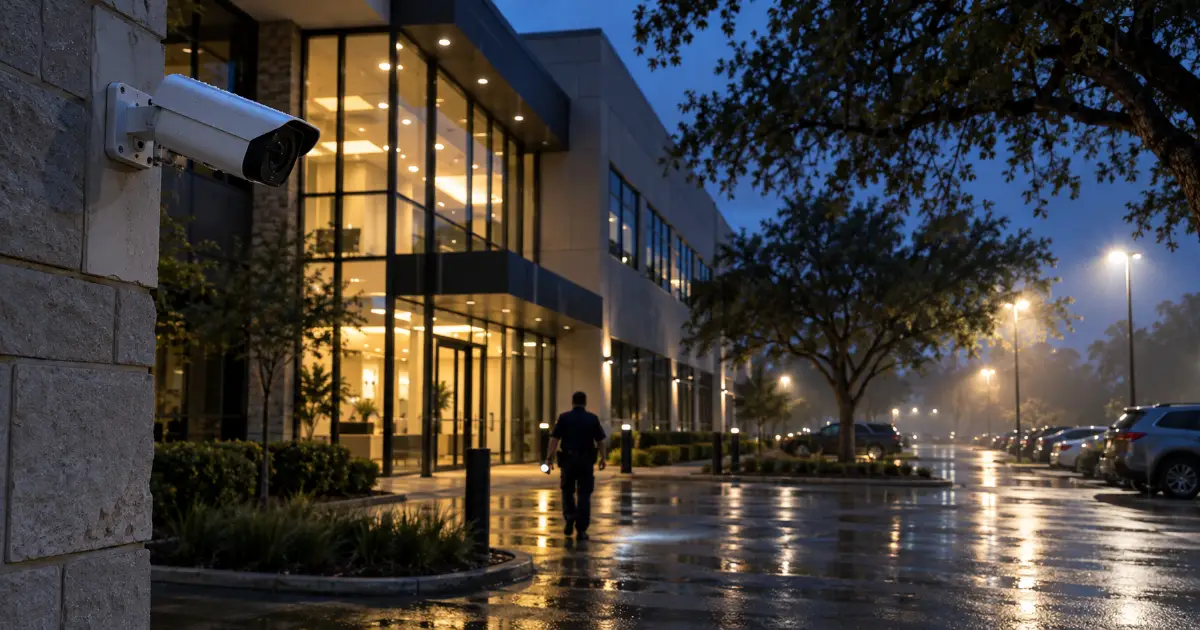
Physical security as a service (PSaaS) means renting your building security instead of buying it. Cameras, door access, alarms and monitoring run on a provider’s cloud, you pay a recurring license, and you can see every site from your phone. What you don’t get is a person who can walk to the door when something moves.
That last part decides how a break-in ends. In 2018, Houston police responded to 67,669 alarm incidents, and 96% of them were false, according to a City of Houston presentation to a council committee. A system can see everything and still hand the response to whoever picks up the phone.
We’re a Houston guard company that posts licensed officers on commercial sites, so this guide comes from the side of security that PSaaS leaves out.
What Is Physical Security As A Service (PSaaS)?
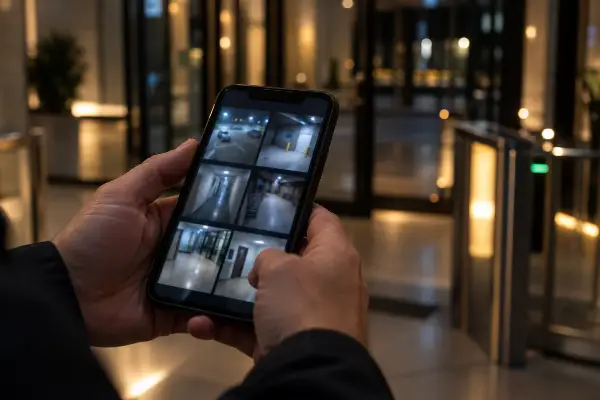
Physical security as a service (PSaaS) is a subscription model for building security. The provider hosts the software for cameras, door access, alarms and video monitoring in the cloud, updates it remotely, and bills a recurring license. You manage every site from a browser or phone. PSaaS covers detection and records. It doesn’t put anyone on site.
The name stacks older acronyms. VSaaS is video surveillance as a service, which means cloud cameras only. ACaaS is access control as a service: cloud-managed doors and badges. PSaaS bundles both, usually with alarms and sensors on the same platform, and sometimes with a remote monitoring center on top.
What A PSaaS Subscription Includes, And What It Leaves Out
A typical PSaaS bundle does 4 jobs: it records video, controls doors, raises alarms and, on some plans, puts an operator on your feeds. Every one of those jobs detects or records. None of them can walk over and deal with what it found.
| Part of the bundle | What it does | What it leaves to a person |
|---|---|---|
| Cloud video (VSaaS) | Records and stores footage, flags motion, streams live to your phone | Going to the scene and stopping a theft in progress |
| Cloud access control (ACaaS) | Grants or denies badge and phone entry, logs every door event, locks down remotely | Stopping someone who tailgates in or forces a door |
| Alarms and sensors | Detect forced doors, broken glass and after-hours motion | Checking whether the alarm is real before police are sent |
| Remote video monitoring | An operator reviews alerts, talks through a speaker and calls police | Arriving on site. The operator isn’t there |
We’ve compared each piece against an on-site officer in more depth: cameras alone, access control after hours and remote video monitoring. The pattern holds across all 3. Technology finds the problem faster, and a person still has to show up to stop it.
How PSaaS Contracts Work In 2026
You don’t buy the system outright. You license it for a term, and that term decides what happens to your security on the day you stop paying.
One cloud camera vendor’s licensing documentation spells it out for its own platform. Licenses come in 1, 3, 5 and 10-year terms. When one expires, a 30-day grace period starts. After that, the documentation says, “you will no longer have access to any of your devices or configure any settings,” and “Alarms and Event notifications will also be disabled.” The cameras keep recording, and the footage comes back when you renew.
Those are 1 vendor’s terms. Other vendors set their own, which is why the exit terms belong in writing before you sign.
| PSaaS license | Guard contract (how we write ours) | |
|---|---|---|
| Term | 1, 3, 5 or 10 years at 1 vendor | Weekly, month to month, short term or long term |
| If you stop paying | At that vendor: 30-day grace, then no access to devices or settings, alarms and notifications off | Coverage ends. Your own cameras and doors keep working |
| What you pay for | Software, storage and updates | A licensed officer on the hours you choose |
| Who acts on an event | You, or an operator who calls police | The officer already on site |
When a guard contract ends, the officer leaves and nothing you own stops working. You were renting a person’s time. With PSaaS, you’re renting the software your hardware runs on. If you’re weighing both, read each one against the same clauses to check before signing.
Does PSaaS Keep Working When The Internet Goes Down?
Partly. The devices keep doing their basic job on site, but the cloud features you’re paying for wait until the connection comes back.
A cloud camera vendor’s support documentation says its cameras “continue to record and save the video without a network connection as long as there is a power source,” then sync the missed footage once they’re back online. Its access controllers keep running their last known settings, so existing badges work but a badge added during the outage won’t. Another access control vendor’s documentation says its door readers cache credentials for outages of up to 36 hours, though a brand-new user isn’t cached until a nightly sync.
What stops, unless the system has a cellular backup, is everything you’d use from off site: live view on your phone, and alerts to whoever’s on call.
Notice the condition in that first quote: a power source. Houston storms take out power on a large scale. After Hurricane Beryl in July 2024, CenterPoint Energy reported restoring service to more than 2 million impacted customers.
Storms also narrow the path to police. The City’s alarm office tells monitoring stations not to request Houston police for alarms during a power outage, in weather-related or low-battery situations, or during a phone or internet upgrade. Battery backup for cameras and network gear belongs in any PSaaS quote here. An officer on post doesn’t need power or a signal to spot a cut fence.
Who Responds When A PSaaS Camera Sees An Intruder?
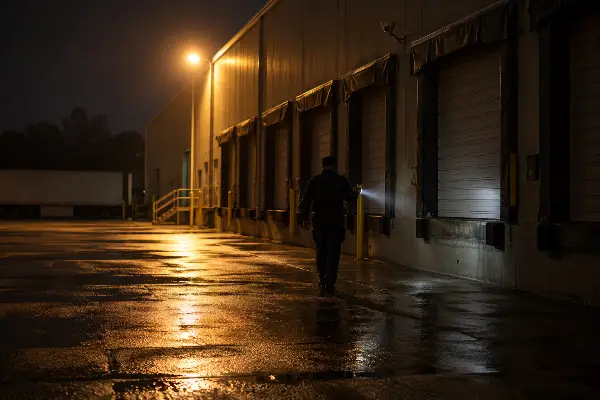
Whoever is on your call list. With PSaaS, that’s usually you, a remote operator who can talk through a speaker and call police, or an officer on site if you’ve posted one.
Timing matters. Commercial break-ins lean toward the hours nobody is on site, and our checklist for a physical security risk assessment walks through the FBI numbers behind that. At night, an unguarded construction site or a closed warehouse sits empty, which leaves the response to whoever gets the alert.
Each option moves at a different speed. You can watch the feed, but you shouldn’t confront anyone yourself. A remote operator can warn someone over a speaker and call police, and from then on you’re waiting on police response time.
An officer on site can step in right away. In Texas that officer has the same arrest authority as any private citizen: a felony or an offense against the public peace, committed in their presence or view, under Code of Criminal Procedure Art. 14.01(a).
Houston’s Alarm Permit Rules And Your PSaaS Setup
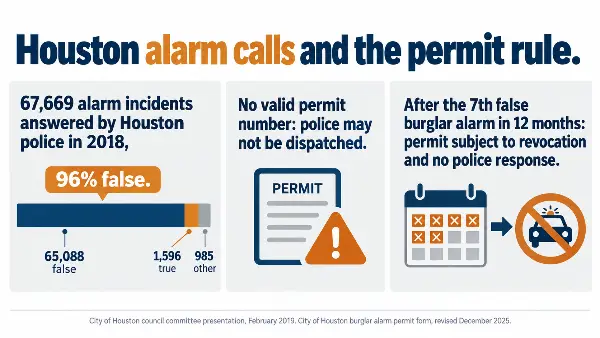
If your setup includes a burglar alarm that requests Houston police, the City’s permit rules apply. The City’s permit form says police may not be dispatched to your location unless the alarm company provides a valid permit number.
A non-residential burglar alarm permit costs $134.28 plus a $33.56 administrative fee, $167.84 a year. The first 3 false burglar alarms in a 12-month period are free. The 4th and 5th cost $50 each, the 6th and 7th cost $75 each, and every one after that costs $100. After the 7th, the permit is “subject to revocation and no police response.” Fees change, so confirm the current schedule with the Houston Permitting Center at 832-394-8802.
This is why we don’t buy the pitch that a subscription replaces guards. The subscription’s last step is a phone call. In Houston, the department taking that call answered 67,669 alarms in 2018, and 96% were false. The City’s alarm office reported about the same rate for 2014, and those are the newest City counts we could find. A site that goes past 7 false burglar alarms in 12 months can lose police response altogether.
Whether a camera-only setup with remote monitoring needs its own permit depends on how the City defines an alarm system. Ask the Permitting Center before you go live.
Can PSaaS Replace Security Guards?
Not the part of the job that happens in person. PSaaS can take over screen-watching and door-buzzing. It can’t stand at a gate or keep watch on a scene until police arrive.
The Bureau of Labor Statistics expects more surveillance technology to limit demand for guards somewhat, and it still projects security guard jobs to grow 1% from 2025 to 2035, from a base of 1,294,300 positions. Technology slows the growth. It hasn’t reversed it. AI cameras raise the same question, and the data on AI points the same way.
Start from the hours that need a person, then buy for those. Sites can run both, with cameras flagging and an officer responding. An integrated security system is built to work that way.
Cloud Cameras Bring Their Own Security Risk
Putting every camera on 1 cloud account puts every feed behind 1 login. If that account or the vendor gets breached, everything is exposed at once.
This has happened. In August 2024, the FTC took action against a cloud camera company. The complaint alleged that a hacker reached over 150,000 of the company’s live customer cameras in March 2021, and that the company failed to require unique, complex passwords or adequately encrypt customer data. Those are allegations from the complaint.
Before you sign, find out whether every user has to log in with multi-factor authentication, and who at the vendor can view your feeds.
3 Questions To Ask Before You Sign
Get these 3 answers in writing before you sign any security contract, PSaaS or guards.
- What stops working if we stop paying? Ask for the grace period and the exact list of features that shut off. The vendor quoted above gives 30 days, then no device access and no alerts.
- Who owns the footage and the hardware, and how do we export it? If the answer is “you can download it from our portal,” ask what happens to that portal on the last day of the contract.
- Who shows up, and how fast? Get a name or a role, not “we notify the appropriate party.” In Houston, if the answer is police, your alarm permit and your false-alarm count decide whether they come.
If the answer to the 3rd question is “nobody until police arrive,” that’s the gap a posted officer fills. We post licensed armed and unarmed officers at Houston office buildings, construction sites, warehouses and retail centers, with GPS-logged patrol rounds, real-time incident reports and supervisor check-ins.
Contracts run weekly, month to month, short term or long term, with no long-term commitment required. Our security guard services page lists the options, and our team can put together a free proposal for your site.
Physical security as a service is good at watching and recording. Decide who does the responding before you sign.
FAQs
What is PSaaS in security?
PSaaS, short for physical security as a service, is building security sold as a subscription. A provider hosts the software for cameras, door access, alarms and monitoring in the cloud, updates it remotely, and bills a recurring license. It covers detection and records. It doesn’t put a person on site.
What is the difference between PSaaS and VSaaS?
VSaaS, or video surveillance as a service, covers cloud cameras only. PSaaS bundles cloud video with access control, alarms and sometimes remote monitoring on 1 platform. Both are licensed for a term rather than bought outright.
What happens if you stop paying for physical security as a service?
It depends on the vendor’s terms, so get them in writing before you sign. One cloud camera vendor’s documentation, for example, gives a 30-day grace period after a license expires, then cuts off access to devices and settings and disables alarms and event notifications. The cameras keep recording, and the footage becomes available again when you renew.
Can physical security as a service replace security guards?
It can replace screen-watching, not the in-person part of the job. A camera or a remote operator can detect a problem and call for help, but someone still has to respond on site. The Bureau of Labor Statistics projects security guard jobs to grow 1% from 2025 to 2035, even as surveillance technology spreads.
Does PSaaS work without internet?
Partly. A cloud camera vendor says its cameras keep recording without a network connection as long as they have power, and an access control vendor says its door readers cache credentials for outages of up to 36 hours. Remote viewing, alerts and changes like adding a new user wait until the connection comes back.
Do you need an alarm permit for a monitored security system in Houston?
If the system will request Houston police, yes. The City of Houston’s permit form says police may not be dispatched to your location unless the alarm company provides a valid permit number. After the 7th false burglar alarm, a permit is subject to revocation and no police response.
How many alarm calls are false alarms?
Nearly all of them. In 2018, Houston police responded to 67,669 alarm incidents, and 96% were false, according to a City of Houston presentation to a council committee. The City’s alarm office reported about the same rate for 2014.


