Does builder’s risk cover theft? Partly. Under the standard ISO forms, theft of materials that aren’t installed yet is limited. Builders’ tools and equipment aren’t covered for theft at all. And a loss with no proof of what happened can be turned down. That covers the copper, tools and stock thieves go after on a job site.
Search the question and the quick answers say yes, builder’s risk typically covers stolen materials stored on site. We guard construction sites across Houston, and the forms behind that answer say something narrower.
What Builder’s Risk Insurance Covers
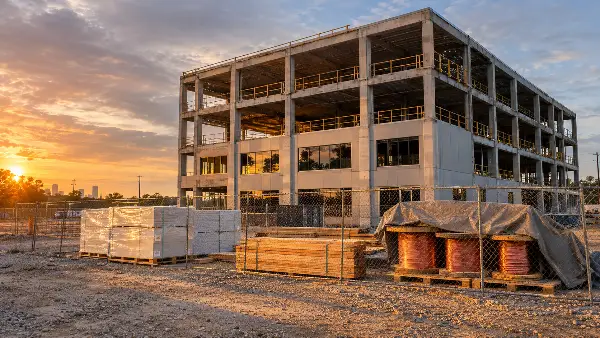
Builder’s risk is property insurance for a building while it’s going up. It covers the structure and the materials meant to become part of it against losses like fire, wind and vandalism until the job ends. Theft is the narrow part. The standard form limits theft of materials that aren’t attached to the building yet.
Who buys it depends on the contract. The American Institute of Architects’ 2017 insurance exhibit, A101 Exhibit A, puts the policy on the owner unless the contract shifts it to the contractor.
Does Builder’s Risk Cover Theft? It Depends On The Item
The answer changes with what was taken and where it sat.
| What was taken | Standard ISO builder’s risk | Where to look instead |
|---|---|---|
| Copper, fixtures or framing already installed | Covered for theft, subject to the policy’s other terms | Your builder’s risk policy |
| Materials delivered but not installed | Theft limited (CP 10 30, C.1.d) | A theft endorsement such as CP 11 21, or the carrier’s own theft wording |
| Contractors’ tools and equipment | Not covered for theft (CP 10 30, C.2.c) | A contractor’s equipment policy |
| Anything taken by your own workers or someone you entrusted it to | Excluded (CP 10 30, B.2.h) | Gate checks, and ask your agent about crime coverage |
| Materials that are gone, with no sign of a break-in | Limited (CP 10 30, C.1.e) | Proof: counts, photos, patrol logs, a police report |
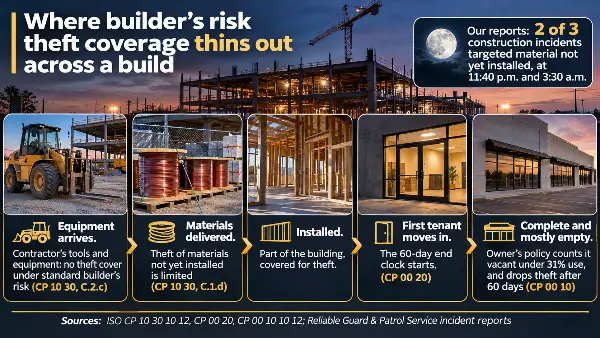
That’s 4 gaps in 5 rows. Carriers also write builder’s risk on their own forms, and their theft terms differ. Our phase-by-phase checklist shows when each of these items lands on a Houston site.
Materials On The Ground: The Copper Your Policy May Not Cover
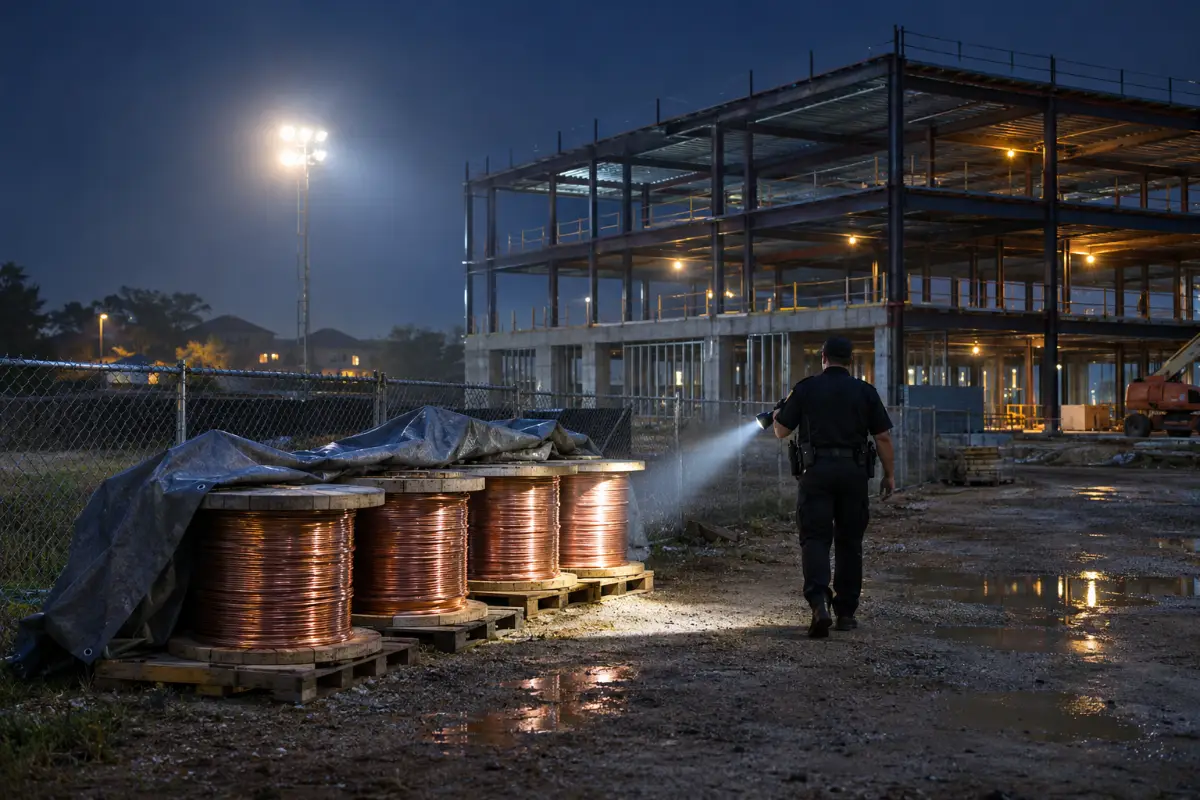
Material that’s on site but not installed is the weakest spot in a standard builder’s risk policy. ISO’s Causes of Loss Special Form, CP 10 30, limits “building materials and supplies not attached as part of the building or structure, caused by or resulting from theft.” The form carves out materials held for sale, but not when they’re insured under the Builders Risk Coverage Form.
That’s the copper spool in the Conex, the pallet of light fixtures and the lumber stacked by the fence. It’s also the window where our construction site security posts usually go to 7 nights: the day the wire lands in the container. Night is when that stock sits alone. FBI figures for 2019 place 55.6% of nonresidential burglaries with a known time at night.
Our own reports point the same way. In 2 of the 3 construction incidents on file, the target hadn’t been installed yet. Building materials were headed for the fence line at 11:40 p.m. Copper wire was coming out of a job-site storage container at 3:30 a.m. Both nights ended with the material back with site management.
Check your contract, too. If it uses the AIA’s 2017 exhibit, the owner’s policy “shall not exclude the risks of fire, explosion, theft, vandalism” and the rest of that list. Ask your agent whether the policy carries ISO’s CP 11 21 theft endorsement or its own theft wording, then read it against that sentence.
Are Contractors’ Tools And Equipment Covered?
Not for theft. Contractors’ tools and equipment are usually left out of builder’s risk. Where they’re included on a site insured under the Builders Risk Coverage Form, they’re covered only for “specified causes of loss.” That list includes fire, windstorm and vandalism. Theft isn’t on it.
So a stolen skid steer, light tower or cordless drill goes to a contractor’s equipment policy, if you carry one.
The line between theft and vandalism decides real claims. In a 2009 ruling on a case that started in Houston’s federal court, the 5th Circuit looked at rooftop air conditioning units that thieves tore apart for the copper. The owners called it vandalism. The court called it theft, applied the policy’s theft exclusion and ruled the insurer owed nothing.
Missing Materials And Inside Jobs
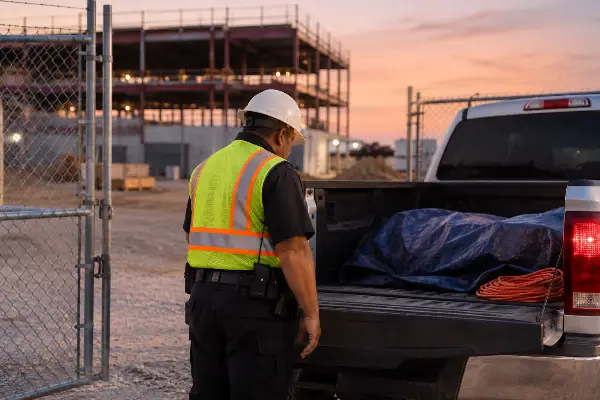
2 more clauses cut theft claims on a job site. One covers losses you can’t explain. The other covers theft by people you let in.
Section C.1.e limits property “that is missing, where the only evidence of the loss or damage is a shortage disclosed on taking inventory.” An insurer’s sample builder’s risk policy says it more bluntly. It excludes “unexplained disappearance” and “shortage found upon taking inventory.”
Either way, the claim turns on proof of what happened. A written count at close, photos, a timestamped patrol log and a police report number are that proof.
Section B.2.h excludes theft by your employees, “including temporary employees and leased workers.” It also excludes theft by “any person to whom you entrust the property for any purpose.” On a site where crews come and go all day, that clause matters. Our officers verify workers and deliveries at the gate, and that includes what drives out.
When Does Builder’s Risk Coverage End?
Often before the building is full. ISO’s Builders Risk Coverage Form, CP 00 20, ends coverage at the first of these, unless the insurer agrees otherwise in writing:
- 90 days after construction is complete
- 60 days after any building on the policy is occupied, in whole or in part, or put to its intended use
- The day a purchaser accepts the property
- The day your interest in the property ends, or the job is abandoned
“In whole or in part” is the trap. 1 tenant in 1 suite can start the 60-day clock for the whole building.
Carrier forms differ here too. That same sample policy ends coverage 90 days after initial occupancy, once 75% of a commercial building is leased, or when permanent property insurance takes over. Find your trigger before move-in day.
The AIA exhibit expects no gap. At substantial completion, the owner keeps the builder’s risk policy going or replaces it with property insurance that stays in force through the period for correcting the work.
After Completion, A New Building Can Count As Vacant
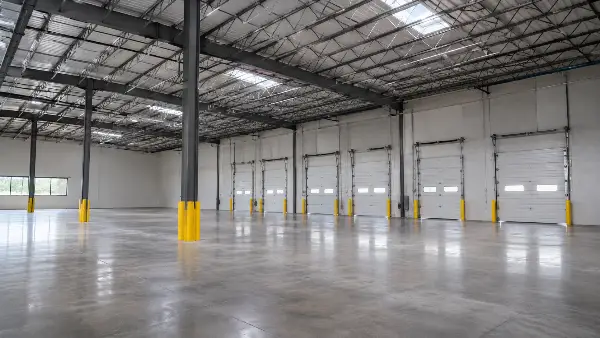
Once construction ends, the owner’s regular property policy takes over, and a mostly empty new building can count as vacant under it.
ISO’s commercial property form, CP 00 10, says “buildings under construction or renovation are not considered vacant.” Once the work is done, that protection is gone. An owner’s building then counts as vacant unless at least 31% of it is in normal use. Past day 60 of vacancy, the form drops theft, attempted theft, vandalism, building glass breakage, water damage and unprotected sprinkler leaks. It pays 15% less on the losses it still covers.
A finished spec warehouse waiting on its first tenant fits that picture. We cover the 60-day vacancy rule on its own page, and our building security guard services pick up where the job site ends.
What A Security Guard Changes About Job Site Theft In 2026
A guard doesn’t change what your policy covers. A guard changes what happens on the nights the gap is open, and what you can prove the next morning.
A builder’s risk loss-control guide from the University of California’s risk services office says “the mere presence of an individual on-site is an effective theft and vandalism deterrent.” Our officers log every round on a GPS guard tour system and file real-time incident reports, and a supervisor checks in on each post. If something does go missing, you get a time window instead of a guess.
Some policies also carry site security conditions, so read that part of yours before the first weekend copper sits on site. We staff construction posts by the week or month to month. That lets you cover the weeks between the first copper delivery and install instead of the whole build.
Does builder’s risk cover theft on your site? Pull your policy, find the theft wording and the end date, and send both to Reliable Guard & Patrol Service. We’ll answer with a written proposal at no charge. Texas DPS license B07315701.
FAQs
Does builder’s risk cover theft of materials stored on site?
Not on the standard ISO setup unless coverage is added. ISO’s special form, CP 10 30, limits theft of building materials that aren’t attached to the building yet. Its carve-back for materials held for sale doesn’t apply under the Builders Risk Coverage Form. Ask whether your policy adds ISO’s CP 11 21 theft endorsement or has its own theft wording.
Does builder’s risk cover stolen tools and equipment?
Not on the standard form. On a site insured under ISO’s Builders Risk Coverage Form, contractors’ machinery, tools and equipment get the specified causes of loss at most. Those include fire, windstorm and vandalism, but not theft. Theft of that gear goes to a contractor’s equipment policy, if you carry one.
Does builder’s risk cover theft by workers or subcontractors?
ISO’s special form excludes theft by your employees, including temporary and leased workers. It also excludes theft by anyone you entrust the property to. Whether a subcontractor’s crew counts as entrusted depends on your policy and contract, so ask your agent. Gate checks on what leaves the site cover a loss the policy may not.
When does builder’s risk coverage end?
On ISO’s standard form, coverage ends 90 days after construction is complete or 60 days after the building is occupied in whole or in part. The first date to arrive wins, unless the insurer agrees otherwise in writing. Coverage also ends when a purchaser accepts the property. Carrier forms vary, so check yours before move-in.
Does builder’s risk cover theft in Texas?
The answer turns on your policy’s wording, and courts read those words closely. In a 2009 case from Houston’s federal court, the 5th Circuit, which covers Texas, ruled on rooftop units stripped for copper. It called the damage theft, not vandalism, so the policy’s theft exclusion applied.
Can a security guard help with a builder’s risk theft claim?
A guard can’t change what the policy covers. An officer can keep uninstalled material from leaving on the nights the gap is open. The patrol log gives the time window and the details an adjuster and the police ask for. Some policies also tie coverage to having security on site.