Most unarmed security guard failures don’t happen because someone lacked muscle. They happen because the guard couldn’t talk down an agitated visitor, didn’t notice the propped-open fire door, or wrote an incident report so vague it was useless in court. The Bureau of Labor Statistics counted roughly 1.27 million security guards employed across the U.S. in 2024, and the industry churned through them at staggering rates. Some firms report annual turnover between 50% and 300%, according to ASIS International’s 2025 workforce research. That revolving door means most guards on any given shift are undertrained.
An unarmed security guard is a trained professional who protects people and property through observation, communication, and de-escalation rather than weapons. In low-to-medium risk environments like offices, retail centers, and residential communities, these guards are the first and often only line of defense.
This article won’t cover armed guard certifications or executive protection. Those are different disciplines entirely. What we’re breaking down here are the seven skills that separate a professional unarmed security guard from someone just filling a uniform.
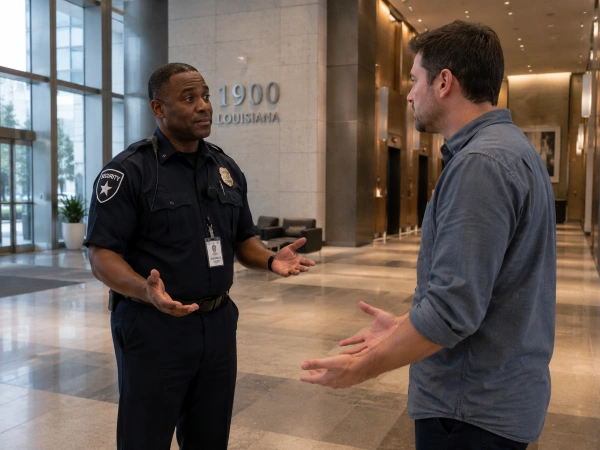
What Skills Does a Modern Unarmed Security Guard Need?
The U.S. security services industry hit roughly $50.4 billion in 2026 (per IBISWorld), and clients expect more from every guard than ever before. A 2025 ASIS International trends report confirmed that security roles are shifting from physical presence toward strategic prevention. Here’s what that looks like in practice.
Communication That Actually Prevents Incidents
About 75% of workplace violence starts as a verbal exchange, according to security training research cited across ASIS conference materials. That stat matters because it means officers with strong communication skills can cut off most incidents before they turn physical.
Good communication for a guard isn’t about being polite (though that helps). It’s about reading tone, adjusting your approach mid-conversation, and knowing when to listen instead of talk. I’ve watched guards defuse parking lot arguments in 30 seconds just by lowering their voice and asking one question. I’ve also watched guards turn a minor complaint into a screaming match because they led with authority instead of empathy.
Body language does half the work. Open posture, steady eye contact, and a calm tone signal control without aggression. The verbal part is simpler than people think: acknowledge the person’s frustration, state what you can do (not what you can’t), and give them a clear next step.
Why Is De-escalation the Most Valuable Guard Skill?
Here’s a contrarian take that practitioners will back up: de-escalation training matters more than any other single skill for unarmed security professionals. More than observation. More than reporting. More than tech literacy. And most companies still treat it as a one-time checkbox during onboarding.
De-escalation means reducing tension before it becomes a physical or legal problem. That includes recognizing early warning signs (pacing, clenched fists, rapid speech), maintaining safe distance, using calm and non-confrontational phrasing, and knowing when to disengage entirely.
The industry rarely asks a question it should: what’s your de-escalation refresh rate? A guard trained once three years ago isn’t trained. NYC’s security workforce showed 77% turnover in 2024 (per the Berkeley Labor Center), which means most guards at any given moment are relatively new. Quarterly de-escalation refreshers aren’t a luxury. They’re a minimum.
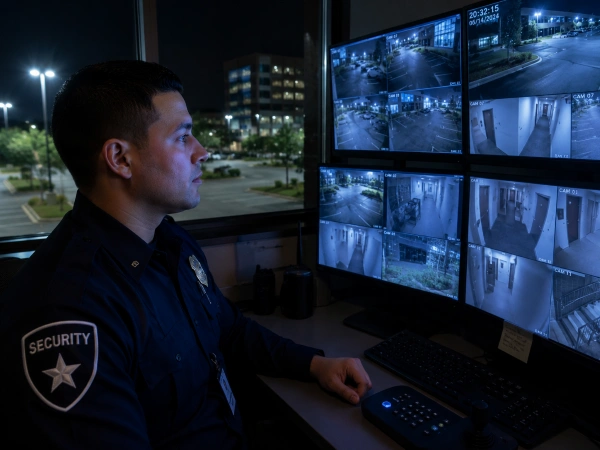
Situational Awareness and Threat Detection
Situational awareness is the ability to observe, process, and act on environmental details in real time. For an unarmed security guard, this means tracking entrances and exits, noticing behavioral changes, and identifying things that break the pattern of normal activity.
A guard with strong situational awareness spots the person circling the parking lot for the third time. They notice the unlocked supply closet that was locked an hour ago. They use patrol checklists and document observations consistently, not just when something goes wrong.
Actually, the better way to frame this skill isn’t “awareness” at all. It’s pattern recognition. Every environment has a baseline. Trained guards learn the baseline fast and flag deviations. Untrained guards just walk around.
Customer Service and Professional Presence
Guards are often the first face someone sees when entering a building. That interaction shapes perception of the entire organization. Being professional doesn’t mean being stiff. It means responding quickly to questions, offering clear directions, and treating every person the same regardless of their role.
This is where unarmed guards have an advantage over armed ones. Without a visible weapon, they’re more approachable. Visitors, employees, and tenants are more likely to report concerns to someone who doesn’t look like they’re expecting a firefight. That approachability is a security asset, not a weakness.
How Does Accurate Reporting Protect Your Business?
A guard who can’t write a clear report is a liability. Incident documentation is the one skill that directly connects to legal outcomes, insurance claims, and operational improvements. Reports need to include time, location, what happened, who was involved, and what actions the guard took.
The standard is simple: another person reading the report six months later should understand exactly what occurred. No opinions, no vague language, no gaps. Companies that require detailed guard reporting see fewer repeat incidents because patterns become visible in the data.
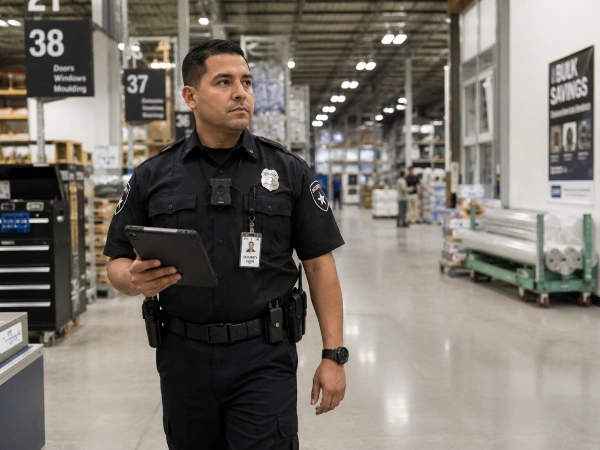
Working With Modern Security Technology
An unarmed security guard in 2026 who can’t operate CCTV software, access control panels, or a patrol tracking app is behind. The industry is moving toward technology-augmented guarding because the demands on each guard keep growing, and the tools available to support them are better than they’ve ever been.
Body-worn cameras are accelerating in private security, serving both as evidence collection and de-escalation tools. Guards who wear them tend to behave more professionally, and subjects they interact with tend to calm down faster. Cloud video platforms and AI-assisted monitoring are becoming standard at mid-to-large sites. A guard doesn’t need to be an IT specialist, but they need to use these tools without hesitation.
How Should Unarmed Guards Handle a Crisis?
Fires, medical emergencies, building evacuations. These situations demand fast, organized responses. An unarmed security guard needs to assess the scene, prioritize life safety, coordinate with emergency services, and direct people to exits.
The mistake most undertrained guards make is freezing or waiting for instructions. A professional guard has rehearsed these scenarios. They know the building’s evacuation routes, they’ve practiced radio protocols, and they submit a complete post-incident report before the end of their shift.
Crisis management is where training investment pays for itself. A single mishandled evacuation or medical event can expose a property to serious legal and operational fallout. Guards who train for emergencies quarterly, not annually, perform measurably better when those moments arrive.
What Separates a Professional Unarmed Security Guard From a Warm Body?
Training frequency and accountability. That’s the real divider.
A professional guard doesn’t just meet the minimum state licensing requirement and call it done. They train quarterly on de-escalation, get evaluated on report quality, and stay current on the technology their site uses. They coordinate with property managers and local law enforcement. They follow international security standards promoted by organizations like ASIS International.
The average security company bidding on contracts in Houston sends whoever is available. Companies that invest in upskilling and retention, like the team at Reliable Security Guard, keep turnover lower and put guards on-site who actually know the property, the tenants, and the threat profile. That consistency is what clients are really paying for.
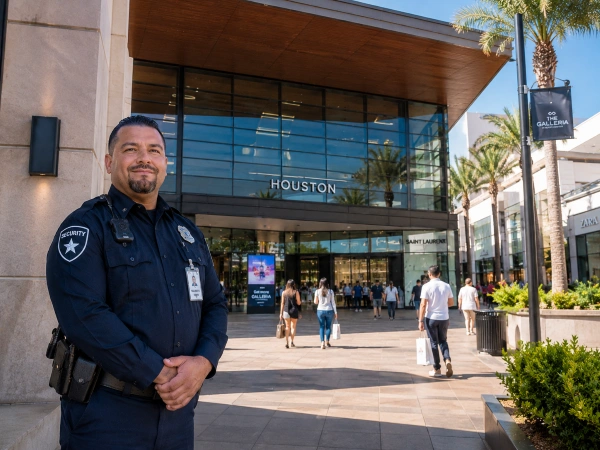
Which Industries Rely on Skilled Unarmed Guards?
Unarmed security guards work best in environments where visible force would create more problems than it solves. Office buildings, shopping centers, schools, medical clinics, and residential complexes all fall into this category. So do corporate lobbies, hotel properties, and low-risk event venues.
In Houston specifically, the demand runs heavy across commercial real estate, the Texas Medical Center campus area, and the Galleria district. Properties in these areas need guards who can manage access, assist visitors, and respond to incidents without escalation.
For most commercial and residential properties, the unarmed option delivers stronger results because the skillset matches the actual risk level. Armed response makes sense for high-threat environments, but in the settings where most Houston businesses operate, a well-trained unarmed guard provides the right balance of safety and approachability.
The one skill that ties everything together isn’t on any certification exam. It’s consistent. A guard who shows up trained, alert, and professional every single shift is worth more than a dozen warm bodies rotating through your lobby. If your current provider can’t tell you their guard retention rate and training schedule, that’s your answer.
FAQs
How many skills does a professional unarmed security guard need?
A professional unarmed security guard should have at least seven core competencies: communication, de-escalation, situational awareness, customer service, incident reporting, technology operation, and crisis management. The BLS tracks over 1.27 million security guard positions in the U.S., and the guards who advance are the ones who develop all seven rather than relying on physical presence alone.
What is the most important skill for an unarmed security guard?
De-escalation is widely regarded as the single most valuable skill. Roughly 75% of workplace violence incidents begin as verbal confrontations, meaning a guard who can reduce tension verbally prevents the vast majority of physical escalations. ASIS International’s 2025 trends research reinforced de-escalation and communication as top-priority training areas.
Why is security guard turnover so high?
The security industry experiences turnover rates between 50% and 300% annually due to demanding schedules, insufficient training investment, and retention challenges. NYC data from 2024 showed 77% turnover among private security officers. High turnover leads to inexperienced guards, inconsistent service, and ongoing costs for recruiting and retraining replacements.
Do unarmed security guards need to know how to use technology?
Yes. Modern unarmed guards are expected to operate CCTV systems, access control panels, digital patrol apps, radios, and in many cases body-worn cameras. Technology-augmented guarding is becoming the industry standard as companies look to improve coverage quality and reduce human error.
What industries hire unarmed security guards the most?
Unarmed guards are most common in office buildings, retail and shopping centers, schools, medical facilities, residential communities, hotels, and low-risk event venues. These environments benefit from a professional security presence that emphasizes approachability and prevention over armed response. In Houston, demand is strong across commercial real estate, medical campuses, and the Galleria retail corridor.
What questions should I ask before hiring an unarmed security company?
Ask about their guard turnover rate, de-escalation training frequency and refresh schedule, technology integration capabilities, and retention strategies. These are the questions that reveal actual service quality. A company that can’t answer them clearly is likely cycling through undertrained staff.