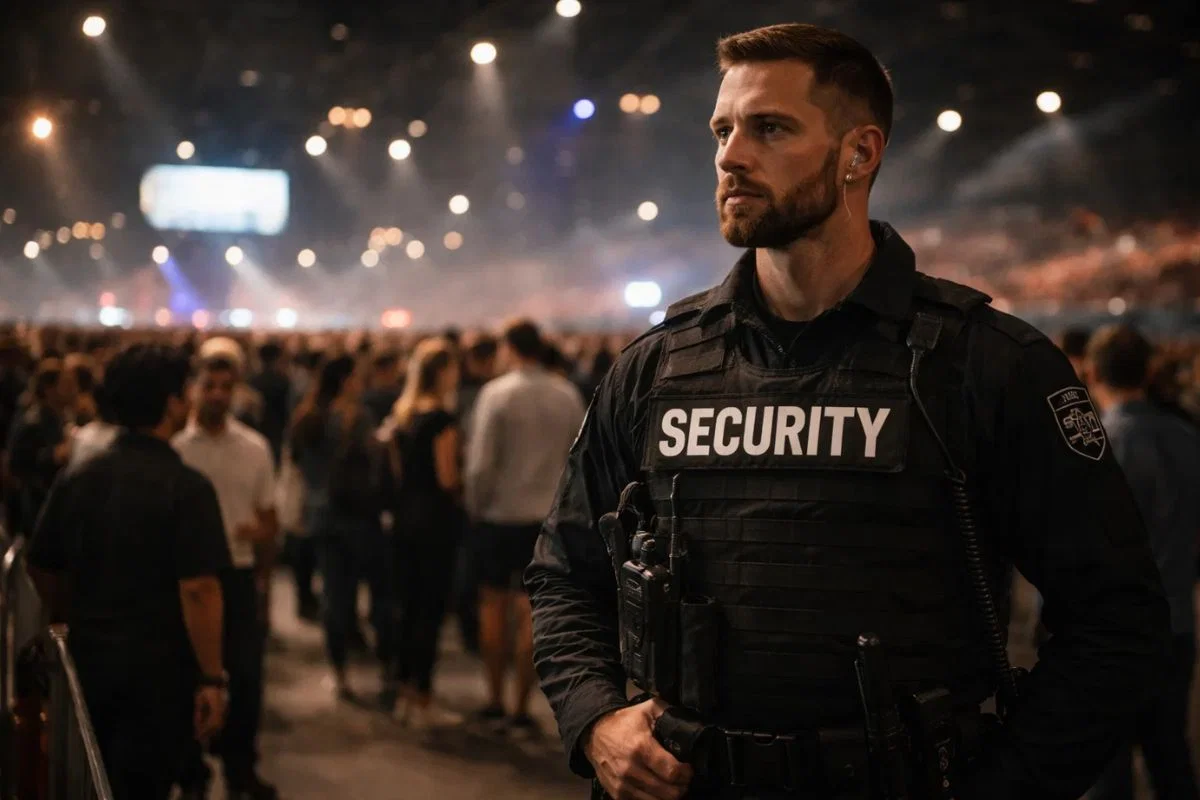
An event security guard is a trained professional responsible for protecting people, property, and the overall flow of your event. Their job goes well beyond standing at the door. They screen guests, manage crowds, respond to emergencies, and handle confrontations before they turn into problems. Whether you’re running a 50-person corporate mixer or a 5,000-person outdoor festival, you need someone whose entire focus is safety so your staff can focus on everything else.
An event security guard handles access control, crowd monitoring, conflict de-escalation, emergency coordination, and VIP protection at gatherings of any size. In 2024, the U.S. employed roughly 1.27 million security guards across all sectors (BLS Occupational Outlook Handbook, August 2025), and the broader security services market hit $47.8 billion in 2023 (Statista, December 2025). Event security is one of the fastest-growing segments within that space.
I’ve seen event planners treat security as a last-minute line item. That’s a mistake. And it usually costs more to fix than it would have cost to plan.
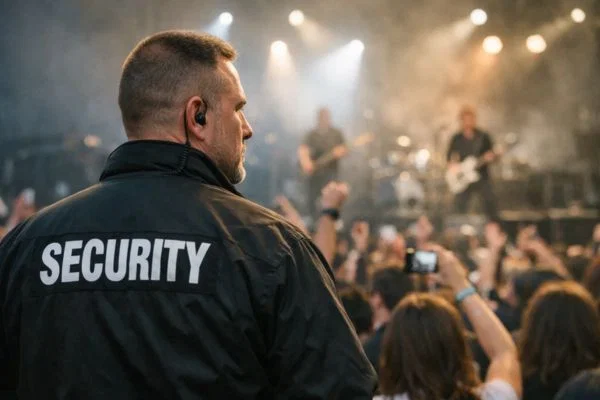
What Does an Event Security Guard Actually Do?
The short answer: everything that keeps your event from going sideways. But let me break it down, because “security” is vague and vague gets you the wrong coverage.
Event security guards handle a mix of preventive and reactive duties. On the preventive side, they’re checking IDs, screening bags, monitoring camera feeds, and watching crowd behavior for early warning signs. On the reactive side, they’re the first ones responding to fights, medical episodes, fire alarms, and uninvited guests.
One thing most articles won’t tell you: a good event security guard spends 80% of their time on customer service. Giving directions, answering questions, and helping someone find a lost friend. The visible, friendly presence does more to prevent problems than any amount of muscle. I’ve worked with teams where the guards who smile and engage with attendees cut incident reports by more than half compared to the stone-faced “intimidation” approach.
That’s the contrarian take here. The industry still sells security as a show of force. The role of security guards in event safety is closer to hospitality than most people realize.
How Much Does an Event Security Guard Cost?
This is the question everyone asks second (right after “do I even need one?”). Costs vary by region, risk level, and whether you need armed or unarmed guards.
Here’s what you can expect to pay per guard, per hour, based on 2025–2026 data:
| Guard Type | National Average | Texas/Southwest | California/Northeast |
| Unarmed | $20–$40/hr | $21–$27/hr | $32–$35/hr |
| Armed | $35–$60/hr | $35–$50/hr | $45–$60/hr |
| VIP/Executive | $60–$100+/hr | $50–$75/hr | $75–$100+/hr |
For a 250-person corporate event running six hours, you’re likely looking at $1,000–$3,000 total. A 1,000-person outdoor festival over eight hours can run $10,000 or more once you factor in risk assessment, CCTV integration, and coordination with local law enforcement (Dahlcore security cost guide, 2024/2026).
The biggest cost mistake I see? Understaffing. The standard ratio is 1 guard per 50–100 attendees, adjusted upward if alcohol is being served or the venue has multiple access points. Skip that math and you’re looking at unchecked incidents, potential lawsuits, and insurance headaches that dwarf whatever you “saved” on fewer guards.
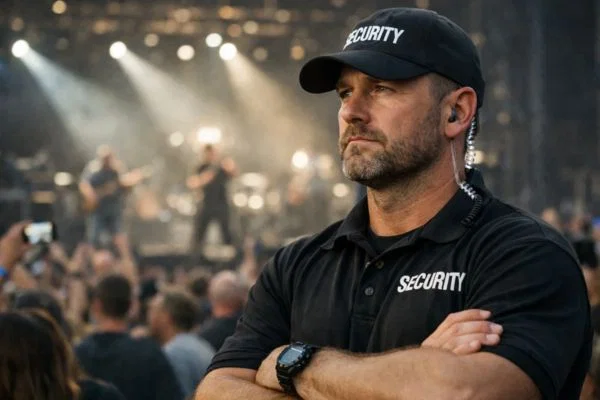
Do You Need Armed or Unarmed Event Security?
For most events, unarmed security guards are the right call. Corporate gatherings, well-planned community events, and private parties with fewer than 500 attendees rarely need armed personnel. Unarmed guards are trained in de-escalation, access control, and emergency response. They’re also less likely to escalate a tense situation by their presence alone.
Armed guards make sense for high-profile or high-risk events. Political fundraisers, events with celebrity appearances, and large outdoor gatherings in areas with elevated threat profiles are all situations where armed security is worth the 50–100% cost premium.
Actually, let me reframe that. The question isn’t “armed or unarmed?” It’s “What’s the actual threat level?” A good security company will run a risk assessment before recommending one or the other. If they jump straight to upselling armed guards without asking about your venue layout, guest list, and alcohol policy, that’s a red flag.
What Should Happen Before Your Event Starts?
Pre-event planning is where security either works or falls apart. And most event organizers don’t realize how much happens (or should happen) before the first guest walks in.
A proper pre-event risk assessment covers the venue’s physical layout, all entry and exit points, emergency evacuation routes, and any known threats. The security team should walk the site in advance, identify blind spots in camera coverage, and coordinate directly with your event staff on communication protocols.
This is where things get specific to your event. A corporate conference in a hotel ballroom has different risks than a music festival in an open field. Indoor events deal with capacity limits and fire codes. Outdoor events deal with weather, perimeter control, and the reality that people will try to sneak in.
The BLS projects roughly 162,300 annual job openings for security guards through 2034, driven mostly by turnover and retirements (BLS, August 2025). That turnover matters to you as a client. Ask your security provider how long their guards have been with the company. High turnover means the person showing up to your event might have weeks of experience, not years.
How Do Event Security Guards Handle Crowds?
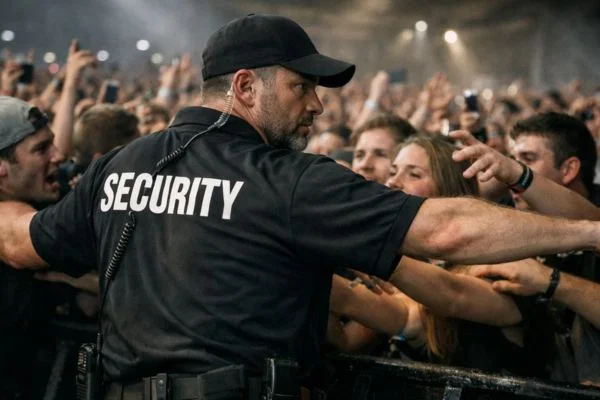
Crowd control is the most visible part of the job and the one that goes wrong the fastest when it’s done poorly.
Trained event security guards manage foot traffic at entrances and exits, monitor for signs of overcrowding, and step in early when they spot aggressive behavior or intoxication. At larger events, they’ll coordinate through radio communication to share real-time updates across the venue.
One detail that rarely gets mentioned: beverage enforcement. At any event serving alcohol, guards should be monitoring for signs of impairment, underage drinking, and outside beverages being brought in. According to ASIS International’s 2025 security trends research, security professionals are increasingly acting as operational partners rather than just enforcers. That means your guards should be trained in alcohol awareness, not just crowd management.
The 1:50–100 staffing ratio I mentioned earlier? That assumes a low-risk crowd. Add alcohol, tight spaces, or a younger demographic, and you need to tighten that ratio. I’ve seen 500-person events where seven guards weren’t enough because the venue had four separate bar areas and an outdoor smoking section with poor sight lines.
What Happens When Something Goes Wrong?
Emergencies don’t announce themselves. Fires, medical episodes, structural issues, severe weather, and yes, active threats can all happen at events.
Your security team should have a written emergency response plan that covers evacuation routes, first aid protocols, and coordination with local police and fire departments. Guards should know the site layout cold and have clear radio communication procedures so they can call for backup without confusion.
One of the biggest challenges at large events is noise. Background music, crowd chatter, and distance between posts can make radio communication difficult. That’s why pre-event briefings matter. Every guard should know where every other guard is posted, where the medical station is, and who makes the call to begin an evacuation.
States are starting to pay more attention to this. Maryland now requires security guard employers to register and carry proof of insurance as of January 2025 (Maryland State Police, December 2024). Washington state is creating a Security Guards Industry Standards Board to set minimum training and pay standards by 2028 (HB 2524, reported February 2026). These changes are overdue.

What Questions Should You Ask Before Hiring?
Here’s what separates a smart hire from a costly one. Most event organizers ask about price and availability. Few ask the questions that actually matter.
Before signing a contract, ask these:
- What liability insurance do you carry, and what does it cover?
- What specific training do your guards have in de-escalation and alcohol awareness?
- What’s your staffing ratio recommendation for my event size and type?
- How do you handle shift rotations for events longer than six hours?
- What’s your contingency plan if you need to scale up staffing on the day of the event?
If they can’t answer those clearly, keep looking. A company that knows how to hire and train security guards properly will welcome these questions, not dodge them.
How Do Event Security Guards Work with Your Team?
Security doesn’t operate in a vacuum. The best outcomes happen when guards and event staff share the same communication channels and know each other’s roles.
Before the event, the head of security should meet with your lead organizer to review the timeline, identify high-traffic periods, and agree on escalation procedures. During the event, guards and staff should have a shared radio channel or at least a direct phone line for quick coordination.
I’ve seen events where the security team and the catering staff didn’t even know each other existed until a guest had a medical emergency in the kitchen. Don’t let that be your event. A 30-minute pre-event briefing with everyone in the same room, security, event staff, and venue management, prevents 90% of coordination failures.
Working with a marketing partner who understands your vertical can also help you plan the public-facing side of your security presence, from signage to guest communication, so security feels like part of the experience instead of an afterthought.
What Separates a Good Event Security Company from a Bad One?
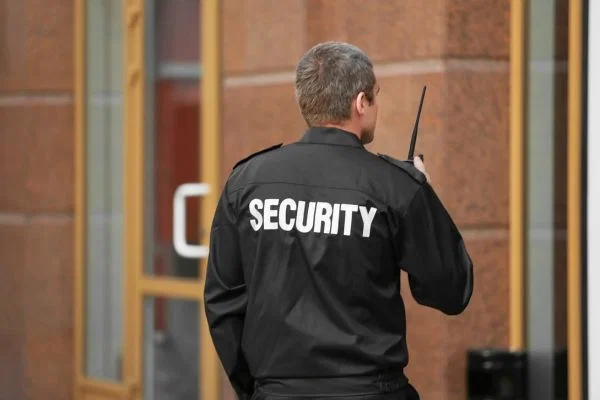
The security industry has a branding problem. Companies advertise highly trained professionals, but guards on the ground report minimal ongoing training, low pay, and burnout. Wages have stayed flat at roughly $17–$18 per hour nationally (Center for American Progress, September 2025), and about 40% of security officers don’t have employer-provided health insurance.
That gap between marketing and reality means you need to vet carefully. Look for companies that invest in ongoing training (not just state-mandated minimums), carry proper insurance, and have a track record with events similar to yours. Ask for references. Check reviews. And if the price seems too good to be true, it probably means the guards are underpaid and undertrained.
The IBISWorld 2025 industry analysis projects the U.S. security services market will reach $49.1 billion by 2026, but that growth doesn’t mean quality is keeping pace. Your job is to find the providers who treat their people well, because those are the providers whose guards actually show up prepared.
The single biggest takeaway? Don’t hire event security by the hour like you’re booking a temp worker. Hire them like you’re hiring a partner who’s responsible for every person in that venue getting home safely.
Frequently Asked Questions
How many event security guards do I need for my event?
The standard staffing ratio is 1 guard per 50–100 attendees. Adjust upward for events serving alcohol, outdoor venues with multiple entry points, or crowds over 500. A 250-person indoor corporate event typically needs 3–5 guards, while a 1,000-person outdoor festival may require 10–15 or more, depending on the risk assessment.
How much does it cost to hire an event security guard in Houston?
In the Houston and greater Texas area, unarmed event security guards typically cost $21–$27 per hour. Armed guards run $35–$50 per hour. VIP or executive protection can exceed $75 per hour. A mid-size event (250 guests, 6 hours) usually costs between $1,000 and $3,000 total.
What’s the difference between an event security guard and a bouncer?
Event security guards focus on prevention, planning, and coordination across an entire venue. Bouncers typically work a single door and respond reactively. Guards are trained in risk assessment, emergency protocols, and de-escalation. If someone tells you “just hire a bouncer,” they’re underestimating the complexity of event safety.
Do event security guards need special training?
Yes. Beyond basic state licensing, event security guards should have training in de-escalation techniques, alcohol awareness, emergency evacuation procedures, and site-specific risk assessment. ASIS International’s 2025 research found that security professionals are increasingly expected to serve as operational partners, not just a physical presence.
Should I hire armed or unarmed security for a wedding or private party?
For most weddings and private parties, unarmed security is the right fit. One or two guards can manage access, monitor alcohol-related issues, and handle any disruptions. Armed guards are typically reserved for events with a specific, elevated threat level. If your guest count is under 100 and the venue is low-risk, unarmed is almost always enough.
What insurance should an event security company carry?
At a minimum, your security provider should carry general liability insurance and workers’ compensation coverage. Ask for a certificate of insurance before signing any contract. Maryland’s 2025 employer registration law now requires proof of insurance for security guard employers, and more states are following suit.
Can event security guards respond to medical emergencies?
Many event security guards are trained in basic first aid and CPR. They’re typically the first responders on scene until paramedics arrive. Your security provider should confirm that their guards have current first aid certification and that the event plan includes a designated medical response station.


