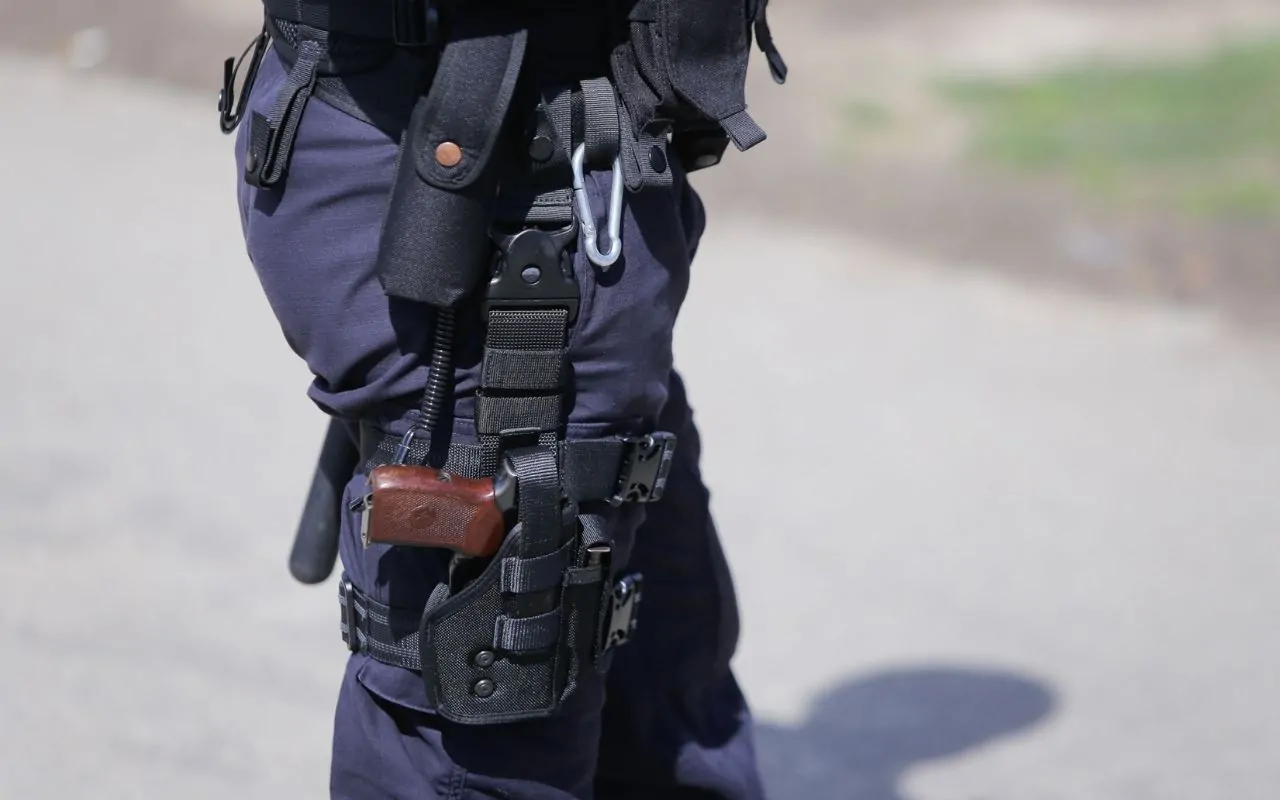
Security guard use of force in Texas is decided by Texas Penal Code Chapter 9, not by the 5-level continuum chart most of this industry publishes. Chapter 9 runs broader than that chart in one place and narrower in another. It justifies force to protect a client’s property. It removes any duty to retreat. And it gives an officer no arrest power beyond an offense committed in their presence or within their view.
Get that backwards and the officer loses the justification argument before anyone asks whether the force was proportional.
Below: what the statute allows, and what the tool rules demand before an officer carries the thing they used. Then 5 nights from our own log where Texas law would have permitted more than our officers chose to do.
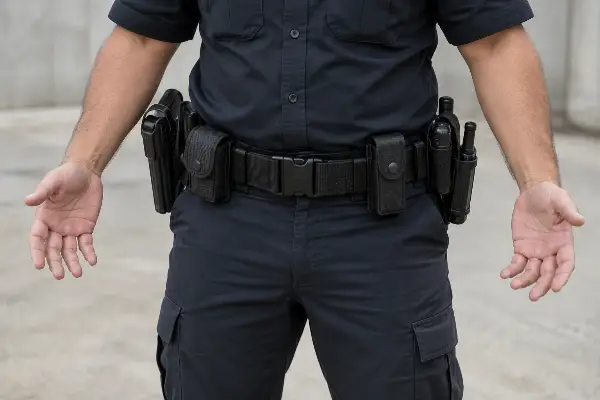
What is security guard use of force?
Security guard use of force is physical force applied by a private officer under the same justification defenses as any private citizen, set out in Texas Penal Code Chapter 9. Guards have no police powers. Force is justified only when and to the degree the officer reasonably believes it is immediately necessary, and ends when that necessity does.
That last clause does more work than anything else on this page. “When and to the degree” is the statutory language, and it shows up in the property sections too. So the test is not a level on a ladder. The test is necessity, measured moment by moment, and it can expire mid-incident.
A private officer also carries no qualified immunity and no sovereign protection. When the justification fails, what remains is assault, or false imprisonment, or both.
The force continuum is a training tool, not Texas law
The force continuum carries no statutory force in Texas or anywhere else. The continuum is a teaching diagram. Courts do not apply it.
Count the levels across the pages that publish it and the looseness shows. The 4 national pages ranking for this question run 6 levels, 5, 5, and 4. One widely shared industry page publishes a 5-row matrix and calls it a “Force Justification Matrix.” Then it states a rule. Guards should use force “one level higher than the resistance encountered.”
That rule has a problem. The objective reasonableness standard that same article invokes comes from Graham v. Connor, 490 U.S. 386 (1989). Graham says close to the opposite. Reasonableness gets judged on the totality of the circumstances, and officers are not required to use the least intrusive means available. A ladder that demands the lowest rung first is not that standard.
The legal research organization AELE reached the same tension in its review of use-of-force continuums. Its warning: a continuum can pull a court away from the reasonableness test, toward whether the officer followed the diagram.
Graham also does not govern a private guard. Graham is a Fourth Amendment case about state actors. Our officers answer to Chapter 9 and Texas tort law. Citing Graham at a private security officer is a category error, and this field repeats it constantly. It is also one of the clearest lines between private security and police.
None of that makes the continuum worthless. A new officer gets a decision structure from it. A company gets a way to teach restraint. 2 of those 4 at least call it a policy convention rather than law. So teach it. Do not expect it to answer the question a Texas court asks.
What does Texas Penal Code Chapter 9 allow in 2026?
Chapter 9 gives a private officer 4 justification routes. Each one has its own trigger, and the trigger is what decides the case.
| Situation | Statute | What it justifies | The condition that decides it |
|---|---|---|---|
| Threat to the officer or another person | 9.31, 9.33 | Force against unlawful force | Immediate necessity. No duty to retreat under 9.31(e) |
| Trespass or interference with property in the officer’s lawful possession | 9.41(a) | Force to prevent or end the trespass or interference | Immediately necessary, and only to the degree believed necessary |
| Recovering property just taken | 9.41(b) | Force to reenter or recover | Used immediately or in fresh pursuit, plus a belief the taker had no claim of right or used force, threat, or fraud |
| Protecting a client’s property | 9.43 | Force or deadly force, borrowing the 9.41 or 9.42 standard | The client requested the protection, or the officer has a legal duty to protect it, or the officer believes the interference is theft or criminal mischief |
| Arson, burglary, robbery, or nighttime theft or criminal mischief | 9.42 | Deadly force, in narrow conditions | All 3 statutory conditions have to be met at once. See below |
Row 4 matters most for contract security, and nobody in this field writes about it. Section 9.43 justifies force to protect a third person’s land or movable property. The officer borrows the standard they would have for their own property. The trigger: the third person requested that protection, or the officer has a legal duty to protect it.
A security services agreement is that request and that duty, in writing. So 9.43 is the legal basis for a guard doing anything at all about a theft in progress on someone else’s site. It beats “reasonable force” hand-waving, because it names the reason the guard was there.
Section 9.31(a) adds a presumption that the officer’s belief was reasonable in certain forced-entry situations, including an occupied place of business or employment. A posted officer’s assignment can be their place of employment. Worth knowing. Not a shortcut.

Deadly force to protect property is real in Texas, and narrower than it sounds
Section 9.42 justifies deadly force to protect land or tangible, movable property. That surprises anyone who has read the national blogs, which say flatly that a guard may only defend people. Texas says otherwise. Pretending the section does not exist is how officers end up untrained on the thing they are most likely to meet at 3 a.m.
Read the conditions, because all 3 have to be met at once.
- The officer would already be justified in using non-deadly force under 9.41.
- Deadly force is immediately necessary, in the officer’s reasonable belief, to prevent the other person’s imminent commission of arson, burglary, robbery, aggravated robbery, theft during the nighttime, or criminal mischief during the nighttime. Or to stop someone fleeing immediately after burglary, robbery, aggravated robbery, or nighttime theft from escaping with the property.
- In that same reasonable belief, the property cannot be protected or recovered by any other means. Or that using anything less would expose someone to a substantial risk of death or serious bodily injury.
Condition 3 is the wall. Put a patrol vehicle, a spotlight, a radio, and a phone on a construction site, and “cannot be protected by any other means” gets hard to believe reasonably. Harder still to defend afterward.
Chapter 9 is a set of defenses. An officer raises them after the fact, in front of a prosecutor or a jury, having already acted. No part of it is a permission slip issued in advance.
We train to condition 3 as a stopping point, not a threshold to clear. Our view: an officer who reaches for the statute has already lost the shift. The rest of this page covers the tools that keep you away from it.
No duty to retreat, and why that changes less than people think
Texas dropped the duty to retreat for anyone lawfully present who did not provoke the encounter and is not engaged in criminal activity. Section 9.31(e) says that person need not retreat before using force. Section 9.31(f) goes further. A finder of fact may not consider a failure to retreat when weighing whether the belief was reasonable.
A posted officer on a client’s site is lawfully present by definition. Here the retreat question does not arise the way it does in duty-to-retreat states. Readers in Texas get no answer on this from the national pages.
What it does not change: necessity. Dropping the duty to retreat does not lower the bar for whether force was immediately necessary in the first place. The other side loses 1 argument. Nothing else moves.
Officers who hear “no duty to retreat” and conclude they may stand their ground and escalate have misread it. That misreading is a liability problem for the officer, for us, and for the property owner.
Can a security guard stop someone leaving with stolen property?
Sometimes, and the window is narrow. Section 9.41(b) justifies force to reenter land or recover movable property on 2 conditions. The officer uses that force immediately or in fresh pursuit after the dispossession. And the officer reasonably believes the person either had no claim of right, or took it by force, threat, or fraud.
Read “fresh pursuit” strictly. A decision to go looking an hour later is not fresh pursuit. Neither is a stop at the gate the next morning. Once the moment passes, the lawful move is documentation and a police report, which is what actually recovers material in our experience.
Section 9.42(2)(B) carries the same idea into deadly force, for someone fleeing immediately after burglary, robbery, aggravated robbery, or nighttime theft. All 3 conditions above still apply. Our answer to that scenario is the radio. Our construction site officer duties are built around observing and reporting for exactly this reason.
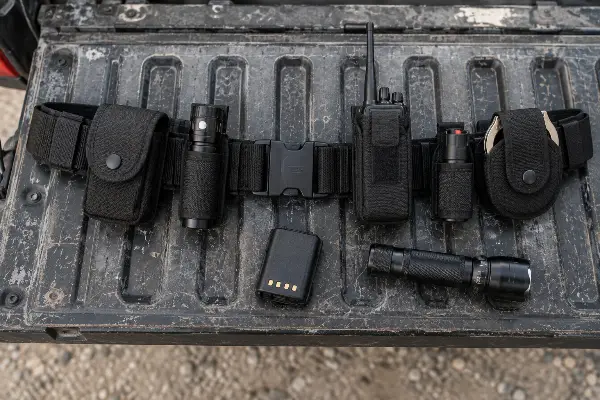
Can a security guard carry pepper spray, a baton, or a Taser in Texas?
Pepper spray requires board-approved training in Texas. A baton requires no certification at all. A Taser requires nothing either. That ordering runs backwards from the national guidance, and getting it wrong loses a case before the force question is even reached. An officer carrying a tool unlawfully starts the justification argument in a hole.
Here is what the Texas Department of Public Safety says about each one.
| Tool | Texas position | Training or certification required |
|---|---|---|
| Chemical dispensing device (pepper spray beyond a commercial personal-protection dispenser) | Restricted under Penal Code 46.05. A security officer has a defense once the required training is complete | Yes. Training provided by TCOLE or approved by the Private Security Board. Level III training satisfies it |
| Club or baton | Carry is prohibited in specific locations under Penal Code 46.03, with limited exceptions | No. DPS states there is no certification specific to carrying a club |
| Taser or similar device | Not expressly prohibited under Texas law | No. No certification or training requirement under the Private Security Act or the administrative rules |
Read that table twice. The pepper spray needs board-approved training. The baton has no certification pathway in Texas, only location limits. The Taser has no training mandate. Most of the internet gets this wrong because most of the internet is describing California.
For a property manager the practical point is short: no state rule stops a company from handing an officer a Taser with zero hours of instruction. Whether that happens is a company decision, and it is a fair question on a quote call. What our officers carry is set per post, and we name the tools and the training behind each one before anyone starts a shift. Our breakdown of what unarmed officers carry covers the rest of the kit, and the tool list differs between an armed officer and an unarmed officer on the same property.
Detention is a narrower question than force, and a separate one
Texas gives a private person just 1 warrantless arrest route. Code of Criminal Procedure Article 14.01(a) lets any person arrest an offender without a warrant when the offense is committed in their presence or within their view. The offense also has to be a felony or an offense against the public peace.
Presence or view. Not probable cause, not reasonable suspicion, not a hunch that hardens over a shift. Plenty of national guidance states the rule as witnessing a felony or having probable cause for a misdemeanor breach of peace. The probable cause half of that is not the Texas rule. An officer who detains on suspicion in Texas has built the fact pattern for a false imprisonment claim.
We cover the detail elsewhere rather than repeat it here. Start with when guards can detain, then guards and handcuffs for the restraint question.
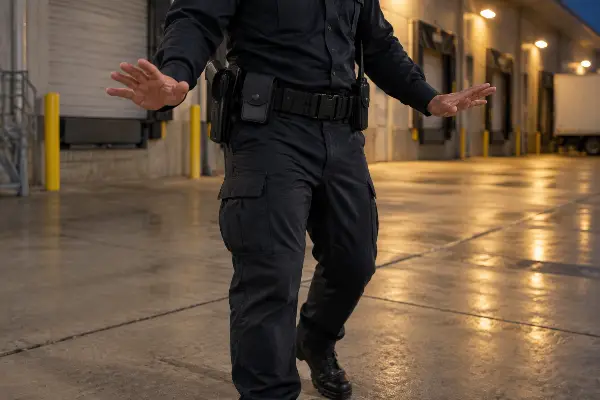
The moment force stops being justified
Every force section in Chapter 9 reads “when and to the degree” the officer reasonably believes force is immediately necessary. Both halves are limits. The “when” ends. The “degree” caps.
So the justification is not a switch flipped at the start of an incident and left on. It expires the instant the necessity does. The subject stops resisting. The trespass ends. The property comes back. The fleeing person is gone. Force applied after that point has no statutory cover, whatever the officer was justified in doing 10 seconds earlier.
In our reading of claims against this industry, that gap is where most of them live. Not the decision to act. The failure to stop. A 5-level continuum handles it worst of all, because a ladder teaches an officer how to climb and says nothing about coming down.
What goes in a use-of-force report
A report is the only version of the incident that survives. Write it as though the reader is a prosecutor who was not there and does not like you.
What it has to contain:
- The observable behavior that created the necessity, written as behavior rather than conclusion. “Raised a pry bar and stepped toward me” survives. “Became aggressive” does not.
- Every verbal instruction given, in the words used, and the response to each.
- What was tried before contact, and why it failed. This is the necessity element in plain language.
- The force used, described precisely, with the point at which it stopped and what stopped it.
- Injuries observed, medical aid offered, and the answer to that offer, including a refusal. Offering care and logging the offer belongs in the record either way.
- Witnesses, with contact details, plus any scene or injury photographs.
- Times. Real ones, to the minute.
2 habits matter more than the format. Write it the same shift. Write behavior instead of adjectives. Our reports come in through a GPS guard tour system in real time, not at the end of a week. That is the difference between a record and a recollection. Ask any company whether it keeps a written use-of-force policy, then ask to see the section headings. A company that cannot produce one is training its officers to nothing.

5 Houston nights when the law allowed more than we used
We can put something real here that nobody else in this field can, because the numbers everyone else publishes are invented. One widely circulated page claims de-escalation resolves 94 percent of incidents, cutting injuries 73 percent and liability 81 percent, credited to 4 sources. 3 of those 4 do not exist. The fourth is California’s regulator. No dataset sits behind any of those figures.
Our own log is smaller and it is checkable. 5 incidents, all property crimes in progress, all between 11:20 p.m. and 3:30 a.m., all on commercial sites in the Houston area. A pickup circling a construction perimeter. 2 people carrying materials toward a fence line. Copper wire coming out of a tampered storage container. A boarded window being forced at a vacant building. An unauthorized vehicle at a warehouse dock after hours. We tell all 5 in full in our write-up on security guard emergency response.
What matters on this page is how they read against the statute. 4 of the 5 are nighttime theft or criminal mischief at a site we were contracted to protect, which is 9.43 pointing at 9.42. On the copper wire and the material theft, an officer could have made a colorable argument for more than he used. In all 5, nobody was touched. Lights, a spotlight, distance, a radio, a verbal instruction, and a written report closed every one.
There is the real answer to the question this topic keeps asking. Presence resolves a property crime in progress. The statute is the thing you never want to need. We run about 150 officers across more than 100 sites, most of them construction sites, warehouses, and vacant buildings. Ask any company how many use-of-force incidents it logged last year and whether it can hand you the reports. That number is checkable. The percentages on the rest of this topic are not.
We work under Texas DPS license B07315701 and cover the Houston area 24 hours a day with no holiday closures. Our officers work in English and Spanish. Every account gets a named supervisor.
What to ask a guard company about force before you sign
Ask these 2 questions on the call, and listen for what a real answer sounds like.
“What is your officers’ use-of-force standard, and can you name it?” An answer that stops at a 5-level continuum means the company has not read the statute governing its own officers. A real answer names Chapter 9, separates the property sections from the self-defense sections, and says where the officer’s authority stops.
“What tools do your officers carry on my site, and what training did they complete for each one?” Texas demands board-approved training for a chemical dispensing device and demands nothing for a Taser. Any company that can tell you which officers completed which is tracking it properly.
For the rest of the vetting conversation, our plain-language overview covers what guards can do. If your question is the consumer version of this one, we answer guards and physical contact separately, alongside an officer’s legal authority.
Security guard use of force comes down to statute, restraint, and records. The companies that get it right are the ones whose officers rarely have to answer for it. We are a Houston security guard company that trains to the statute and reports on every shift. Our contracts run weekly, monthly, or long term, because we do not require a long-term commitment to start. Ask us the 2 questions above and we will answer them on the phone.
This article describes Texas statutes as the state publishes them and is not legal advice. Verify current law with Texas counsel, and check officer and tool requirements with the Texas Department of Public Safety Private Security Program before making any policy or compliance decision.
FAQs
What is the security guard use of force standard in Texas?
Texas Penal Code Chapter 9. A security officer uses the same justification defenses as any private citizen, and force is justified only when and to the degree the officer reasonably believes it is immediately necessary. No separate security-industry standard exists, and no police-style authority comes with the job. Section 9.31(e) also removes any duty to retreat for an officer who is lawfully present and did not provoke the encounter.
Can a security guard use force to protect property?
In Texas, yes. Section 9.41 justifies force to prevent or end a trespass or unlawful interference with property in the officer’s lawful possession, and Section 9.43 extends that to a client’s property when the client requested the protection or the officer has a legal duty to protect it. A security services contract is that request. The force still has to be immediately necessary and limited to the degree believed necessary.
Is the use of force continuum actually law?
No. The continuum is a training and policy diagram with no statutory force in Texas or any other state. The 4 national pages we reviewed publish it with 6, 5, 5, and 4 levels, which measures how little consensus sits behind it. Graham v. Connor, the case usually cited alongside it, holds that reasonableness is judged on the totality of the circumstances and that officers are not required to use the least intrusive means available.
Does security guard use of force follow the same rules as police use of force?
No. Graham v. Connor sets a Fourth Amendment standard for state actors, and a private security officer is not one. Private officers answer to Texas Penal Code Chapter 9 and Texas tort law, carry no qualified immunity, and hold no arrest authority beyond Code of Criminal Procedure Article 14.01, which requires the offense be committed in the officer’s presence or within their view.
Can a security guard carry pepper spray or a Taser in Texas?
The rules run opposite to most national guidance. Texas DPS states that a security officer needs training provided by TCOLE or approved by the Private Security Board for a chemical dispensing device, and that Level III training satisfies it. For a Taser or similar device, carry is not expressly prohibited and no certification or training is required under the Private Security Act. A club has no certification pathway at all, only location restrictions under Penal Code 46.03.
When does a security guard have to stop using force?
The moment the necessity ends. Every force section in Chapter 9 justifies force only “when and to the degree” the officer reasonably believes it is immediately necessary, so the justification expires when the subject stops resisting, the trespass ends, or the property is recovered. Force applied after that point has no statutory cover, and in this industry that gap is where most excessive-force claims begin.
Can a security guard detain someone for a theft they did not see?
Not in Texas. Article 14.01(a) permits a private person to arrest without a warrant only when the offense is committed in their presence or within their view, and only if it is a felony or an offense against the public peace. Detaining on suspicion, or on a report from someone else, builds the fact pattern for a false imprisonment claim rather than a lawful detention.