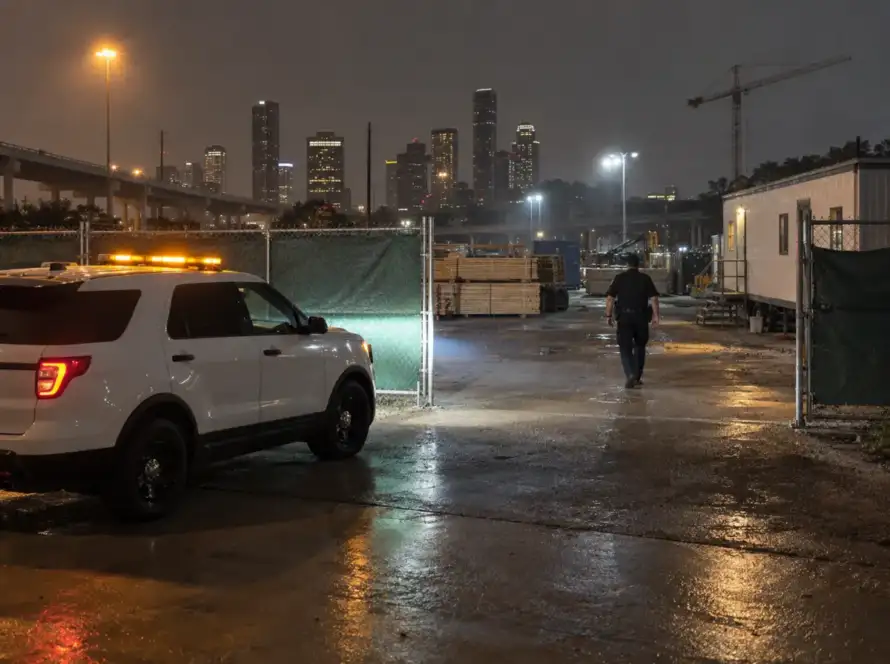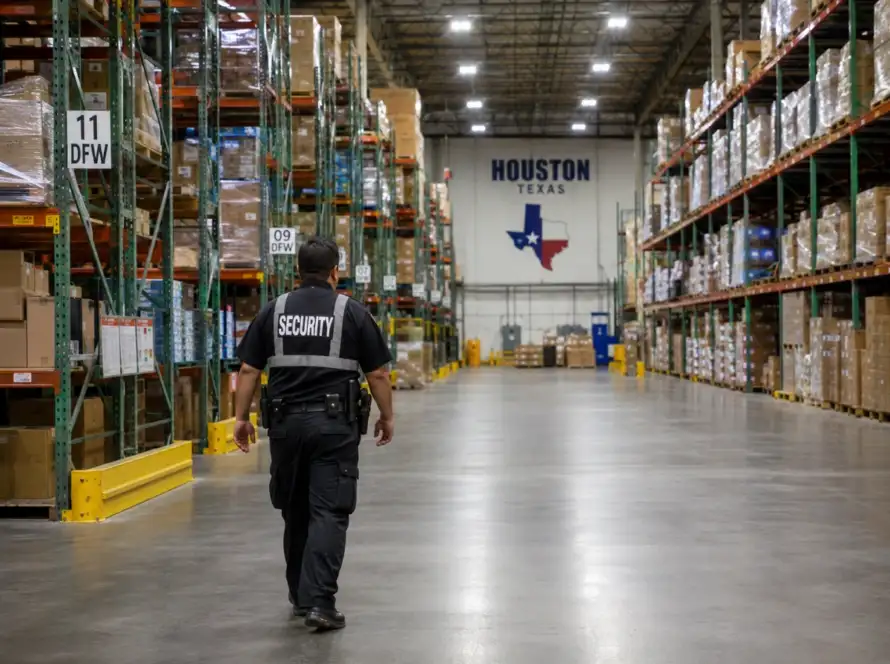
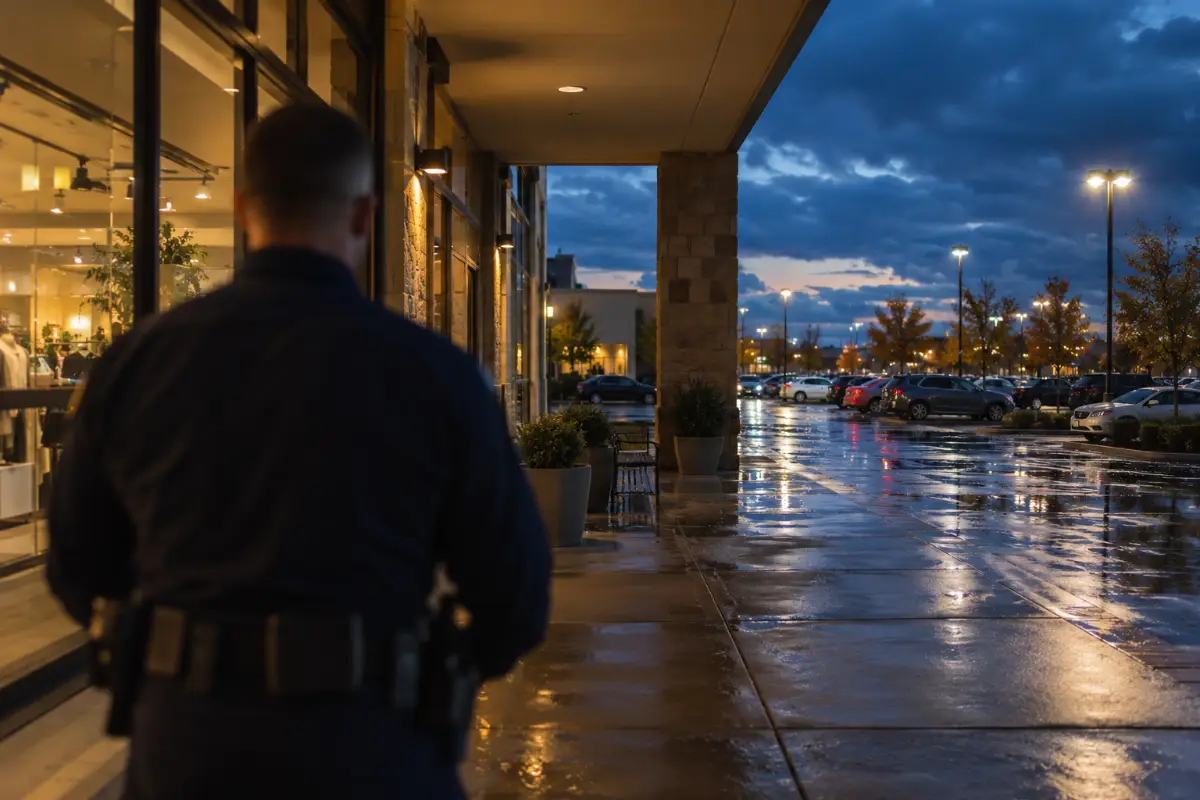
Preventing organized retail crime comes down to 3 things. Make your property hard to work. Make your staff certain about what they can and can’t do. And document incidents well enough that a prosecutor can actually file the case. The third one changed in Texas on September 1, 2025, and most retail security advice hasn’t caught up to it.
Coordinated crews don’t behave like single shoplifters. They pick the site in advance, they arrive with assigned roles, and they count on your team hesitating. Locked cases and camera coverage slow them down. They don’t stop them.
Below is what the current numbers say, what Texas law now needs from your incident reports, and what to change at your property this quarter.
What is organized retail crime, and how is it different from shoplifting?
A single shoplifter takes something for themselves. An organized crew is running inventory for resale, and Texas charges that differently.
Organized retail crime is coordinated theft of retail merchandise for resale rather than personal use. It involves people who plan targets, assign roles, and move goods through resale channels, including online marketplaces. Texas law also counts a single person who unlawfully takes merchandise from a merchant on 2 or more occasions within a 180-day period.
That difference matters operationally, not just legally.
| Single-offender shoplifting | Organized retail crime | |
|---|---|---|
| Who shows up | 1 person, usually unplanned | 2 or more, roles assigned in advance |
| Target selection | Opportunity at the shelf | Site picked before arrival, often scouted |
| What moves | 1 or 2 items, personal use | Volume, resale |
| Time on site | Minutes, browsing pattern | Straight to a known fixture, then out |
| What deters it | Visible camera, locked case, staff greeting | Officer presence at the entrance and the exit path, plus a documented pattern that supports a filed charge |
| Texas charge basis | Value of what was taken | Value aggregated across the pattern, plus the concert-of-action prongs |
If your property is seeing the same faces or the same method twice in a quarter, you’re not dealing with opportunists, and the response has to change.
Is organized retail crime actually rising in 2026?
Not by the most recent count. The National Retail Federation’s study published July 30, 2026 reports a 12.4% decrease in shoplifting incidents and an 8.1% decrease in merchandise theft incidents between 2024 and 2025, across 66 retail companies and 143 brands representing $1.7 trillion in annual sales.
That’s a real shift from the numbers most articles still quote. NRF’s December 2024 report found a 57% average increase in organized retail crime incidents from 2022 to 2023, but only among retailers that could track those incidents specifically. The same report found a 93% increase in the average number of shoplifting incidents per year in 2023 against 2019, with retailers averaging 177 incidents per day in 2023. Those are 2023 figures. They are not a description of this year.
Two more numbers from the 2026 report are worth knowing before you set a budget. 63% of retailers report fewer than half of their incidents to law enforcement, with 60% pointing to the small size of the loss and 54% pointing to a lack of police follow-through. And when retailers were asked where they put their money, the top 2 answers were management training at 72% and employee training at 65%, ahead of risk-intelligence technology at 61%.
One more piece of context. In December 2023, NRF withdrew a widely repeated claim that organized retail crime accounted for nearly half of $94.5 billion in 2021 shrink. An NRF spokesperson said the statement “was a mistaken inference made by the K2 analyst linking the results of the NRF NRSS survey from 2021 and an assertion by Ben Dugan from CLEAR.” That withdrawn figure is still sitting in retail security articles today. If you see it, you’re reading something written before the correction or copied from something that was.
How organized crews actually work a retail center
Three methods account for most of what officers see at shopping centers, and each one has a different weak point.
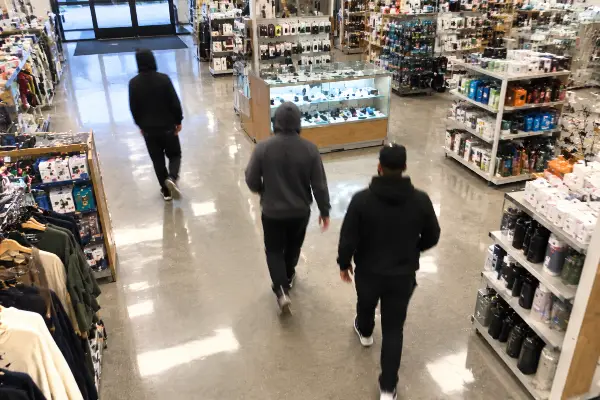
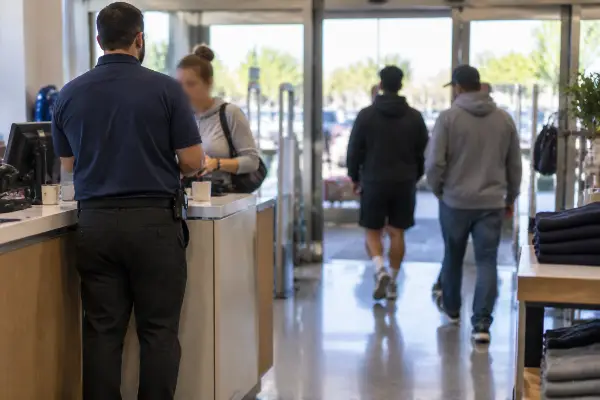
The blitz entry. A small group enters together, one occupies staff near the door, the rest go straight to a known fixture. The whole thing is built around the gap between the first thing your staff notices and the moment someone decides to act. NRF’s 2026 report puts walkout or pushout theft at 37% of external theft methods reported.
Scan avoidance at self-checkout. Ticket switching and not scanning items are ordinary loss now, but a crew uses them to move volume while looking like a normal customer. Your exception reports catch this after the fact. An officer positioned where the receipt gets checked catches it during.
Resale. Goods move through online marketplaces where the original source is hard to trace, often mixed in with legitimate stock. Some of that volume never passes a sales floor at all, which is why loading docks and back-of-house doors belong in the same plan as the storefront, and why warehouse coverage matters to retail groups that run their own distribution. Repeat offenders show up in 50% of external theft reports in the 2026 data, and organized retail crime incidents in 40%.
The common thread is that all 3 depend on your property producing no usable record. A crew that gets a clean run and a shrug comes back. That’s the actual pattern behind most repeat targeting, and it’s fixable without buying anything.

What Texas changed on September 1, 2025
Texas rewrote its organized retail theft statute, and the new version is far easier for a prosecutor to use. Senate Bill 1300 amended Texas Penal Code 31.16 effective September 1, 2025.
Under the current text, a person commits organized retail theft by doing any of the following:
- Acting in concert with 1 or more other people to unlawfully take retail merchandise, money, or other property from a merchant.
- Unlawfully taking retail merchandise on 2 or more occasions within a 180-day period.
- Knowingly obtaining a benefit from conduct under 1 or 2, which reaches the buyer and the fence, not just the person in the store.
- Knowingly acting in concert with others to overwhelm the security response of a merchant.
Prong 4 is the one that describes a blitz entry directly. Prong 2 means a repeat offender working alone can be charged under the organized statute. And 3 procedural changes make the charge stick: value is now the merchant’s posted or advertised sales price including sales tax rather than fair market value, a price tag is prima facie evidence of both value and ownership, and an indictment no longer has to name each individual item, only the merchant and the aggregate value range.
Read those 3 together and the practical effect is clear. The evidence that decides the charge is the evidence your property generates.
The charge ladder that decides whether your case gets filed
The value of what was taken sets the offense grade, and the thresholds moved up under SB 1300.
| Aggregate value | Offense grade |
|---|---|
| Under $100 | Class B misdemeanor |
| $100 to $749 | Class A misdemeanor |
| $750 to $2,499 | State jail felony |
| $2,500 to $29,999 | Third degree felony |
| $30,000 to $149,999 | Second degree felony |
| $150,000 and above | First degree felony |
The line worth memorizing is $750. Below it you have a misdemeanor. At $750 you have a felony. Because the statute lets value aggregate across a 180-day pattern and prices at posted retail including tax, a series of small hits that each looked unworthy of a call can cross that line together.
That is the argument for reporting the small ones. 60% of retailers in the 2026 NRF data point to the small size of the loss as the reason they don’t report. Under the current Texas statute, the low-value events are what build the felony.
What has to be in the incident log for a felony charge to hold?
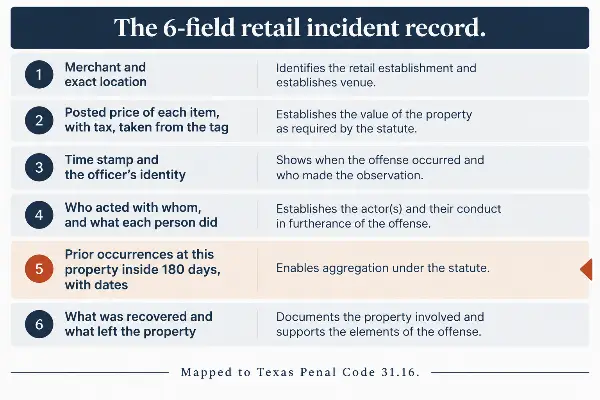
Six fields. If your reports carry all 6, a prosecutor can work the case. If they carry 3, you have a paper trail that proves nothing.
We use this standard across our patrol accounts, and it maps directly to what Penal Code 31.16 now needs:
- Merchant and exact location. The statute charges by merchant and aggregate value. A report that says “shopping center” instead of the tenant name is not chargeable.
- Posted price of each item, with tax, taken from the tag. Value is the posted retail price now. Photograph the tag or record the SKU price. Do not estimate.
- Time stamp and the officer’s identity. Ours come off a GPS guard tour system, so the patrol round and the report share a verified clock.
- Who acted with whom, and what each person did. Prongs 1 and 4 turn on concert of action. “Three individuals” is not enough. Who blocked, who took, who drove.
- Prior occurrences at this property inside 180 days, with dates. This is what makes aggregation possible. Without it, every incident is charged alone at its own small value.
- What was recovered and what left the property. Recovery changes the value calculation and it changes what the merchant can claim.
Field 5 is the one almost nobody keeps. It’s also the only one that converts a run of misdemeanors into a felony, and it costs nothing but a maintained log. Documentation is only one part of what a retail officer does, but it’s the part that decides what happens after.
Officers also need to know where their authority stops before any of this matters. Texas law is specific about a guard’s authority during a stop, and our officers work inside the limits on detaining a suspect rather than testing them. A report from a lawful stop is usable. A report from an unlawful one creates a second problem for the merchant.
The 4 layers that prevent organized retail crime
Four layers, in this order: people, position, hardware, and record. The order matters, and it runs opposite to how most security proposals are written.
People first. Retailers themselves rated training their highest investment in 2026, at 72% for management and 65% for employees. Staff who know the 3 methods above and know exactly what they’re authorized to do act instead of pausing. Staff who don’t, freeze, and that pause is what the blitz entry is designed to buy.
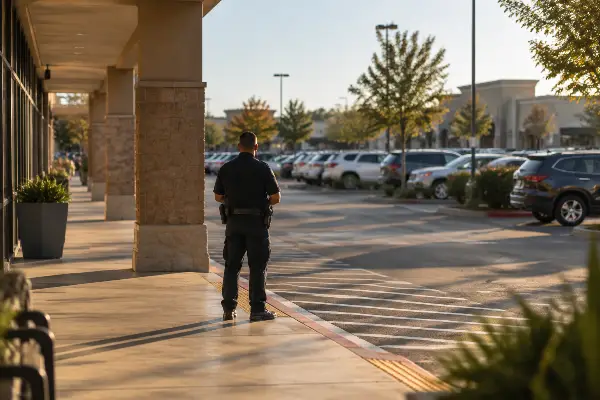
Position second. An officer standing where the exit path meets the parking lot changes crew behavior more than an officer walking the interior. A crew scouting your property is looking for the gap between the fixture and the car. Whether that officer should be armed, unarmed, or a mix is a separate decision, and the trade-offs sit in our breakdown of loss prevention and guard coverage.
Hardware third. Locked cases, receipt checks at self-checkout, and the right tag on the right merchandise all work, and choosing between the tag types is a merchandise-by-merchandise decision rather than a store-wide one.
Record fourth, and it’s the one that compounds. The 6 fields above are what turn this quarter’s incidents into next quarter’s filed charge.
Notice what isn’t on that list: buying a system because a national statistic said crime is up. The current numbers say incidents fell last year, and the retailers surveyed put their money into training ahead of technology. Our full approach to retail security is built in that order.
When should you call HPD instead of handling it internally?
Call when there’s a pattern, an injury risk, or recoverable value. Handle internally when it’s a single low-value walkout with no usable identification, and log it anyway.
That second half is where most properties lose cases. 63% of retailers report fewer than half of their incidents to law enforcement. The 2 reasons given, small loss size at 60% and lack of police follow-through at 54%, are both real. Neither changes the fact that Texas now lets value aggregate across 180 days, which means the incident you didn’t report is the evidence you don’t have when the pattern finally justifies a call.
A workable rule: log every incident against the 6 fields, call on anything with a vehicle description, a repeat face, or a recovered item, and bring the 180-day history with you when you do. Our officers keep documented patrol rounds and file real-time incident reports through a dedicated account supervisor, so the history exists when a detective asks for it.
Coverage follows entrances and hours, not square footage
Coverage follows entrances, hours, and the exit paths, not floor area. A center with 4 tenant entrances and 2 parking structures needs different coverage than a single-anchor strip of the same size.
What we ask before quoting: how many entrances stay unlocked after 6 p.m., where the loading and back-of-house doors are, which tenants carry the concealable high-value stock, and what the last 90 days of incidents look like by hour. That last one usually reshapes the schedule more than anything else on the list, because most properties are staffing the hours that feel risky rather than the hours their own log says are.
Contracts run weekly, month to month, short term, or long term. There’s no long-term commitment required, which is the single most common misconception we correct on a first call, and we issue insurance certificates same day. Full detail on how we cover retail properties sits on our shopping center security page, and the wider range of guard services covers the rest of the portfolio.
Where to start this quarter
Pick the 3 that cost nothing first.
- Pull your last 90 days of incidents and sort them by hour and tenant. Staff against that, not against instinct.
- Add the 6 fields to your incident form this week. Field 5, the 180-day prior-occurrence log, is the one that changes outcomes.
- Report the small ones. Under the current Texas thresholds, a run of low-value incidents is what aggregates past the felony line.
- Brief your staff on the 3 methods and on exactly where their authority ends.
- Then look at position and hardware, in that order, and track what changes after each move so you can tell which one earned its place.
Preventing organized retail crime at a Texas property in 2026 is less about the newest system than about whether your record survives contact with a prosecutor. If you want a read on where your property stands, our team will walk it and give you a written proposal at no cost.
FAQs
How do you prevent organized retail crime at a shopping center?
Layer people, position, hardware, and record, in that order. Train staff on the 3 common crew methods and on the limits of their authority, post officers where the exit path meets the parking area, match hardware to the merchandise, and keep an incident log that supports a filed charge. Retailers surveyed by the National Retail Federation in 2026 rated management training their top investment at 72%, ahead of risk-intelligence technology at 61%.
Is organized retail crime getting worse?
Not by the most recent count. The National Retail Federation’s July 2026 study reports a 12.4% decrease in shoplifting incidents and an 8.1% decrease in merchandise theft incidents between 2024 and 2025. The often-quoted 57% increase in organized retail crime incidents describes 2022 to 2023, and only among retailers that tracked those incidents specifically.
What counts as organized retail theft in Texas?
Four kinds of conduct, under Texas Penal Code 31.16. Acting with 1 or more other people to unlawfully take merchandise from a merchant, taking merchandise on 2 or more occasions within 180 days, knowingly benefiting from either of those, or acting with others to overwhelm a merchant’s security response. Senate Bill 1300 put this version in effect on September 1, 2025.
What should be in a retail theft incident report?
Six things: the merchant and exact location, the posted price of each item taken from the tag, a time stamp with the officer’s identity, who acted with whom and what each person did, any prior occurrences at the property inside the past 180 days, and what was recovered versus what left the property. The prior-occurrence history is the field most often missing, and it is the one that lets a prosecutor treat a series of incidents as a single pattern.
Why does the 180-day window matter for retail theft in Texas?
Because Texas Penal Code 31.16 lets value aggregate across a 180-day period, and it treats 2 or more separate takings inside that window as organized retail theft on their own. A property that keeps a dated incident history can show the pattern. A property that logs each event in isolation cannot, so each one is judged alone.
Should retail security guards report small theft incidents?
Yes. Because Texas allows value to aggregate across a 180-day pattern, small incidents are what build the more serious charge. National Retail Federation data from 2026 shows 63% of retailers report fewer than half of their incidents to police, with 60% pointing to the small size of the loss as the reason and 54% pointing to a lack of police follow-through.