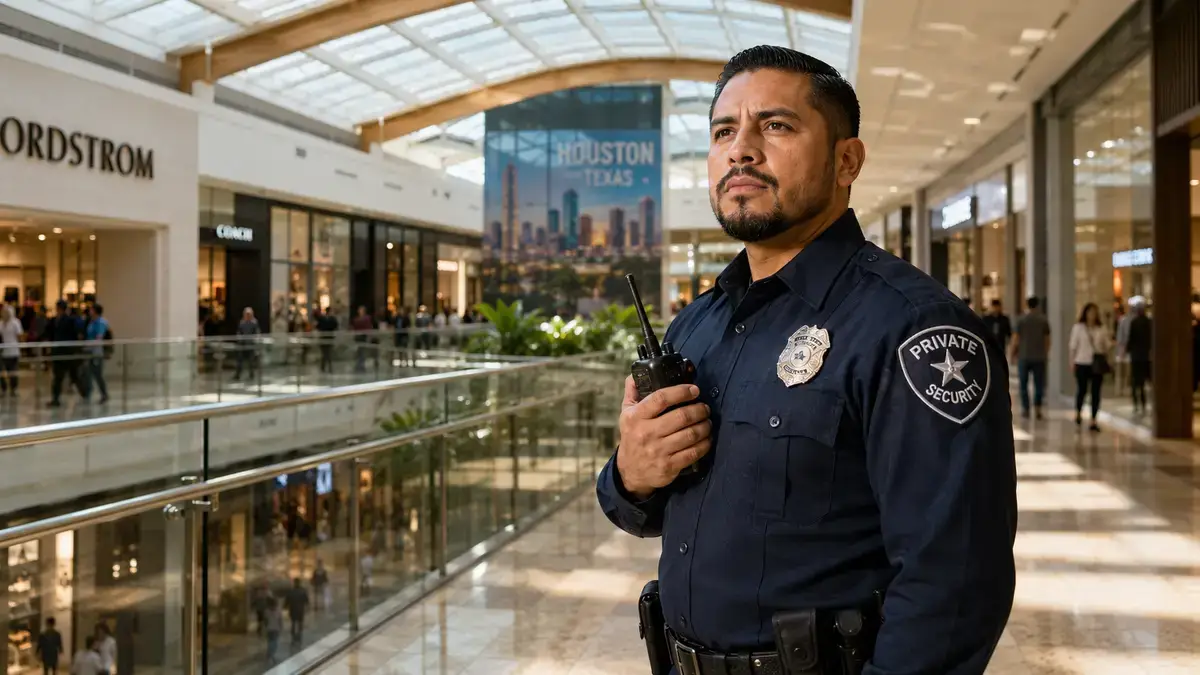
No, a mall security guard cannot arrest you the way a police officer can. That’s the short answer to the question can mall security arrest you, and most write-ups stop there. The real story is more useful. In Texas, a mall guard sits in roughly the same legal position as any other private citizen, with two specific exceptions that change everything: a citizen’s arrest for a witnessed crime, and a merchant’s right to detain a suspected shoplifter. Both are tightly limited. Both carry real liability if a guard gets them wrong. What follows is how mall security authority actually works, what they can do to you, and what you can refuse. We’ve trained private security personnel across the Houston area on exactly these limits, so the framework here mirrors what working teams actually use.
What is a mall security guard, really?
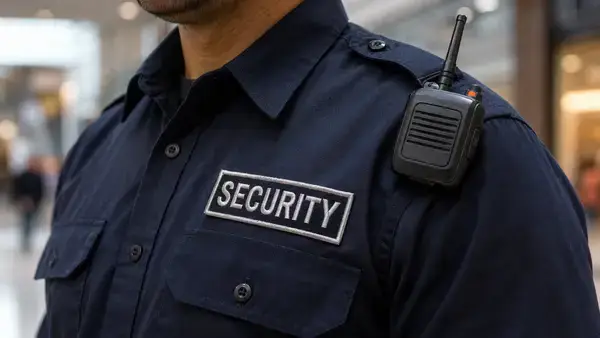
A mall security guard is a private employee paid to protect property and people inside a shopping center. They aren’t peace officers. They don’t carry police authority. The U.S. Bureau of Labor Statistics counted 1,272,400 security guards nationwide in 2024, and the vast majority work in roles like this one, where the job is presence, deterrence, and incident reporting.
I’ve worked alongside enough retail security teams to say this plainly: the average mall guard is undertrained for the situations they’re expected to handle. Median pay sits around $38,370 per year. Turnover is brutal. ASIS International’s 2025 workforce data shows roughly 32% of unarmed guards earn between $13.25 and $18.00 per hour. At those wages, you don’t get seasoned ex-cops. You get someone three weeks into the job being asked to make snap legal judgments about probable cause. That gap between expectation and training is where most lawsuits start.
What does a mall security guard actually do?
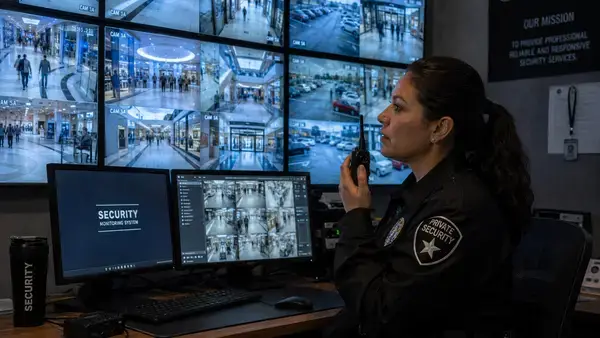
A mall guard’s day is mostly patrol, observation, and reporting. The full list runs longer than people assume. They monitor surveillance feeds. They walk perimeter loops through parking lots. They handle lost children, shoplifting tips from store managers, drunk patrons, medical emergencies, and the slow steady churn of customer complaints. At Houston-area shopping center security teams, guards typically also handle vehicle assistance in parking garages, after-hours lockdown, and coordination with local police on serious incidents.
What they’re not doing is investigating crimes. Their job ends at observation and notification. The moment something requires legal authority, they’re supposed to be on the phone with Houston Police Department or Harris County Sheriff.
The legal powers of mall security (and the line they can’t cross)
Mall security operates under private citizen authority on private property. That’s the whole framework. A mall is private property; the property owner can set rules for who comes in and who stays. The guard enforces those rules as the owner’s agent. Beyond that, they have the same legal toolkit as anyone else: defend themselves from imminent harm, perform a citizen’s arrest under narrow conditions, and detain a suspected shoplifter under Texas merchant statutes.
What they cannot do is broader than what they can. They can’t pull you over in the parking lot for a traffic violation. They can’t run your ID. They can’t search your bag without consent. They can’t hold you for “questioning” the way TV shows imply. If they try, that’s false imprisonment, and Texas courts have been consistent on this point.
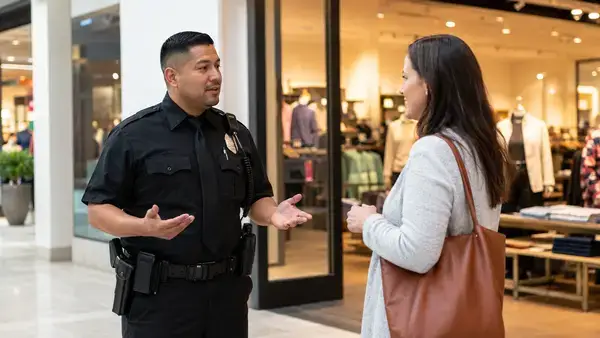
So, can mall security arrest you? Here’s the answer.
No. Mall security cannot arrest you. They can detain you, briefly, under two specific Texas statutes.
The first is Article 14.01 of the Texas Code of Criminal Procedure, which lets any person (not just police) arrest an offender for a felony or breach of the peace committed in their presence. The second is Texas Civil Practice & Remedies Code §124.001, the shopkeeper’s privilege, which lets merchants detain someone they reasonably believe stole merchandise. That detention has to be in a reasonable manner and for a reasonable time, which courts have generally interpreted as long enough to call police and verify what happened.
Here’s the contrarian take that practitioners don’t always say out loud: the framing “guards can’t arrest you” is misleading. They can detain you, sometimes physically, and the legal exposure for resisting a lawful detention is real. People online tell each other to “just walk away.” That’s terrible advice in most situations. If the detention is lawful, walking away can add resisting or evading charges. If it’s unlawful, your remedy is a civil lawsuit later, not a footrace.
What mall guards can and can’t do (the clear breakdown)
Most explainers bury this in prose. Here it is in two columns. For a deeper read on guard authority across settings, our team wrote a breakdown of what security guards can and can’t do that covers the same questions for non-retail settings.
| Mall guards CAN | Mall guards CAN’T |
| Observe and report suspicious activity | Make a formal arrest |
| Detain under shopkeeper’s privilege or citizen’s arrest | Search you or your bag without consent |
| Use reasonable, proportional force in self-defense | Use excessive or punitive force |
| Ask you to leave private property | Hold you indefinitely without cause |
| Enforce mall policies (no smoking, no soliciting) | Question you the way police would |
| Provide first aid and emergency response | Read Miranda rights (only police, only in custody) |
| Issue criminal trespass warnings | Impersonate law enforcement |
That last “can’t” matters more than people realize. Impersonating a peace officer is a felony in Texas under Penal Code §37.11. Guards who imply police authority, wear badges that look like sheriff’s stars, or order you around with “I’m placing you under arrest” language are stepping into legal trouble of their own.
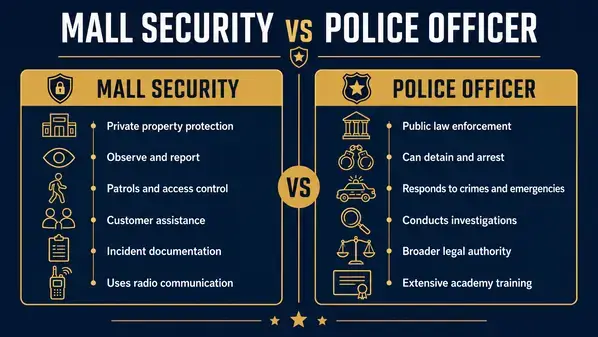
Mall security vs. police: where the line really sits
The training gap alone tells you most of what you need to know.
| Authority | Mall Security | Police |
| Source of power | Private property rights / citizen authority | State sworn officer status |
| Can make arrests | No (detention only) | Yes |
| Miranda obligations | No | Yes, in custody |
| Qualified immunity | No | Yes |
| Can investigate crimes | No | Yes |
| Use of lethal force | Self-defense only, like any citizen | Yes, under departmental policy |
| Training hours (TX) | 6-hour Level II non-commissioned minimum | 696+ hours TCOLE academy |
A Texas Level II non-commissioned (unarmed) guard needs six hours of classroom training to start working. A peace officer in Texas needs roughly 696 hours through TCOLE to earn a basic license. Same uniform style. Very different legal worlds. Property owners who want trained personnel should specifically ask about licensed security guards in Houston and verify credentials through the state.
What is a citizen’s arrest, and when does it apply at a mall?
A citizen’s arrest is when a private person detains someone for a crime committed in their presence and turns them over to police. In Texas, the statute is narrow. The crime has to be a felony or a breach of the peace, and the person making the arrest has to actually witness it. Hearing about it later doesn’t count. Suspicion alone doesn’t count.
This is where mall guards most commonly run into trouble. They watch on camera as a person hides merchandise. They confront them at the door. The person denies it. Now what? If the guard hasn’t actually seen the theft in person, or if the merchandise gets dropped before they intervene, the legal ground gets soft fast.
There’s a national trend worth watching. A New York Senate bill (S5138) advanced in 2025 to abolish citizen’s arrests statewide. Other states are weighing similar limits. Texas hasn’t moved on this, but if you’re a property owner who relies on security guards to handle shoplifting, the ground may shift in the next few years. Industry guidance from ASIS International is increasingly pushing firms toward de-escalation-first training as a result.
What happens if mall security detains you?
If a mall guard detains you, stay calm, ask if you’re free to leave, and ask whether police have been called. Those three sentences alone protect you legally.
You have the right to remain silent. You have the right to refuse a search of your bag, person, or vehicle. You don’t have to answer questions about what you bought, where you’ve been in the mall, or who you’re with. You can ask for the detention to end, and if it doesn’t, you can ask for the guard’s name, employer, and badge number. Most malls in Texas operate under contract with private security firms, and those firms carry insurance. That insurance is what you’d file against if the detention turned out to be unlawful.
Don’t resist physically. Document everything mentally or on your phone. Save the legal fight for after you’re released.
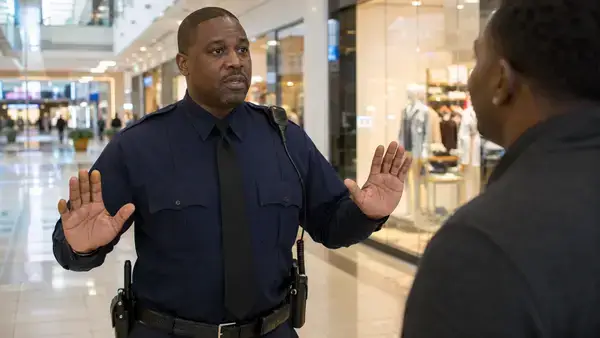
Can mall security use force on you?
Yes, but only reasonable force, and only in narrow situations. The standard is proportionality. If a person is walking away after a confronted shoplifting attempt, a guard tackling them to the ground is almost certainly excessive. If the person swings first, a guard restraining them is proportional.
ASIS International publishes a Use of Force Standard that has become the reference document for the private security industry. Most contracted Houston security companies build their training around it. The standard is clear: force is a last resort, must be proportional, and stops the moment the threat does.
Excessive force is where lawsuits live. Watch any viral video of mall security in an arrest gone wrong, and that’s almost always the issue. Wages drive turnover, turnover drives undertrained staff, and undertrained staff over-rely on physical control when they should be de-escalating.
Can mall guards carry weapons?
In Texas, yes, but only with a Level III commission and ongoing license requirements through the Department of Public Safety. Armed coverage carries higher insurance premiums, more rigorous license maintenance, and a sharper liability calculus, which is why most mall properties stick with unarmed guards for general patrol and bring in armed personnel only for cash-handling, high-value tenants, or specific event security.
The thing armed status doesn’t grant: more arrest authority. An armed guard has the exact same citizen’s arrest powers as an unarmed one. A firearm changes the use-of-force math, not the legal authority to detain. Confusing the two is one of the most expensive mistakes in this industry.
When does mall security call the police?
Anytime the situation goes beyond observation and immediate de-escalation. That includes physical altercations, weapons sighted, shoplifting beyond a low threshold, suspected drug activity, missing persons, vehicle theft, or domestic disputes. A well-run mall security team treats Houston Police Department dispatch as the first call, not the last.
Here’s a truth that retail managers sometimes don’t want to hear: if your security team isn’t calling police promptly, you have a liability problem. A guard holding a suspect for 40 minutes trying to get a confession is the kind of detail that turns a clean shoplifting case into a civil suit against the property.
Your rights inside a mall: what you can refuse
Mall property is private property, but private property doesn’t strip your civil rights. You have the right to refuse a bag search. You have the right to refuse to answer questions. You have the right to leave, unless you’re being lawfully detained under one of the narrow exceptions above.
What you don’t have a right to do is stay if the property owner wants you to leave. Mall management can ban you for any non-discriminatory reason, including reasons you may find petty. If you’ve been issued a criminal trespass warning, returning to that property is a Class B misdemeanor in Texas. Take the warning seriously.
Legal recourse if mall security oversteps
If you’ve been unlawfully detained, falsely accused, or physically mistreated, you have several paths. File a written complaint with the mall management office. File a complaint with the Texas Department of Public Safety Private Security Bureau, which licenses security companies in this state. Consult a civil attorney about false imprisonment, battery, or civil rights claims.
Document everything. Get the guard’s name, badge number, and the contracting company. Request copies of incident reports. If there’s surveillance footage, request preservation through a legal letter before it’s overwritten. Most malls retain footage for 30 to 90 days, after which it’s gone. Property owners who want to reduce this exposure on their own side benefit from working with an experienced security guard service in Houston that documents incidents properly.
How shopping mall security systems actually work
A modern mall security setup is more than guards walking around. It’s CCTV coverage with overlapping camera angles, access-controlled employee corridors, alarm systems on emergency exits, radio-coordinated patrol routes, and increasingly, AI-flagged camera analytics. IBISWorld puts the U.S. security services market at $49.8 billion in 2025, growing to roughly $50.4 billion in 2026. Most of that growth is technology, not headcount. Property owners can see how this layered approach plays out on our main service overview page, which walks through patrol coverage and tech integration.
Tech vendors will tell you cameras reduce liability. That’s only true if the system is monitored in real time and the footage is preserved. A bank of cameras nobody watches is a record-keeping tool, not a security system.
What this means for shoppers, store owners, and property managers
So can mall security arrest you? No, not in the way police can. They can detain you under specific Texas statutes, and the practical effect feels similar in the moment. Knowing the limits protects you whether you’re a shopper, a store owner, or a property manager. The security industry is getting more open than it used to be. Trade associations like ASIS publish public standards. Reputable firms work with an experienced marketing partner to communicate their service capabilities clearly online. The result is that property owners can compare providers based on real service offerings, not tagline marketing.
FAQs
Can mall security guards handcuff you?
Generally no. Most mall security policies prohibit handcuffing, and unarmed guards rarely receive the training to do it safely. Even when a guard is performing a lawful citizen’s arrest, Texas courts have ruled handcuffs constitute force that must be proportional to the threat. If a non-violent shoplifter is calmly waiting for police, restraints aren’t justified. Improper handcuffing is one of the most common false imprisonment claims filed against private security firms.
Can mall security search your bag or person?
They can ask. You can refuse. Without your consent, mall security has no authority to search your belongings or your body. The narrow exception is a pat-down for weapons if they reasonably believe you’re armed and dangerous. If you refuse a search, the guard’s lawful options are limited to asking you to leave the property. A significant share of mall bag searches happen because the person consented without realizing they didn’t have to.
Do mall security guards have to read me my rights?
No. Miranda warnings apply only to custodial interrogation by state actors, meaning police. Private security guards have no Miranda obligation because they aren’t government agents. Anything you say to a mall guard can still be used against you, so the practical advice is the same: stay quiet, ask if you’re free to leave, and request police.
Can mall security ban me for life?
Yes. As agents of private property owners, mall security can issue a criminal trespass warning that permanently bars you from the property. In Texas, returning after a trespass warning is a Class B misdemeanor under Penal Code §30.05. The ban doesn’t have to be “fair” in any subjective sense; private property owners have broad discretion to issue or rescind it.
What should I do if I think mall security violated my rights?
Document everything immediately: guard names, company name, time, location, and witnesses. Request a copy of any incident report. File complaints with mall management and the Texas DPS Private Security Bureau. Consult a civil attorney about false imprisonment or battery claims. Do this within days; surveillance footage typically gets overwritten within 30 to 90 days.
Can mall security chase you outside the mall?
They can follow in some situations, but their authority is limited. Once you’re off private property, the shopkeeper’s privilege defense weakens significantly, and the citizen’s arrest standard still requires a witnessed crime. Most professional security firms train guards to call police rather than pursue, both because pursuit creates safety risks and because off-property detentions invite lawsuits.
Are mall security guards required to be licensed in Texas?
Yes. Texas requires all commissioned security personnel to register with the Department of Public Safety Private Security Bureau, complete required training, pass background checks, and renew credentials regularly. Guards operating without proper credentials are committing a state offense, and the property owner who hired them is exposed to the same legal risk.

