Mobile patrol usually means a shared route: 1 officer in 1 car working a loop of client properties, with your site getting short stops through the night. Reliable Guard & Patrol Service Inc. runs the other model. A licensed officer in a marked patrol vehicle stays on your property for the hours you choose, drives the perimeter and walks the doors, and every round is scanned into a GPS guard tour system.
The Texas Department of Public Safety issued our company license, B07315701, in 2018, and the owner's security career goes back 20 years. About 150 officers now cover over 100 commercial properties. Book a single week to start, with no long-term contract, and a certificate of insurance comes back on the day of your request.
What Mobile Patrol Means On A Houston Proposal
The name covers 2 products, and only 1 of them keeps an officer on your property all night.
A shared route puts 1 officer and 1 car on a loop of client properties. Your site gets stops. Between stops, the car is somewhere else on the loop.
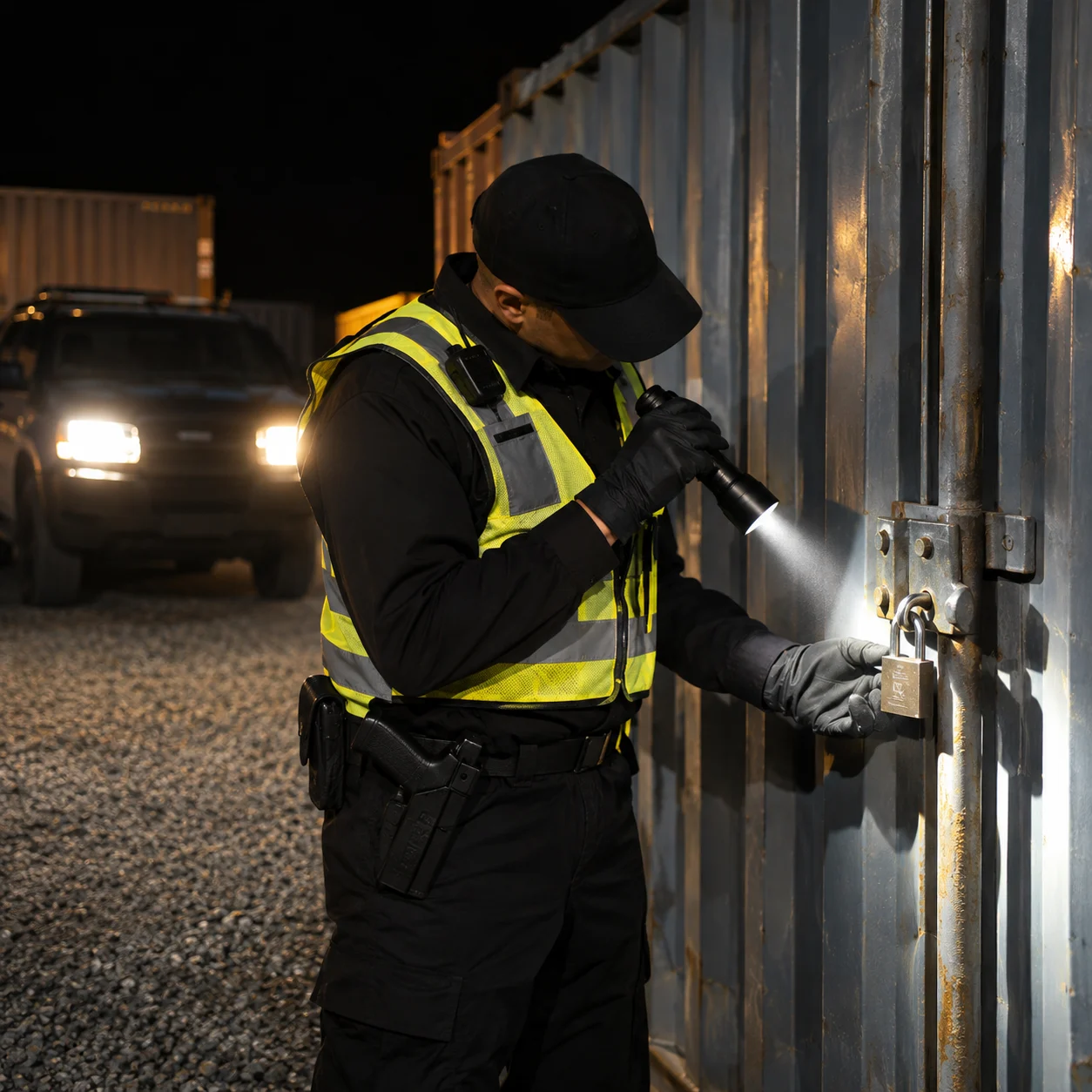
A single-site vehicle patrol keeps 1 officer and 1 car on your property for the whole shift. The car never leaves to cover another client. That’s the only kind we run.
Neither one is a fixed post, which holds 1 point such as a gate or a lobby desk. Our breakdown of how a fixed post, an on-site rover and a shared route compare covers where each one fits. Fixed posts and the rest of what we staff are under all our Houston security guard services. This page is for the property that needs a car.
The Longest Gap Test
Before you count visits, find the longest stretch of the night when nobody is on your property. That number tells you what a patrol can protect. A visit count leaves it out.
We call this the Longest Gap Test. Count every gap in a night: from the time the property empties to the first visit, between each pair of visits, and from the last visit to the time people come back. The longest one is your exposure.
What Random Timing Does To The Gaps
Random visit times have a real upside, since a schedule that keeps moving can’t be learned. The cost is a longer longest gap, and it’s largest when visits are few.
Take a 12-hour empty window, 6 p.m. to 6 a.m., with 3 visits a night. Space the 3 visits evenly and the longest gap is 3 hours flat. Easy to predict, but short.
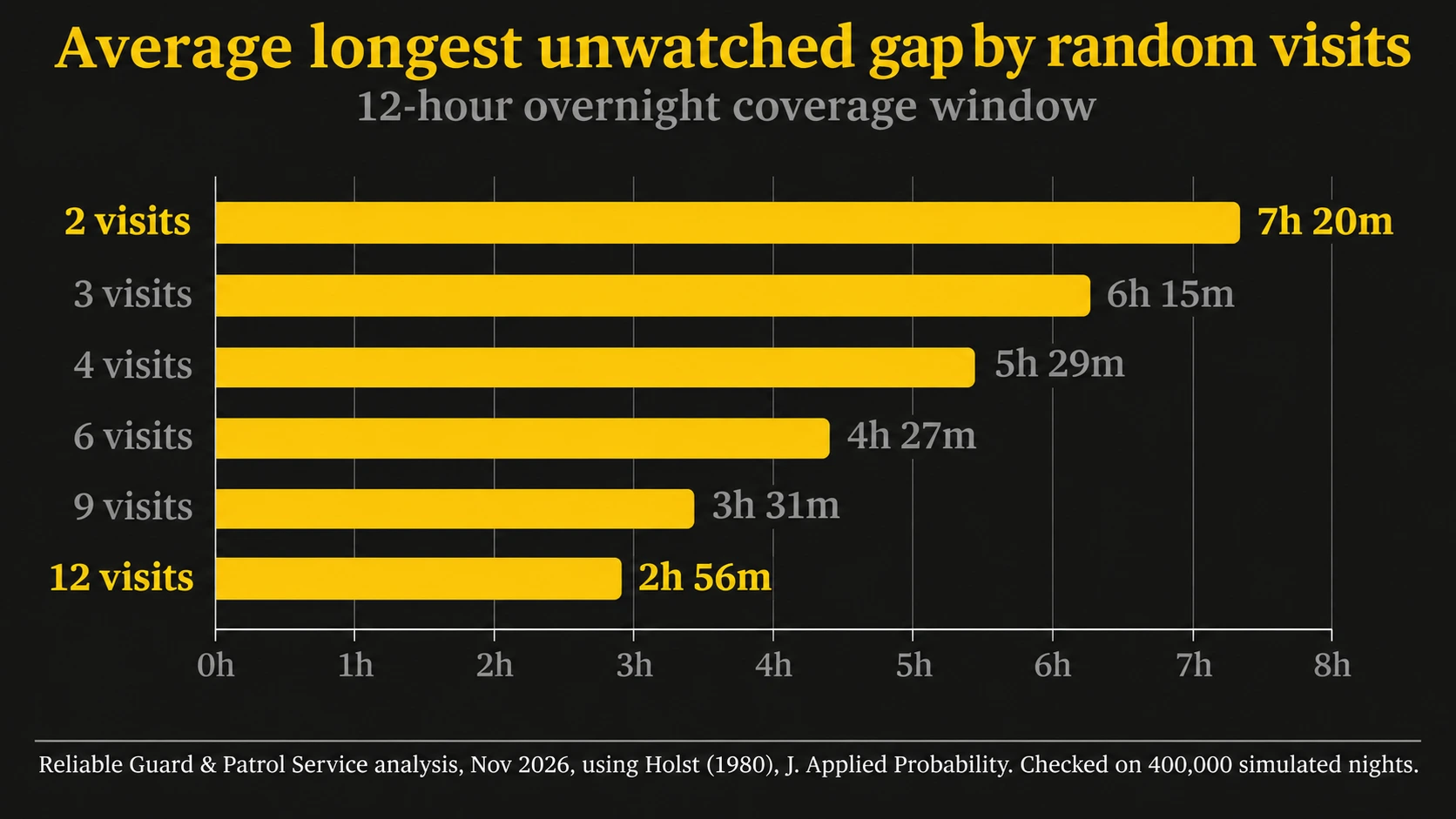
Put the same 3 visits at random times across the night and the longest gap averages 6 hours 15 minutes. On 50% of nights it runs 6 hours or more. On 96% of nights it runs at least 4 hours.
Adding visits shrinks the gap slowly. At random times across the same 12-hour night:
- 2 visits leave an average longest gap of 7 hours 20 minutes.
- 4 visits leave 5 hours 29 minutes.
- 6 visits still leave 4 hours 27 minutes.
- 9 visits leave 3 hours 31 minutes.
- 12 visits, about 1 an hour, leave 2 hours 56 minutes.
These averages come from a published result on random breaks along a line (Holst, Journal of Applied Probability, 1980), and our simulation of 400,000 nights matched every one. They count each stop as a moment. A stop measured in minutes is small next to a gap measured in hours.
How To Run The Test On Your Property
Pull 30 nights of visit times for your property. Patrol logs work, and so does camera footage of the gate. Then work through 4 steps.
- Mark the time your property empties and the time people come back.
- For each night, find the longest stretch with no visit, counting the start and the end of the night.
- Average those 30 numbers, and write down the worst night.
- Walk your property and ask what someone could load in that much time.
If the answer to step 4 is copper, a trailer or anything on a pallet, a route leaves it exposed for that long. If the answer is nothing, because the building is locked and the lot is empty, a route may be all you need.
On a single-site vehicle patrol, the officer doesn’t leave. The gap at any spot on your property is the time between rounds, and the tour log time-stamps every checkpoint scan, so the same test works on our records too.
CALL US FOR SMART SECURITY SOLUTIONS
We Cover Houston, TX, Sugar Land, TX, Pearland, TX, Conroe, TX
More Visits Or Longer Visits: The Trade A Route Makes
A route can’t give you both. The minutes an officer spends at your site each night are fixed by the price, so more visits means shorter ones, and longer visits means fewer of them.
A randomized trial in Birmingham, England, tested that trade. West Midlands Police assigned each day at 7 crime hot spots to 1 of 2 schedules with the same planned patrol time: 3 visits of 15 minutes, or 9 visits of 5 minutes. Crime and anti-social behavior came in about 20% lower on the days with 3 long visits (Williams and Coupe, 2017).
Now run those 2 schedules through the Longest Gap Test, at random times over a 12-hour night. 9 short visits bring the average longest gap down to 3 hours 31 minutes. 3 long visits leave it at 6 hours 15 minutes. The schedule that did better in the trial is the one with the bigger hole.
So a route buyer picks a weakness. 9 short stops shrink the gap but did less in the trial. 3 long stops did more and leave the property alone for hours.
The trial has 3 limits. It measured police at street hot spots, and a Houston yard with a licensed officer is a different setting. It was small: 7 places over 100 days. And officers fell short of the plan on both schedules, at 24 to 26 minutes a day at each hot spot against the 45 planned.
A single-site patrol skips the trade. The officer is on your property for the whole window, so stop length never has to be bought with a longer gap. How each round is built, stop by stop, is set out on our security patrol services page.
Get Your
Free Armed & Unarmed Security Proposal
Why Houston businesses choose Reliable Guard & Patrol Service
Why Choose Our Armed Guards:
01. Fully Licensed to Carry in the State of Texas
02. Background-Checked and Drug Tested
03. Trained in Firearms Handling and De-Escalation
04. Experienced in High-Risk Property Protection
05. Serving Houston Businesses for Over 20 Years
06. Corporate, Construction, Retail, and Event Coverage
07. 24/7 Coverage Including Holidays
What Our Vehicle Patrol Puts On Your Property
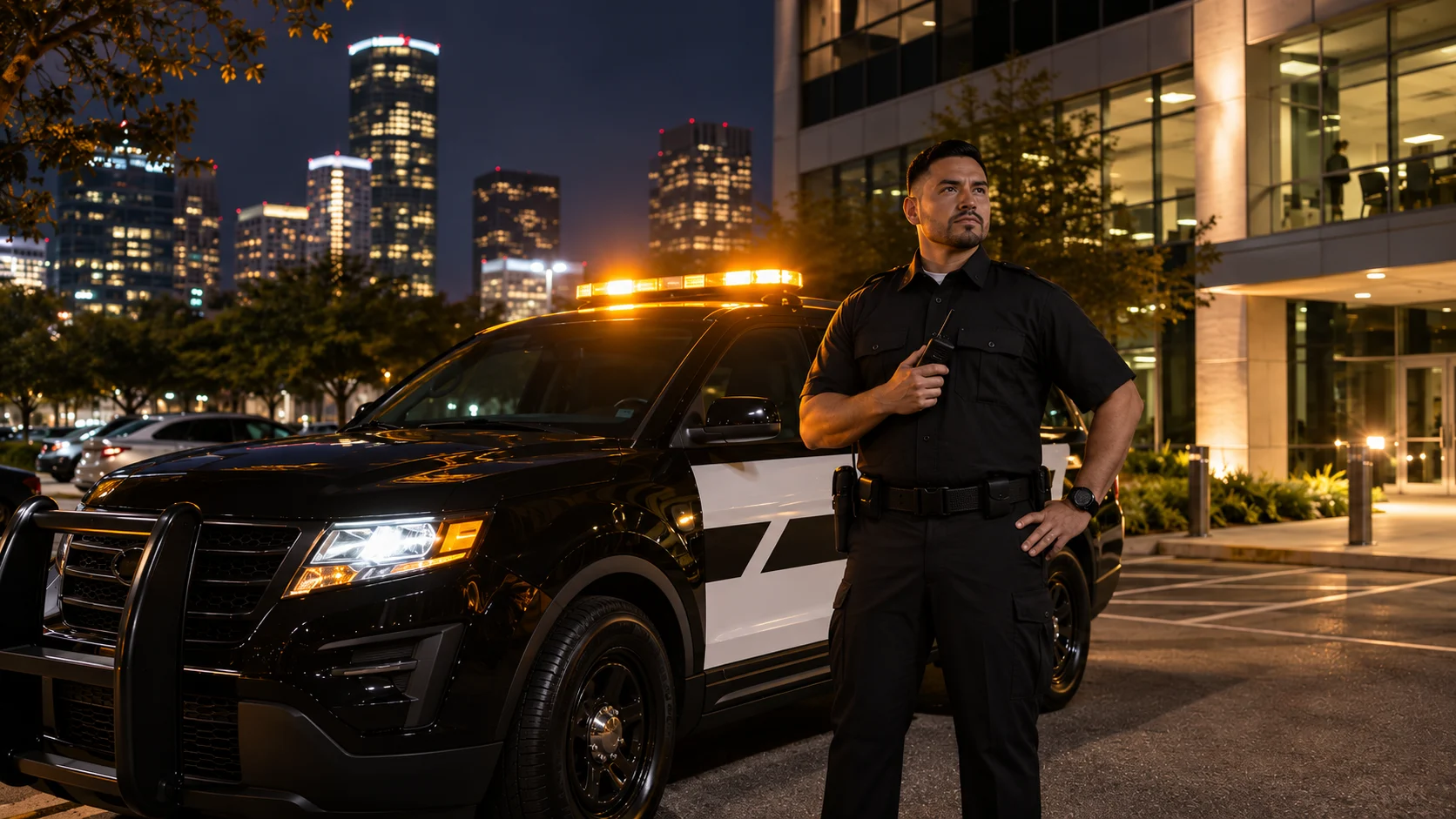
1 licensed officer and 1 marked patrol vehicle, on your property only, for the hours in the proposal. The car covers distance: fence lines, parking lots, yards and the back of the building. The officer gets out for what a car can’t check, like a door handle, a container lock or a gate chain.
Every round goes on the record: GPS checkpoint scans, incident reports filed in real time and check-ins from a supervisor. An account supervisor is assigned to your property. Our guide to what a usable patrol log has to show lists what to ask for before you sign.
No officer works a post without a background check, a drug test, a license check, an interview and references on file. Officers who speak Spanish are on the roster, and so are commissioned officers for armed posts. Our policies cover commercial auto, general liability and workers’ compensation.
When A Route Is Enough, And When It Isn't
If a check now and then covers your risk, a route costs less and does the job. We don’t run routes, and we’ll still tell you when a route is the right buy.
A route fits when the building is locked, the lot is empty and nothing outside would fit in a pickup. A single stop to confirm the doors and the gate is enough there.
A single-site patrol fits when your longest gap runs longer than the time it takes to load what’s sitting there. Open yards, stacked materials, trailers, copper and buildings a thief can reach from 4 sides all land here. So does a site that’s been hit before.
To compare cost, set the minutes an officer would spend on your property each night beside the hours on a shift quote. What sits inside a guard’s hourly rate covers the rest of a quote.
The Limits Of A Vehicle Patrol
A car covers ground fast. It doesn’t see through walls, and it doesn’t turn the officer into a police officer.
- It can’t check a lock from the driver’s seat, so the officer gets out at doors, gates and containers.
- It can’t see inside a building. If you need interior checks, ask for foot rounds in the proposal.
- It doesn’t give the officer police powers. When something happens, the officer calls police, keeps watch from a safe distance and writes the report.
We don’t sell alarm call-outs, parking enforcement, K-9 or fire watch. We work commercial property only, so no homes, HOAs or events.
Frequently Asked Questions
Do you run mobile patrol routes in Houston?
No. Our patrol car doesn’t leave to cover other clients. It stays on 1 property for the whole shift with 1 licensed officer, and each round shows up in the GPS tour log.
How long can a property go unwatched on a patrol route?
With 3 visits at random times over a 12-hour night, the longest stretch with nobody on site averages 6 hours 15 minutes, and 50% of nights run 6 hours or more. Doubling to 6 visits still leaves 4 hours 27 minutes on average.
Is it better to get more patrol visits or longer ones?
On a route, you trade one for the other. A 2017 trial in Birmingham, England, found about 20% less crime and anti-social behavior when the same planned patrol time came as 3 visits of 15 minutes instead of 9 visits of 5. The 3 long visits leave a bigger gap, though: 6 hours 15 minutes on average against 3 hours 31 minutes, at random times over 12 hours. A patrol that stays on site avoids the trade.
Is there a minimum term for a vehicle patrol?
1 week, with no long-term contract. Weekly and month-to-month terms are standard, and a longer term is there if the property calls for one.
Can the patrol officer be armed?
Yes, if the site calls for it. An armed officer holds a Texas security officer commission, which requires Level III training. An unarmed officer is non-commissioned, trained at Level II, and doesn’t carry a firearm on duty.
How does a vehicle patrol get started?
A first call about the property, its empty hours and what’s at risk, then a free proposal. If the property needs a site assessment, it happens before the officer is deployed. Then the officer starts, with an account supervisor assigned to your site.
Which areas do you cover?
Houston, including Downtown, the Texas Medical Center and the Energy Corridor, plus Sugar Land, Katy, Pearland, The Woodlands, Spring, Conroe and Humble. Vehicle patrol runs 24 hours a day if the property needs it.
Start With A Free Vehicle Patrol Proposal
Tell us the property, when it's empty and what stays outside overnight. We'll send a free proposal for a patrol car and officer that stay on your site.