Licensed officers who watch your dock doors, verify drivers and shipments against the booking, keep unauthorized people off the dock floor and log every round on a GPS guard tour system. Texas DPS license B07315701. About 150 officers. Weekly or month-to-month terms, and a certificate of insurance issued the day you approve.
What a loading dock security guard does
A loading dock security guard decides who reaches your shipping and receiving doors and what leaves through them, then writes it all down. Your post orders set which of these duties the officer runs on your dock.
- Every dock door gets checked on a timed round and logged at a GPS checkpoint.
- Each arriving driver is checked in by name, carrier, load number, tractor, trailer and plate.
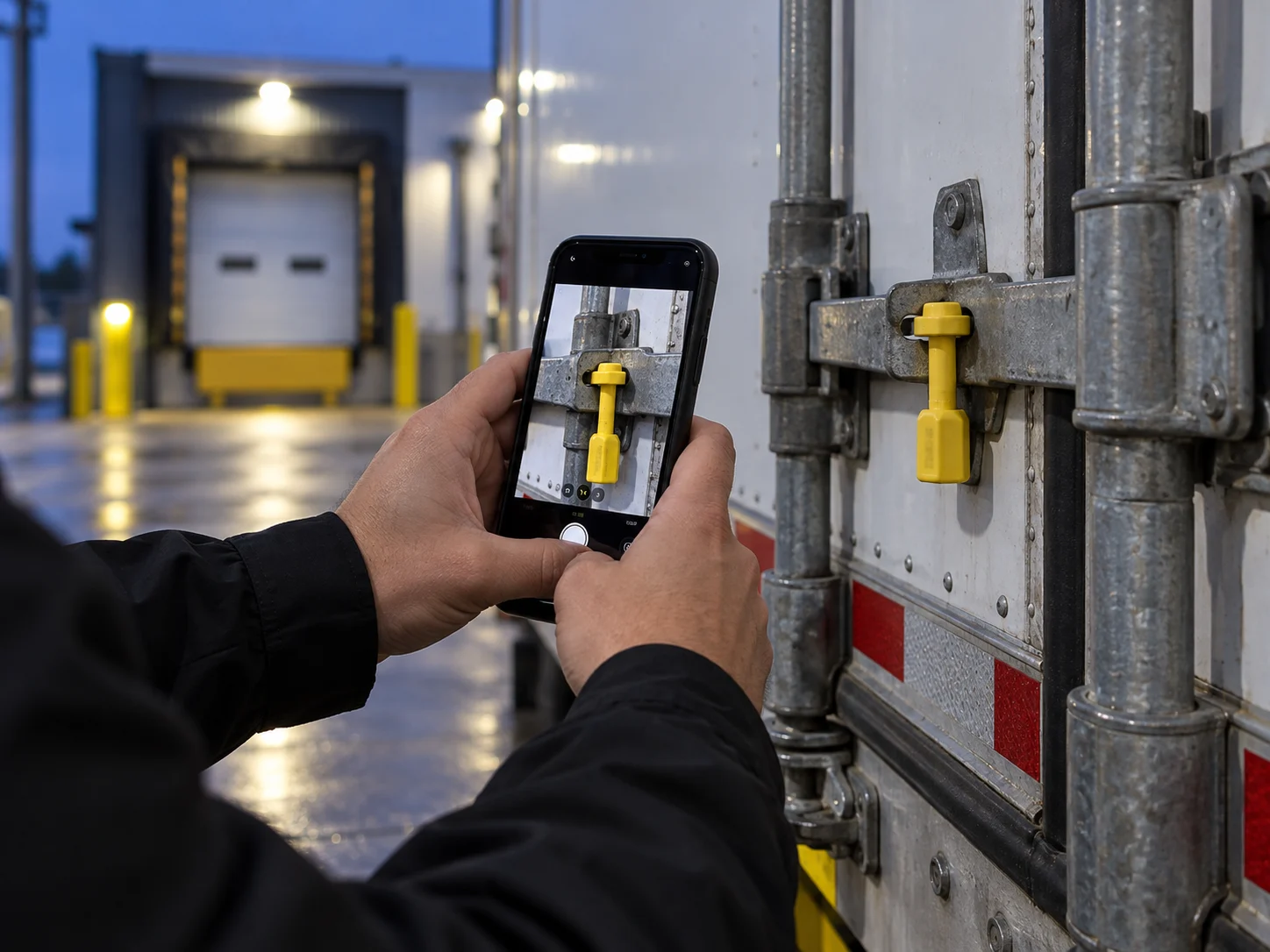
- Seal numbers are recorded on inbound and outbound trailers, with a photo.
- Outbound loads are verified before release. The first check is a phone call to the carrier at the number in its federal FMCSA record.
- Drivers wait in the driver room unless a dock lead walks them onto the floor.
- After hours, patrol rounds cover drop trailers, gates and the fence line.
- Incident reports go to you as they happen.
Your dock lead runs the freight. Our officer runs the record. The officer checks paperwork and seals against the booking, and your receiving team still counts the freight and signs for it, so the log stays independent of the people moving the load.
Cargo theft in 2026, and what it means for a Houston dock
Theft counts fell in Q1 and Q2 of 2026, Q2 losses more than doubled, and the fraud that works through a shipper’s release desk held almost steady.
Verisk CargoNet’s Q2 2026 count came to 677 supply chain theft incidents across the U.S. and Canada, 26% below a year earlier. Estimated losses still more than doubled, to $304.6 million from $135.7 million. Fictitious pickups slipped only from 165 to 158.
Texas counts dropped as well, from 102 incidents in Q1 2025 to 80 in Q1 2026. CargoNet said the opportunistic theft once typical of the Houston and Dallas-Fort Worth corridors seems to be shifting toward targeted operations in other parts of the country. The paperwork schemes stayed put. In Q2, theft built on business email compromise or shipment misdirection held roughly level in Texas while other theft fell, CargoNet reported.
Those schemes start far from your dock. An April 30, 2026 FBI public service announcement describes thieves getting into broker and carrier systems through spoofed emails, fake URLs and compromised carrier accounts, posting fake listings on load boards and redirecting freight away from its intended destination.
By the time that driver reaches your door at 10 a.m., his paperwork can look clean. The officer who catches him has to be at the release desk, with written authority to say no to the release.
The door status sweep: how our officers walk a dock
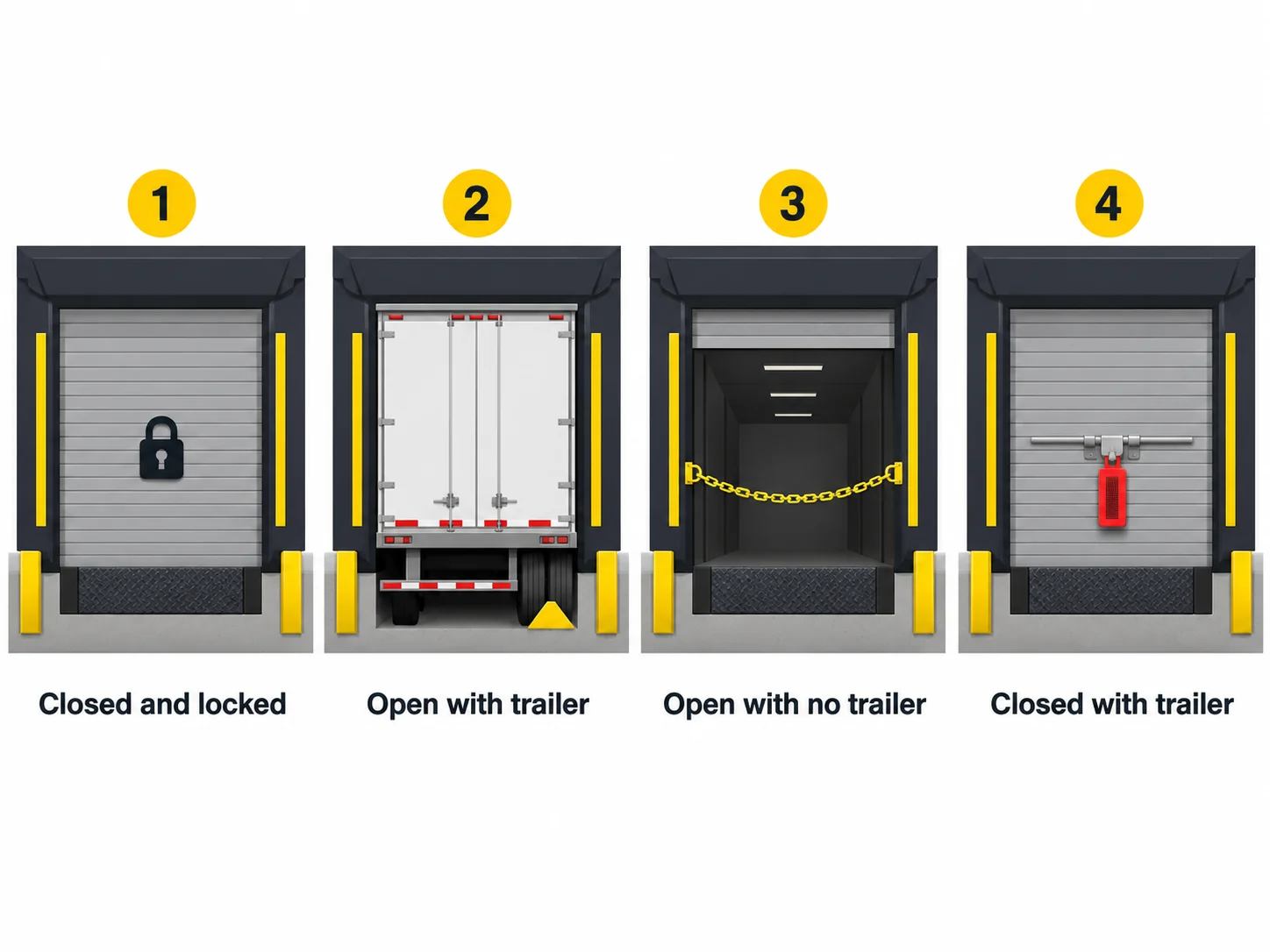
Every dock door is in 1 of 4 states at any moment, and 2 of them are where freight walks off or people get hurt. On each round the officer scans a GPS checkpoint at the door, notes the state and calls your dock lead when a door is in the wrong one.
- Closed and locked. The officer notes the time and moves on.
- Open, with a trailer at the door. The officer notes the outbound seal number, whether the driver is in the driver area, and whether a wheel chock or vehicle restraint is in view while a forklift works the trailer. If none is in view, the dock lead gets a call.
- Open, with no trailer. The officer notes whether a barrier or chain is across the opening, calls the dock lead and rechecks the door 10 minutes later.
- Closed, with a trailer at the door. The officer checks the seal against the yard list and calls your shipping supervisor if the seal or the trailer number doesn’t match.
States 2 and 3 matter for safety as well as theft. OSHA requires the brakes set and wheel chocks under the rear wheels while a forklift boards a highway truck (29 CFR 1910.178(k)(1)), and measures such as wheel chocks or sand shoes to keep a trailer from moving while employees are on a dockboard (1910.26(d)). An open dock edge 4 feet or more above the drive falls under OSHA’s rule for unprotected edges (1910.28(b)(1)). Its loading-dock exception applies only on the working side of the platform, when the employer can show fall protection isn’t feasible, the work is in progress and only trained, authorized employees have access. Treat this as general information. Your safety manager owns compliance.
Our officers observe and report. They don’t chock wheels, set restraints, run levelers or drive forklifts, and the sweep doesn’t replace your safety program or a safety inspection. The call exists so the condition gets fixed while the trailer is still at the door.
A workable schedule covers post start, shift change and close, plus set intervals while freight moves. Your post orders fix the times.
The dock is also where 2 OSHA priorities meet. When OSHA relaunched its National Emphasis Program on warehousing and distribution centers on July 31, 2026, for 5 years, powered industrial vehicle operations and walking-working surfaces stayed on its list of inspection focus areas. Our guide to what OSHA’s warehouse inspections target in 2026 covers the rest of the program.
CALL US FOR SMART SECURITY SOLUTIONS
We Cover Houston, TX, Sugar Land, TX, Pearland, TX, Conroe, TX
From our patrol log: a dock stop at 11:20 p.m.
Every stop in our published patrol logs falls in the same overnight window, 11:20 p.m. to 3:30 a.m. This is the one that took place at a distribution warehouse dock, with the client’s name and address removed.
Around 11:20 p.m., a vehicle with no business on site was parked by the loading docks after operating hours, and a person was attempting to reach a secured storage area adjacent to the dock doors. Our patrol officer radioed dispatch and alerted the site supervisor without taking his eyes off the person. Then he walked up, gave his name and instructed the person to get out of the restricted section. The person complied and left the property without incident. Local police were notified and the report was documented.
A walk-through afterward showed the storage area intact and inventory complete. Before resuming his route, the officer confirmed each dock door, gate and access point was secure.
The other 4 stops were at construction sites and a vacant building, with no freight changing hands at any of them. Night rounds catch intruders. A release-desk check during shipping hours catches the fake carrier, so we scope the 2 posts separately.
Match the coverage to the hours your freight moves
Staff the release desk while trailers are being released, and cover the closed hours with patrol rounds. The right mix depends on your door count, your shifts and what sits in the yard overnight.
- A single-shift dock with under 10 doors usually needs 1 unarmed officer at the release desk during shipping hours, plus after-hours patrol rounds for the doors and yard.
- Docks running 2 shifts across 10 to 30 doors need a release-desk officer and a roving dock officer on each shift, because 1 officer can’t handle a refused release and walk 30 doors at the same time.
- A 24/7 distribution center with a drop-trailer yard needs an around-the-clock post plus timed yard checks, and that post takes a full roster of officers to cover days off and leave.
- High-value freight, cash on site or a threat history makes the case for an armed Level III officer at the release desk, with unarmed officers elsewhere.
- Inside a Port Houston restricted area, the officers need a TWIC or an approved TWIC escort.
For most docks, unarmed Level II officers are the right post. Level II is non-commissioned, so the officer carries no firearm on duty. Armed Level III officers hold a DPS commission to carry one after added training and a firearm proficiency course, and ours requalify every 2 years. Neither license adds arrest power, because a Texas security officer’s power to detain is the same as any private citizen’s. Armed coverage buys deterrence and a response option at the release desk. Officer type also moves the rate, as the next section shows.
Get Your
Free Armed & Unarmed Security Proposal
Why Houston businesses choose Reliable Guard & Patrol Service
Why Choose Our Armed Guards:
01. Fully Licensed to Carry in the State of Texas
02. Background-Checked and Drug Tested
03. Trained in Firearms Handling and De-Escalation
04. Experienced in High-Risk Property Protection
05. Serving Houston Businesses for Over 20 Years
06. Corporate, Construction, Retail, and Event Coverage
07. 24/7 Coverage Including Holidays
Port Houston and TWIC rules at a port-connected dock
If your dock is inside a Port Houston restricted area, the officers on it need a TWIC or an approved escort, and truck drivers need more than a CDL.
Port Houston’s terminal rules require a valid Transportation Worker Identification Credential (TWIC) for anyone seeking unescorted access to a restricted area. Holding a TWIC doesn’t guarantee entry, because Port Houston grants access on business need, approval and the TWIC together. Anyone without a TWIC needs an approved TWIC escort. Truck drivers need a valid TWIC, a UIIA-approved SCAC, a license plate registered in Port Houston’s Lynx system and a valid gate transaction before they get in.
Federal rules apply the same credential to secure areas of any vessel or facility regulated under the Maritime Transportation Security Act (33 CFR 101.514). An inland distribution center that isn’t MTSA-regulated doesn’t need it.
A sample dock post order
Post orders are the written instructions an officer works from, and they decide what happens when a driver pushes back. Here’s an illustrative excerpt for a single-officer dock post, in the same format we write for each site. Ask us for a redacted copy from a dock like yours.
Sample post order: dock release desk (illustrative)
Post: shipping office, doors 1-8. Hours: 06:00-14:30, Monday to Friday. Officer: unarmed, Level II.
- At post start, scan the shipping office checkpoint and walk doors 1-8.
- Log each arriving driver: name, carrier, load number, tractor, trailer and plate.
- Drivers wait in the driver room. No driver on the dock floor without a dock lead.
- Before an outbound load is released, complete all 5 fields of the pickup log. Call the carrier on the phone number listed in FMCSA SAFER. If SAFER shows a contact update dated after the booking, also confirm through the shipper or broker contact on the load tender.
- If any check fails, do not approve the release and do not sign the paperwork. Call the shipping supervisor on the number on file. If the driver leaves, record the tractor, trailer and plate, then call police.
- Record the seal number when it’s applied and again before the truck pulls out, with a photo both times.
- Door open with no trailer: call the dock lead, log the time and recheck in 10 minutes.
- Forklift working a trailer with no chock or restraint in view: call the dock lead at once and log the call.
- Walk doors 1-8 at 08:00, 10:00, 12:00 and 14:00, and again at close.
- Do not sign for, count or move freight. Do not operate dock equipment.
- Crime in progress: call 911, then the account supervisor. File the incident report before the shift ends.
Each line is something the officer can be held to, and something you can check against the log.
When a dock guard is the wrong spend
A dock post is the wrong spend when the loss happens somewhere the officer can’t see. We’ll tell you on the first call.
- Shortages turn up at cycle count with no pattern at the doors. The leak is likely inside the building, so start with inventory controls and cameras on the pick areas.
- Your dock releases freight on 1 or 2 days a week. Book an officer for those days instead of a standing post.
- Your losses happen in transit, after the trailer leaves the yard. A dock post can show who took the load, but it can’t protect the trailer on the road.
- Your post sits in a TWIC area and we can’t confirm eligible officers. You’ll hear that before you sign anything.
Frequently Asked Questions
How much do loading dock security guards cost in Houston?
Dock posts bill per post-hour. The rate depends on officer type, total post-hours, the number of posts and the site’s risk level, and a 2-shift weekday dock runs about 348 post-hours a month. You get the rate in a free written proposal after a 10-minute call.
Will your officer turn away a suspicious pickup?
Yes, if your post orders put that authority in writing. The officer declines to approve the release, doesn’t sign the paperwork and calls your shipping supervisor. If the driver leaves anyway, the officer records the tractor, trailer and plate and calls police. Physically stopping a driver or a truck carries legal risk, because a Texas security officer has only a private citizen’s authority. Write refusal authority into the post orders that go with your contract.
Do dock security officers need a TWIC in Houston?
Only when the post sits inside a secure area of a Port Houston terminal or another facility regulated under the Maritime Transportation Security Act. An officer without a TWIC needs an approved TWIC escort there. An inland warehouse that isn’t MTSA-regulated doesn’t require one.
Should my loading dock have an armed or unarmed guard?
Unarmed for most docks. Choose armed when you store high-value freight, keep cash on site or have a threat history, and put the armed officer at the release desk.
Does my insurance cover a load released to a fake carrier?
Check before you count on it. The standard commercial property special form excludes property handed over because of a fraudulent scheme, trick or false pretense, and losses shown only by an inventory count. Theft by your own employees belongs on a commercial crime policy, while cargo policies and warehouse legal liability forms vary. If a crime or cargo policy does cover the loss, a timestamped release record and seal photos document what happened at the door. Your broker or insurer can tell you what your own policy covers.
Request a dock security proposal for your Houston site
Send your door count and your shipping hours. The proposal comes back with draft post orders, officer type and rate, and your certificate of insurance follows on the day you approve.