
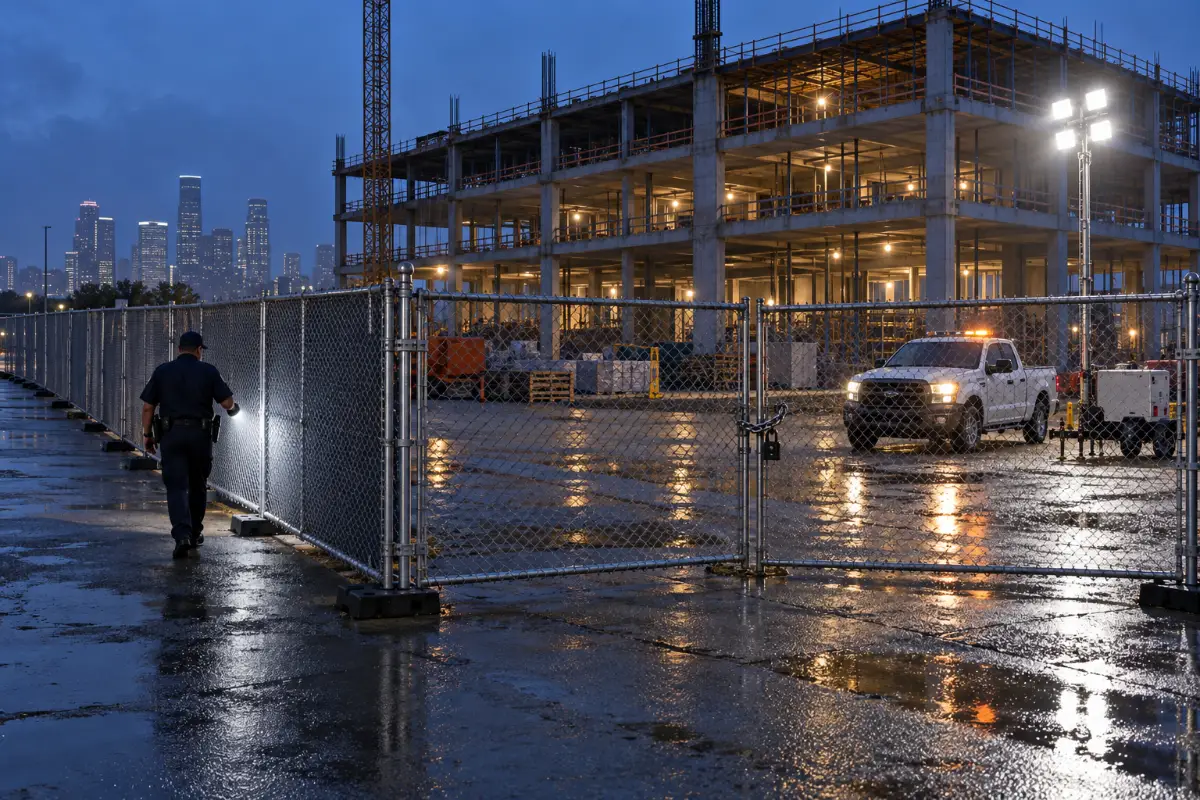
Construction site security fencing marks your property line, slows people down, and in Texas it counts as legal notice that entry is forbidden. It won’t stop a thief who drives through an open gate, lifts a panel that lost its clamp, or walks in dressed like your crew. A fence holds up when somebody checks it. Left alone overnight, it’s a boundary nobody is watching.
Texas has the most at stake. The latest equipment theft report we could find from the National Equipment Register and the National Insurance Crime Bureau covers 2016. That year, Texas led the country with 2,375 of the 11,574 reported thefts, almost 3 times North Carolina in 2nd place. The report’s own summary says, “Most thefts are from work sites with little or no security.”
We’re a Houston guard company that posts licensed officers on construction sites across the metro. This guide comes from the fence line after the last truck leaves, the part fencing guides skip.
What Is Construction Site Security Fencing?
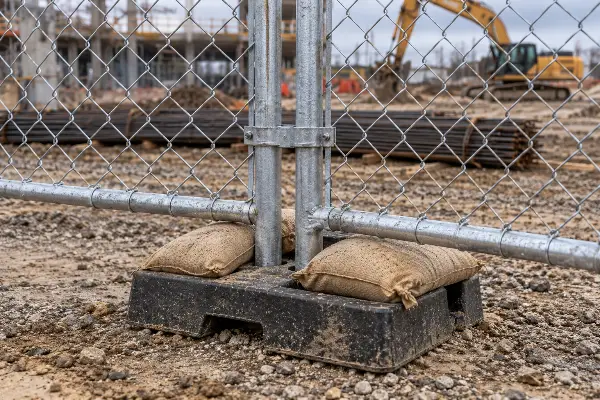
Construction site security fencing is a temporary perimeter, usually 6-foot chain-link panels set in weighted stands and clamped together, that closes off a job site during the build. It marks the boundary and slows entry, and its gates decide where people and vehicles come in. In Texas, it also counts as legal notice that entry is forbidden.
That last part comes from the Texas trespass statute, Penal Code Section 30.05. It lists “fencing or other enclosure obviously designed to exclude intruders” as notice, the same as a posted sign. Entering or staying without the owner’s consent after notice is criminal trespass, a Class B misdemeanor in most cases.
The same section counts “oral or written communication by the owner or someone with apparent authority to act for the owner” as notice too. That’s what an officer gives when they tell someone to leave. So a fenced site with an officer on it has 2 forms of notice, and only 1 of them can see who’s inside.
One thing the fence isn’t: an OSHA rule for keeping the public out. OSHA’s fall protection rule does call for guardrails, fences or barricades at some excavation edges 6 feet or deeper. That rule is about workers falling in. It says nothing about trespassers.
Does A Fence Stop Construction Site Theft?
A fence slows theft down and makes crossing it a crime. By itself, it rarely stops someone with bolt cutters and a trailer.
Fencing guides often call the fence your first line of defense. The people who steal from job sites rank it lower. A U.S. Justice Department guide on construction-site burglary, written for police, reports that “burglars say that security guards pose the greatest threat to their activities.” The same guide notes that “Properly constructed and secured fences can control access to construction sites.” Secured is the word doing the work there, and somebody has to check it.
Once something leaves the site, the odds turn against you. Only 21% of the equipment stolen in 2016 was recovered, and the guide calls property taken in construction-site burglaries “rarely recovered.”
The fence is one of the 8 security layers we compare for job sites. On its own, it can’t call anyone.
How Do Thieves Get Past Construction Site Security Fencing?
The easy way in is a gate or a gap, not the wire. And some thieves don’t look like intruders at all.
The guide sorts construction-site thieves into opportunists, professionals and insiders. What they share, it says, is “the ability to blend in with regular construction workers.” A fence can’t tell a thief in a hard hat from your framing crew. During work hours, that’s a gate problem. After hours, it’s a patrol problem.
Equipment tends to leave the same way. In the 2016 theft report, loaders made up 18% of stolen machines and tractors 14%. A loader needs an opening wide enough to drive or tow it out, and on a fenced site, that opening is the gate.
These are the 6 weak spots we’d check first on any fenced site after hours:
| Weak spot | What it looks like after hours | What a patrol should check |
|---|---|---|
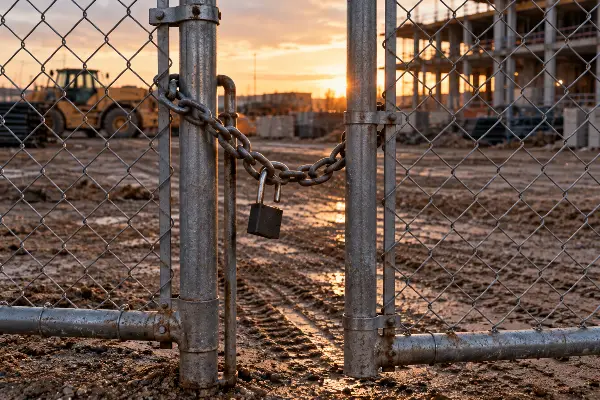
| Gate left open or unlocked | The last delivery ran late, or the only key left with a sub | Gate shut, lock set and chain pulled tight, on the first round and every round after |
| Missing clamps or shifted stands | A panel that swings or lifts at the base | Clamps at each joint and stands in line, all the way around |
| Panels down after wind | A screened run blown flat after a storm | A full perimeter walk after any storm, with photos to the site lead |
| Materials stacked near the fence | Copper, conduit or lumber close enough to pass over the top | Anything staged at the line gets flagged to site management and lit |
| Dark stretches | A back corner or side run with no light | A spotlight sweep on every round, and a request for a light tower |
| Screened runs | Privacy mesh hiding part of the yard from the street | Walks along the inside of the screen, since nobody outside can see in |
What A Guard Adds At The Fence Line
A fence can’t see anyone. An officer can, and can then challenge them, call police and write it all down. Depending on the site, that’s an unarmed officer walking the line or a patrol vehicle working the perimeter.
What Our Incident Reports Show
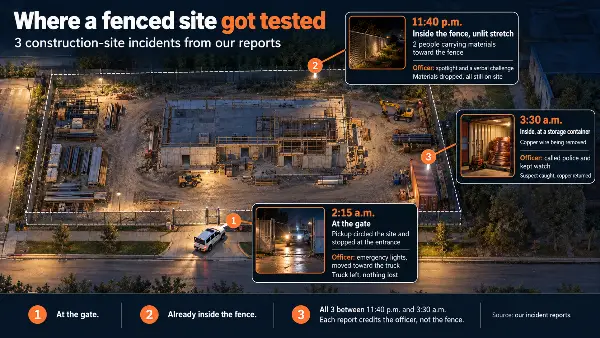
Our reports from 3 construction-site incidents show where a fenced site gets tested.
| Time | Where on the site | What the officer did | How it ended |
|---|---|---|---|
| 11:40 p.m. | Inside the fence, in a poorly lit stretch: 2 people carrying materials toward the perimeter fence | Put a spotlight on them and called out a verbal challenge | They dropped the materials and ran. An inventory check found everything still on site |
| 2:15 a.m. | At the gate: a pickup circled the site slowly, then stopped near the gated entrance while the people inside seemed to size up the access points | Activated the emergency lights on the patrol vehicle and approached the truck | The truck left. The officer logged the vehicle description, and nothing was lost |
| 3:30 a.m. | Inside the site, at a storage container that had been tampered with: someone trying to remove rolls of copper wire | Called police, kept watch from a safe distance and kept dispatch updated | The suspect dropped the wire and ran, and responding officers caught the suspect. The copper went back to site management |
Look at where each one happened. One was at the gate. The other 2 were already inside the fence. Each report credits the officer’s response with how it ended, and none credits the fence. All 3 also happened in the same stretch of the night, between 11:40 p.m. and 3:30 a.m.
Fence, Lights, Cameras Or An Officer: What Each One Does
Each layer covers a different gap, and only the officer can respond to what the others catch.
| Layer | What it does after hours | What it can’t do | What the Justice Department guide says |
|---|---|---|---|
| Fence | Marks the line, slows entry, counts as notice under Texas law | See, challenge or report anyone | Controls access when “properly constructed and secured” |
| Lighting | Lets officers, passersby and police see movement | Respond to what it shows | A review of 13 U.S. and British studies found a 20% drop in crime across them |
| Cameras | Record, send alerts, help after the fact | Stop a theft in progress | Work best where access points are few and controlled |
| Officer on patrol | Spots activity, challenges, calls police, documents | Stand at every stretch of fence at once | Burglars name guards as their greatest threat |
A camera can show you a panel went down at 1 a.m. It can’t walk over, light up the gap and wait there for your site lead. That’s why cameras alone leave the response to whoever reads the alert.
An officer’s authority has limits. In Texas, a security officer has the same warrantless arrest power as any other private person. Under Code of Criminal Procedure Article 14.01(a), that covers a felony or an offense against the public peace committed in their presence or view. On a fenced site, the usual job is to be seen, give notice, call police and keep watch. That’s how the 3:30 a.m. copper call ended. Force and detention follow their own rules under Texas use-of-force law.
Setting Up A Fence A Patrol Can Work in 2026
Set the fence up so an officer can check it fast and see across it. Gates and lighting come first, then screen and staging.
Fewer Gates, In The Light
Every gate is one more lock to check and one more opening to watch. Use the fewest your deliveries allow, and put them where a street, a light pole or the officer’s route can see them. The burglary guide makes the same point: lighting helps passersby and police spot suspicious activity. A lit gate facing the street is harder to work than a dark one in back. If a gate has to stay open for a late pour, put a person on it until it closes.
Should You Add Privacy Screen?
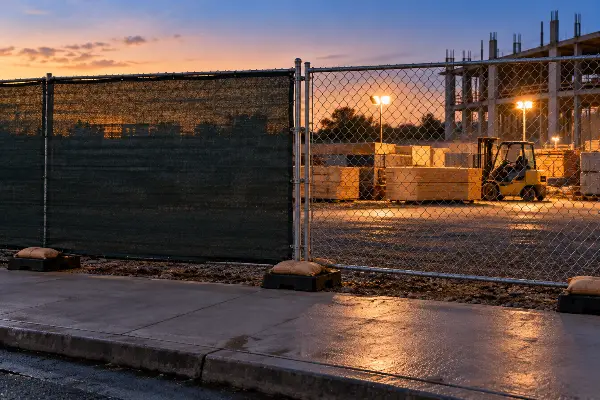
Only where you need it. Screen hides your copper from people driving by, and it also hides anyone inside the fence from everyone outside it.
Visibility matters here. The burglary guide lists being “neither occupied nor easily watched” among the reasons houses under construction get hit. Screen makes any site harder to watch from the street, for passing patrol cars and for an officer working the outside of the line. If you need it for dust control or an owner’s requirement, keep the gate and the lay-down yard in view and light the screened runs. Screened panels catch wind, so add weight to the stands.
Keep Materials Off The Fence Line
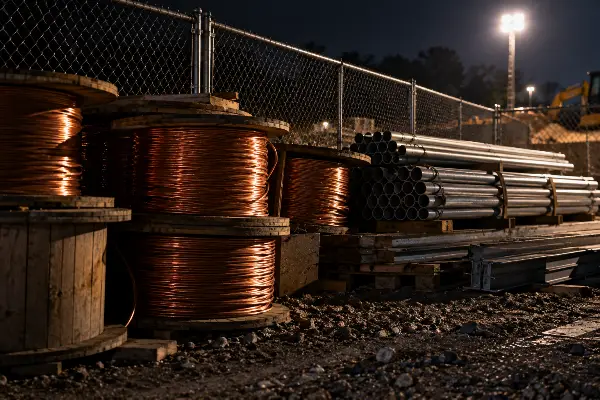
Stage high-value materials well inside the fence, and shorten the time they sit there. In our 11:40 p.m. incident, 2 people were hauling materials toward the fence through a dark stretch. Material stacked near the fence turns that into a short carry and a quick hand-off. The burglary guide recommends shortening the time between delivery and installation, so book copper and equipment deliveries close to install day.
Getting A Fenced Houston Site Covered
We post construction site security officers on fenced sites across Houston, including the Energy Corridor, Katy, Pearland, Conroe and The Woodlands. Every round is logged with GPS, incident reports reach you in real time, and supervisors run check-ins. You can book coverage by the week or month to month, short or long term, without a long contract. Coverage can start the same day.
Before your next big delivery, walk your construction site security fencing after dark, one gate and one corner at a time. If the list of fixes runs longer than one night’s work, call us for a free proposal and ask about a site walk.
FAQs
Is construction site security fencing enough to stop theft?
Not by itself. A fence slows entry and counts as legal notice in Texas, but it can’t see, challenge or report anyone. The 2016 equipment theft report from the National Equipment Register and the National Insurance Crime Bureau found only 21% of stolen equipment was recovered. It says most thefts came from work sites with little or no security.
Is a fence legal notice for trespassing in Texas?
Yes. Texas Penal Code Section 30.05 lists “fencing or other enclosure obviously designed to exclude intruders” as notice that entry is forbidden. Entering or staying on the property without the owner’s consent after that notice is criminal trespass, a Class B misdemeanor in most cases.
Do I still need No Trespassing signs if my site is fenced?
Texas law lists a fence and a posted sign as separate forms of notice. A fence designed to keep people out counts without a sign. Signs at the gates still help. They tell crews and visitors who to call and take away any question about whether entry is allowed.
Can construction site security fencing stop insider theft?
No, because a fence keeps people out and insiders are already let in. A U.S. Justice Department guide on construction-site burglary says insiders “may be more likely to take tools and small equipment.” It adds that thieves of every type share “the ability to blend in with regular construction workers.” Gate control during work hours and a tool check-out before the crew leaves do more against insider theft than any fence.
When should you add a guard to a fenced construction site?
Before your first big delivery. The fence usually goes up at the start of the job, but theft follows the machines and materials. The 2016 equipment theft report from the National Equipment Register and the National Insurance Crime Bureau says “Theft levels closely correspond with peak construction periods.” Put an officer on the fence line the week high-value equipment and copper arrive.
What should a guard check on a fenced construction site?
The gates first: shut, locked and chained tight. Then clamps and stands, any panel that moved, materials stacked near the fence, dark stretches and the inside of any screened run. With GPS-logged rounds, every check leaves a time-stamped record you can review the next morning.


