Almost everyone who reaches this page is here because guard coverage stopped. A contract firm no-showed. A vendor was terminated mid-term. A building emptied faster than procurement moves. Reliable Guard & Patrol Service Inc. posts licensed officers at Houston commercial properties while you sort out what happens next.
A Gap In Guard Coverage Can Cost You A Fire Claim
If your commercial property policy schedules a security service as a protective safeguard, letting that service lapse can defeat a fire claim even when the missing officer had nothing to do with the fire. That is the mechanism nobody explains to the buyer, and it is the reason some of these calls cannot wait until Monday.
The standard ISO form is CP 04 11, Protective Safeguards. It works by symbol.
P-1 is the automatic sprinkler system, including related supervisory services. P-2 is an automatic fire alarm protecting the entire building, connected to a central station or reporting to a fire alarm station. P-3 is a security service, with a recording system or watch clock, making hourly rounds covering the entire building, when the premises are not in actual operation. P-4 is a service contract with a privately owned fire department. P-5 is an automatic commercial cooking exhaust and extinguishing system. P-9 is whatever protective system the policy schedule describes.
Read your own schedule and find the symbol. That one character decides which of the 6 you are contractually maintaining.
P-3 is the one a guard company sits inside.
What the endorsement asks of you
You agree to maintain the scheduled safeguards in complete working order, and to notify the insurer if you know of any suspension or impairment of a scheduled safeguard. The exclusion that follows is short: the insurer will not pay for loss or damage caused by or resulting from fire if, prior to the fire, you failed to comply with those conditions.
The fire does not have to be caused by the coverage gap. The gap can still defeat the claim.
Outcomes turn on the wording actually attached to your policy and on state law, and courts have not read these clauses identically everywhere. Your broker answers that, not a security company’s website. What we can tell you is what a P-3 schedule asks a guard service to produce.
The 3 parts of P-3, and what to ask any vendor
P-3 has 3 separate requirements. A vendor who meets 2 of them has not satisfied the schedule.
- A recording system or watch clock. The schedule wants a record, not an assurance that rounds happened. Our officers work a GPS guard-tour system, so each round produces a timestamped log instead of initials on a clipboard.
- Hourly rounds. Frequency lives in the post orders. If your policy schedules P-3, say so on the first call and the post orders get written to hourly.
- Coverage of the entire building while the premises are not in actual operation. A perimeter drive-by does not meet that. Ask what the word “patrol” means in the proposal you are holding.
Bring your declarations page to the first call, or ask your broker one question: is a protective safeguard scheduled on this location, and which symbol.
The Endorsement Question, Asked The Way A Scheduled Safeguard Makes You Ask It
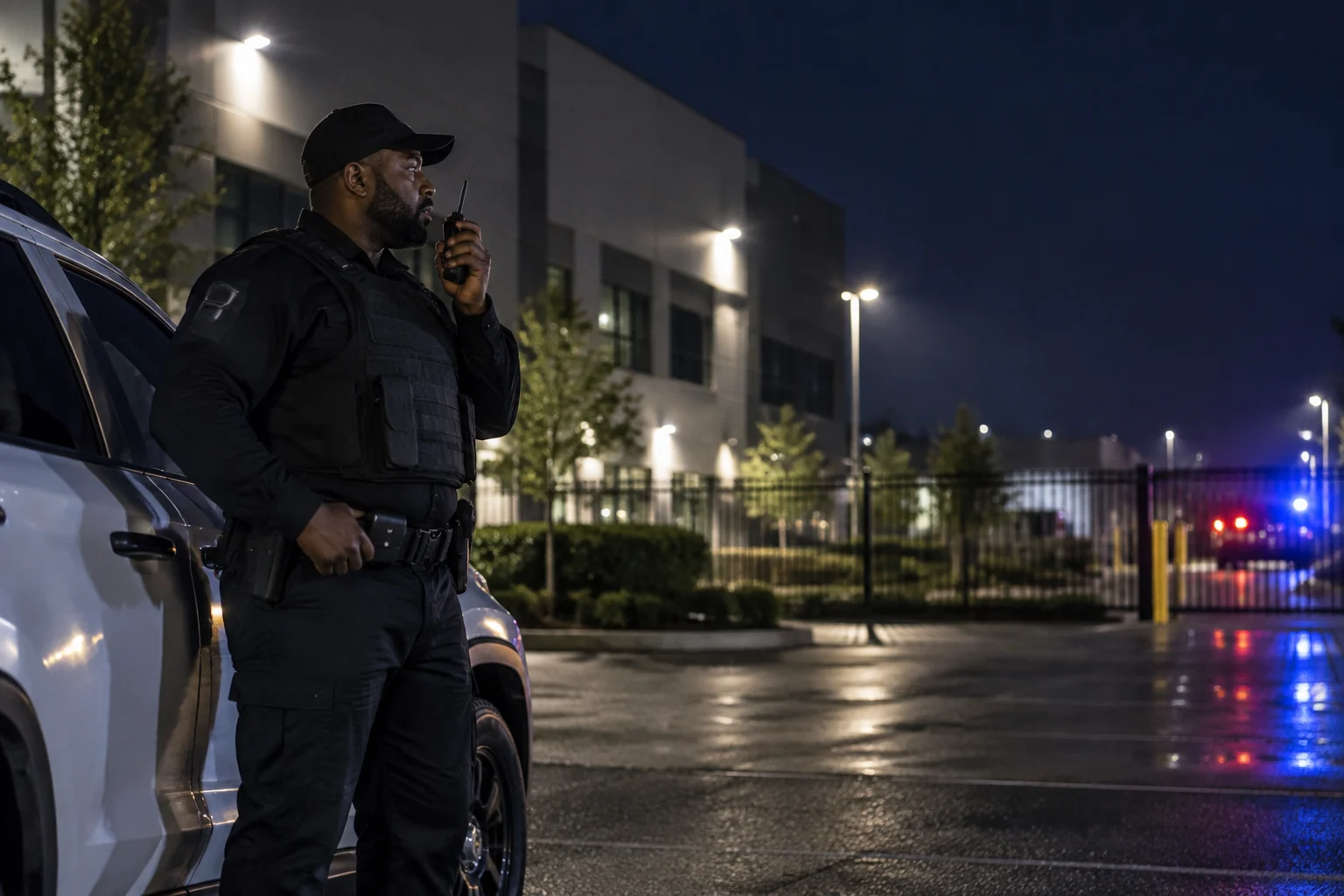
If a safeguard is scheduled on your policy, you have 2 insurance questions on this call rather than one. The first is the ordinary vendor question: is your business named on the guard company’s policy by endorsement, or only listed on a certificate. The second is specific to the schedule: does the vendor’s coverage produce the record your own carrier will want to see that the safeguard was maintained.
The first question is answered in full, with the statutory limits and the 5 documents to collect, on our post about what Texas actually requires a security company to carry. Read it before you sign anything, and read it whether you hire us or not.
The second question is the one this page exists for, and it is the one your guard vendor answers rather than your broker. We carry general liability, workers’ compensation and commercial auto, and the certificate is issued the same day. On a P-3 post, the thing to ask for beyond that certificate is the tour export, because that is the document that shows the schedule was met.
Four Things To Collect Before You Release The Outgoing Vendor
Collect these 4 documents from the vendor you are replacing, on the day you terminate rather than after. Each one exists only while the account is open. These are the offboarding set, and they are a different list from the 5 documents you collect when you bring a vendor on, which our insurance requirements post covers.
- The tour export or patrol log covering their final 30 days. If a safeguard is scheduled on your policy, this is your only proof it was maintained up to the moment they walked. Once the account closes you may not be able to get it at all.
- Every incident report from the term, including anything still open. Something logged 3 nights ago that you never saw changes what the next officer watches for, and it is the first document an adjuster asks about.
- The date their additional-insured status ends for your site. It usually ends with the contract rather than with the last shift, and those are rarely the same day.
- Written confirmation of the last shift actually worked, as opposed to the last shift invoiced. On a vendor who was already missing posts those 2 dates differ, and your gap starts at the earlier one.
Then make one call that has nothing to do with security. If your policy schedules a security safeguard, your notification duty to the insurer is triggered by the gap itself, not by the replacement. Tell your broker the day coverage stops, not the day it resumes.
CALL US FOR SMART SECURITY SOLUTIONS
We Cover Houston, TX, Sugar Land, TX, Pearland, TX, Conroe, TX
What We Will Not Take, Even Tonight
We post officers at commercial properties: construction sites, warehouses and distribution centres, vacant buildings, retail and shopping centres, offices and multi-tenant buildings. Armed or unarmed, on foot or in a patrol vehicle.
We do not staff any of the following, in an emergency or otherwise:
- Residential properties and HOA communities
- Fire watch and hot work watch
- K-9 units
- Alarm-response call-outs
- Parking enforcement
- Level IV personal protection and executive protection
If your emergency needs one of those, say so in the first minute and we will tell you in the first minute instead of the first hour. Posting an officer after a break-in is our work. Contracting to respond to alarm signals is not.
Most emergency posts run unarmed, and on a same-night call there is a practical reason beyond risk. Commissioned officers are a smaller pool, so asking for armed coverage inside a few hours cuts down who can actually take the post tonight. If the risk profile allows unarmed with a written escalation plan, you get an officer on site sooner and you get more hours for the same spend.
Get Your
Free Armed & Unarmed Security Proposal
Why Houston businesses choose Reliable Guard & Patrol Service
Why Choose Our Armed Guards:
01. Fully Licensed to Carry in the State of Texas
02. Background-Checked and Drug Tested
03. Trained in Firearms Handling and De-Escalation
04. Experienced in High-Risk Property Protection
05. Serving Houston Businesses for Over 20 Years
06. Corporate, Construction, Retail, and Event Coverage
07. 24/7 Coverage Including Holidays
The Record You Can Hand An Adjuster
A stopped break-in is worth what you can document about it 6 months later. Nobody sells that part, and it is what a claim, a subrogation file or a vendor dispute is actually decided on.
Here are the 7 things that actually get requested, and what each kind of record can answer.
- Proof an officer was physically on site at a stated time. A paper sheet offers initials, written whenever the officer got round to it. A tour log offers a timestamped checkpoint hit with the location attached.
- How often rounds ran across the shift. On paper this becomes an estimate after the fact. In a tour log every round is already there, in sequence.
- Whether the whole building was covered or only the perimeter. Paper says nothing about this at all. Checkpoint coverage can be read straight against the post orders.
- How long passed between detection and the call to police. That is a recollection on paper. It is 2 timestamps in an incident report.
- What the officer observed before anyone had a theory about it. Usually a short note, if anything. A report filed the same shift gets written before the story sets.
- Whether a supervisor verified the post. Paper carries no trace either way. A check-in leaves a record.
- Whether a scheduled protective safeguard was maintained. Nothing on a clipboard will satisfy an underwriter. The tour export for the period in question will, and on a P-3 post this is the one that decides the claim.
Every row in the right-hand column exists because somebody requests it later. Footage shows what happened inside one frame of view. A logged officer produces the time, the place, the observation, the notification and the sign-off as separate, timestamped items.
Two Lookups Before You Let Anyone On Site
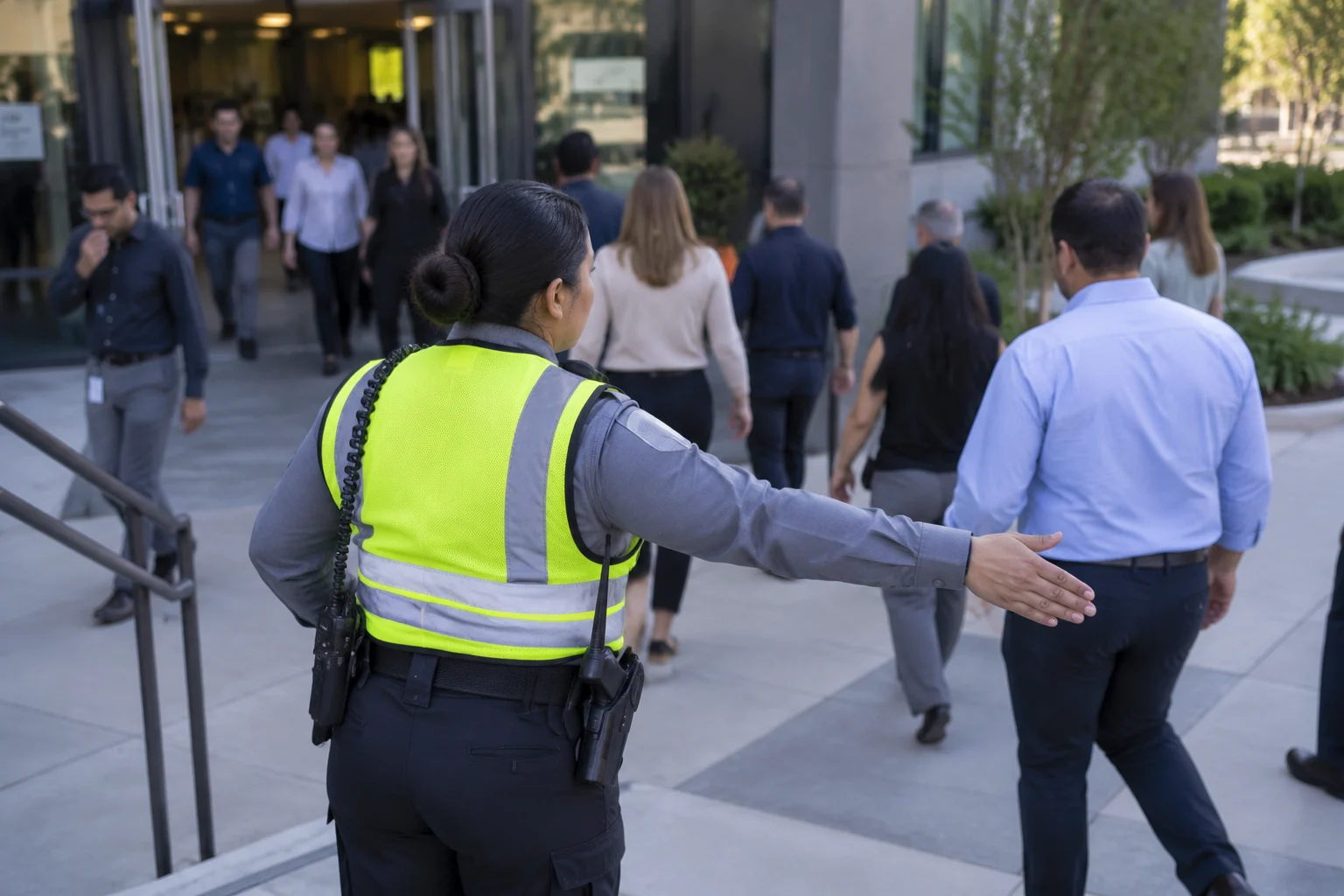
Run 2 searches, not one. The company licence and the individual officer’s registration are separate records on the state’s public licence search, and “we’re licensed” usually covers only the first. Ours is B07315701. We give officer names on request, and the step-by-step version of both lookups is on our homepage.
A salesperson who will not hand over a company licence number in the first 5 minutes of an emergency call has answered a different question than the one you asked.
Frequently Asked Questions
Can you cover the gap while I terminate my current security company?
Yes, and it is the most common reason we get called. Read the handover list above before you release them, because 4 of those 7 items stop being available once the account closes.
Is the officer your employee or a subcontractor?
Ours. On an emergency post that matters because a subcontracted officer can sit on a different licence, a different insurance policy and a different set of post orders, and a coverage gap is a bad moment to find out which. Whose workers’ compensation covers whom is a longer answer, and it is on our insurance requirements post.
What do you need from me on the first call?
The site address, what happened, how many officers, the hours to cover, and whether a protective safeguard is scheduled on the property policy. That last one changes how the post orders are written, so it is worth checking before you call.
What happens to the record if I only need you for 4 nights?
You get the same tour export and the same incident reports as an annual account, and you keep them. A short engagement is the one most likely to end up in front of an adjuster, because it usually exists because something already went wrong.
Tell Us The Address And The Hour You Need Covered
We answer 24 hours a day, holidays included. You get a free proposal with the post orders, the officer level and the term written out.