An unarmed security guard in Texas is a licensed noncommissioned security officer: an individual licensed by the Texas Department of Public Safety who may not carry a firearm on duty and who holds the same detention authority as any private citizen. Reliable Guard and Patrol Service Inc. staffs unarmed officers on commercial property across the Houston metro under Texas DPS company license B07315701, active since 2018.
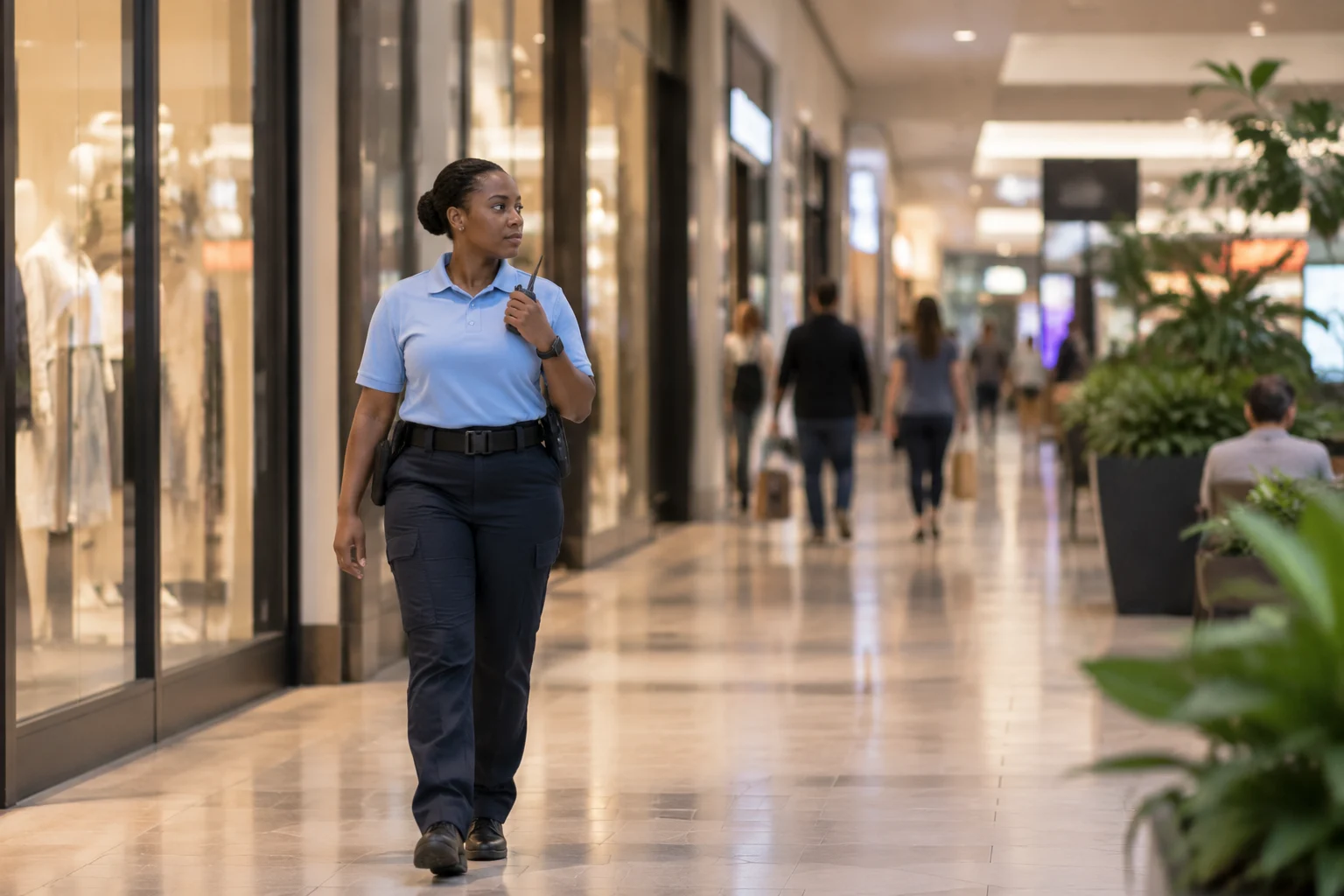
What An Unarmed Security Officer Is In Texas, Exactly
An unarmed guard in Texas is a noncommissioned security officer holding an individual license from the Texas Department of Public Safety, employed by a licensed company. The credential is a license, not a registration, and it has not been called a registration since September 1, 2019.
Occupations Code 1702.221 sets the requirement in two parts. To do the work, an individual must “obtain the proper individual license” and “be employed by a company license holder.” Subsection (b)(1)(G) names the license class: a noncommissioned security officer. Both halves matter to you as the client. An officer with a valid license working for an unlicensed company is not compliant, and neither is a licensed company putting an unlicensed person on your post.
Firearms are the line between the two officer classes, and the statute is short about it. Occupations Code 1702.161 reads: “An individual may not accept employment as a security officer to carry a firearm in the course and scope of the individual’s duties unless the individual holds a security officer commission.” The DPS Level II course manual puts it plainer in its own duty table. A noncommissioned officer carrying a firearm: “Under no circumstances while on duty.”
That is worth checking rather than assuming. If a Houston quote comes back as “armed” at an unarmed price, ask which officer and confirm the commission before anybody stands a post.
Individual licenses run for a term set by DPS, capped at 2 years from issue under Occupations Code 1702.301(b). Because renewal dates are staggered, a term can be shorter than 24 months, so “up to 2 years” is the accurate way to say it. Let a license sit expired for a year or more and it cannot be renewed at all under 1702.302. A new application is the only route back.
What An Unarmed Officer Can And Cannot Do To A Person On Your Property
An unarmed officer may use force to stop a trespass or to stop someone interfering with your property. They may not use deadly force to protect property, and on an unarmed post that option does not exist in any form.
Texas Penal Code 9.41, “Protection of One’s Own Property,” is the operative section. A person in lawful possession of land or tangible movable property “is justified in using force against another when and to the degree the actor reasonably believes the force is immediately necessary to prevent or terminate the other’s trespass on the land or unlawful interference with the property.” Force. Not deadly force.
Your contract officer is not the owner of your property, so the authority runs through Penal Code 9.43, “Protection of Third Person’s Property.” It extends 9.41 to someone acting for the owner where the actor reasonably believes the interference is attempted or consummated theft or criminal mischief, or reasonably believes “that he has a legal duty to protect” the property. That legal-duty prong is the one a contract guard operates under, and it is why the post order needs to exist in writing.
Penal Code 9.42 is the deadly-force section and it requires 3 conditions at once, including a reasonable belief that the property cannot be protected by any other means. An unarmed officer is not equipped to reach that section and is not asked to.
So here is the sentence a property manager should never say to an unarmed officer: pick them up and put them on the sidewalk.
We have had it said to us. Different site, different year, and it comes up more than you would think. Somebody will not leave a vestibule, a manager is out of patience, and the officer standing there is the nearest available pair of hands. What happens next is not a security question. It is a liability question, and the certificate of insurance is the document that gets read afterward. If an officer oversteps, the exposure lands on the property owner as well as on us.
Our post orders name the limit instead of leaving it to judgment at 2 a.m.:
- Observe, document, notify police and the client contact.
- No physical contact except to defend against an imminent assault, or where the written site policy and Texas law allow it.
- “Remove them” is not an instruction unless the legal basis is written into the post order.
- Routine physical removals are a different service with different insurance and a different conversation.
One more limit that clients trip over. Occupations Code 1702.130 bars a licensee or its employees from using a title, insignia, identification card or uniform “with the intent to give an impression that the person is connected with the federal government, a state government, or a political subdivision of a state government,” and bars any uniform or card carrying the designation “police.” If a vendor’s officers look like police, that is not a strong deterrent. That is a rule violation.
CALL US FOR SMART SECURITY SOLUTIONS
We Cover Houston, TX, Sugar Land, TX, Pearland, TX, Conroe, TX
The Shift One Audit
Five things you can check on your own unarmed officer during their first shift, without calling us. Three of the five are Texas rules, so they apply to any vendor you hire.
Guard reliability is the thing clients raise first, ahead of price. This is how you test it on day one instead of finding out in month 4.
1. Read the outermost garment. 37 Texas Administrative Code 35.14 requires that all commissioned and noncommissioned officers “display on their outermost garment the name of the company by which the security officer is employed, the word ‘Security,’ and the last name of the security officer,” each “clearly visible by a reasonable person under normal conditions.” Three items. Company name, the word Security, the officer’s last name. A generic black polo with no company name and no surname is a compliance problem standing on your property, and you can see it from 20 feet away.
2. Look for anything that says police. Under Occupations Code 1702.130, no uniform, badge, insignia or identification card may carry the designation “police” or imply a connection to any government. Star-shaped badges and department-style patches are a warning sign about the vendor, not a sign of seriousness.
3. Match the license class to the post. An unarmed post is staffed by a noncommissioned officer, and that officer cannot carry a firearm on duty under Occupations Code 1702.161. If your contract says unarmed and the officer is armed, or your contract says armed and the officer has no commission, stop the shift. The hiring restriction reaches the client, not only the vendor.
4. Ask for the post order and find the force limit in it. The document should name, in writing, what the officer does when someone will not leave. If it says “use discretion,” you have no policy. Ours names Penal Code 9.41 and 9.43 and states the contact limit explicitly.
5. Ask for the first shift’s tour log as an export, not a summary. Times, checkpoints, gaps. A vendor who can only send you a narrative recap cannot show dosage, and dosage is the thing the research says matters. Ask how the tour data exports before you sign, especially if your carrier will want documentation after a loss.
Get Your
Free Armed & Unarmed Security Proposal
Why Houston businesses choose Reliable Guard & Patrol Service
Why Choose Our Armed Guards:
01. Fully Licensed to Carry in the State of Texas
02. Background-Checked and Drug Tested
03. Trained in Firearms Handling and De-Escalation
04. Experienced in High-Risk Property Protection
05. Serving Houston Businesses for Over 20 Years
06. Corporate, Construction, Retail, and Event Coverage
07. 24/7 Coverage Including Holidays
When Unarmed Is The Wrong Buy
We turn work away, and this is where.
Armed makes sense when the site holds cash, when the assets are high-value and easily resold, when there is a documented history of violent incidents, or when there is a specific named threat. Armed costs more per hour. Plenty of sites are better served by unarmed coverage plus a written escalation plan than by paying an armed differential for a risk that is not there. If your site is in that first group, start on the armed security guard page instead.
We do not take residential, HOA or event work. We do not run K-9, alarm response, parking enforcement or fire watch, in any form or as an add-on. If your building needs a fire watch, hire a provider who does that work and ask them directly. Commercial posts are the whole business, which is the reason our officers know them.
An officer also cannot replace a lock. If the gate stands open, the keys live in the ignition and the copper is stacked against the fence, an unarmed post buys you a witness rather than prevention. Fix the closeout first. We will walk it with you whether or not you hire us.
And per the Oakland result above, an unarmed post on its own is a detection and access-control layer. It is not a crime-control guarantee. If your threat model needs someone who can stop a person, that is a different license class, a different rate and a different conversation. We would rather have it on the first call.
Where We Post Unarmed Officers
Unarmed is the right call on most commercial posts. The risk on a warehouse, a job site, a vacant building or a shopping center is theft, trespass and vandalism, and deterrence plus documentation handles the large majority of that. Construction sites. The officer patrols the site, monitors equipment and materials, controls access, verifies workers and deliveries, and documents activity. The risk is equipment and material theft, trespassing, vandalism, project delays and after-hours access.
Warehouses and distribution centres. Loading dock monitoring, shipment and delivery verification, employee and visitor access control, and patrol of inventory areas. The risk is inventory theft, cargo theft, employee theft and dock losses.
Vacant commercial buildings. Routine rounds, door and window checks, watching for entry, documenting property condition and reporting damage. The risk is squatters, copper theft, vandalism, arson, illegal dumping and liability claims.
Retail and shopping centres. Visible presence in parking lots and at entrances, loss prevention support, and response to disturbances. The risk is shoplifting, organized retail crime, customer disputes and vandalism.
Offices and commercial buildings. Access control, visitor verification, lobby coverage, observe-and-report rounds and written reports. The risk is unauthorized access, loitering, property damage and after-hours entry.
How We Staff And Document An Unarmed Post
Every officer clears the same 6 checks before working a site, and every round they walk is logged.
Active Texas DPS license verified for the level the post requires. Fingerprint background screening. Pre-assignment drug testing, armed or unarmed, no exceptions. An in-person interview against company conduct and presentation standards. References contacted and confirmed. Current Level II training for unarmed officers. Nobody is deployed who has not cleared all 6.
Proof is where clients push hardest, and rightly. We run GPS guard tour systems with documented rounds, real-time incident reports and supervisor check-ins. You see the activity rather than a promise. When a round is missed, the file says so and your supervisor flags it the same shift.
That supervisor is one named person who wrote your post orders and knows your access points. Not a call center, and not a different name every week. We had a retail client change property managers twice in a year. The account supervisor briefed both, and the post orders never got re-litigated.
In most cases we deploy same-day and issue a certificate of insurance the same day. We carry general liability, workers’ compensation and commercial auto. Contract terms run weekly, month to month, short term or long term, set to the job. The “you have to sign for a year” line is a sales tactic and it is worth pushing back on with any vendor, including us.
Frequently Asked Questions
Do you require a long-term contract?
No. Weekly, month to month, short term or long term, set to the job. That is the single biggest misconception buyers bring to a first call.
How fast can you start?
Same day in most cases. Give us the address, the access points and the hours, and we will tell you on the call whether we can post an officer tonight.
Are you licensed, and how do I verify it?
Texas DPS company license B07315701, first licensed in 2018, with about 20 years of ownership experience behind it. Search the state’s public TOPS portal by that number or by “Reliable Guard and Patrol Service.” Do not treat a badge graphic on a website as proof.
What is the difference between an unarmed and an armed officer in Texas?
The license class. An unarmed officer is a noncommissioned security officer and may not carry a firearm on duty under Occupations Code 1702.161. An armed officer holds a security officer commission, earned through the Level III course. Carrying a firearm does not widen arrest authority. Both classes hold the same citizen-level authority. The difference is presence and response options on a high-risk post.
Can an unarmed guard put their hands on someone?
Only inside narrow limits. Texas Penal Code 9.41 justifies force, and not deadly force, to prevent or terminate a trespass or unlawful interference with property, and 9.43 extends that to someone with a legal duty to protect a third person’s property. Our post orders limit physical contact to defense against an imminent assault or where the written site policy and state law allow it. Routine physical removals are not part of an unarmed post.
How much training do your unarmed officers have?
Current Level II, the state-approved course for noncommissioned officers, 6 hours across 9 modules including verbal de-escalation and de-escalation during a mental health crisis. On top of that: fingerprint background screening, pre-assignment drug testing, an in-person interview, verified references and site-specific post orders.
How do I know the patrols actually happened?
GPS guard tour tracking, documented rounds and real-time incident reports, reviewed by your account supervisor. A missed round shows in the file. Ask any vendor how their tour data exports before you sign.
Get An Unarmed Officer On Your Site
Tell us the address, the access points and the hours you need covered. We will quote the post, and in most cases we can start today.