Roughly 30% of hotel guests rank safety as their top factor when picking where to stay. That’s not a soft preference. It’s a booking decision. And for hotel managers in Houston and other metro markets, it means hotel security guards aren’t a line item you can cut without consequences.
Hotel security guards are trained professionals who patrol hotel property, control access to restricted areas, monitor surveillance systems, respond to emergencies, and serve as a visible crime deterrent. In a hospitality setting, they also handle guest complaints, noise disturbances, parking issues, and after-hours requests that blur the line between security and concierge work.
This article covers what hotel security guards actually do day to day, how to decide between in-house and contracted teams, and what separates a good security program from a wasted budget. It won’t cover cybersecurity or IT infrastructure protection, because those require a completely different skillset and vendor relationship.

What Do Hotel Security Guards Actually Do?
The short answer: a lot more than most hotel managers expect. I’ve seen job descriptions that list “monitor cameras and patrol hallways.” In practice, hotel security services cover everything from escorting guests to their rooms at 2 a.m. to de-escalating domestic disputes to (yes, this happens regularly) delivering towels during overnight shifts when no housekeeping staff is on duty.
Security practitioners on Reddit’s r/securityguards forum consistently report that hotel posts involve more “people problems” than actual security incidents. That’s not a complaint. It’s the reality of hospitality security, and the guards who understand that distinction are the ones worth paying for.
How Do Patrols and Surveillance Work in Hotels?
Regular patrols cover lobbies, parking structures, stairwells, pool areas, conference halls, and back-of-house zones like loading docks and kitchens. The BLS counted approximately 1,272,400 security guards employed nationally in 2024, with about 31,280 working specifically in the traveler accommodation sector. That number hasn’t grown, and BLS projects 0% employment growth through 2034. What does grow is turnover, with roughly 162,300 annual openings driven almost entirely by replacements.
Patrols aren’t just about visibility. A guard walking the parking garage at random intervals is harder to predict than one who shows up at the same time every night. Properties that stick to rigid patrol schedules are basically advertising their gaps. Good security patrolling follows randomized routes and documents every check.
Camera monitoring adds a second layer, but here’s the contrarian take most security vendors won’t tell you: cameras alone don’t prevent anything. They record. Loss prevention studies suggest that visible guard presence can reduce theft by up to 30%, while camera-only setups create false alarms and delayed response times. The best hotel security programs combine both, with guards who know how to read a monitor bank and respond to what they see.
Access Control and Guest Verification
Controlling who gets into which areas is one of the highest-value duties a hotel security guard performs. Guest floors, staff-only zones, IT closets, cash-handling areas, and storage rooms all need restricted access. Guards verify credentials at entry points, check visitor and contractor IDs, and address situations where someone’s somewhere they shouldn’t be.
This matters more than most managers realize. The AHLA’s Safe Stay initiative (ongoing through 2025–2026) includes the 5-Star Promise, which specifically addresses employee safety measures like panic buttons and de-escalation training. Properties that take guest and staff protection seriously don’t just benefit from fewer incidents. They signal to guests and employees that the property runs a professional operation.
Incident Response and De-Escalation
When something goes wrong (a medical emergency, a fire alarm, an altercation between guests), the security guard is the first responder on scene. Not technically a first responder in the legal sense, but functionally, they’re the person who shows up first and makes the initial decisions.
I’ve seen this play out dozens of times: the guard who stays calm and follows protocol buys the property 5–10 minutes of organized response before police or EMS arrives. The guard who panics creates a second problem. Training quality is the difference, and it’s why the cheapest contract provider is almost never the best option. New York City’s Safe Hotels Act (signed November 2024, effective May 2025) now mandates that hotels with over 400 rooms maintain continuous on-site security guard coverage. That’s a regulatory signal other metro areas are likely to follow.
Why Hotels Can’t Afford to Skip Security in 2026
Hotels are open environments by design. Guests come and go at all hours. Contractors, delivery drivers, and event attendees rotate through constantly. That openness is what makes hospitality work, and it’s exactly what creates security gaps.
Does Guest Confidence Actually Affect Bookings?
Yes. And not in the abstract way most articles frame it. A single negative safety-related review on Google or TripAdvisor can drop a property’s booking conversion rate in measurable ways. Guests don’t write “I felt unsafe” and move on. They write detailed, emotional reviews that rank highly because review algorithms prioritize engagement.
Properties that invest in visible, professional security see the opposite effect. Guests mention feeling “safe” and “well taken care of,” and those reviews build the kind of trust that drives repeat stays and referrals. This isn’t marketing theory. It’s what happens when security guards are trained to balance approachability with authority.
The Legal Risk of Going Without
A single lawsuit from a guest assault, theft, or slip-and-fall in an unmonitored area can run a mid-size hotel $50,000–$250,000 or more in legal fees, settlements, and insurance premium increases. Hotels that document consistent security coverage and incident response protocols are in a much stronger position when claims arise.
Hotels also carry liability for employee safety. Staff working late-night shifts in isolated areas like parking lots and loading docks are at higher risk of harassment or assault. AHLA’s 5-Star Promise specifically addresses this with panic button requirements, but those buttons only work if there’s someone trained to respond when they’re pressed.
How Staff Safety Shapes Retention
The security guard industry turns over at staggering rates (some analyses peg NYC’s sector at 77% annually), and hotels face similar retention challenges across all departments. Staff who don’t feel safe quit. In a labor market where the median hotel security guard earns approximately $19.48/hr according to BLS industry data, replacing a trained employee costs far more than the salary savings from cutting a guard shift.
What Should Hotels Budget for Security Guard Coverage?
Most hotel managers want a ballpark before they start calling providers. Pricing varies by region, guard type, and coverage level, so here’s a general overview of what the market looks like:
| Guard Type | National Range | Houston Area | NYC Area |
| Unarmed (basic) | $25–$40/hr | ~$30/hr | ~$38/hr |
| Unarmed (dedicated on-site) | $35–$50/hr | ~$35–$40/hr | ~$45–$50/hr |
| Armed | $40–$65+/hr | ~$45/hr | ~$55/hr |
| Mobile patrol (interval visits) | $25–$35/hr | ~$28–$32/hr | ~$35–$40/hr |
Keep in mind, those are billed rates, not guard wages. The national median wage for a security guard is $38,370/year ($18.46/hr) per 2024 BLS data. The gap between what the guard earns and what you pay covers the security company’s overhead: insurance, training, workers’ comp, management, and margin.
Actually, that framing isn’t quite right. The better way to think about it is this: you’re not paying for hours of a person standing somewhere. You’re paying for trained response capability, liability coverage, and documented incident management. The cheapest provider skimps on all three, and you won’t know that until something goes wrong.
The US security services industry hit approximately $50.4 billion in 2026 (IBISWorld), growing at a modest 0.3–0.5% CAGR. That slow growth means the market is mature and competitive, which is good for buyers. But it also means quality varies wildly between providers.
Should Your Hotel Use In-House or Contract Guards?
This is the question that separates properties that take security seriously from those that treat it as a checkbox.
- Contract security gives you flexibility. You can scale coverage up for conference season and scale down during slow months. You get access to pre-trained guards without managing hiring, benefits, or scheduling yourself. The tradeoff: high turnover (50–77% annually in some markets), inconsistent quality between shifts, and guards who don’t know your property as well as permanent staff would.
- In-house security gives you control. Guards learn the property, build relationships with repeat guests and staff, and develop judgment that only comes from knowing a specific building. The tradeoff: higher fixed costs, HR and benefits administration, and the need to manage training and scheduling internally. Most Reddit practitioners in the security field prefer in-house for hotel posts, but it’s rarer at properties with fewer than 150 rooms because the cost structure doesn’t pencil out.
For Houston-area hotels running 100–300 rooms, a hybrid model often works best: one or two in-house security officers who anchor the program, supplemented by contracted guards from a professional security provider during peak periods and events.
What Most Hotels Get Wrong About Security
The biggest mistake I see is treating security guards as interchangeable bodies. Hotels will pick the lowest bid, get a rotating cast of undertrained guards who don’t know where the fire exits are, and then wonder why their “security program” doesn’t work.
Here are the questions most hotel operators forget to ask before signing a contract:
- What are your exact policies on guest interactions and use of force?
- How do you handle turnover and guarantee shift coverage?
- What training do your guards receive on de-escalation and hospitality-specific scenarios?
- What metrics will you report beyond “no incidents”?
- Can you provide guards who are bilingual (relevant in Houston, where roughly 44% of the population speaks Spanish at home)?
ASIS International’s 2025 reports emphasize that security is becoming more strategic within organizations, including hotels. That means your event security guard and your lobby overnight guard shouldn’t be treated identically. Different posts require different skill sets, and providers who acknowledge that are the ones working with teams who understand your vertical.
The technology conversation matters too, but it’s simpler than vendors make it sound. Manned guarding still accounts for roughly 34% of the physical security market, while remote monitoring grows faster (~5.5% CAGR). A 200-room hotel doesn’t need an AI-powered facial recognition system. It needs cameras that work, a guard who watches them, and clear protocols for what happens when something looks wrong.
FAQs
Do hotel security guards scare away guests?
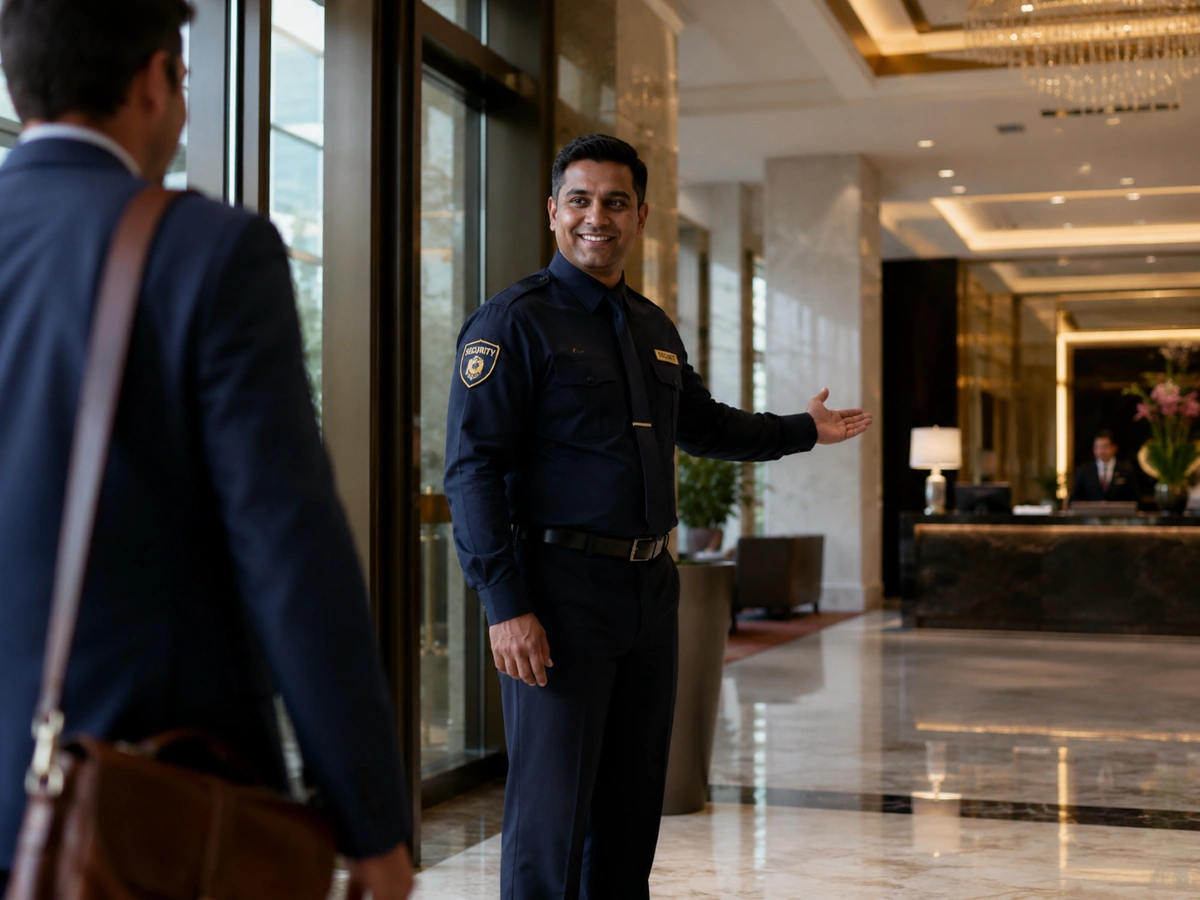
No. Properly trained hospitality-focused guards are selected for approachable demeanor and de-escalation skills. Industry feedback consistently shows that visible security makes guests feel more comfortable, not less. The key is training. A guard in a well-fitted uniform who greets guests and offers directions creates a very different impression than one standing silently with arms crossed.
What’s the difference between armed and unarmed hotel security?
Unarmed guards handle the vast majority of hotel security needs: patrols, access control, guest assistance, and incident reporting. Armed guards are reserved for properties with demonstrably higher risk profiles, like hotels in high-crime areas or those hosting high-value events. Most hotel operators should start with unarmed coverage and only add armed guards based on a formal risk assessment.
Should a hotel hire in-house security or use a contract company?
It depends on property size. Hotels under 150 rooms typically can’t justify the fixed costs of in-house security. Larger properties benefit from a hybrid model: in-house staff who know the building, supplemented by contract guards for peak periods. Contract security offers flexibility but averages 50–77% annual turnover in some markets, which means inconsistent quality.
Are hotel security guards required by law?
Requirements vary by jurisdiction. New York City’s Safe Hotels Act (effective May 2025) mandates continuous on-site security guard coverage for hotels with over 400 rooms. Most other cities don’t have specific mandates yet, but liability exposure makes professional security a practical requirement for any mid-size or large hotel.
What training should hotel security guards have?
At minimum: de-escalation and conflict resolution, emergency response procedures (fire, medical, active threat), CPR and first aid certification, and hospitality-specific customer service training. AHLA’s Safe Stay initiative also recommends human trafficking recognition training. Guards working hotel posts should receive property-specific orientation covering floor plans, alarm systems, and guest interaction protocols.
Can hotel security guards detain someone?
Security guards are not law enforcement. They can ask someone to leave the property (trespassing), and in most states they can perform a citizen’s arrest if they witness a felony in progress. But the use of force is extremely limited and varies by state law. Hotels should have written policies that define exactly when guards should call police instead of intervening physically.


