
A security guard’s five basic duties are simple to name and hard to do well: patrol and deter, control access, respond to incidents, document everything, and communicate with the people on site. That is the short answer. The longer answer is what separates a guard who stops a loss from one who just files a report after it happens. At 3:30 a.m. on a Houston construction site, one of our officers found a man pulling rolls of copper wire out of a storage container. He called police, kept eyes on the suspect from a safe distance, and stayed on the radio with dispatch until officers made the arrest. The copper went back to the site. That is what the duties and responsibilities of a security guard look like when they are done right.
Security guard duties and responsibilities are the tasks a guard performs to protect people and property: patrolling and deterring crime, controlling who enters, responding to incidents and emergencies, writing accurate reports, and acting as the visible point of contact on a site. In Texas, what a guard may legally do also depends on their license level.
The 5 duties at a glance
| Duty | What it looks like on a Houston site | What it costs you when it is missing |
| Patrol and deter | GPS-logged rounds on foot or by vehicle, lights and presence after dark | Theft, trespassing, and vandalism that a visible officer would have scared off |
| Access control | Checking IDs, verifying deliveries, logging who comes and goes | Unauthorized entry, tailgating, and disputes over who was on site |
| Incident response | First on scene, calls police or EMS, follows the site’s emergency plan | Slow reaction that turns a small problem into a claim |
| Reporting | Real-time incident reports, shift logs, photos, timestamps | No paper trail for insurance, police, or a court |
| Communication | Greets and verifies visitors and vendors, de-escalates, bilingual on our sites | Confusion, missed threats, and a bad experience for tenants and staff |
What are the 5 basic duties and responsibilities of a security guard?
The five duties are patrol and deterrence, access control, incident response, reporting and documentation, and on-site communication. Every legitimate guard job in Texas is some mix of these five. The order of importance shifts with the property: a vacant building leans on patrol and deterrence, a warehouse leans on access control, a retail center leans on communication and response. About 1,262,100 people worked as security guards in the United States in 2024, according to the U.S. Bureau of Labor Statistics, so the role is common, but the gap between an average officer and a good one is wide.
Duty 1: Patrol and visible deterrence
Patrol is the duty that prevents crime instead of documenting it. A guard who is seen, on a schedule that is not predictable, stops most opportunistic theft before it starts. On one Houston construction site at 2:15 a.m., an officer noticed a pickup circling the perimeter and stopping near a gated entrance while the occupants studied the access points. He hit the patrol vehicle’s emergency lights and moved toward the gate. The truck left. He logged the description and called site management. No loss, no report of stolen property, because the deterrence worked.
We run every patrol on four things: GPS-logged rounds so you can see where the officer was and when, real-time incident reports, supervisor check-ins during the shift, and same-day response when something changes. We do not do random, undocumented walk-arounds. If you want to compare coverage models, how often officers patrol is worth asking any company before you sign.
Duty 2: Access control and verifying who belongs
Access control means deciding who gets on the property and proving it later. Guards check identification, verify deliveries and vendors, watch entry points, and keep a log. At a Houston distribution warehouse at 11:20 p.m., an officer spotted an unauthorized vehicle near the loading docks after hours and a man trying to reach a secured storage area. The officer called dispatch and the site supervisor, identified himself, and told the man to leave the restricted area. The man complied and left. A follow-up check found no forced entry and no missing inventory.
That matters more than it sounds. Cargo and warehouse theft is climbing: Verisk CargoNet recorded 3,625 cargo theft events across the U.S. and Canada in 2024, up 27 percent from 2023, with an average loss of $202,364 per theft. Access control at the dock is the cheapest point to stop that number from landing on your books. For high-turn facilities, dedicated warehouse guard duties go deeper than a front-gate check.
How fast should a security guard respond to an incident?
Fast enough to change the outcome, which for us means the officer is already on site and moving within seconds, not minutes. Response is the duty where seconds decide whether you file an insurance claim. At a vacant commercial building at 1:45 a.m., an officer saw two people prying at a boarded rear window. He called dispatch and police, put the patrol lights on, and made himself visible. Both fled before they got in. The only damage was to the window covering.
A guard’s job in those seconds is narrow and specific: get to the scene, call the right help (police or EMS), follow the site’s emergency plan, and keep people back. On our sites the officer is radioing dispatch the whole time, so a supervisor and, when needed, Houston police are moving before the situation grows.
Duty 4: Reporting and documentation that holds up later
Reporting is the duty that protects you after the incident is over. A guard records what happened, when, where, and who was involved, with timestamps and photos. That record is what your insurer, the police, and sometimes a court will rely on. A vague “all clear” log is worthless the day you actually need it.
Our officers file real-time incident reports and GPS-stamped patrol logs, so a client can see the round that happened at 3:30 a.m. rather than take someone’s word for it. When the copper-wire suspect on that construction site was arrested, it was the officer’s timed observations and description that let responding officers act. Good documentation is also how a client proves to their own insurer that a site was actively guarded.
Duty 5: Communication and being the visible point of contact
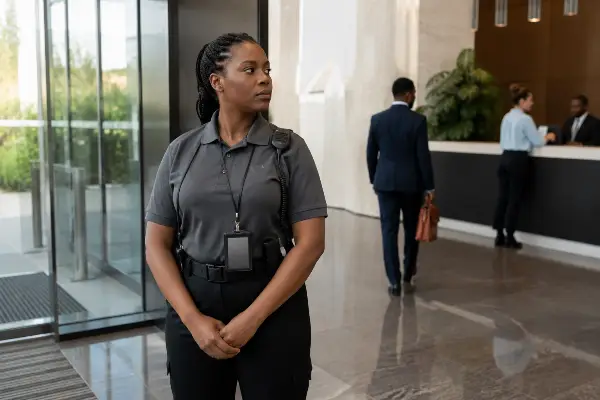
Communication is the duty people underrate until a guard handles a tense moment badly. On most sites the officer is the first person a visitor, vendor, or trespasser meets, so the job is part verification, part de-escalation, part plain professionalism. A calm, clear officer defuses disputes that a badge-heavy one makes worse. Houston is a bilingual city, so our officers work in English and Spanish, which keeps a vendor check or a warning from turning into a standoff.
What can armed and unarmed guards legally do in Texas?
Here is the part the generic five-duty lists skip, and it is the thing that actually decides whether a guard can help you: in Texas, authority follows the license level, not the job title. This is our one firm disagreement with the standard article. The five-duty listicle is identical on every security company’s site, and it will not tell you whether the guard you hire can carry a firearm, work a commissioned post, or legally stand a high-risk assignment. License level tells you that.
Texas splits private security into levels set by the Department of Public Safety. A Level II course covers non-commissioned (unarmed) officers. A commissioned, armed officer must hold a Level III certification, which the Texas DPS sets at a minimum 45-hour course that includes a firearms proficiency test. Personal protection officers add a Level IV course of at least 15 hours. Commissioned officers also owe continuing education (6 hours) to renew. Our armed officers requalify on firearm proficiency every two years, and our unarmed officers carry the Level II training. If you want the deeper version, what a Level 3 commissioned guard does is its own topic, and so are the limits on what a guard can legally do once on your property.
Armed vs unarmed at a glance
| Unarmed officer (Texas Level II) | Armed officer (Texas Level III, commissioned) | |
| Training | Level II course required for the role | Minimum 45-hour commissioned course plus firearms proficiency test |
| Carries a firearm | No | Yes, on a licensed commissioned assignment |
| Typical Houston use | Access control, patrol, and reporting at standard-risk sites | Cash handling, high-value assets, higher-risk or after-hours industrial |
| Ongoing training | Company refresher training | 6-hour continuing education to renew, plus our firearm requalification every 2 years |
Deciding between armed and unarmed officers is usually a risk-and-cost call, not a prestige one. Plenty of Houston sites are safer and cheaper with a sharp unarmed officer than with an armed one they did not need.

How a guard’s duties change by property type
The five duties stay the same, but the weight shifts hard by site. That is why a construction guard and a mall guard do the same job on paper and a completely different job in practice.
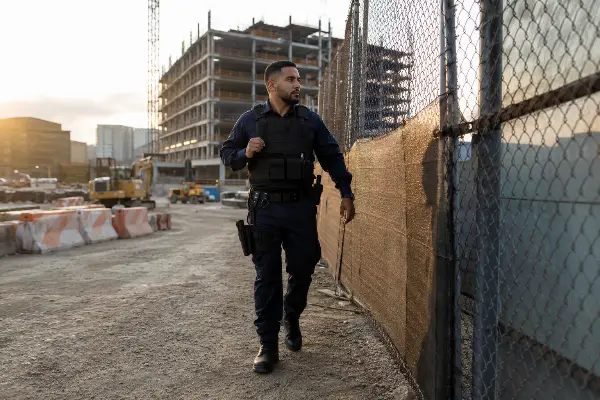
On construction sites, the target is copper, tools, fuel, and materials, and the risk window is overnight and weekends. Our logged incidents there cluster between 11 p.m. and 3:30 a.m., which is exactly when generic “drive-by” patrols are thin. Dedicated construction site security in Houston is built around that window.
In warehouses and distribution, access control at the dock is the whole game, for the theft reasons the CargoNet numbers show. In retail and shopping centers, the job tilts toward visible presence, communication, and loss prevention: the National Retail Federation’s National Retail Security Survey put total U.S. retail shrink at $112.1 billion in 2022, about 1.6 percent of sales, and a guard is a direct check on the external-theft slice of that. Vacant buildings are a patrol-and-deter problem: squatters, copper theft, and vandalism, caught by presence at odd hours. Matching the officer and the coverage to the property is the part a checklist cannot do for you; retail and shopping-center security is a different build than a vacant-lot post.
What makes a Houston security guard worth hiring in 2026?
The duties are the floor. What you are really buying is whether the company shows up, documents the work, and puts the right officer on your site. Reliable Guard & Patrol Service runs 150 guards across more than 100 active Houston-area sites. The company works under Texas DPS license B07315701 and brings two decades of security experience. We cover Houston and the metro: Downtown, the Medical Center, the Energy Corridor, Katy, Sugar Land, Pearland, Conroe, Spring, Humble, and The Woodlands, 24 hours a day.
Two things we do that the industry usually does not. First, we can deploy an officer same day and issue a certificate of insurance the same day, so a site that gets a break-in on Friday is not exposed all weekend. Second, we do not require a long-term contract. The biggest myth we hear is that guarding means locking into a year. It does not. We run month-to-month, short-term, long-term, and even weekly, because a construction job and a holiday retail season are not the same length. That is also the honest limit: we focus on construction, warehouses, buildings, and retail, and we do not take residential, HOA, events, or fire watch. If that is your need, we will say so up front. When you are ready to compare, hiring a security guard in Houston should start with a site walk and a written scope, not a phone quote.
FAQs
What are the 5 basic duties and responsibilities of a security guard?
The five basic duties and responsibilities of a security guard are patrol and deterrence, access control, incident response, reporting and documentation, and on-site communication. Most guard jobs are some mix of these five, weighted by the property. A vacant building leans on patrol; a warehouse leans on access control.
What is the difference between an armed and unarmed security guard in Texas?
An unarmed officer holds a Texas Level II certification and does not carry a firearm. An armed, commissioned officer holds a Level III certification, which the Texas Department of Public Safety sets at a minimum 45-hour course with a firearms proficiency test. The right choice is usually a risk-and-cost decision, not a prestige one.
What are the duties of a construction site security guard in Houston?
A construction site security guard patrols the perimeter, controls access for workers and deliveries, watches for theft of copper, tools, fuel, and materials, and documents everything with timestamps. On our Houston sites, logged incidents cluster between 11 p.m. and 3:30 a.m., so overnight coverage matters most.
Can a security guard detain or touch someone?
A guard’s core job is to observe, deter, and report, not to make arrests. In Texas a private citizen’s authority to detain is narrow and fact-specific, and guard companies train officers to keep a safe distance and call police rather than get physical. This is general information, not legal advice; the specifics depend on the situation.
What goes in a security guard’s report?
A useful report records what happened, the exact time and location, who was involved, and any action taken, backed by photos and GPS-stamped patrol logs. That record is what an insurer, the police, or a court will rely on later. A vague all-clear log is worthless the day you actually need it.
How many security guards does a site need?
It depends on the size of the property, the number of access points, the hours you need covered, and whether the post is armed or unarmed. One officer can cover a small single-entry site; a large warehouse with multiple docks needs more. The honest answer comes from a site walk, not a phone quote.
How much does it cost to hire a security guard in Houston?
Cost depends on armed versus unarmed, coverage hours, and the number of posts, so a real number comes from a written scope, not a flat rate. Reliable Guard quotes per site and requires no long-term contract, running month-to-month, weekly, or longer, and can issue a certificate of insurance the same day.