Licensed officers for the parts of a Houston warehouse where freight changes hands: dock doors, staging lanes, trailer yards and the handoff between crews. Texas DPS license B07315701. 150 officers on 100+ active sites. Contracts can be as short as a week, and your insurance certificate arrives on signing day.
Why the dock is where warehouse losses happen now
In 2025, warehouses and distribution centers were the most-targeted location for U.S. cargo theft, at 36% of events, according to Overhaul’s 2025 annual cargo theft report. Thefts there rose 10% over 2024, and Texas had the second-highest share of thefts of any state, at 20%.
The method is moving to the dock door. Deceptive pickups grew faster than any other method in 2025, and in Q1 2026 Overhaul counted fewer thefts in total than a year earlier while deceptive pickups rose another 31%. In these thefts, criminals use fake identities, forged credentials and carrier impersonation to drive away with legitimate loads.
On April 30, 2026, the FBI published a warning titled “Cyber-Enabled Strategic Cargo Theft Surging” (PSA I-043026-PSA). It put 2025 cargo theft losses in the U.S. and Canada at nearly $725 million, with an average theft of $273,990. Its first recommendation is to verify pickups by a second method before releasing any load.
A fence-line patrol at 2 a.m. never meets that driver. The officer at your dock does.
The 3 windows a dock post has to cover
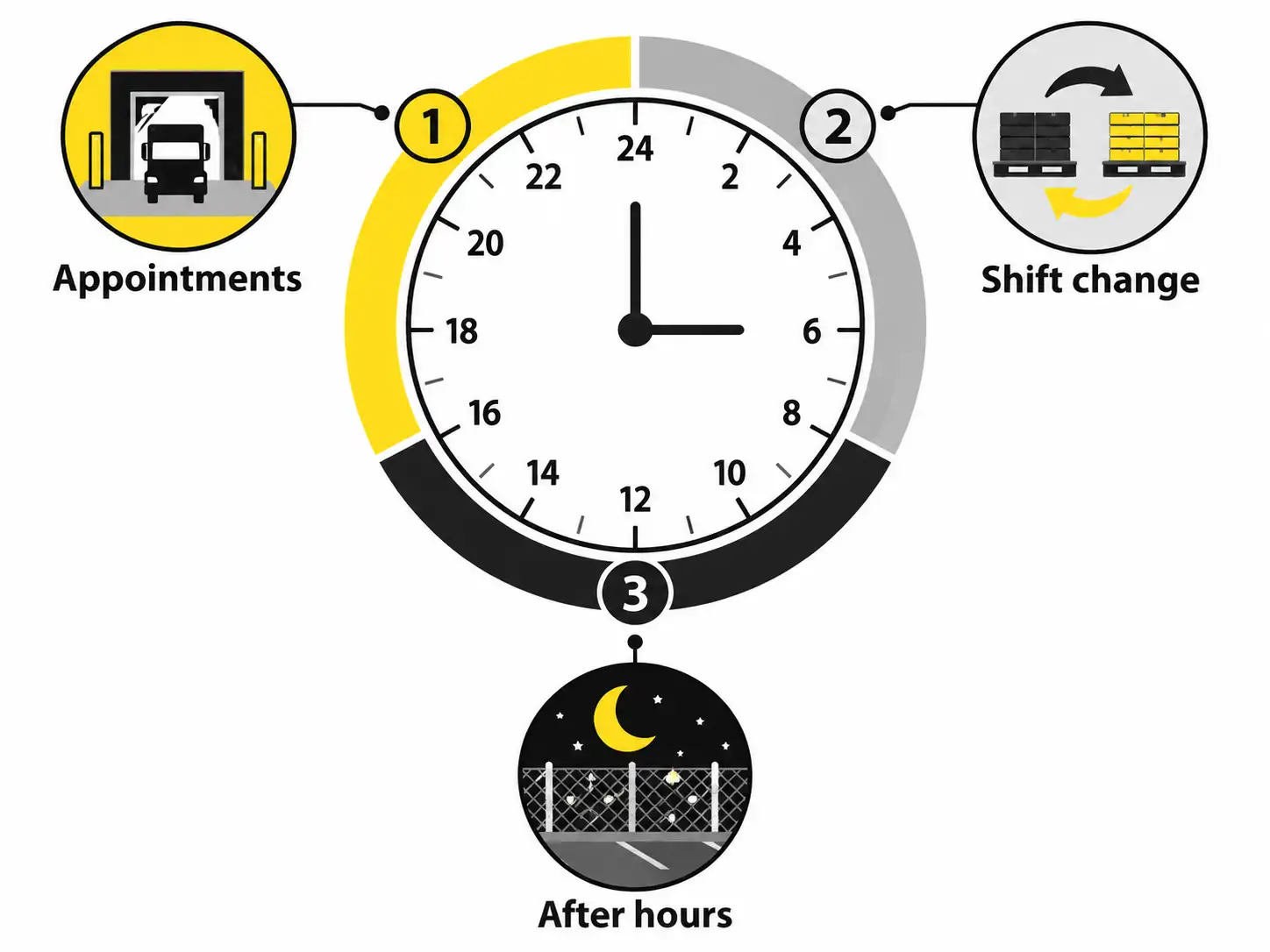
Product leaves a warehouse in 3 windows: during receiving and shipping appointments, at shift changes, and after the building closes. Each window needs its own post orders. A contract that only buys night patrols covers the third window and leaves the dock open during the other 2.
Window 1: receiving and shipping appointments
This is where a fake carrier shows up with clean paperwork. The control is verification at the source before any trailer leaves: the carrier checked against its federal record, the driver and equipment matched to the booking, the seal number recorded. Our gate officers work from a written 5-field pickup log, and our logistics facility page lays it out field by field.
Window 2: shift changes
Shift change is when your own process leaks. A dock door stays up between crews. Pallets sit wrapped and staged with nobody assigned to them, and the outgoing supervisor is signing off while the incoming one is still parking.
Theft in this window doesn’t trip an alarm, because the alarm is off while the building runs. It shows up weeks later as a cycle-count variance with no report behind it.
We recommend a close-out walk for the 30 minutes either side of each handoff, written into the post orders. During that walk the officer:
- checks every dock door against the open-door list
- confirms each loaded trailer is sealed and that the seal number matches the paperwork
- walks the staging lanes and notes freight sitting there without a load assigned to it
- runs exit screening under your written policy
- reports exceptions to your shift supervisor before the outgoing crew leaves
Your inventory team gets a timestamped record of doors, seals and exceptions to reconcile against. “The count is off” becomes “door 14 was up and unattended at 2:12 p.m.”
Window 3: after hours
This is the window night patrols are bought for, and it still matters. Trailer yards hold loaded freight overnight, and dock doors and fence lines are where a break-in starts. Our officers run GPS-logged rounds, so every checkpoint carries a timestamp you can audit. Add yard seal checks to the post orders and they become part of each round.
Our published incident log includes an 11:20 p.m. stop at a Houston distribution warehouse, where someone tried to reach a secured storage area by the docks after closing. Before approaching, the officer alerted dispatch and the site supervisor. Then he identified himself, and the person left the property. When the docks were checked afterward, nothing had been forced, damaged or taken.
Sizing a dock post by the hour
Every 40 hours of weekly coverage is 1 full-time officer. A dock post that never closes needs all 168 hours of the week covered, so it takes more than 4 full-time officers before a single day off.
Use that to test a bid. 4 officers working 40 hours each leave 8 hours of every week with nobody on post, so a 24/7 post built on 4 people runs on overtime, and the first sick call opens a hole in your schedule. Turnover makes it worse: annual turnover in the security industry reached 89% in 2024, against a 66% private-sector average, according to the UC Berkeley Labor Center.
A dock that runs 1 or 2 shifts may not need a 24/7 post. Price the windows you need: appointments and shift changes during the day, the yard at night. Then compare the hours with a full 24/7 post before you decide.
Port Houston and Ship Channel docks: the TWIC rule
Officers who need unescorted access to the secure areas of a port or Ship Channel facility regulated under the Maritime Transportation Security Act must hold a Transportation Worker Identification Credential, or TWIC (33 CFR 101.514).
A TWIC is a federal card issued by TSA. It is separate from the Texas DPS license, and holding one doesn’t get you the other. TSA lists the enrollment fee at $125.25, and the card is valid for 5 years. Applicants without disqualifying factors generally receive the card in 7 to 10 business days, and TSA tells applicants to enroll at least 60 days before they need it.
That makes TWIC a staffing question before it is a price question. Only officers who already carry a card can stand an unescorted post on day 1, and the relief officers who cover days off need cards too. Escorting has limits. In restricted areas, a person without a TWIC needs a TWIC holder as a side-by-side companion (33 CFR 101.105), which can mean paying for 2 people on 1 post.
Tell us at the first call if your site is MTSA-regulated. We confirm officer TWIC status before we quote, and we staff to the escort rules in your Facility Security Plan.
CALL US FOR SMART SECURITY SOLUTIONS
We Cover Houston, TX, Sugar Land, TX, Pearland, TX, Conroe, TX
What a dock officer can do under Texas law
A Texas security officer acts for you on your property, with the same arrest and detention authority any private person has. Your post orders set the rest, so put them in writing.
- Tell a person to leave. Anyone who stays after notice from someone with apparent authority to act for the owner commits criminal trespass (Texas Penal Code 30.05).
- Hold a person they reasonably believe is stealing or trying to steal, as long as the detention stays reasonable in how it’s done and how long it lasts, while ownership of the property is checked (Civil Practice and Remedies Code 124.001).
- Check a bag only with consent, under an inspection policy you’ve given employees in writing. An officer has no power to force a search.
Arrest limits and force are covered in how Texas use-of-force law applies to guards. This section is general information, not legal advice, so have your attorney review your post orders.
Get Your
Free Armed & Unarmed Security Proposal
Why Houston businesses choose Reliable Guard & Patrol Service
Why Choose Our Armed Guards:
01. Fully Licensed to Carry in the State of Texas
02. Background-Checked and Drug Tested
03. Trained in Firearms Handling and De-Escalation
04. Experienced in High-Risk Property Protection
05. Serving Houston Businesses for Over 20 Years
06. Corporate, Construction, Retail, and Event Coverage
07. 24/7 Coverage Including Holidays
What we need to quote your dock
These 6 details let us price a dock post in writing:
- dock doors and gates, and which ones stay open during operations
- shift start and end times, and when receiving and shipping appointments run
- whether trailers stay in the yard overnight, loaded or empty
- what’s on the racks, including any cash or high-value stock
- whether the site is MTSA-regulated
- your exit screening policy, if you have one
You don’t sign a year to get a dock covered. Contracts can run by the week. Your insurance certificate arrives on signing day, 1 supervisor answers for your account, and every round leaves GPS checkpoint data you can request, with incidents reported as they happen. Officers speak English and Spanish.
Frequently Asked Questions
When is a warehouse most exposed to theft?
During receiving and shipping appointments, at shift changes, and after hours. Warehouses and distribution centers were the most-targeted location for U.S. cargo theft in 2025, at 36% of events (Overhaul). Deceptive pickups, which happen at the dock during business hours, grew faster than any other method that year.
What should a guard check at a warehouse shift change?
Every dock door against the open-door list, the seal on each loaded trailer against its paperwork, the staging lanes for freight with no load assigned, and exit screening under your written policy. Exceptions go to your shift supervisor before the outgoing crew leaves.
Can a security guard search bags at a Houston warehouse?
Only with consent, under an inspection policy you’ve given employees in writing. If an officer reasonably believes someone is stealing, Texas law lets the officer hold that person briefly while checking who owns the property (Civil Practice and Remedies Code 124.001).
Can an officer without a TWIC work an escorted post?
In secure areas, an escorted person must be continuously accompanied or monitored. In restricted areas, a person without a TWIC needs a TWIC holder as a side-by-side companion (33 CFR 101.105). Your Facility Security Plan sets the details.
Get your dock post priced
Tell us how many doors and gates you run and when trucks come and go. We'll send the post orders and the price in writing.