
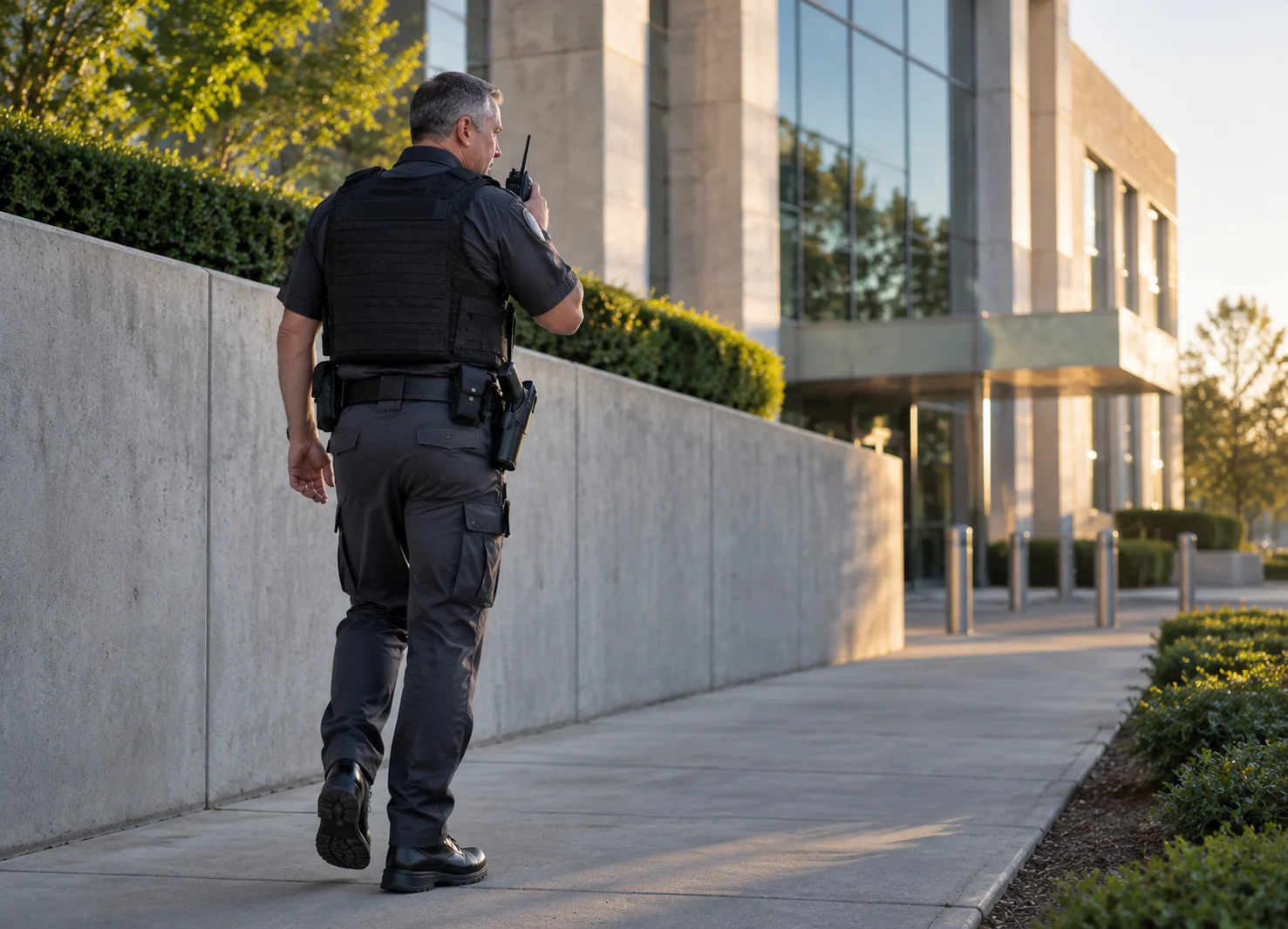
An armed security guard service posts a commissioned officer, licensed by the state to carry a firearm on duty, at a site under a written post order. What you are buying is not the firearm. It is a specification: who stands where, for how many hours, on what route, documented how, backed by whose insurance.
3 Ways To Put An Armed Person On Your Property
Buyers treat these as 3 prices for one job. They are 3 different legal objects, and the liability lands in a different place in each.
A licensed private armed officer, through a licensed company
A commissioned officer employed by a company holding a Texas DPS license, working under that company’s workers’ compensation and its general liability policy.
The exposure sits with the security company, where the right endorsements exist. Worth knowing: privately employed guards get no qualified immunity. The Supreme Court settled that in Richardson v. McKnight, 521 U.S. 399 (1997).
An off-duty Texas peace officer
Occupations Code 1702.322 exempts a full-time Texas peace officer from private security licensing, but only under 5 conditions. The officer has to average at least 32 hours a week as a peace officer, be paid at least minimum wage for that work, receive every benefit a peace officer receives, not be a reserve officer, and not be employed by another peace officer. The permitted roles are limited to security guard, patrolman, watchman and extra job coordinator. The exemption does not extend to investigations.
Where the exposure sits depends on how the detail is papered. Pay an officer on a 1099 outside a licensed company and you can become the employer. And because the officer still acts under color of law, a bad stop can produce a federal civil-rights claim that a private guard cannot generate. In Bracken v. Okura the Ninth Circuit held that an off-duty officer working hotel security acted under color of state law for section 1983 purposes, then denied him qualified immunity anyway, because he used his badge in service of a private goal.
Your own employee, or a volunteer, with a License to Carry
Not a security officer. No commission, no DPS oversight, no requalification record, no security-specific coverage.
The exposure is yours. All of it. This is the model a business picks believing it saves money, and it is how the whole liability tail arrives in-house.
A License to Carry is not a security officer commission. A civilian self-defense or concealed-carry membership excludes paid security work, so it is not coverage for a post. And a personally owned pistol is not automatically a duty weapon.
We work the first model only. Where an off-duty detail is the better answer for a property, we say so rather than bid against it.

What The Evidence Supports, And What It Does Not
No published study isolates armed against unarmed contract guards at a commercial site. We looked, across 6 search strategies and 2 systematic reviews that would have captured one. The research that does exist measures presence, patrol dosage and arrest powers.
That absence matters more than it sounds. Every claim you will read about armed officers reducing crime is built on research that studied patrol presence, not firearms. The patrol research is real, and it belongs on the unarmed side of the catalog, because unarmed officers are what those studies actually measured. None of it separates the armed officer from the unarmed one.
What the research does say is that the effect depends on the offense. Zimmerman examined US state-level data from 1999 to 2010 and found guard employment tracked with lower murder, larceny and auto theft. Rape, assault, robbery and burglary showed no statistically significant relationship. So a property worried about inventory shrink and a property worried about an assault in the parking lot are not buying the same thing, and the evidence supports one of those better than the other.
Why The Documentation Is The Deliverable
Under Texas law, a property owner’s own exposure for a third party’s criminal act turns on 2 questions, and the security record is how both get answered.
The Texas Supreme Court set the foreseeability test in Timberwalk Apartments, Partners, Inc. v. Cain, 972 S.W.2d 749 (Tex. 1998). The general rule is that nobody owes a duty to protect another from third-party crime. A duty arises where the owner knows or has reason to know of an unreasonable and foreseeable risk. Foreseeability is weighed on 5 factors, taken together: proximity, recency, frequency, similarity and publicity of prior crime.
19 years later the court supplied the other half. In UDR Texas Properties, L.P. v. Petrie, No. 15-0197 (Tex. 27 January 2017), it held Timberwalk goes to foreseeability alone, and that a plaintiff must separately prove the risk was unreasonable. The court’s words: if the burden of preventing the harm is unacceptably high, the risk of the harm is not unreasonable. That plaintiff lost for putting no evidence in the record about what the measures he said were owed would have cost.
Read together, the consequence is practical. The incident history at and around a property shapes the exposure, and what the owner did about it is the rest of the record. Time-stamped patrol logs, dated incident reports and a written post order are evidence. A guard with no log is not.
CALL US FOR SMART SECURITY SOLUTIONS
We Cover Houston, TX, Sugar Land, TX, Pearland, TX, Conroe, TX
The Armed Post Specification
Seven items define an armed post. Get them in writing before the first shift, from us or from anyone else you are considering.
- Post orders, written, site-specific, naming the access points and the standing instructions. Not a generic template with your address on it.
- Coverage hours, exact, including how holidays and no-shows are covered and who authorizes overtime.
- Patrol pattern and frequency, with the checkpoint list and how rounds are logged.
- Reporting route and timing: who receives an incident report, in what format, and how fast.
- Weapon category the named officer qualified on, and the date of that qualification.
- Escalation protocol: what the officer does before calling police, and who at your organization gets called at 3 a.m.
- Replacement plan: if the officer leaves, who covers the post, already commissioned, already qualified, already briefed on these orders.
Item 5 and item 7 are the two most buyers skip, and they are the two that are armed-specific.
Here is the mechanic. A Texas security officer commission runs on a 2-year cycle. Under Occupations Code 1702.309, the firearm proficiency certificate filed at renewal has to be under 90 days old at that moment. Nothing requires a fresh qualification in between. So a commission can be perfectly valid while the officer’s last live-fire date is 22 months back.
That makes “licensed” and “currently qualified” 2 different statuses, and only one of them tells you anything about the person standing on your property tonight. Ask for the qualification date and the weapon category, not the license number. Then ask the same question about whoever covers the post when that officer calls out.
One rule worth knowing on item 6: if an officer discharges a firearm on duty, 37 Texas Administrative Code 35.7 requires the officer to report it to the employer immediately and the employer to notify DPS in writing within 24 hours. Ask who files that notice.
Get Your
Free Armed & Unarmed Security Proposal
Why Houston businesses choose Reliable Guard & Patrol Service
Why Choose Our Armed Guards:
01. Fully Licensed to Carry in the State of Texas
02. Background-Checked and Drug Tested
03. Trained in Firearms Handling and De-Escalation
04. Experienced in High-Risk Property Protection
05. Serving Houston Businesses for Over 20 Years
06. Corporate, Construction, Retail, and Event Coverage
07. 24/7 Coverage Including Holidays
What We Cover, And What We Turn Down
Commercial property only: construction and active job sites, warehouses and distribution centers, vacant and unoccupied buildings, retail and shopping centers, offices and corporate facilities, cash handling and high-value operations.
We do not take residential or HOA security, event security, K9 units, alarm response runs, parking enforcement, or fire watch.
If the Armed Post Specification above describes a post you need in the Houston area, start at armed security guards in Houston. If none of the 3 conditions on that page apply to your site, unarmed coverage usually does the work for less.
Frequently Asked Questions
What is included in armed security guard services?
A commissioned officer licensed to carry on duty, working a written post order at a defined site, on set coverage hours and a logged patrol route, with incident reports routed to a named contact. The service is the specification, not the firearm. The 7 items above are what a complete one contains.
Who is liable if an armed guard uses force on my property?
It depends which of the 3 deployment models you used. With a licensed company, the exposure sits with that company where the right endorsements exist, and privately employed guards carry no qualified immunity. With an off-duty officer paid outside a licensed company, you may be the employer. With your own employee on a License to Carry, it is all yours.
How do I know the officer is currently qualified and not just licensed?
Ask for the qualification date and the weapon category. A Texas commission renews every 2 years and the proficiency certificate filed at renewal must be under 90 days old at that point. Between renewals, “licensed” says the commission is valid and says nothing about when the officer last qualified.
Can I use my own armed employee instead of hiring a company?
A License to Carry is not a security officer commission, and civilian self-defense policy forms exclude paid security work. That model gives you no DPS oversight, no requalification record, no security-specific coverage, and the entire liability tail.
Do I legally have to provide security at my commercial property?
No Texas statute requires it in general. Exposure arises through premises liability, where a duty attaches if the owner knew or had reason to know of an unreasonable and foreseeable risk, weighed on the 5 Timberwalk factors, and where the plaintiff must also prove the risk was unreasonable under UDR v. Petrie. Some insurance policies and leases do require a guard by contract. Ask counsel about your property.
Write The Specification Before You Compare Rates
Send us the site, the hours and any clause your carrier or lease already requires. We will return a post order, the coverage hours, the patrol pattern and the endorsement pages with the proposal.