
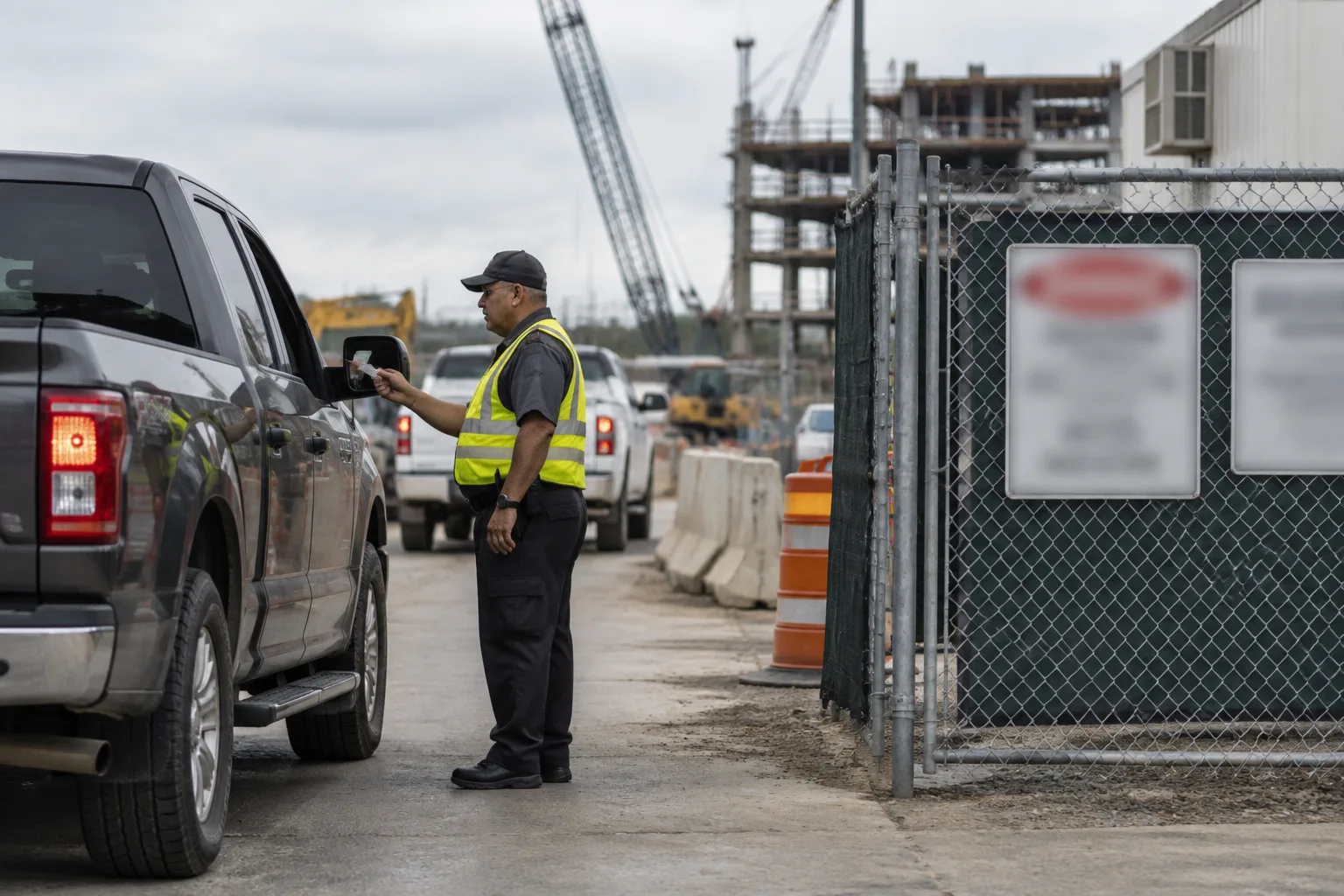
A temporary security post is a licensed officer assigned to your property for a set period with a defined end date. Reliable Guard & Patrol Service Inc. runs them weekly, month to month, or for the length of a project, with no minimum contract term. Texas DPS company license B07315701, active since 2018. About 150 officers, all of them already registered with the state before they take an assignment.
What temporary actually changes
Not the officer. Not the training. Not the license. What changes is everything around the officer: who wrote the post orders, who covers a call-out on night 9, and who owns the paperwork when the assignment ends.
Vendors quote a temporary post at the same hourly rate structure as a standing one and then run it differently. Six things are worth pinning down, because a 3-week post fails in different places than a 3-year one.
On a standing post, post orders get written once and adjusted over months. On a temporary one they are written before shift 1, or the officer improvises. A standing post runs on 1 or 2 regulars who know the site. A temporary post is where that continuity breaks, so the question worth asking is who the named backup is. Supervisor familiarity builds on its own across a year, and on a 3-week job it has to be front-loaded into the site assessment instead.
Substitutions are the clearest split. Rare on a standing post, and the sub gets briefed. Common on a short assignment, and often not briefed at all. Records go the same way: reviewed monthly and held on file when the relationship is ongoing, frequently never handed over when it ends. Ending it should be a date rather than a notice period you negotiate.
Continuity, records and the end date are the 3 that actually sink a temporary post. The rest of this page is about those.
How Fast An Officer Can Start, And The Texas Rule Behind The Answer
Same day, in most cases. The thing that decides it is not dispatch or scheduling. It is whether the officer walking onto your property already holds an active Texas registration.
The 48-hour rule
Texas DPS publishes a provision called Working Prior to Licensure. A licensed company may put a person to work in an unarmed capacity once 48 hours have passed since a substantially complete application was filed, before any license has been issued, provided the company runs its own background check and keeps the record. Armed work before licensure is not permitted at all. The provision sits under Texas Occupations Code Section 1702.230, with the conditions in Texas Administrative Code Sections 35.21 and 35.3.
That rule exists for a reason and it is not a loophole. But read it against a vendor promising an officer tonight on a 2-week job.
Two companies can both keep that promise and be selling different things. One assigns an officer whose card has been active for 3 years. The other assigns someone who filed paperwork on Tuesday and cleared 48 hours on Thursday. Short-notice work is exactly where the second version happens, because the bench is thin and the assignment is short enough that nobody expects you to check.
What we do
Every officer we assign to a temporary post holds a current Texas DPS registration for the level the post requires, verified before deployment. We do not staff a temporary assignment with a pending application. Ask for the roster with registration numbers before shift 1 and you will get it.
CALL US FOR SMART SECURITY SOLUTIONS
We Cover Houston, TX, Sugar Land, TX, Pearland, TX, Conroe, TX
The Texas Temp Post Check
Five things to get in writing before a temporary officer walks your property. Any licensed Texas company can answer all 5 on the first call. A company that cannot is the risk you were trying to cover in the first place.
1. The company license number, and the legal name it was issued to. Not “licensed and insured.” The number, and a name that matches the one on the invoice. Ours is B07315701, issued to Reliable Guard & Patrol Service Inc.
2. The officer roster, with registration numbers, before shift 1. Plus the substitution rule. Texas registers officers individually, separately from the company. On a short assignment the roster changes more often, so the question is not only who starts. It is who is authorized to replace them, and whether you get told. Our answer: you get the name and the number of any replacement before that person works your site.
3. Who employs the officer. The person on your property should be on the payroll of the licensed company you are paying, not subcontracted to a firm you never screened. Ask before the shift rather than after an incident.
4. Post orders in writing, with a handover clause. Where the officer walks, what they check, who they call, what gets logged, what they are not authorized to do, and who briefs the next officer. A temporary post with no written orders is how a stopped incident falls apart later.
5. The certificate of insurance, from the carrier or the broker. General liability, workers’ compensation, and commercial auto. We issue ours the same day. A PDF a salesperson generated is not a certificate.
You get what you inspect, not what you ask for.
Get Your
Free Armed & Unarmed Security Proposal
Why Houston businesses choose Reliable Guard & Patrol Service
Why Choose Our Armed Guards:
01. Fully Licensed to Carry in the State of Texas
02. Background-Checked and Drug Tested
03. Trained in Firearms Handling and De-Escalation
04. Experienced in High-Risk Property Protection
05. Serving Houston Businesses for Over 20 Years
06. Corporate, Construction, Retail, and Event Coverage
07. 24/7 Coverage Including Holidays
When Businesses Buy A Temporary Post
Six situations, and none of them are about the building. They are about a clock.
Replacing a provider. The most common one we take. Your current contract is ending or has gone bad, and the property cannot sit without coverage during the switch.
A shutdown or turnaround. A plant or facility running non-standard hours for a fixed window, with contractors and equipment on site who are not normally there.
A vacancy between tenants. A building empties and the exposure changes overnight. Copper, squatters, illegal dumping, and an unreported entry that becomes an insurance argument later.
A seasonal or event-driven surge. Retail through the holidays, or a stretch where foot traffic and shrink both climb.
Interim coverage after an incident. Something happened, the insurer or head office wants a body on site now, and the permanent decision has not been made yet.
A deadline set by someone else. A lender, an insurer, or a contract requirement with a date attached. The post exists to satisfy a document.
That last one is worth naming plainly. Sometimes the officer is there because a carrier circled a box, and what you actually need is a defensible record that the coverage existed. Say so on the first call and the post orders get written for it.

Taking Over From Your Current Provider
Yes, and it is routine. We can run alongside an outgoing provider through a handover, or take the post cold.
Cold is more common and it is the harder one, because nothing transfers. No post orders, no record of who belongs on site, no incident history, no idea which gate has the bad latch. So the site assessment does that work in one pass: access points, blind corners, who is authorized to be there after hours, and what the last provider was supposed to be doing.
One thing to sort out before shift 1, and it gets forgotten every time: keys, fobs, codes and access cards held by the outgoing provider. Get them back or have the codes changed. An access credential in the hands of a company that no longer works there is a live problem, and it is not ours to fix once we are the ones on site.
How The Assignment Ends
On the date you set, with the records in your hands.
Almost nobody asks about this before signing, and it is the part of a temporary engagement most likely to leave you with nothing. The post ran for 5 weeks, something happened in week 2, and the file lives on a vendor’s server you no longer have a relationship with.
Three things happen when a Reliable Guard temporary post closes:
- The record package. GPS tour logs, every incident report, and the daily exception reports for the full term, handed over as a set. That record is what holds up with an insurer or in a dispute months later, which is the whole reason it gets written.
- Access returned. Keys, fobs, codes and cards logged back to a named person on your side, with a receipt.
- A close-out note. What the officers found repeatedly and did not have authority to fix. Lighting that never got repaired, a gate that never latched, a door propped every Thursday. It is a short document and it is usually the most useful thing a temporary post produces.
Ending it is a date, not a negotiation. Weekly, month to month, short term or long term, the term follows the job. The belief that temporary coverage requires a 12-month agreement is the single most common thing buyers arrive with, and it is not a condition we set.

Who Shows Up On Night 9
The named officer, with a named backup, under one account supervisor who knows your site.
This is the question to press hardest on a short assignment, because the industry gives you a reason to. Turnover across US security ran 89% in 2024, against 66% across the private sector, per the UC Berkeley Labor Center’s July 2026 report on the security guard workforce. Roughly 60% of officers work for a contract firm rather than for the site they stand on.
A 3-year post absorbs that. A 3-week post does not. If the officer changes twice inside a fortnight and nobody briefs the replacement, you are paying for presence and getting a stranger reading a gate for the first time at 11 p.m.
What we hold to: a named primary and a named backup on every temporary assignment, one account supervisor over the site for the whole term, and the roster updated to you before a substitution works the post. Every round is scanned at fixed GPS checkpoints, so a missed round shows on the supervisor’s screen that night rather than surfacing in an invoice review 3 weeks later. We do not run unscheduled drive-by patrols and call it coverage.
Frequently Asked Questions
What is the shortest term you will take?
We quote on a weekly basis and will go shorter for a defined coverage gap. Give us the hours and the end date on the first call.
Do I have to sign a long-term contract for temporary coverage?
No. Weekly, month to month, short term and long term are all available, and there is no minimum term.
How fast can an officer actually start?
Same day in most cases. Every officer we assign already holds an active Texas DPS registration for the level the post needs, so the start time comes down to shift scheduling rather than paperwork.
Will the same officer work the whole assignment?
A named primary with a named backup, under one account supervisor. If a substitution is needed you get the replacement’s name and registration number before they work the site.
Can you cover the gap while we change providers?
Yes. We can run alongside an outgoing provider or take the post cold. Recover their keys, fobs and access codes before our first shift, or change the codes.
What do I get when the assignment ends?
The full record package: GPS tour logs, incident reports and daily exception reports for the whole term, plus access credentials returned to a named person and a close-out note on anything the officers kept finding.
Start A Temporary Post On The Date You Choose
Give us the site, the hours, and the date it ends.