Reliable Guard & Patrol Service posts licensed unarmed and armed officers at Houston distribution centers, cross-docks, truck yards and 3PL warehouses. Our officers check carrier and driver identity against the federal FMCSA record before a trailer leaves your dock, and they log every release and every refusal.
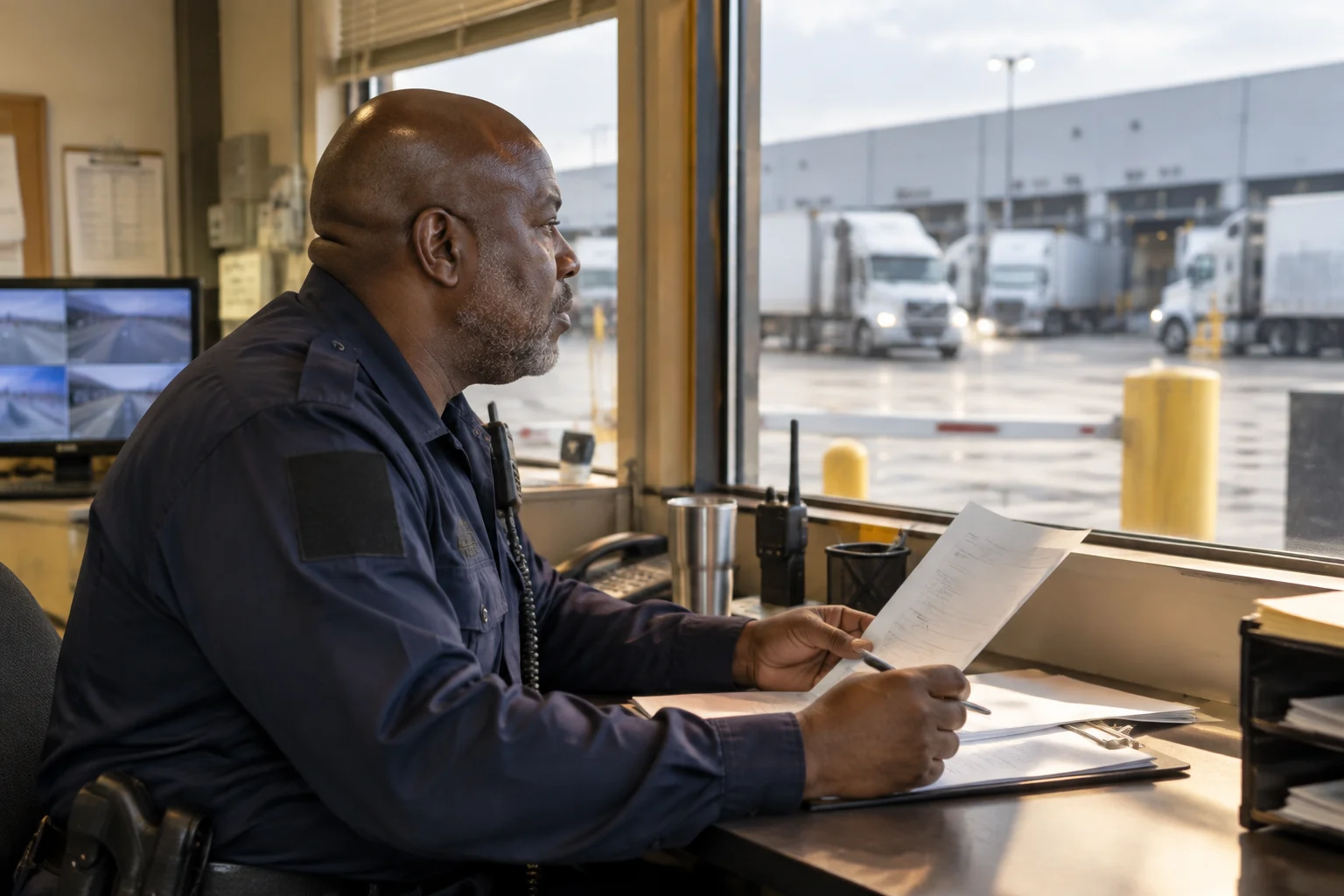
A Patrol Lap And A Verification Post Are Two Different Jobs
Perimeter patrol stops the person cutting your fence at 02:40. A verification post stops the driver with a clean bill of lading at 10:15. Most security vendors quote one officer and let you assume they cover both.
They do not cover both, because the two posts fail differently.
A patrol post fails when nobody is walking. You catch that with GPS tour data and timestamps. A verification post fails when the officer is a receptionist with a radio, checking that a license exists rather than checking that the carrier holding it is the carrier your dispatcher booked. You catch that in the log, or you do not catch it until the real carrier calls.
We staff these as separate decisions on the same site. Fence line at 2 a.m. is one scope. Appointment fraud at 10 a.m. is another. If you only need one, we will tell you which one, and we will not bill you for the other.
The Five-Field Pickup Log
Five fields, recorded before the trailer moves, are the difference between a gate log a cargo underwriter will accept and a clipboard nobody reads.
This is the standard our officers work to on logistics posts in Houston. Every field is a written entry, not a habit.
Field 1. The carrier, verified at the source. The officer looks up the carrier on the FMCSA SAFER Company Snapshot and calls the phone number on the federal record. Not the number on the rate confirmation. Not the number the driver offers. SAFER returns legal name, DBA name, USDOT number, MC number, operating authority status, out-of-service date, physical address and the phone on file. A cloned authority does not survive a callback to the number the government has, because the real carrier answers and says they did not book it.
FMCSA published a bulletin on 19 March 2026 warning that USDOT and MC numbers are being sold, purchased and leased, and stating the agency will move to inactivate numbers used by anyone other than the assigned legal entity. That is the fraud your gate is standing in front of.
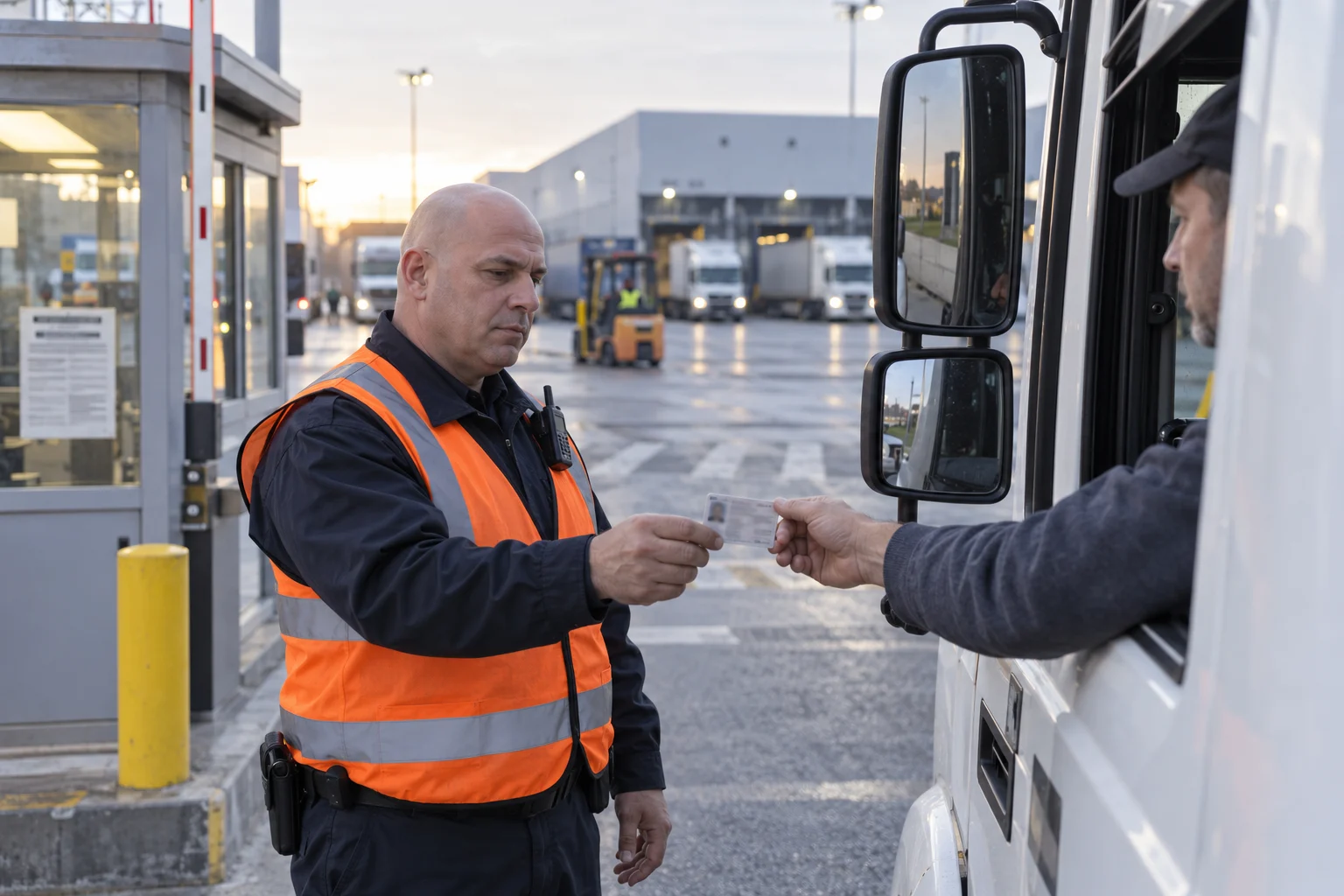
Field 2. The driver, matched to dispatch. Name on the commercial driver license, compared against the driver name your dispatcher or broker actually sent. A high-quality forged CDL passes a glance. It does not pass a name mismatch.
Field 3. The equipment, matched. Tractor number, trailer number, license plate, and the MC or USDOT number painted on the door. All four recorded. All four compared to the booking.
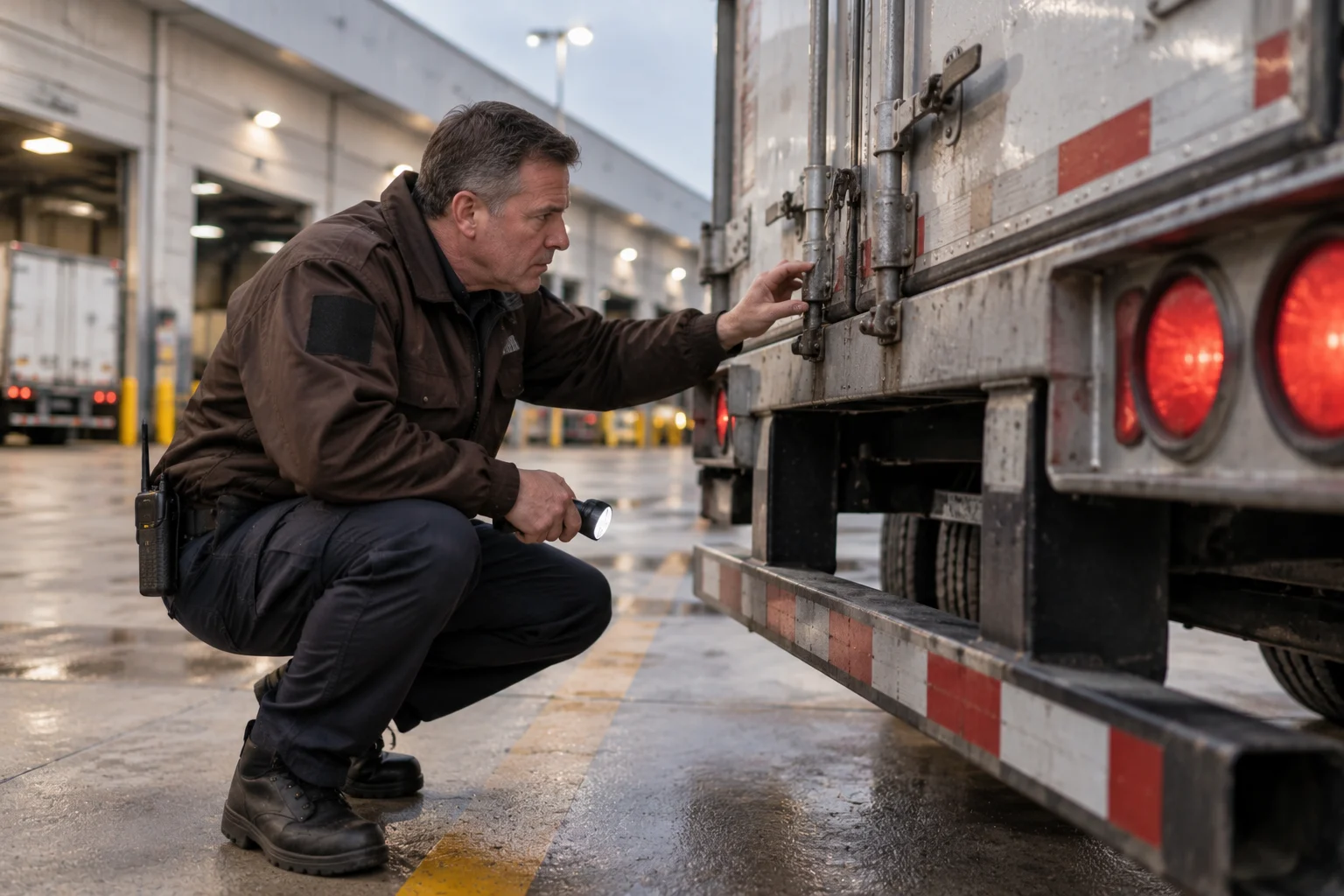
Field 4. The seal, recorded and photographed. Seal number written down at attach and again at departure, with a photograph of the seal in place. A seal number in a log with no photograph is an assertion.
Field 5. The release or the refusal, named and timestamped. Who authorized the load to leave, at what time, or who refused it and why. Our officers carry written authority to refuse a release when any of fields 1 through 4 fails, including when the dock is stacked and the yard is backing up onto the street.
That last field is the one buyers skip and the one that matters. An officer without written refusal authority will wave the truck through, because the person shouting at him works for you and the paperwork looks fine.
We hand you the log. Daily by email if you want it, and on request for any date inside the retention window.
CALL US FOR SMART SECURITY SOLUTIONS
We Cover Houston, TX, Sugar Land, TX, Pearland, TX, Conroe, TX
What A 24/7 Gate Post Actually Takes
One around-the-clock post is not one officer. It is closer to 5, and the bid that hides this is the bid that leaves your booth empty on a Sunday.
Here is the arithmetic. A 24/7/365 post is 8,760 post-hours a year. One full-time equivalent officer is 2,080 hours. That gives 4.21 officers as a floor, and 4.21 assumes nobody ever takes a day off, gets sick, goes to training or quits.
Real relief factors run higher. Nevada’s Department of Corrections publishes its shift relief factor calculation: 1.60 FTE per 7-day post requiring relief, which across 3 shifts covering 24 hours works out to 4.80 officers per around-the-clock post, and its recalculated institutional average came in at 5.10. Florida codifies the same method in Administrative Code R. 33-602.602, dividing workdays required annually by workdays available per officer after days off, holidays, leave and training. Both are corrections sources rather than private security, and the method transfers cleanly because the constraint is the calendar, not the industry.
So when a vendor quotes you 2 posts, ask how many people are on the roster. Two chairs is not 2 people. It is nearer 10.
Get Your
Free Armed & Unarmed Security Proposal
Why Houston businesses choose Reliable Guard & Patrol Service
Why Choose Our Armed Guards:
01. Fully Licensed to Carry in the State of Texas
02. Background-Checked and Drug Tested
03. Trained in Firearms Handling and De-Escalation
04. Experienced in High-Risk Property Protection
05. Serving Houston Businesses for Over 20 Years
06. Corporate, Construction, Retail, and Event Coverage
07. 24/7 Coverage Including Holidays
What Our Own Incident Log Does Not Contain
Our officers have documented stops at Houston commercial sites going back years, and the published set runs from 11:20 p.m. to 3:30 a.m. Copper pulled from a storage container. Two people prying at a boarded window. A pickup circling a gated entrance at 2:15 a.m. You can read those on our Houston security guards homepage.
Here is what struck me when I went back through them for this page.
Not one of them is a pickup.
Every documented stop is a perimeter event, after hours, in the dark, against someone with no paperwork and no appointment. That is what a patrol post is built to catch, and the log says it catches it. But the loss profile that grew through 2026 is the opposite shape: daylight, an appointment, a driver who belongs there on paper. A perimeter route never touches it.
That absence is the argument. Our officers were doing the job they were posted to do, and the post orders they inherited described patrol duties with nothing in them about identity. We write logistics post orders from the pickup side first now, and the perimeter second.
Where We Are Not The Right Call
We turn down work every month, so here is the list before you spend a call on it.
We do not do fire watch. No K-9 units. No alarm response. No parking enforcement. No events, no residential and no HOA work. Commercial posts are the whole business.
If your officers must hold a TWIC because your site sits inside a Port Houston restricted area, say so at the first call so we can confirm officer eligibility before quoting rather than after.
And if your entire exposure is fence-line entry between midnight and 5 a.m., with no daytime pickup risk, a monitored camera package may cost less than a staffed booth. We will say so. A camera cannot refuse a truck, which is the argument for a body at the gate, but it is a poor argument when there is no truck to refuse.
How A Houston Logistics Post Gets Set Up
Four steps, and you can be covered the same day on an unarmed post.
- First call. 10 minutes. Site type, gate count, dock count, hours freight actually moves, and whether your exposure is pickup, perimeter or both.
- Free proposal. Scope, officer type, hours, post orders and rate in writing.
- Site assessment. On sites where the gate and dock layout warrants a walk, we walk it before the first shift.
- Deployment. Certificate of insurance issued the same day. Post orders written against your policy conditions and, for CTPAT members, in the written form criterion 10.10 requires.
Contract terms run weekly, month to month, short term or long term, whichever fits. There is no long-term commitment, and that is the single thing Houston buyers most often assume wrong about this industry.
Every account gets a named account supervisor. Patrol rounds are logged through a GPS guard tour system with real-time incident reports and supervisor check-ins, so the tour record is verifiable rather than asserted. Officers are available in English and Spanish, which on a Houston dock is an operational requirement rather than a nice-to-have.
Check Our License Before You Sign Anything
Texas publishes every guard company license, so verify ours rather than taking our word for it.
Open the Texas Online Private Security public search at tops.portal.texas.gov/psp-self-service/search/index and enter license number B07315701, or search “Reliable Guard and Patrol Service.” Confirm the status is active and free of open issues. A lapsed license is your liability and your insurance problem, not just ours.
Two field checks while you are at it. Under 37 TAC 35.14, a Texas officer’s outermost garment must display the employing company name, the word “Security,” and the officer’s last name, all clearly visible. Under 37 TAC 35.8(d), any vehicle showing the company name must also carry the company license number in contrasting characters at least 1 inch high on each side. If an officer or a patrol vehicle on your site fails either check, the company is out of compliance.
Which Officer Your Logistics Site Needs
Most Houston distribution posts are unarmed. Armed makes sense for high-value commodity storage, cash handling, or a site with a known threat history.
Unarmed, Level II non-commissioned. Gate and dock verification, access control, patrols, observe and report, written incident reports. This is the standard logistics post.
Armed, Level III commissioned. Everything unarmed covers, plus a firearm on a high-risk post. Texas Occupations Code 1702.1675(c) sets the Level III basic course at a minimum of 30 hours, with a further 10 to 15 in-person hours of handgun proficiency and self-defense instruction under 1702.1675(g). Under 37 TAC 35.161, commissioned officers requalify with a firearm proficiency certificate completed within 90 days of renewal, and complete 6 hours of continuing education inside the 2 years before the license expires. Licenses run on a 2-year cycle (Texas Occupations Code 1702.301).
Our armed officers complete firearm proficiency and the requalification training every 2 years. Unarmed officers complete the DPS-approved Level II course, 6 hours across 9 modules. Every officer, armed or unarmed, clears a background check, pre-assignment drug testing, license verification, a standards interview and confirmed references.
Armed and unarmed authority is covered in depth on our Houston security guards homepage, including what a Texas officer may and may not do under Code of Criminal Procedure Articles 14.01 and 18.16.
Frequently Asked Questions
Do your officers verify carrier identity, or just check paperwork?
Both, in that order. The officer looks the carrier up on the FMCSA SAFER Company Snapshot and calls the phone number on the federal record, then matches driver name, tractor, trailer, plate and the MC number on the door against what your dispatcher booked. Paperwork alone is what fictitious pickup defeats.
Will a guard post satisfy my cargo insurer's pickup conditions?
It can, if the log matches what your policy asks for. Bring your broker the pickup-verification conditions on your cargo or warehouse legal liability form and we will write the post orders against them. Ask any vendor for a sample gate log showing driver, plate, trailer, seal photograph, callback record and timestamp. If they cannot produce one, the control does not exist.
Can your officer refuse to release a load?
Yes, when it is written into the post orders, which is how we write them. Refusal authority is field 5 of the pickup log. Without it in writing, an officer under pressure from your own dock staff will release the trailer.
Can I get the gate log daily?
Yes. Daily by email, or on request for any date inside the retention window. Patrol rounds come through a GPS guard tour system with timestamped tour data.
How many officers does a 24/7 gate post take?
About 4.8 on the roster for one around-the-clock chair, once days off, leave, training and call-outs are counted. The arithmetic floor is 4.21, from 8,760 post-hours divided by 2,080 hours per full-time officer.
Get A Gate And Dock Post Quoted For Your Houston Site
Tell us the site type, the gate count and the hours your freight actually moves. You get a written proposal with scope, officer type and rate, and a certificate of insurance the same day you approve it.