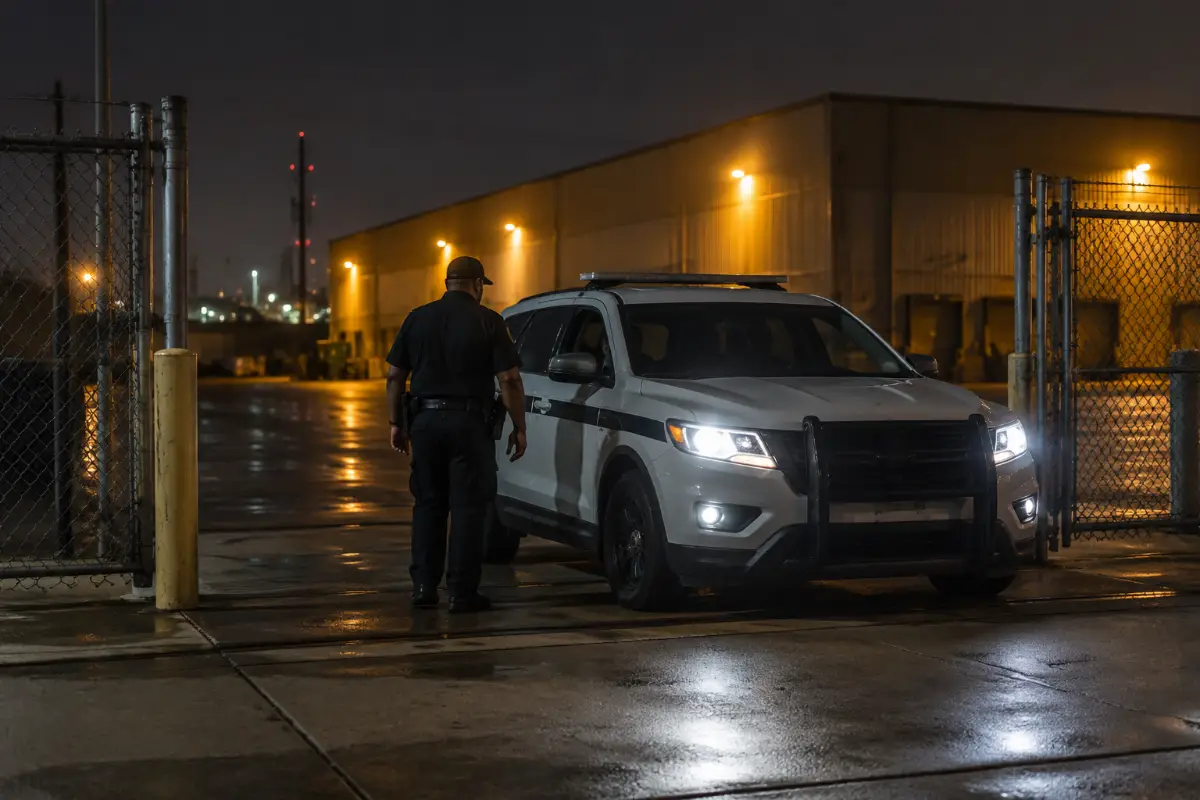
A security supervisor schedules the post, assigns the officers, shows up unannounced to check the work, writes the escalation up, and is the person you call at 2 a.m. That is the short version of security supervisor duties and responsibilities. Here is the part no job description mentions: Texas does not license that job. There is no supervisor exam, no supervisor training course, no supervisor registration. So the title on the proposal tells you nothing, and the only way to know what you bought is to ask what the supervisor produces.
What is a security supervisor?
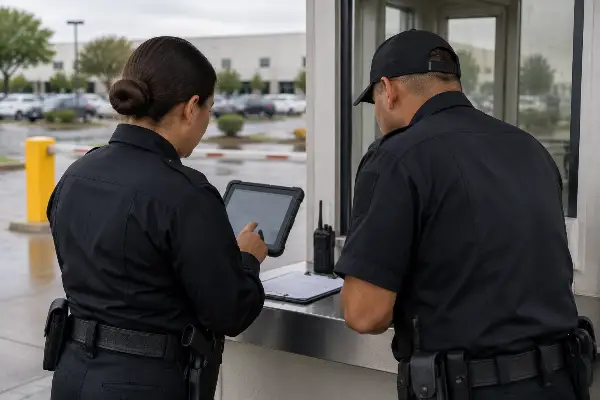
A security supervisor is the person a guard company puts between its officers and its clients. They build the schedule, cover call-offs, visit posts during a shift, review incident reports, and answer to the client when something goes wrong. In contract security the title covers 3 different jobs, and which one you get changes what you can expect.
None of that is the officer’s work. The duties on the post and the functions an officer performs belong to the person standing the shift. A supervisor who is standing a post is not supervising.
The 3 supervisors hiding behind one word
Ask a guard company who supervises your site and you’ll get one word back. Push, and it splits into 3 people with different jobs, different pay, and different reasons to be on your property.
| Role | Where they physically are | Who they answer to | What you get from them |
|---|---|---|---|
| Site or shift supervisor | On your post, working a shift | The field supervisor | A senior officer on the ground who assigns positions, handles the first escalation, and writes the shift report |
| Field supervisor | Roving between accounts, mostly overnight | Operations | Unannounced post visits, uniform and equipment checks, and the catch when an officer is not where the schedule says |
| Account supervisor | In the office, on the phone, on site when needed | The client, then operations | Your named contact, the person who fixes staffing and reads the reports before you do |
A site with 1 officer per shift often has no site supervisor at all. That’s normal, and it isn’t a problem by itself. It becomes a problem when nobody tells you, and you assume the word “supervised” means somebody senior is standing there.
Every account our Houston officers work gets a dedicated account supervisor, not a rotating call center queue. That person knows your gates, your after-hours delivery window, and the name of your night officer.
Does Texas license security supervisors?
No. Texas licenses security companies, issues individual officer licenses, and issues security officer commissions to armed officers. It does not issue anything to a supervisor.
Read the rules and the absence is loud. Title 37, Part 1, Chapter 35 of the Texas Administrative Code is the whole private security rulebook. It has subchapters on licensing, manager standards, commissioned security officers, personal protection officers, training, and continuing education. The definitions in 35.1 list the credential types the state issues: original, renewal, duplicate, and updated individual licenses, security officer commissions, and company licenses. “Supervisor” is not defined in that section, and no subchapter creates the credential.
So when a company tells you its supervisors are licensed, the accurate reading is that they hold the same Level II or Level III credential as the officers they supervise, under the same Texas Occupations Code Chapter 1702 framework. Nothing about supervising was tested.
The only supervisor Texas actually regulates
There is exactly 1 supervisory role in Texas private security law, and most buyers have never heard of it. It’s the company representative.
Under 37 TAC 35.41, the company representative is the individual DPS sends all correspondence to, and the person the department relies on to keep the company compliant with the rules and the Act. For anything other than a sole proprietor, that person has to be either an officer who oversees security operations or a partner or shareholder holding at least 25% of the company. They have to meet the experience requirement for the license and pass a written exam under 35.42, where the minimum passing score is 70%. The experience bar comes from Occupations Code 1702.115: 2 consecutive years in each security services field the company applies for, as an employee or an owner, reviewed by the department and judged adequate.
One person. A 70% exam. That is the entire supervisory qualification the State of Texas checks before a company puts officers on your property.
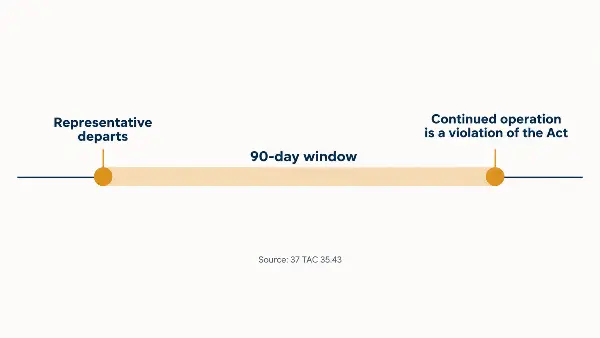
Now the part that should change how you write your contract. Under 37 TAC 35.43, if the company representative leaves, an owner, officer, partner, or shareholder may keep running the business for up to 90 days. Past 90 days without a qualified company representative, continued operation is a violation of the Act.
Read that again as a customer. The one individual the state holds accountable for your guard company can walk out on a Friday, and your site keeps getting billed for 3 months while somebody else holds the seat. Nothing about that is illegal. Nobody has to tell you. Ask your provider who their company representative is and how long they’ve held the role, then check the license number against the state’s public record. Ours is B07315701, active since 2018, and the people behind it have 20 years on Houston posts.
How many guards does one supervisor cover?
There is no legal ratio in Texas, and no industry standard anybody enforces, so the number is set by economics. Here is the arithmetic that decides it.
The US Bureau of Labor Statistics puts the median wage for security guards at $38,020 a year as of May 2025. For first-line supervisors of security workers, the Labor Department’s O*NET occupational profile reports a median of $55,940 from the same May 2025 federal wage survey, across about 71,900 supervisors nationally. That’s roughly 47% more per person.
Every supervisor hour is priced against guard hours. Stretch 1 supervisor across 30 posts and the margin looks good on paper. The posts just stop getting visited. That is the whole mechanism, and it is why “we have supervisors” is a claim worth pricing rather than trusting.
Churn makes it worse. BLS counts about 1,304,000 security guards employed in 2025 and projects roughly 157,200 openings a year through 2035, mostly to replace people leaving the occupation rather than to fill new posts. Growth over that decade is projected at 1%. A workforce replacing itself at that pace needs supervision that catches problems, not supervision that coaches quarterly.
So ask for the number. How many posts does the field supervisor cover on a Tuesday overnight? A company that knows its own answer will say it. A company that doesn’t is telling you something anyway.
What a real post visit leaves behind
A supervisor visit either produces a record or it did not happen. Five things separate a documented visit from a phone call.
| What the visit produces | What it proves | What its absence hides |
|---|---|---|
| Arrival and departure time on the site log | A person was physically there, in a window you can check | Visits logged from a truck 4 miles away |
| The officer’s name and post at the time of the visit | Who was actually working, not who was scheduled | An unbooked fill-in, or a post left empty |
| Uniform, equipment, and post-order check | Somebody looked at the job, not just the person | Dead radios, missing keys, orders nobody has read |
| A note on 1 site condition | The supervisor walked something, not just the gate | Gates, docks, and back lots nobody inspected |
| Corrective action, or an explicit “none” | The visit had consequences either way | Visits that exist only as a checkbox |
The visit measures the officer against a written security officer job description and the post orders for that specific site, not against a general impression. Our supervisors check in on posts through the shift and the officers run documented rounds on GPS guard tour systems, so the visit and the patrol land in the same record. You should be able to read last week’s without asking twice. Texas already requires licensed companies to keep documentation reflecting the actual provision of the service for 2 years, so this is a records request, not a favor.
What happens when a guard does not show up
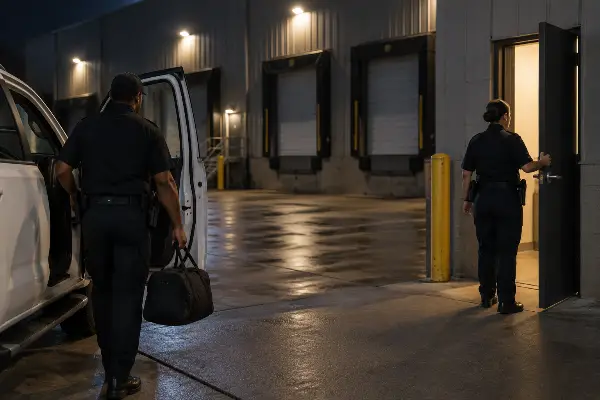
This is the real test of supervision, and it happens on every account eventually. Somebody calls off at 10:40 p.m. and your post is empty at 11.
Three things have to work. Somebody has to know the post is uncovered, which means the check-in cadence has to be short enough to catch it. Somebody has to have a licensed officer who can be there, which means the company needs bench depth in your part of Houston, not statewide. And somebody has to tell you, which is the step most companies skip.
We run about 150 licensed officers across more than 100 commercial sites in Greater Houston, and we respond same day rather than sending a random one-off patrol as a substitute. Officers work in English and Spanish. Coverage runs 24/7 including holidays. On warehouse and distribution posts, where the exposure is after-hours dock activity, an empty hour is the whole risk. The escalation path is written into the standing orders every officer works to, so the officer on post knows to call dispatch and the supervisor before anything else.
The supervision line on your invoice
You almost never see one. In contract security, supervision is built into the hourly bill rate rather than billed separately, which is exactly why it is easy to cut without telling anyone.
That cuts both ways. A provider quoting a rate well below the market for your post type is funding the gap somewhere, and supervision is the quietest place to take it from. Compare bill rates by all means. Just ask what supervision the rate includes before you treat 2 quotes as the same thing. Every rate we quote across our Houston guard services has the account supervisor and the shift check-ins in it, and our patrol coverage works the same way. It’s also why we don’t require a long-term contract. Weekly, month to month, short term, and long term all work.
What to ask before you sign in 2026
Four questions, and every one has a same-day answer if the company is real.
- Who is my named account supervisor, and what else do they cover?
- How many posts does the overnight field supervisor visit, and how often does mine come up?
- Can I see a supervisor check-in record from a live account with the client name removed?
- Who is your DPS company representative, and how long have they held the role?
You can verify the last one yourself. DPS runs a public licensee search through the Texas Online Private Security portal, and you can look up any Texas company or officer license by name or number in about 2 minutes. Check the number on the proposal before you check anything else.
Security supervisor duties and responsibilities are not what a job description says they are. They’re whatever the company can show you a record of. Tell us about your site and we’ll show you ours, along with the certificate of insurance the same day you ask.
FAQs
What are the main duties and responsibilities of a security supervisor?
A security supervisor builds and covers the schedule, assigns officers to posts, visits posts during shifts to verify coverage, reviews incident reports, handles escalations from officers, and communicates with the client. In contract security the role also carries the call-off problem: finding a licensed replacement when an officer does not show. None of these duties is separately licensed or tested in Texas.
What is the difference between a site supervisor, a field supervisor, and an account supervisor?
A site or shift supervisor works your post and handles the first escalation on the ground. A field supervisor roves between accounts, usually overnight, and makes unannounced post visits. An account supervisor is your named contact in the office who fixes staffing and reads the reports. A single-officer post frequently has no site supervisor at all, so ask which of the 3 your contract actually includes.
Does Texas require a license to be a security supervisor?
No. Title 37, Chapter 35 of the Texas Administrative Code creates company licenses, individual officer licenses, and security officer commissions. It defines no supervisor credential and sets no supervisor training requirement. A supervisor at a Texas guard company holds the same Level II or Level III credential as the officers they oversee.
Who is legally responsible for how a Texas guard company supervises its officers?
The company representative under 37 TAC 35.41. That individual is who DPS corresponds with and relies on for the company’s compliance, and for a corporate applicant they must be an officer over security operations or hold at least 25% of the company. They pass a written exam with a minimum score of 70% and meet the 2 consecutive years of experience required by Occupations Code 1702.115.
How many guards does one security supervisor oversee?
Texas sets no ratio and no industry body enforces one, so the number is an economic choice by the provider. Federal wage data shows a first-line security supervisor costs a company roughly 47% more per person than a guard, which makes stretching one supervisor across more posts the cheapest margin available. Ask for the overnight number in writing before you sign.
Do I pay extra for a security supervisor?
Usually not as a separate line. Supervision is built into the hourly bill rate in most contract security agreements, which is what makes it easy to reduce without notice. When you compare 2 quotes, ask what supervision each rate includes: the named account contact, the post visit frequency, and whether check-in records are available to you.


