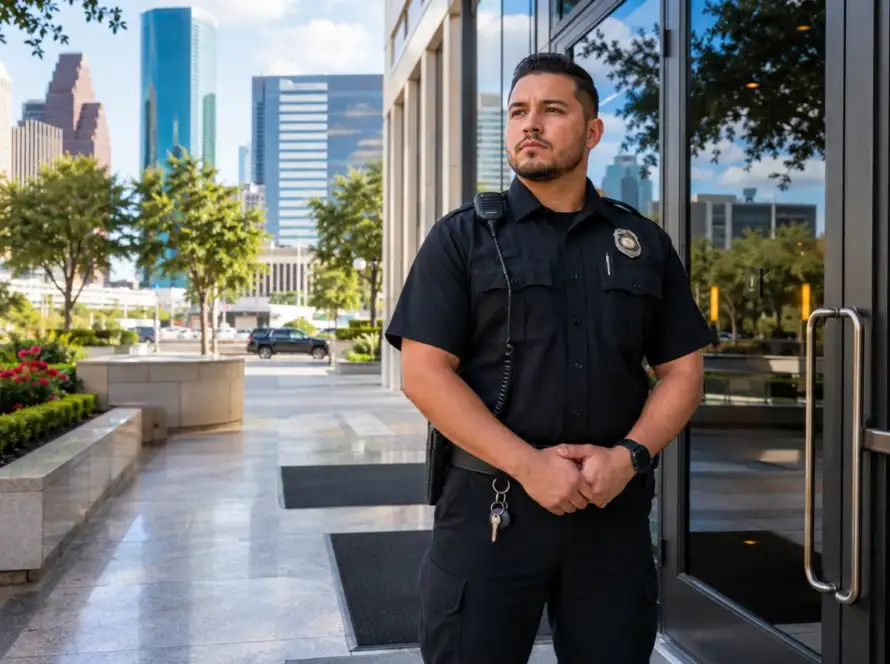
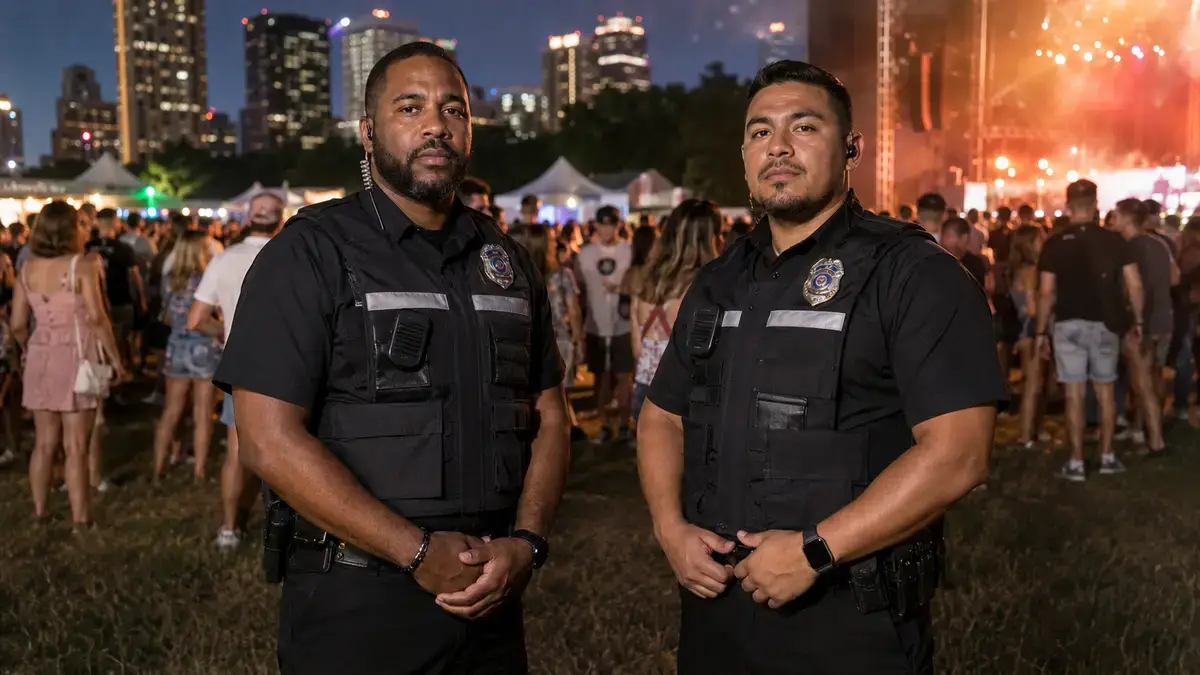
The five biggest event security risks in 2026 are severe weather, alcohol-fueled crowd behavior, medical emergencies, petty theft and vandalism, and major incidents like active assailants or unplanned demonstrations. Skip planning for any one of them and you’re looking at a lawsuit, an insurance spike, or a canceled event. I’ve watched outdoor festivals in Texas get shut down at 2 p.m. because nobody planned for 104-degree heat with a 60-person guard team that wasn’t trained on heat illness. That’s not bad luck. That’s bad planning.
This piece walks through each risk, what it actually takes to handle properly, and where most organizers cut corners that come back to bite them. We’re not covering cyber attacks on ticketing platforms here (that’s its own animal), and we’re skipping the compliance side of permits and insurance. Those deserve their own deep treatment. This is about what your event guard team has to handle on the ground.
1. Weather Is the Risk Organizers Ignore Until It’s Too Late
Weather is the single most predictable risk at any outdoor event. It’s also the one most planners treat as background noise until somebody collapses.
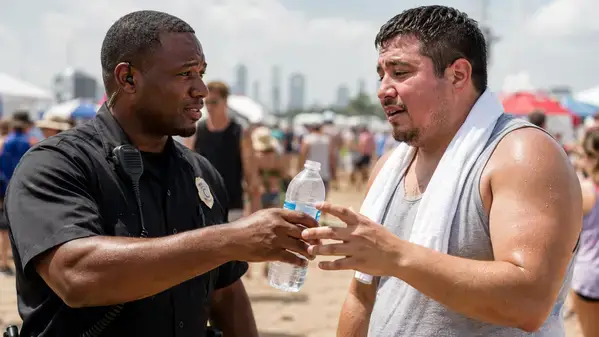
In Houston, heat is the killer. Literally. We’ve run security for events where the heat index hit 108 by 1 p.m. and guards started pulling attendees from the crowd every 15 minutes. If your team isn’t trained to spot early heat exhaustion (confusion, stopped sweating, slurred speech) you’re going to lose someone before EMS arrives. The CDC’s extreme heat guidance is the baseline every event lead should know cold.
What proper weather planning looks like
- A trigger protocol. At what temperature do you add water stations? At what point do you start cooling tents? At what point do you cancel?
- Guard-to-attendee ratios that flex with conditions. A 1-to-100 ratio in mild weather should drop to 1-to-75 in extreme heat. Hot-weather events need more eyes, not fewer.
- Lightning protocol with a hard rule. Most planners say “we’ll watch the radar.” That’s not a plan. The rule is 30/30: if thunder follows lightning by under 30 seconds, evacuate. Resume only 30 minutes after the last strike.
- Cold-weather kits if you’re running a winter event. Hypothermia shows up in attendees before they realize they’re in trouble.
Contrarian take: Most security companies will tell you weather isn’t their job. They’ll say it’s an event operations issue. That’s nonsense. If your guards can’t identify heat illness, can’t help with an evacuation, and can’t coordinate with EMS, you don’t have event security. You have warm bodies in polo shirts.
2. How Does Alcohol Change the Risk Profile of an Event?
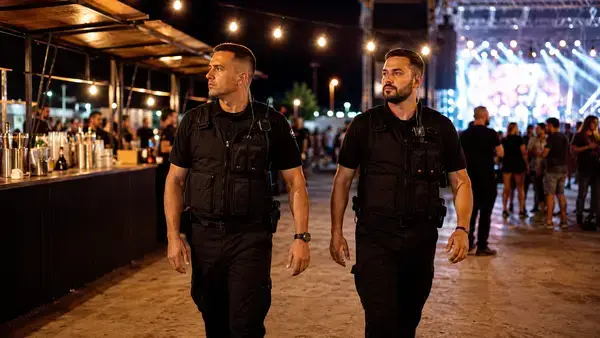
Alcohol turns predictable crowds into unpredictable ones. The math is simple: more drinks, more fights, more medical calls, more theft, more property damage.
Industry guidance puts a baseline guard ratio at 1 per 100 attendees. At alcohol-served events, that ratio needs to drop hard. I’d argue for 1 per 50 at any event with open bars, and 1 per 35 if you’ve got attendees under 30 in a general-admission format. Not because younger crowds are worse people. Because the combination of standing-room density, sustained drinking, and loud music produces friction. ASIS International’s 2025 live event risk research backs this up: alcohol service is one of the four core variables in their risk tier model.
The training gap nobody talks about
Here’s what gets missed. Most event guards have never been trained on alcohol monitoring. They know how to ID a fake license. They don’t know how to spot a pre-fight escalation. They don’t know how to read body language across a crowd of 800 people.
Real alcohol-trained guards do three things differently. They patrol the bar perimeter on a clock, not when called. They communicate constantly with bartenders about cut-offs. And they extract problem attendees before the fight starts, not after. That’s a skill set, not a uniform. The less-obvious tasks event guards handle often matter more than the visible ones.
Quick reference: guard ratio adjustments for alcohol service
| Event Type | Baseline Ratio | With Alcohol Service |
| Seated corporate / gala | 1 per 150 | 1 per 100 |
| Standing concert / festival | 1 per 100 | 1 per 50 |
| General-admission outdoor | 1 per 75 | 1 per 35 |
| VIP / high-profile | 1 per 25 | 1 per 15 |
3. Medical Emergencies: What Your Guards Actually Need to Handle
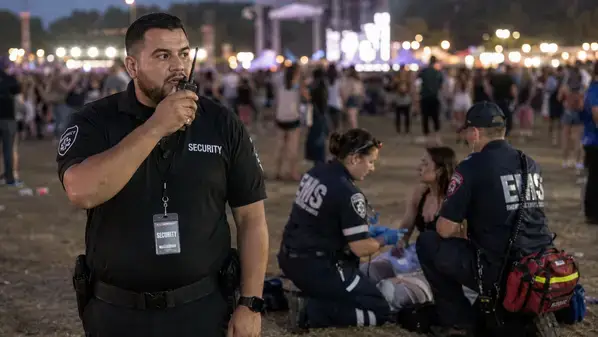
At any event over 500 people, expect medical calls. Sprained ankles, panic attacks, diabetic episodes, drug reactions.
Your guards are the first responders before EMS arrives. If they can’t bridge those four to seven minutes, you’ve got a problem.
What changes by event type
Electronic music festivals and rave-format events skew toward stimulant and dehydration calls. Sporting events skew toward heat and impact injuries. Corporate galas skew toward cardiac and choking. Religious events skew toward fainting and falls. The demographic of your attendees tells you what calls you’ll get.
This is where I’ll push back on a standard practice. A lot of organizers hire “event medical” as a separate vendor and let the guards stay in their lane. That fails the moment a guard finds someone unconscious in a porta-john at 11 p.m. and the medic is parked 400 yards away.
Better model: every guard carries a radio with direct EMS channel access, every guard has Stop the Bleed and Narcan training, and at least one guard per 200 attendees has current CPR/AED certification. OSHA’s first-aid standards cover the baseline; event organizers should aim higher.
The Narcan question
Should event security carry Narcan? Yes. Even if you don’t think your event “has a drug problem.” Fentanyl contamination has shown up in alcohol, gummies, and pressed pills at events that didn’t expect it. Stock it. It has saved lives at corporate weddings.
4. Why Petty Theft and Vandalism Cost More Than You Think
Petty disturbances sound minor. They’re not.
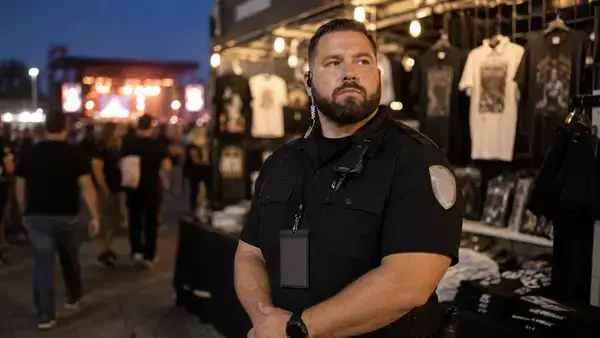
A stolen merch table at a music festival adds up fast once you count product, fixtures, and lost sales. Tagged restrooms take repainting and cleanup hours after the event closes. A laptop snatched from a corporate green room is the value of the device plus the data breach exposure if it had attendee info on it. I’ve worked events where the biggest loss of the night was the catering staff’s tip jar, but the insurance write-up took eight hours of guard time to document.
How professional teams handle low-level crime
- Pre-event walk: identify blind spots, dead corners, and “opportunity zones” near unattended assets.
- Roving patrol shifts. Static guards get predictable. Predictable means easy to avoid.
- Visible deterrence at high-value zones (merch, green rooms, parking).
- Pre-staged trespass-warning language so removal happens fast, not after a debate.
If your event sits in a higher-risk urban zone, you probably want mobile patrol coverage in addition to static guards. The patrol unit handles parking lots, exterior perimeters, and the gaps between your venue and the public street. That’s where most of the petty stuff actually happens.
5. Major Incidents: Active Assailants, Protests, and the Plans Nobody Wants to Run
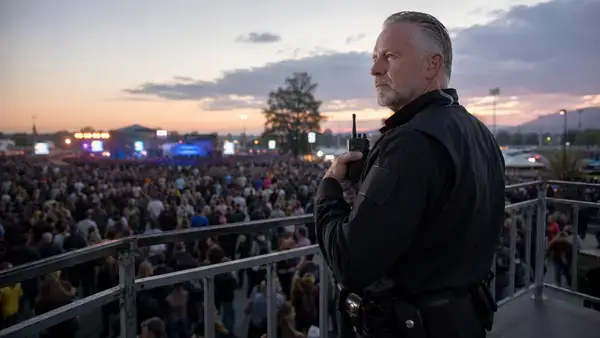
Major incidents are the ones that end careers and bankrupt event companies. They’re also the ones planners try hardest not to think about.
ASIS International’s 2025 reporting highlights active assailant preparedness as the fastest-growing concern at mass gatherings. Federal coordination through the Cybersecurity and Infrastructure Security Agency has expanded its Special Event guidance specifically because mid-size events kept getting caught flat-footed.
What a real major-incident plan includes
- Written run/hide/fight protocol distributed to every staff member before doors open. Not the day of. The week before.
- Designated incident commander on-site at all times with authority to call the show.
- Pre-coordinated handoff with local law enforcement. Phone numbers, channel frequencies, and a meeting point if comms fail.
- Evacuation routes labeled on every staff radio and posted at every entry point.
- Reunification plan for separated families. This gets forgotten constantly.
The political demonstration angle
Peaceful protests near or through your event aren’t necessarily a security failure. They’re a logistics challenge. The mistake organizers make is treating demonstrators as adversaries. Trained event security knows how to keep separation, communicate with organizers of the demonstration, and protect the right to assemble while keeping ticket holders safe.
Aggressive tactics in those moments create the viral video that ends your event series. Calm separation works. Get guards trained for it.
What Does Real Event Security Actually Cost?
Let’s get specific. National averages run $15 to $40 an hour for unarmed event guards, and up to $100 or more per hour for experienced armed or specialized personnel according to 2025 IBISWorld industry data. Texas sits at roughly $27 an hour for unarmed guards, which is on the lower end nationally compared to California ($35) and New York ($32).
Event security cost ranges by event size (2025 industry data)
| Event Size | Guard Type | Hourly Range | Total Event Cost |
| Small (under 200) | Basic unarmed | $15-$25/hr | $200-$500 |
| Medium | Trained unarmed + patrol/comms | $25-$50/hr | $1,000-$3,000 |
| Large / high-risk | Armed + tech integration + K9 | $50-$100+/hr | $10,000+ |
Source: 2025 industry cost guidance compiled across BLS wage data and IBISWorld security services market reports.
Here’s what the cheap-bid math misses: ASIS International’s 2025 live event research both flag liability avoidance as the primary value driver in event security. Crowd-related incidents continue to drive lawsuits, insurance scrutiny, and event cancellations. Saving a few hundred dollars on guard hours is roughly the smallest line item in your event budget. Underspending it doesn’t save you money. It moves the risk.
If you’re shopping event security services in Houston, ask the bidder three questions before price comes up. What’s the average tenure of guards they’d assign to your event? What specific event/crowd management training do those guards have? And what’s their incident response record from the last 12 months? Cheap providers fall apart on question two.
The Hiring Mistake That Costs Events the Most
Industry-standard advice says “more guards equals more safety.” That’s wrong. Five well-trained guards beat fifteen warm bodies every time.
The most expensive mistake in event security isn’t under-staffing. It’s hiring cheap. BLS wage data puts the median security guard wage at $18.46 an hour. Providers quoting well under that are running thin margins on training, vetting, and retention, which is why turnover hit roughly 51% nationally in 2023 and 77% in some major cities. The guard who showed up at your event last year probably isn’t the one showing up this year.
What you actually want is a smaller team with current training. Crowd management certifications. De-escalation hours logged. A working relationship with local law enforcement. Documented incident response from real events, not bullet points on a website. Knowing how to vet a security provider is the single most important decision in your planning process.
The contrarian play: spend the same total dollars on fewer guards from a better provider. Your event runs smoother and your insurance file looks better in a deposition.
How to Build an Event Security Plan That Actually Works in 2026
Start backwards. Imagine the worst day at your event. Now work back from that scenario to today and write down every decision that has to be in place to avoid it.
That exercise will tell you your guard count, your training requirements, your medical coverage, your communications setup, and your law enforcement coordination needs. It also tells you what kind of provider to hire.
Working with a security partner who actually understands event-specific risk, beyond plain “guarding,” is the difference between a smooth event and a lawsuit. The same logic applies to picking an experienced team for any marketing service. Generalists deliver generic outcomes. Specialists deliver results.
If you’re planning an event in the Houston metro and want to talk through your specific risk profile, get a quote from our team. We’ll walk through your venue, attendee count, alcohol service plan, and incident history before we quote a number. That’s the only way to do it right.
The numbers that should worry every organizer
A few data points before we dig in. The crowd management and event security market was over $2.1 billion in 2025 and is projected to hit $12.89 billion by 2035, growing at roughly 19.9% per year according to Research Nester. That’s not because organizers got nervous. It’s because incidents kept happening and insurance carriers stopped writing policies without proof of a real security plan.
Meanwhile, the labor side is rough. Bureau of Labor Statistics data shows the median wage for a security guard sits at $38,370 a year, or $18.46 an hour. Turnover hit roughly 51% nationally in 2023 and 77% in some major cities. Translation: the guard who showed up at your event last year probably isn’t the one showing up this year.
FAQs
How many security guards do I need for my event?
The standard industry guideline is 1 guard per 100 attendees for low-risk seated events. At standing-room concerts and alcohol-served events, drop that to 1 per 50. High-risk or VIP events with armed personnel can require 1 per 15 to 25. Adjust for venue layout, alcohol service, and attendee demographics before locking your number in.
What are the biggest event security risks in 2026?
The five biggest event security risks in 2026 are severe weather, alcohol-related crowd behavior, medical emergencies, petty theft and vandalism, and major incidents like active assailants or unplanned demonstrations. Each requires a specific response plan, trained personnel, and pre-event coordination with EMS and law enforcement. Skipping any one of these creates real legal and financial exposure.
What’s the most overlooked event security risk?
Weather is the most overlooked risk at outdoor events. Heat illness, lightning, and storm-related equipment failures cause more event interruptions than any other single risk category. Most planners write a generic weather plan and never train guards on heat exhaustion symptoms, lightning evacuation triggers, or shelter routing. That’s the gap that turns a manageable risk into a medical emergency.
Do I need armed security guards for my event?
Most standard events use unarmed security. Armed guards make sense for VIP events, events with significant cash handling, controversial speakers or topics, prior threats, or any event in a high-risk venue. Armed personnel require additional licensing and insurance coverage. Talk to your provider about your specific risk profile before deciding.
What training should event security guards have beyond a state license?
Beyond basic licensing, look for crowd management certification, de-escalation training, CPR and AED current within 12 months, Stop the Bleed certification, Narcan administration, and venue-specific protocols. Cheap providers cut all of these. The 51% national turnover rate in security services means you should also ask about average tenure on similar events.
How do I vet a security company before signing a contract?
Ask for proof of current general liability insurance, current state licensing documentation, written training records, three references from similar-size events in the last 12 months, and their incident response history. If a provider can’t produce these in writing within 48 hours, move on.
Is event security different for indoor versus outdoor events?
Yes. Outdoor events add weather risk, perimeter control, and parking lot exposure that indoor venues don’t face. Indoor events focus more on capacity limits, fire exits, and stairwell management. Outdoor events typically require 20% to 30% more guards per attendee than equivalent indoor events for the same risk level.