
The 4 Ps of security guard work are professionalism, preparedness, proactiveness, and physical fitness. They’re the four habits that decide whether a guard stops a problem or just writes it up after the fact. We run guard teams across Houston, and every theft our officers have prevented traces back to at least one of these four. This guide breaks down each P, shows what it looks like at 2 a.m. on a real Houston site, and points out where the better-known “5 Ds” and “3 Ps” security models fit. If you’re hiring guards to protect a property, the 4 Ps are your checklist for telling a professional apart from a warm body in a uniform.
What are the 4 Ps of security guard work? They’re professionalism, preparedness, proactiveness, and physical fitness: the four traits an officer needs to prevent crime instead of only reporting it. Professionalism sets conduct. Preparedness sets training. Proactiveness drives early action. Physical fitness keeps a guard able to move and respond.
Start with the numbers. The U.S. Bureau of Labor Statistics counted 1,262,100 security guards working in 2024, at a median wage of $18.46 an hour. That’s a lot of uniforms, and the gap between the best and the worst is wide. In Texas, an armed guard has to clear a 45-hour Level III course through the Department of Public Safety before carrying a weapon on duty. The stakes are real: on a jobsite or in a warehouse, one overnight break-in can mean stolen equipment, copper, and days of downtime. The 4 Ps are how a guard company keeps that from happening.
What does professionalism really mean on post?
Professionalism is the P that shows before anything happens: how a guard looks, talks, documents, and calms a situation down. It’s the line between an officer who ends an incident and one who starts a lawsuit.
On paper it means the right license. A non-commissioned guard in Texas carries a Level II card; an armed officer holds the Level III commission. It also means the vetting behind the badge. Before we place anyone, we run background checks, drug testing, license verification, reference checks, and an interview against company standards. A large share of Houston speaks Spanish at home, so we staff guards who work in English and Spanish, which matters the moment a guard has to give an instruction and be understood.
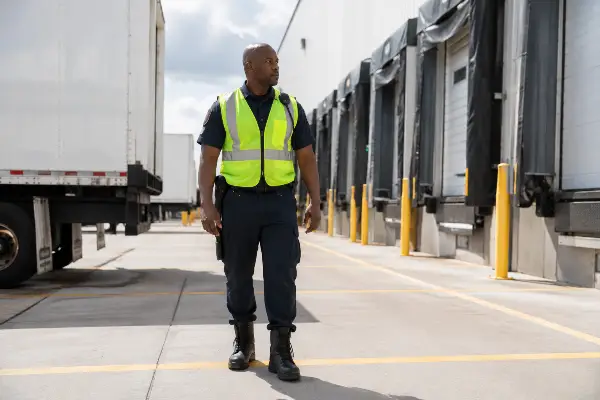
Here’s what it looks like live. At 11:20 p.m. on a distribution warehouse, one of our officers found an unauthorized vehicle by the loading docks and a man trying to reach a secured storage area. The officer identified himself, told the man to leave the restricted section, and the man complied and left. No force. No headline. A report filed for the record and every dock door checked afterward. That’s professionalism doing its quiet job. The industry’s professional body, ASIS International, builds its whole certification track around that kind of conduct.
Preparedness: the training behind the badge
Preparedness is everything a guard does before the shift so the shift goes right: training, licensing, the correct equipment, and knowing the site cold. A prepared officer has already thought through the call before it comes in.
In Texas, that training is a legal floor, not a nice-to-have. The Level III commission runs a minimum of 45 classroom hours plus a course of fire, and the state license renews every two years, with current firearm proficiency required at renewal. Our armed officers requalify on that cycle, and every guard works documented rounds through a GPS guard-tour system, not a clipboard nobody checks. Rounds get logged, incidents get written in real time, and a supervisor checks in.
The copper-wire call shows why preparation beats luck. At 3:30 a.m., on a scheduled patrol, an officer noticed a storage container had been tampered with and spotted a man pulling out rolls of copper wire. He didn’t rush it. He called law enforcement, held a safe visual distance, and fed updates to dispatch until officers arrived and made the arrest. The wire went back to the site. A guard who wasn’t trained to hold position and coordinate would have turned a clean arrest into a chase.
What does proactiveness look like at 2 a.m.?
Proactiveness is catching the problem before it becomes a loss. It’s the P that actually saves you money, because a theft you prevent costs you nothing.
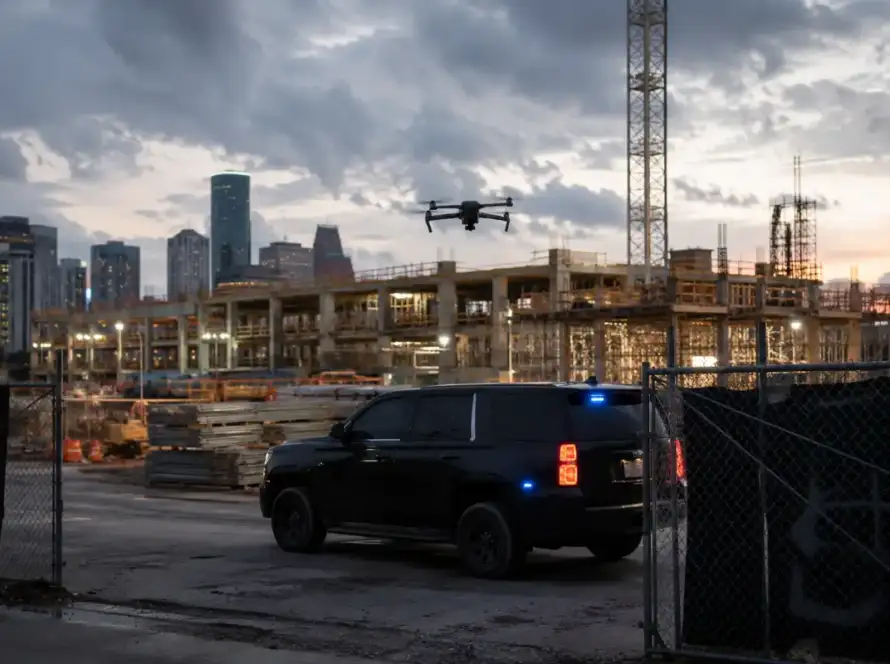
Picture a construction site at 2:15 a.m. Our officer watched a pickup circle the site slowly, then stop near a gated entrance while the people inside sized up the access points. He hit the patrol vehicle’s emergency lights and made his presence known. The truck left. He logged the description and told site management. Nothing was stolen, because the crime never started.
Here’s where we break with a chunk of the industry: random patrols are mostly theater. Plenty of firms sell unpredictable drive-bys and call it coverage. We don’t do random patrols. We run documented rounds, and the proof is in our own logs. Every incident our officers have stopped happened on a structured patrol at a recorded time: 2:15, 11:40, 3:30, 1:45. A round you can’t prove happened is a round a jury, an insurer, and a thief all treat the same way, as if it never did. Documented beats random, and our incident record is the evidence.
You see the same pattern on other sites. At 11:40 p.m. an officer caught two people carrying materials toward a perimeter fence, lit them up with a spotlight, and challenged them; they dropped the load and ran. At a vacant building at 1:45 a.m., a patrol reached the rear entrance while two people were prying at a boarded window, and they fled before getting in. Early eyes, early action.
Physical fitness: why the overnight shift is harder than it looks
Physical fitness is the P people underrate. A guard who can’t stay alert and mobile through a long overnight shift can’t deliver the other three, no matter how well trained.
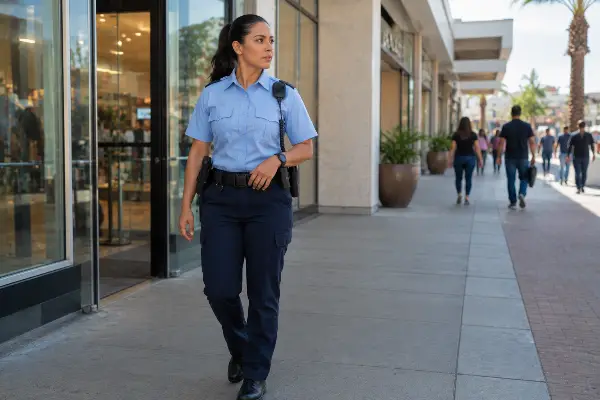
This isn’t about intimidation. It’s about endurance and readiness. Our guards cover large construction yards and warehouse perimeters on foot and by vehicle, through the night, in Houston heat and rain. Reaching the rear of a vacant building in time, or repositioning a patrol vehicle to cut off an exit, takes a body that’s ready at hour ten as much as hour one. Fitness is what turns a sighting into a response instead of a report written the next morning about what got away.
Are the 4 Ps the same as the 5 Ds of security?
No. The 4 Ps describe the guard. The 5 Ds describe the strategy. Good security runs both at once.
The 5 Ds, covered for years in trade outlets like Security Magazine, are deter, detect, delay, deny, and defend. A separate “3 Ps” idea names what security protects: people, property, and premises. Line them up and they connect. A professional, prepared, proactive, fit officer is how the 5 Ds actually happen on the ground: the patrol lights that deter, the trained eyes that detect, the challenge that denies entry, the coordination that defends the site until police arrive. The frameworks aren’t rivals. The 4 Ps are the person; the 5 Ds are the plan that person carries out.
The 4 Ps of security guard work, side by side
Each P maps to a behavior you can watch for and a real call our officers have run. This is the fastest way to grade any guard company, including us.
| The P | What it looks like on site | A real Houston call |
| Professionalism | Licensed, uniformed, documents everything, de-escalates | Warehouse dock, 11:20 p.m.: officer identified himself, told the intruder to leave, no force, report filed |
| Preparedness | Level III training, GPS-logged rounds, right equipment | Copper wire, 3:30 a.m.: a scheduled patrol caught a tampered container; police made the arrest, wire recovered |
| Proactiveness | Early detection, visible deterrence, documented patrols | Construction site, 2:15 a.m.: a circling truck left the moment patrol lights came on |
| Physical fitness | Alert and mobile across long overnight shifts | Vacant building, 1:45 a.m.: patrol reached the rear entry in time; two people fled before getting in |
What Houston properties should demand from guards in 2026
If you’re hiring in Houston, the 4 Ps turn into a short list of questions to ask before you sign anything. Ask them of every company you call, ours included.
First, armed or unarmed? Unarmed officers patrol, control access, verify visitors, and report; armed officers add a higher level of presence for cash handling, high-value assets, and higher-risk sites. Second, are the patrols documented or random? Ask to see how rounds are tracked. Third, do the guards work in English and Spanish? Fourth, how fast is response, and what’s the coverage area? We run same-day response, 24/7, with no holiday gaps, across Downtown, the Medical Center, the Energy Corridor, Katy, Sugar Land, Pearland, Conroe, Spring, Humble, and The Woodlands.
One more, because it’s the question people forget: what’s the contract? The biggest myth we hear is that guard service means a long lock-in. It doesn’t. We run month-to-month, short-term, and even weekly, and we can put insurance in place the same day. Behind all of it: a team with two decades in Houston security, 150 guards, more than 100 active sites, a Texas DPS license (B07315701).
The 4 Ps of security guard work aren’t a slogan we printed on a truck. They’re the checklist we hire against and the reason our officers stop crimes instead of just recording them. If you want a team that patrols on a log you can read, ask us for a free proposal and a site assessment. We’ll show you the rounds.
FAQs
What are the 4 Ps of security guard work?
The 4 Ps are professionalism, preparedness, proactiveness, and physical fitness. Together they describe a guard who can prevent an incident rather than only report it. They focus on the officer; the related 5 Ds of security (deter, detect, delay, deny, defend) describe the strategy that officer carries out.
What are the 5 Ds of security, and how do they relate to the 4 Ps?
The 5 Ds are deter, detect, delay, deny, and defend, a physical-security framework covered for years in trade publications like Security Magazine. The 4 Ps are the human side of the same job: a professional, prepared, proactive, and fit guard is how those five strategies actually get delivered on a property.
How much training do Texas security guards need?
An unarmed officer holds a Level II card. An armed, commissioned officer must complete a Level III course of at least 45 hours plus a course of fire through the Texas Department of Public Safety, and the state license renews every two years with current firearm proficiency required at renewal.
Do the 4 Ps of security guard work apply to unarmed guards too?
Yes. Professionalism, preparedness, proactiveness, and physical fitness apply to every officer regardless of whether they carry a weapon. An armed guard adds firearm training and the Level III commission on top of the same four habits.
Do professional guards actually prevent theft?
Yes, and prevention is the point, because stolen equipment, copper, and materials are rarely recovered once they leave a site. A visible, documented patrol deters people who are testing a property. Our officers have turned away circling vehicles and stopped material and copper-wire thefts on GPS-logged overnight rounds, at recorded times like 2:15 and 3:30 a.m.
Do I need a long-term contract to hire security guards in Houston?
No. Contract terms should match your needs, whether that’s month-to-month, short-term, weekly, or longer. We can also put insurance in place the same day, so a lock-in period is not a requirement to get covered.
How fast can Reliable Guard respond in Houston?
We run same-day response, 24 hours a day, with no holiday gaps, across the greater Houston area including Downtown, the Medical Center, the Energy Corridor, Katy, Sugar Land, Pearland, Conroe, Spring, Humble, and The Woodlands.