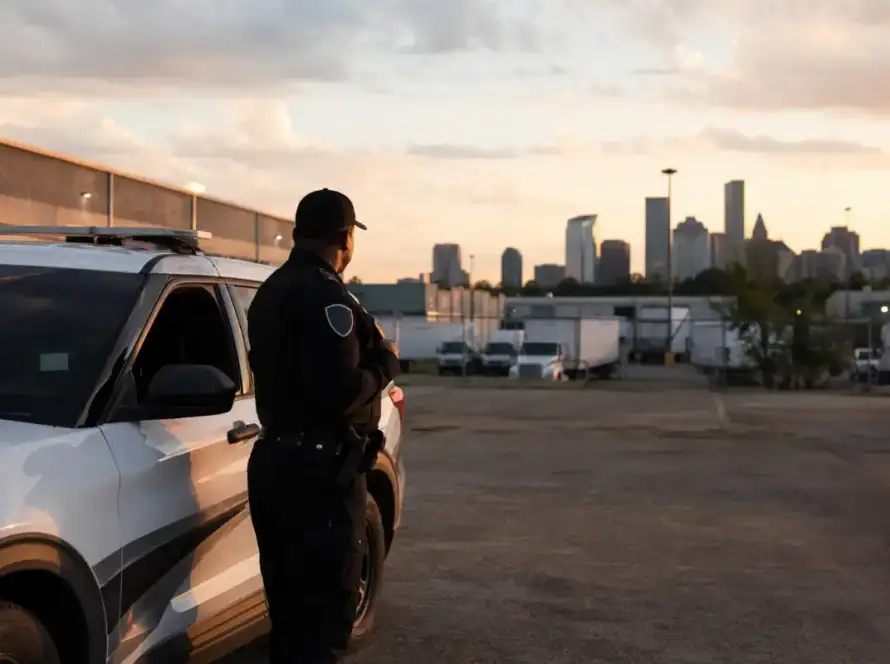
Texas has more construction equipment theft than any other state, and most of it happens after the crews clock out, according to National Equipment Register data. That is the whole case for night security guards in Houston. The risk moves to the hours when no one is on site, and stolen equipment is rarely recovered, so stopping a theft beats filming one.
This guide covers what overnight guards do on a real shift, what drives the price of night coverage in Houston, what an armed versus unarmed officer can legally do on your property, and five after-hours incidents from Reliable Guard & Patrol Service where a visible officer, not a camera, ended the theft.
A night security guard is a licensed officer who patrols a property after business hours, usually from dusk to dawn, to deter theft and trespassing, check doors and gates, respond to incidents, and file time-stamped reports. In Texas, these officers are licensed and regulated by the Department of Public Safety.
What does a night security guard do after midnight?
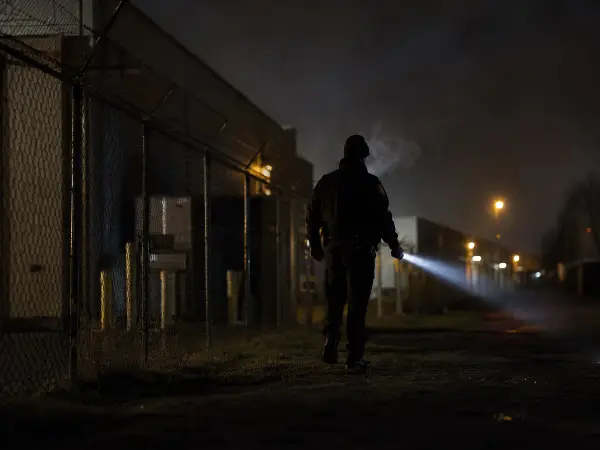
The short version: they run scheduled patrols, control who gets on the property, watch for the behavior that comes before a break-in, and document all of it. A good overnight officer is not standing at a gate for eight hours. They move on a route, and at Reliable that route is logged through a GPS guard-tour system that time-stamps each checkpoint, so a client can see the 1 a.m. and 3 a.m. rounds actually happened.
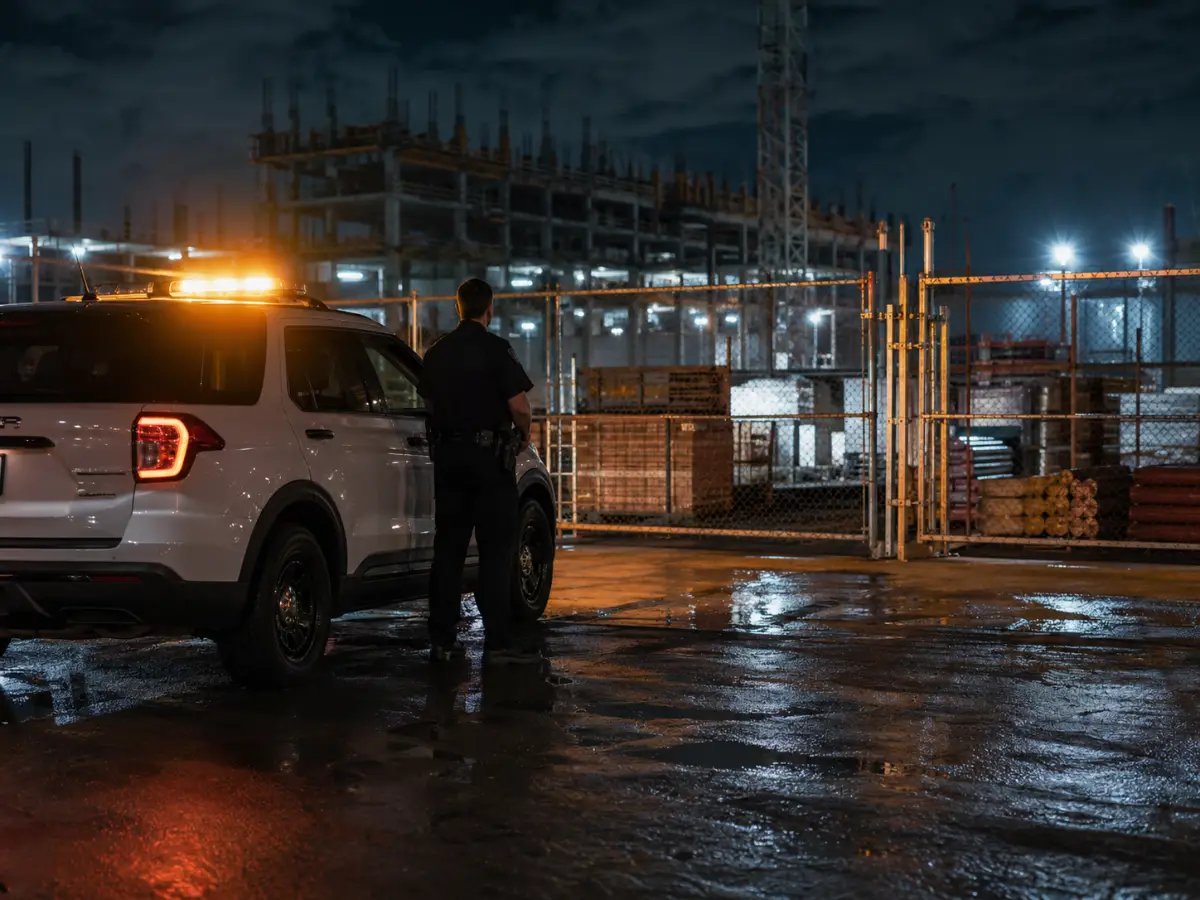
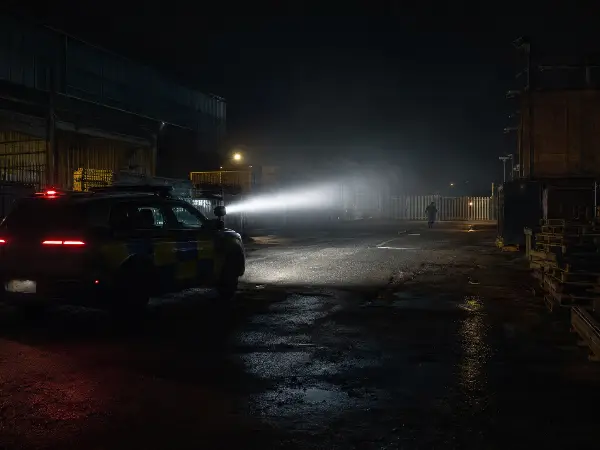
Three of the five documented Reliable incidents show the pattern. At 2:15 a.m. on a construction site, an officer watched a pickup truck circle the fence line and stop near the gate while the people inside studied the entrance. He switched on his patrol vehicle’s emergency lights and walked toward them, and the truck left before anyone stepped out. On another site at 11:40 p.m., an officer saw two people carrying materials toward the perimeter fence in a dark corner of the lot. He drove over, lit the area with a spotlight, and called out, and the suspects dropped the materials and ran. At 3:30 a.m. elsewhere, an officer found a storage container that had been pried open and a man pulling out rolls of copper wire. He held his distance, called police, and kept eyes on the suspect until officers arrived and made an arrest. The copper went back to the site.
Notice what did the work in each case. Not a recording. A person who showed up while it was happening.
Why after-hours is when Houston sites get hit
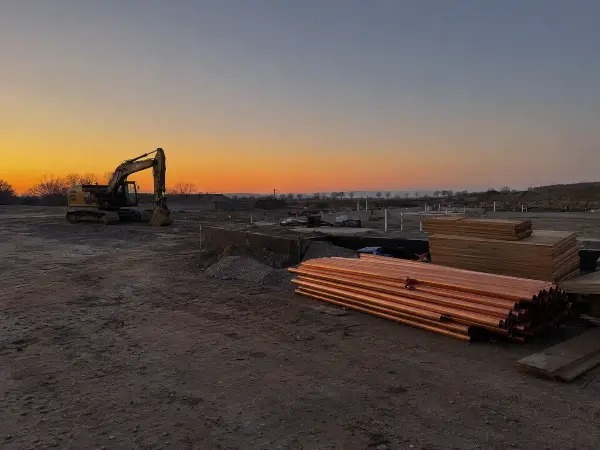
Because that is when the crews leave and the property sits full of portable value with nobody watching it. The numbers behind this are worse than most owners think, and Texas sits at the center of them.
Texas leads the country for construction equipment theft in National Equipment Register data, at roughly a quarter of reported U.S. incidents. Nationally, stolen construction equipment costs builders between $300 million and $1 billion a year, according to the National Equipment Register and the National Insurance Crime Bureau. The U.S. Department of Energy has estimated about $1 billion a year in stolen copper on top of that. And here is the part that decides the whole security question: only about one in five stolen machines is ever recovered. The rest is gone.
Read those two facts together. Theft clusters after dark, and recovery almost never happens. That combination is why after-hours guard coverage exists as a category, and why a site owner who relies only on cameras is really relying on their insurance deductible.
Armed or unarmed at night? Commissioned vs non-commissioned in Texas
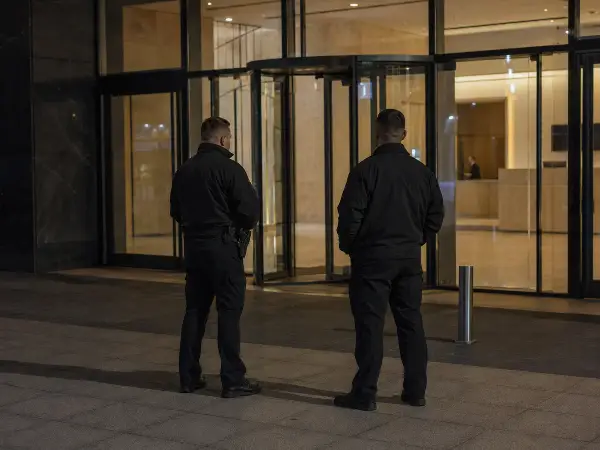
Both work, and the right call depends on the site. Under Texas Department of Public Safety rules, an unarmed officer holds a Level II (non-commissioned) license and does not carry a firearm on duty. An armed officer holds a Level III (commissioned) license, which requires a 45-hour course with in-person handgun proficiency. Reliable’s armed officers requalify on firearm proficiency every two years, which the state requires.
What can either one legally do at night? A licensed officer has the same detain-or-arrest authority as any private citizen, no more. They observe, document, ask a trespasser to leave, and detain someone only when a crime happens in their view, then hand off to police. An officer is not a police officer and does not carry that authority. Reliable trains officers to use that limited authority correctly and to document it, so a stopped incident holds up afterward.
For most construction sites, warehouses, and vacant buildings, an unarmed officer with a patrol vehicle and a spotlight ends the problem, because the goal is to be seen. Armed officers fit high-value cash handling, sites with prior violent incidents, and locations where the client wants that extra presence.
What do overnight security guards cost in Houston in 2026?
It comes down to four things, and any honest company gives you a number per site instead of a menu rate. The price tracks whether the officers are armed or unarmed, how many hours and posts you need, the risk level of the property, and how many officers it takes to cover it. Overnight shifts tend to run a little higher than daytime, because fewer officers want the hours.
Reliable sets the price after a short call and a free proposal built around your actual site. Two things set the terms apart from most Houston companies. There is no long-term contract, so you can run weekly, month-to-month, short term, or long term. And the certificate of insurance is issued same day, so a contractor who needs coverage tonight is not stuck waiting on paperwork.
Do night guards actually stop theft, or just report it?
They stop it, and that is the part cameras miss. A camera gives you a recording of a loss you will probably never recover, since only about one in five pieces of stolen construction equipment comes back. A visible officer changes the decision before the crime starts.
The research backs this up. In a National Institute of Justice-rated study of Los Angeles business districts that added private security patrols, robberies fell about 12%, and the researchers found the community benefit far outweighed what the districts spent on that security. Reliable’s own record says the same thing in plainer terms. Across the five documented night incidents, at a construction gate, a materials pile, a copper container, a vacant building where two people were prying at a boarded window at 1:45 a.m., and a warehouse loading dock at 11:20 p.m., the outcome was identical. The suspects left the moment an officer became visible. No property lost.
That is the honest case for a person over a lens. The lens tells you who robbed you. The person keeps it from happening.
The Houston properties that need night guards most
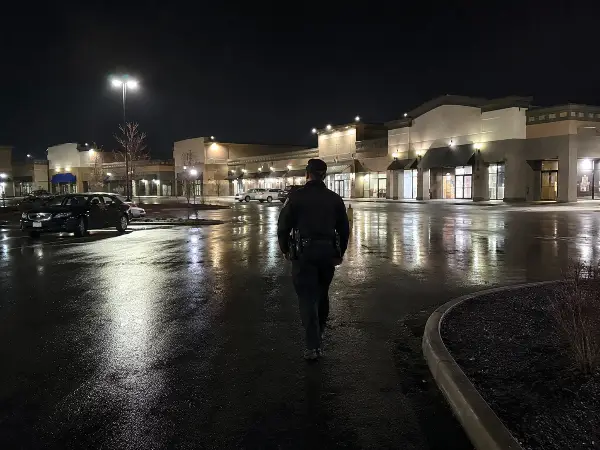
The four that show up in almost every after-hours theft: construction sites, warehouses, vacant buildings, and retail centers. Reliable protects all four across Houston and the surrounding metro, including Downtown, the Medical Center, the Energy Corridor, Katy, Sugar Land, Pearland, Conroe, Spring, Humble, and The Woodlands.
Construction sites carry loose copper, fuel, tools, and heavy equipment, which is why construction site security is Reliable’s most requested service. Distribution warehouses face loading-dock and inventory losses after the last shift, so warehouse security focuses on dock doors and access points. Vacant buildings draw copper strippers and squatters. Retail centers need a visible presence during late close and early open.
How fast a Houston security company can start
Same day, in most cases. Reliable’s process is a first call, a free proposal, a site assessment where the property calls for one, and deployment, with insurance issued the same day. That speed matters most for a contractor who had a break-in last night and cannot afford another.
The company runs 150 officers across more than 100 active sites, holds Texas DPS license B07315701, and carries a 5.0 rating across 144 Google reviews. Officers work in English and Spanish, patrols are tracked by GPS, and every shift produces documented rounds and real-time incident reports rather than a signature on a clipboard. When you are ready, you can get a free proposal and set coverage for tonight.
Here is the math worth keeping. One overnight officer costs a fraction of a single copper or equipment loss, and the odds of getting stolen gear back sit near 20%. You are not paying a night security guard in Houston to watch an empty lot. You are paying so the 2 a.m. truck keeps driving.
FAQs
How often do night security guards patrol a property?
On a typical overnight post, officers run scheduled rounds instead of sitting at one spot, and each checkpoint is logged on a GPS guard-tour system with a time stamp. That record shows a client the 1 a.m. and 3 a.m. rounds actually happened, and it is what holds up with an insurer or in a dispute later.
Are night security guards in Houston armed or unarmed?
Both are available. Unarmed (Level II, non-commissioned) officers fit most construction sites, warehouses, and vacant buildings, where being seen is the point. Armed (Level III, commissioned) officers fit cash handling and higher-risk locations. Reliable’s armed officers requalify on firearm proficiency every two years.
Do security guards prevent theft or just report it?
They prevent it. Only about one in five pieces of stolen construction equipment is ever recovered, so a recording rarely gets your property back. In all five of Reliable’s documented night incidents, the suspects left the moment an officer became visible, and nothing was lost.
How fast can Reliable start night patrols?
Usually the same day. The process is a first call, a free proposal, a site assessment where needed, and deployment, with insurance issued same day. That speed matters most after a site has already been hit.
What can a security guard legally do in Texas at night?
A licensed officer has the same authority as any private citizen: patrol, observe, document, ask a trespasser to leave, and detain a person only when a crime happens in their view, then hand off to police. Officers are regulated by the Texas Department of Public Safety and do not hold police authority.
Is a long-term contract required?
No. Reliable runs weekly, month-to-month, short-term, and long-term terms based on the site. This is a common misconception in the industry; many companies require long contracts, and Reliable does not.
Which Houston areas do you cover?
Houston and the surrounding metro, including Downtown, the Medical Center, the Energy Corridor, Katy, Sugar Land, Pearland, Conroe, Spring, Humble, and The Woodlands, 24 hours a day, every day of the year.