
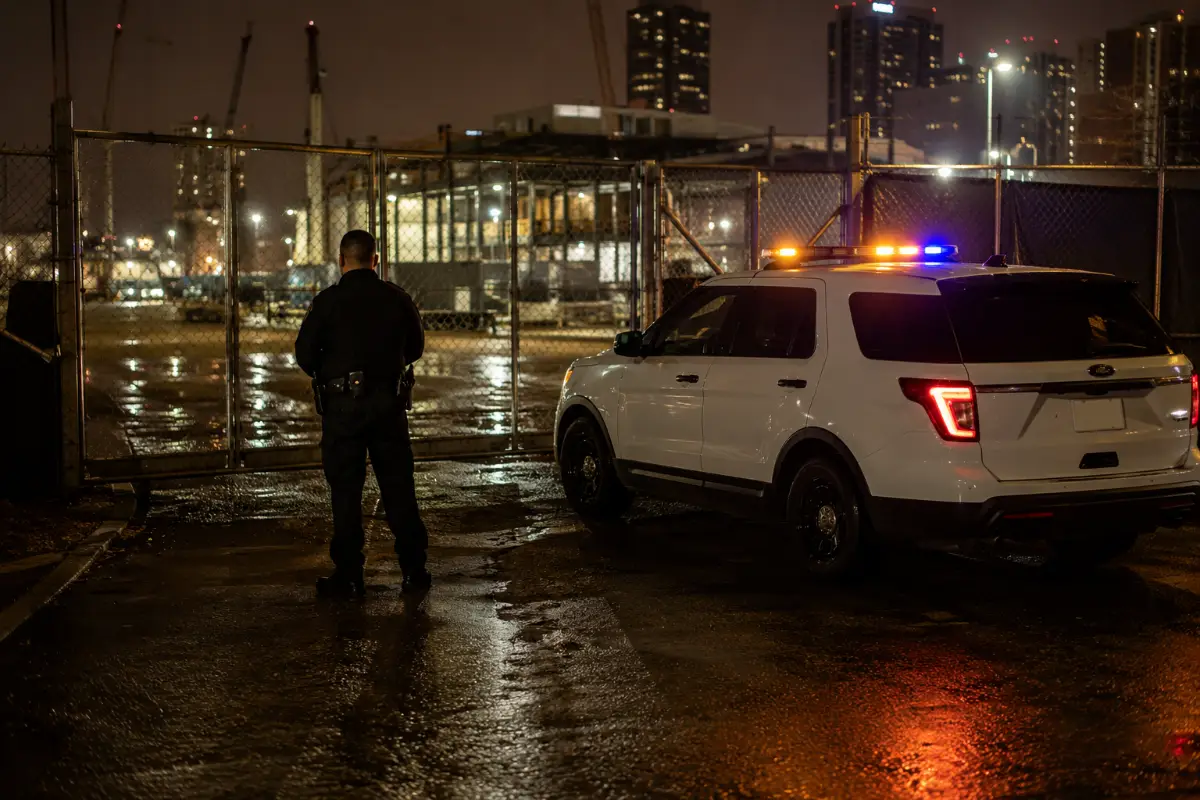
A security camera can capture a break-in in sharp 4K and do nothing to stop it. That’s what the technology is built to do: watch and record. It won’t walk the fence line, challenge a stranger, or radio an incident in from thirty feet away. On a commercial property, that limit is why security cameras are rarely enough to protect a business on their own.
The short answer is no. Cameras are useful. They’re just not enough by themselves. A camera shows you what happened after it happens, and on a commercial property, that “after” is usually too late to keep your equipment, copper, or inventory. Cameras belong in almost every security plan. They can’t be the whole plan.
Camera-only security means relying on recorded or monitored video with nobody on site to act on it. A 40-year review of camera research archived by the U.S. Department of Justice found closed-circuit cameras cut crime only modestly, with the strongest effects in parking lots, and concluded they should “not be deployed as a stand-alone crime prevention measure.”
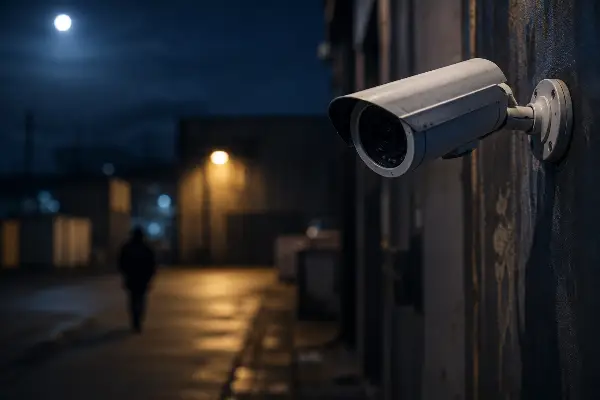
Do security cameras actually stop crime, or just record it?
They record it. A camera has no way to physically stop someone, and criminals know the difference. The footage matters most after the fact, for police and insurance, and that is exactly where it tends to disappoint.
Here is the part most camera brochures leave out: recorded crime is rarely solved crime. According to FBI Uniform Crime Reporting data, police clear (meaning solve) only about 12 to 13 percent of larcenies and burglaries in a given year. So the video you paid for usually becomes a file nobody closes. You captured the theft in high definition and still lost the copper.
Cameras do have real deterrent value against opportunists. In a University of North Carolina at Charlotte study of 422 convicted burglars, more than 40 percent said the presence of cameras would push them to pick a different target, and close to 60 percent said they would check for cameras before committing. Turn that around: a camera changes the plan for roughly four in ten offenders, and does nothing for the ones who have already scouted your blind spots. Determined intruders treat a camera as scenery.
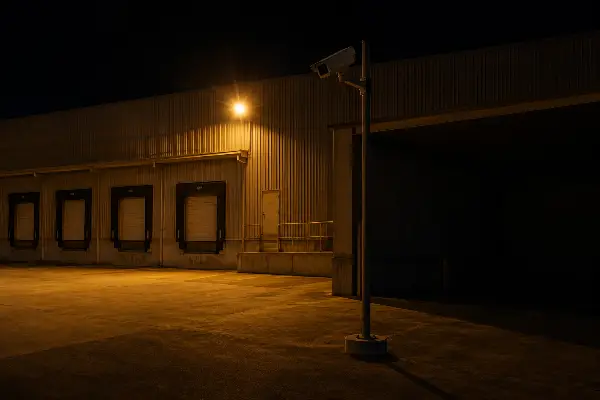
What can a camera miss on a commercial property?
Plenty, and the misses cluster in predictable places. Blind spots between mounted angles. Loading docks and storage containers tucked out of frame. Tampering, when someone turns or covers a lens. And the whole system when the power or network drops.
We watched that last one play out at a distribution warehouse. After hours, an officer on a perimeter round found an unauthorized vehicle near the loading docks and a person trying to reach a secured storage area next to the dock doors. The officer identified himself, the individual left, and a walk-through confirmed no forced entry and nothing missing. A fixed camera pointed at the main gate would have filmed an empty gate while that played out around the corner. People move; a mounted lens does not.
Internal theft is the other blind spot, and it is not about lens placement. Someone who knows where the cameras point, and who is authorized to be near the inventory, is the hardest loss for video alone to catch.
Security cameras vs security guards: what each one does in 2026
Cameras and guards are not competitors. They do different jobs, and the trouble starts when a site buys one and assumes it covers the other. Here is the split, plainly.
| What a commercial site needs | Camera only | Guard only | Cameras + guards |
|---|---|---|---|
| Records what happened | Yes | Partly (written report) | Yes |
| Physically interrupts a crime in progress | No | Yes | Yes |
| Deters someone casing the property | Limited | Strong | Strongest |
| Keeps working in a power or network outage | No | Yes | Yes |
| Covers blind spots and tampering | No | Yes | Yes |
| Same-day, on-site response | No | Yes | Yes |
| Usable evidence for police and insurance | Yes | Yes | Yes |
The DOJ-archived research adds a useful detail here: camera systems with active, live monitoring outperformed passive ones, and sites that paired cameras with other measures beat sites running cameras alone. In plain terms, a camera someone is actually watching and can respond to beats a camera filling a hard drive. That is why we treat cameras as one input to a staffed response, not a substitute for one.
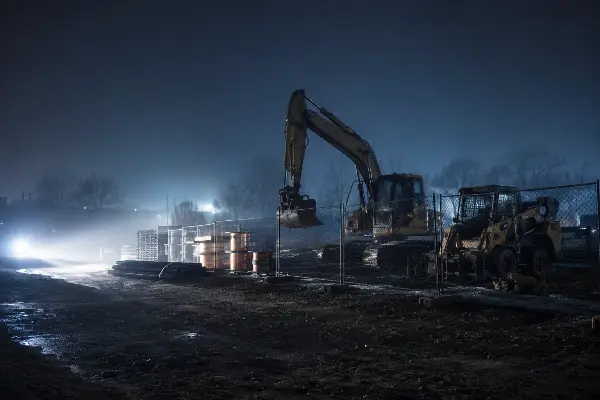
Why is stolen equipment almost never recovered?
Because most of it has no title, no plate, and no central registry, so once it leaves your site it is nearly untraceable. The National Insurance Crime Bureau found only about 23 percent of stolen heavy equipment is ever recovered, against more than 85 percent of stolen passenger vehicles. Roughly 11,600 machines a year walk off jobsites, and most are gone for good.
Copper is the other Houston problem. In a national review of insurance claims for stolen metal, Texas ranked second in the country, behind only Ohio. Copper is fast to strip, easy to sell, and gone before footage is ever reviewed.
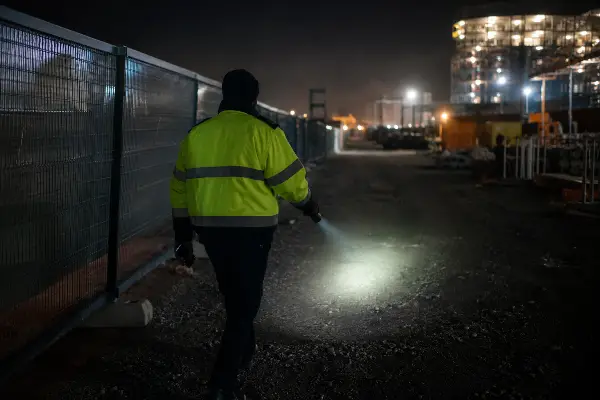
We caught one in progress on a construction site. During an overnight round, an officer found a tampered storage container and someone pulling rolls of copper wire from it. He called law enforcement, kept eyes on the suspect from a safe distance, and fed a live description to dispatch. Responding officers made the arrest, and the copper went back to site management. On video alone, that is a clip of a person you will probably never identify. With an officer on site, it was an arrest and a full recovery.
The real difference is response time, not resolution
A sharper picture doesn’t help you at 2 a.m. A faster response does. This is the metric that decides whether an incident becomes a loss, and it is where staffing beats hardware every time.
Two more from our logs, both construction sites. In one, an officer saw two people carrying materials toward the perimeter fence in a poorly lit corner, lit the area with a spotlight, and challenged them; they dropped the load and ran, and an inventory check came back complete. In another, at a vacant commercial building around 1:45 a.m., an officer spotted two people prying at a boarded window, called it in, and hit the patrol lights; they fled before getting inside, leaving only minor damage to the window cover.
Every one of those was a crime already underway. A camera would have documented each. Our officers ended each. That is the contrarian point worth sitting with: when a site keeps getting hit, adding more cameras is usually spending money on the wrong problem. The DOJ-archived review found camera effects were modest and concentrated in parking lots, thin elsewhere, and researchers said outright that cameras work best when they are not the only thing you are counting on. Presence closes the gap that lenses cannot.
Reliable runs same-day response across Houston, and we don’t do drive-by-and-hope. Officers work GPS-tracked patrol routes with documented rounds, real-time incident reports, and supervisor check-ins, so you can see the property was actually covered, not just billed.
Cameras deter some criminals, not the determined ones
For a casual opportunist, a visible camera sometimes works. For anyone who has already watched your site, it doesn’t. The same burglar study cuts both ways: a visible camera turns some offenders toward an easier target and does nothing to the ones set on yours. A marked patrol vehicle and a uniformed officer send a stronger signal than a small box on a pole, because the officer represents immediate, present risk, not a recording that might be reviewed later.
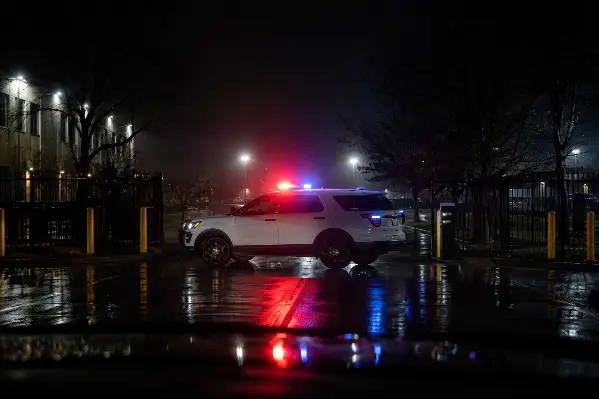
We saw exactly that at 2:15 a.m. on a Houston construction site. An officer watched a pickup roll slowly past the gate, stop, and study the access points. He switched on the patrol lights and moved toward the fence, and the truck left without testing the gate. A camera would have logged a plate and little else. The officer ended the attempt before it started.
What actually works, matched to the property
The right setup depends on what you’re protecting, and the risks are not the same across sites. This is the layered commercial security we build for Houston clients, tuned by property type rather than sold as one package.
Construction sites lose equipment, copper, and materials, mostly overnight and on weekends. These need patrol coverage during dark hours, access control at the gate, and documented rounds, with cameras supporting the officer.
Warehouses and distribution centers carry loading-dock and inventory risk, plus internal theft. Access verification, dock monitoring, and a walking presence catch what a fixed dock camera frames out.
Vacant commercial buildings draw squatters, copper strippers, and vandalism. Frequent patrols and door-and-window checks beat a single camera watching one entrance.
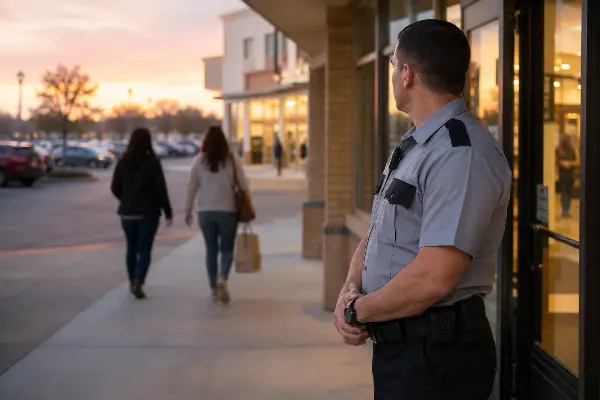
Retail and shopping centers deal with shoplifting, organized retail crime, and disputes on the floor. A visible officer both deters and de-escalates in real time, which no camera does.
Across all of them, you choose commissioned (armed) or non-commissioned (unarmed) officers based on the risk. Both are licensed through Texas DPS, the same regulator you can check us against (our company license is B07315701), and every officer clears a background check, drug testing, license verification, and references before working your site.
The long-term contract myth
The single biggest misconception we hear is that hiring guards means locking into a long, rigid contract. It doesn’t, at least not with us. Terms run month-to-month, short-term, weekly, or long-term, whatever the site actually needs, and we can provide insurance the same day and deploy quickly after a first call, a free proposal, and a site assessment.
On cost, officers do run more up front than mounting another camera. Weigh that against a stolen machine you have less than a one-in-four chance of ever seeing again, or a copper strip that shuts a project down for days. The math on prevention looks different once you count what a camera-only night actually risks.
Cameras are the memory. Officers are the reflex. A property with cameras but no officers pays to watch things go wrong and then files the footage, which is the ceiling on what security cameras alone can do for a commercial site. Reliable Guard & Patrol Service covers the Houston area 24/7, in English and Spanish.
FAQs
Are security cameras enough to protect a business?
No. Cameras record and, if monitored, alert, but they cannot physically stop a crime. FBI data show only about 12 to 13 percent of larcenies and burglaries are solved, so footage rarely recovers your loss. Cameras work best paired with on-site officers who can respond in real time.
Do security cameras stop theft or just record it?
They record it. A camera has no way to intervene, so a determined thief can act and be gone long before anyone reviews the video. That is why only about 23 percent of stolen heavy equipment is ever recovered, per the National Insurance Crime Bureau, even on sites that had cameras running.
Security cameras vs security guards: which is better for a commercial site?
They do different jobs. Cameras document and deter some opportunists; guards physically interrupt crime, cover blind spots, and respond on site. Research archived by the U.S. Department of Justice found cameras work best when they are not used alone, so the strongest setup is cameras plus officers, not one or the other.
Can Reliable work with our existing camera system?
Yes. We build coverage around the cameras you already have, adding officers, documented patrols, and live response so the video feeds an actual reaction instead of just a recording.
How fast can a security guard respond in Houston?
Reliable provides same-day response across the Houston area and runs GPS-tracked patrol routes with documented rounds and supervisor check-ins, rather than random drive-bys, so response is both fast and verifiable.
Do I need armed or unarmed guards?
It depends on the risk. Non-commissioned (unarmed) officers fit most patrol, access-control, and deterrence needs; commissioned (armed) officers suit high-value assets, cash handling, and higher-risk sites. Both are licensed in Texas, and we help you match the level to the property.
Does Reliable require a long-term contract?
No. Terms run month-to-month, weekly, short-term, or long-term based on what the site needs, and we can provide insurance the same day and deploy after a first call, a free proposal, and a site assessment.


