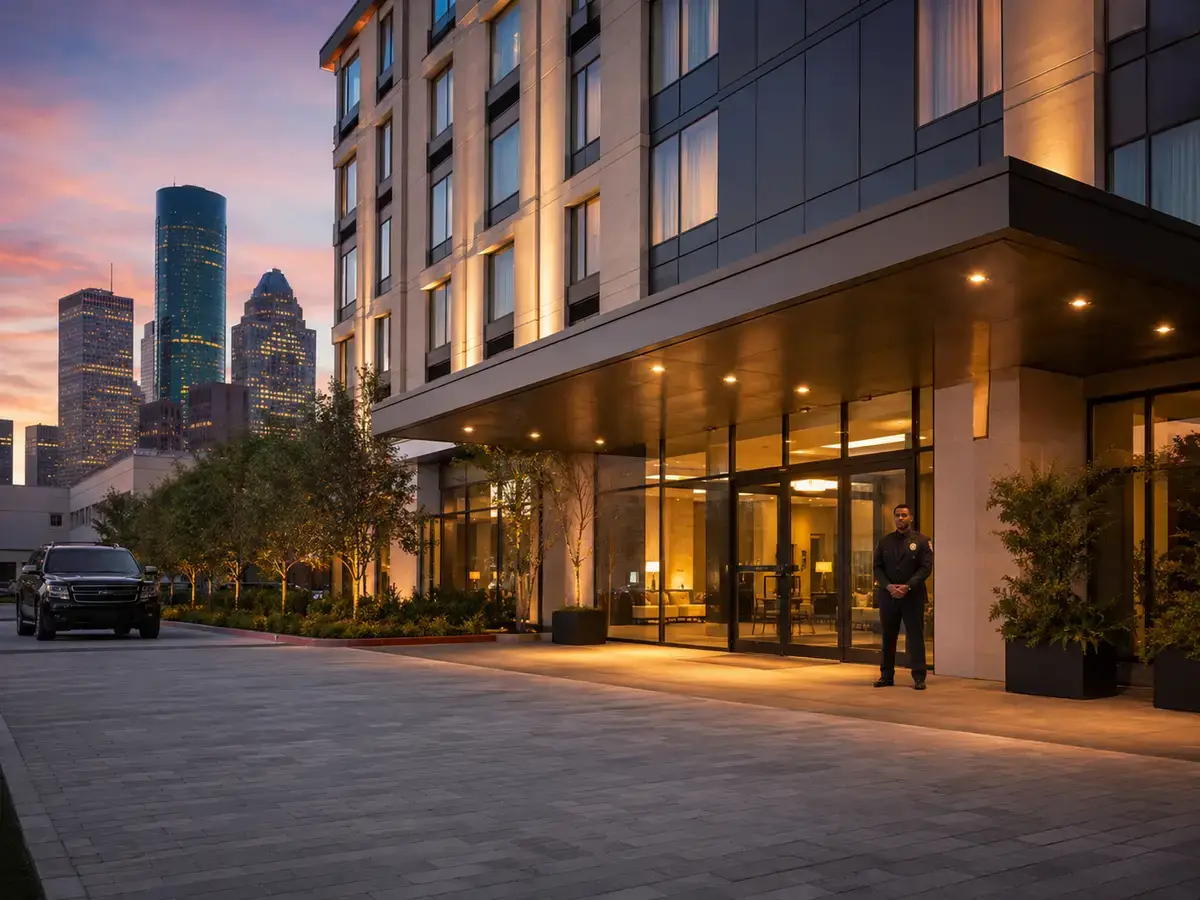
A hotel security system is the mix of cameras, access control, alarms, and trained people that keeps guests, staff, and property safe across a building that never really closes. For a Houston hotel in 2026, the right setup pairs technology with a visible human presence, covers the high-risk spots (lobby, parking, back-of-house), and follows Texas recording law. Get those three things right and you prevent most incidents instead of just filming them.
Put simply, a hotel security system combines surveillance cameras, electronic access control, fire and intrusion alarms, emergency communication, and on-site security guards into one coordinated setup. The goal isn’t to record crime after it happens. It’s to deter it, catch it early, and respond fast, all while protecting guest privacy and meeting state law.
The stakes keep climbing. A 2024 breach of a hotel-management platform exposed roughly 437,000 guest email addresses (along with names, addresses, and booking details) after attackers slipped in through one employee’s stolen login, per Have I Been Pwned. That kind of hotel data breach is a reminder that physical and digital threats overlap now. We run a Houston security guard company, and after hundreds of property walkthroughs the lesson repeats itself: the hotels that stay safe treat security as layers, not gadgets.
Why does hotel security matter more than ever?
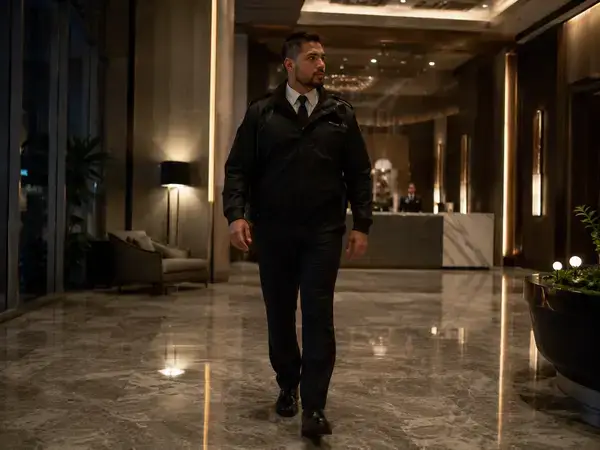
Because a hotel is one of the few buildings that has to stay open to strangers 24 hours a day, with guests, their cars, and their belongings all on-site at once. That openness is the product. It’s also the risk. Most Houston hotels we assess already own cameras. What they’re missing is private security on the floor, watching the feeds and walking the halls.
Guest safety is the booking decision
Travelers book on how safe a place feels, not just how it looks. A guest who watches an officer walk the lobby at 11 p.m. relaxes. A guest who finds an unlocked side door at 2 a.m. writes the one-star review that costs you the next ten bookings.
Safety and reputation are the same line item now. And when the ballroom fills for a wedding or a conference, the staffing math changes, which is where dedicated event security earns its keep.
Protecting your staff
Your night auditor and your housekeepers are the most exposed people in the building. That’s why the American Hotel & Lodging Association’s 5-Star Promise pushed panic buttons and safety training across roughly 20,000 hotel properties covering about 1.2 million workers. A device on a lanyard summons help. A guard nearby is the help.
Less damage, stronger liability position
When a claim lands, what matters is whether you had a plan. A documented security program (guards on patrol, working cameras, incident logs) gives your carrier and your lawyer something to point to. It won’t make claims vanish. It does change the story from “they ignored the risk” to “they had a plan.” Insurers increasingly ask about written security procedures and after-hours coverage at renewal, and a property that can show a staffed post and a clean log of patrols is in a stronger position than one relying on cameras nobody watches.
Faster response when seconds count
Fire, a medical event, an aggressive guest: the gap between “something’s wrong” and “someone’s handling it” is where injuries and lawsuits live. A camera flags it. A trained officer closes that gap in person while dispatch is still on the line. In a large hotel, the difference between a two-minute response and a ten-minute one is often the difference between a contained incident and one that spills into the lobby in front of paying guests. An officer who already knows the floor plan, the exits, and where the fire panel sits moves faster than anyone arriving cold.
How do security cameras actually improve hotel safety?
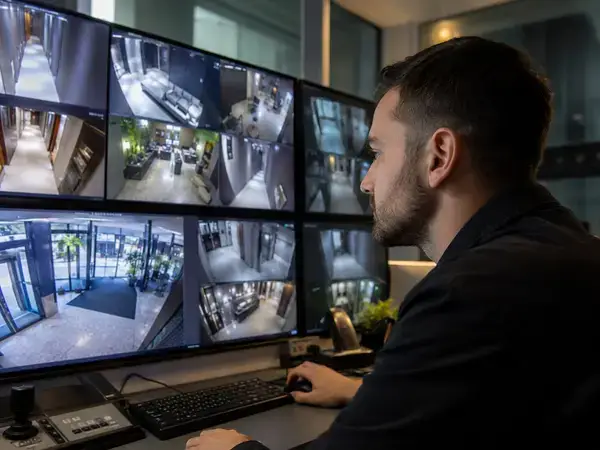
A camera doesn’t stop a crime. It records one. That’s the part most vendors gloss over. Cameras improve safety in three real ways: they settle disputes with footage, they make people behave better, and they extend the eyes of whoever is actually watching. Without that person, you’ve bought an expensive witness.
Settling disputes and false claims
Slip-and-fall claims, “my watch went missing,” “your bellhop scratched my car.” Footage ends those arguments fast. A clear recording is a neutral witness that shields the hotel from claims that didn’t happen and proves the ones that did.
Accountability across every shift
Cameras change behavior on both sides of the desk. Staff follow procedure when they know the lobby is recorded. Managers can review how the front desk handled a 3 a.m. complaint instead of guessing. Hotels run all hours, and no manager is awake for all of them. The same footage protects good employees, too: when a guest complaint turns into a “your staff was rude” review, a recording often shows the front desk did everything right.
Is your parking lot the real weak spot?
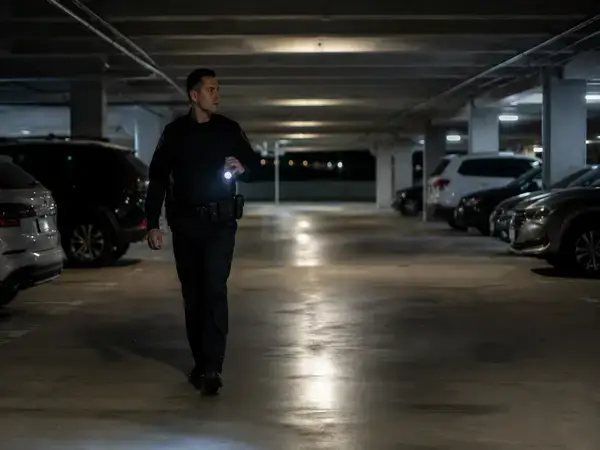
For most hotels, yes. Lots and garages are dark, spread out, and full of cars sitting unattended for days. Vehicle thefts nationwide fell to about 659,880 in 2025, a multi-decade low per the NICB, but the crime stays concentrated in big metros like Houston. Cameras with good night vision plus a guard who actually walks the deck beat either one alone.
Catching trouble before it spreads
A large property has too many corners for one person to watch live. Cameras at pools, bars, corridors, and loading areas let one officer cover ground that used to take five. The footage isn’t the point. The fast call to the right spot is. A guard who sees a cluster forming near the bar on a monitor can walk over before it becomes a fight, and a pool-area camera that catches an unattended toddler buys staff the seconds that matter most.
What makes a good hotel security system?
A good hotel security system isn’t the one with the most features. It’s the one where every piece talks to the others and a trained person ties it together. Six parts carry the weight.
Access control for rooms, elevators, and staff areas
Tiered access is the backbone. Key cards that open a guest’s floor but not the executive suite. Elevators that only reach paid floors after a scan. Server rooms and offices behind higher-level credentials. Every entry logged, so there’s a clear record when something goes sideways. Modern systems also let you kill a lost or cloned credential in seconds and reissue a new one, which beats the old world of rekeying a lock every time a card walked off. For staff areas, the log itself is the deterrent: people are far less likely to wander where they shouldn’t when every door records who opened it and when.
Video surveillance you can actually use
Cameras matter less than placement and whether anyone reviews the feed. Put high-resolution cameras at entrances, hallways, lobbies, elevators, and the parking deck. Keep both live monitoring and stored footage. License-plate and motion features help, but only if a person or a clear process acts on the alerts. The most common failure I see isn’t bad cameras; it’s good cameras pointed at the wrong angle, aimed into a sunrise that washes the image out, or recording to a drive that filled up months ago and quietly stopped. Check the footage you are actually capturing, not the footage you assume you have.

Alarms: fire, intrusion, and panic buttons
Your alarm layer should cover three things: smoke and heat, unauthorized entry into off-limits zones, and panic buttons at the front desk and for lone workers. Tie them all to one platform that pings staff and first responders at once. Loud and visible wins here. Test the panic buttons on a schedule, not once at install, because a button nobody has pressed in a year is a button nobody trusts in a crisis. The same goes for fire alarms: the time to learn a zone is mislabeled is during a drill, not during a real evacuation.
Emergency communication
When something goes wrong, confusion is the enemy. A hotel needs a fast way to reach staff and guests at the same time: push alerts, intercom, SMS, and the radios your officers carry. One clear instruction beats ten people guessing.
One dashboard, one source of truth
Running cameras, access logs, and alarms from separate screens guarantees blind spots. A single cloud dashboard gives your team one live view, remote access, and a record they can pull later. It also makes updates and adding a second property far simpler to manage.
The piece software can’t replace: trained guards
Here’s where I’ll push back on the whole “all-in-one platform” pitch. Software flags a problem. It can’t walk a drunk guest out, calm a hallway dispute, or stand at the door so the threat never tries. A camera is a record. A licensed officer is a deterrent and a responder. The strongest setups I’ve seen in Houston put cameras and guards together, not one instead of the other. Professional security guard services aren’t the backup plan; they’re the layer that makes the rest work.
Where should you put cameras and guards in a hotel?
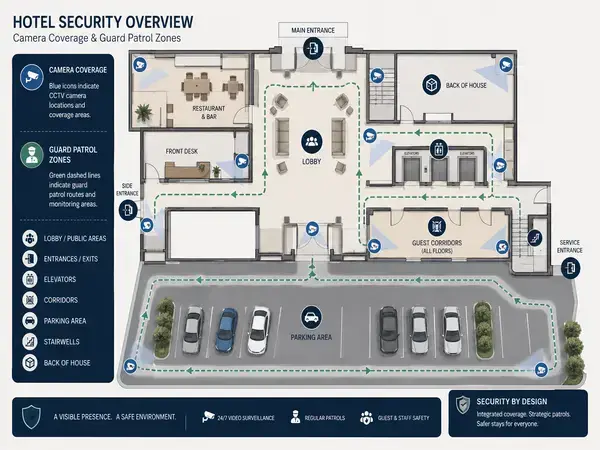
You don’t need a camera in every corner. You need them where risk is highest and a guard where a camera can’t act. Map coverage to vulnerability, not to symmetry. The table below is how I’d prioritize a typical mid-size property.
| Zone | Cameras | Guard / patrol | Why it matters |
| Lobby and reception | Yes | Primary | Highest traffic; first point of contact and first line of sight |
| Entrances and exits | Yes | Primary | Controls who gets in; a visible officer deters before entry |
| Parking lot and garage | Yes | Primary | Cars sit unattended for days; the most common weak point |
| Hallways and corridors | Yes | Support | Spots loitering and protects room access between floors |
| Elevators and stairwells | Yes | Support | Confirms safe, authorized movement between floors |
| Pools, gym, bars | Yes | Support | Busy amenity zones where incidents and theft cluster |
| Kitchens and storage | Yes | Support | Cuts inventory shrink and food or supply theft |
| Staff areas and offices | Yes | Support | Deters internal theft and confirms policy compliance |
| Back-of-house, loading dock | Yes | Primary | Quiet, low-visibility access points crews exploit |
On a typical Houston property, I’d anchor the lobby and parking deck with both cameras and people, then let cameras carry the low-traffic corridors. Dedicated hotel security guards cover the rest by walking a route, not staring at a wall of monitors.
How much does a hotel security system cost?
It depends on your size and risk, and anyone quoting a flat number online is guessing. What I can give you are the pieces with real, sourced ranges and where the money actually goes.
| Component | Typical basis (sourced) | What drives the number |
| Security guard pay (basis for billing) | About $14 to $29/hr; median near $18.46/hr (BLS, May 2024) | Experience, armed vs unarmed, shift, location |
| What you are billed per hour | Higher than guard pay, to cover overhead, supervision, insurance, and overtime | Coverage hours, single vs multiple posts |
| Cameras, access control, alarms | Quote-based; scales with door and camera count | Property size, wiring, cloud vs local storage |
The biggest cost lever is guard hours, not hardware. The BLS puts the median guard wage near $18.46 an hour (May 2024), and the rate you are billed runs higher than that to cover overhead, supervision, and overtime, so a 24/7 post adds up quickly. That’s exactly why placement matters. You cover the highest-risk hours and zones with people, whether that’s armed or unarmed officers, and let cameras hold the rest.
If the budget is tight, spend in this order: cover your worst hours first, then your worst zones, then upgrade hardware. A single overnight officer who walks the lobby and parking deck during the high-risk window often does more for guest safety than adding more cameras that record the same empty hallway in higher resolution. As the property grows or an event spikes the crowd, you scale the staffed hours up and back down without touching the wiring. That flexibility is the practical advantage of leaning on trained people rather than buying your way out of every gap with equipment.
What are the hotel security camera laws in Texas?
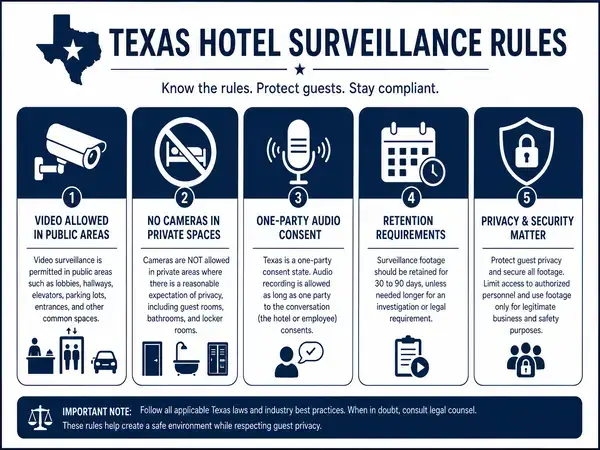
In Texas you can record video in public areas of your hotel (lobby, halls, parking) without consent, but audio and private spaces are where hotels land in legal trouble. Texas is a one-party consent state for audio, and recording guests anywhere they expect privacy is a felony.
Audio and video: what Texas allows
Video-only surveillance in public areas is legal. Audio is a different animal. Under Texas Penal Code 16.02, Texas is a one-party consent state, so you can record a conversation only if someone in it consents. Switch on the microphones across your camera network without thinking it through and you’ve created real exposure. When in doubt, check Texas recording law or talk to a Texas attorney.
Never put cameras in guest rooms or private spaces
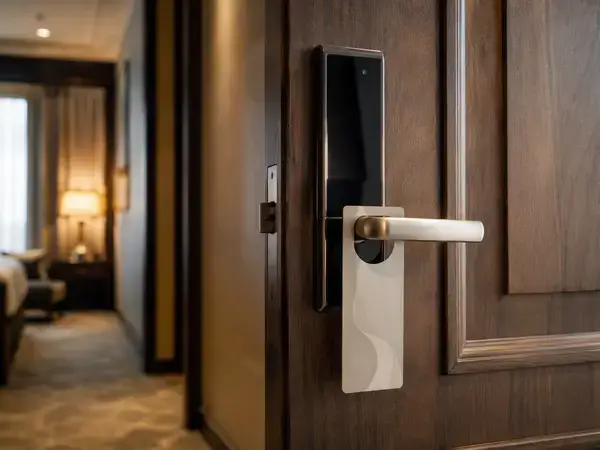
This is the line you do not cross. Cameras in guest rooms, bathrooms, locker rooms, or changing areas violate Texas Penal Code 21.15. As of September 2025, that invasive visual recording law expanded to cover any space where a person reasonably expects privacy. It’s a state jail felony carrying up to two years and a $10,000 fine, and a conviction now triggers sex-offender registration. Past the law, the reputational hit is permanent.
Do you need surveillance signs?
Texas doesn’t legally require signs for video recording in public areas, so the blanket “you must post signs” advice you’ll read online isn’t quite right here. Visible signage is still smart, though: it deters crime and sets guest expectations. Post it at entrances and monitored common areas.
Footage and data: the TDPSA and retention
Security footage is personal data once it can identify someone. The Texas Data Privacy and Security Act took effect in July 2024, and the Texas Attorney General can fine violations up to $7,500 each. Encrypt stored footage, limit who can view it, and set a retention window (30 to 90 days is the common practice unless an investigation needs longer). Write the retention rule down and follow it, because keeping footage “just in case” forever is its own liability if that drive is ever breached. In Texas, the guards and the firms installing this gear must be licensed through the state’s Private Security Bureau, so hiring licensed guards isn’t a nice-to-have. It’s the baseline.
What are the most common hotel security mistakes?
The expensive mistakes aren’t exotic. They’re the same gaps I find on assessment after assessment: blind spots, outdated tech, no backup power, untrained staff, treating cameras as a stand-in for people, and never going back to check whether any of it still works.
Leaving blind spots
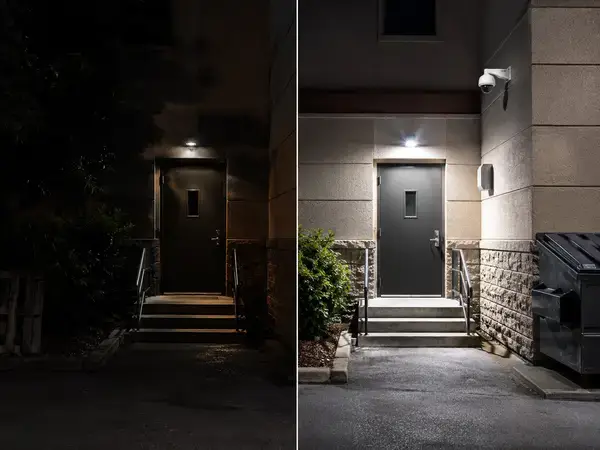
From side doors to back gates and far corners of the garage, the spots no camera sees are the spots burglars pick. Whatever camera you use, aim it on purpose. A quick professional walkthrough finds the gaps faster than guessing from a floor plan.
Running outdated or unpatched tech
Old analog gear and unpatched systems are easy targets for tech-savvy intruders. Update firmware and software on a schedule. A camera you installed and forgot five years ago is a door you left unlocked.
No backup power or failover connectivity
This one gets overlooked until it bites. During an outage, cameras, access control, sensors, and alarms go dark without backup power. And power isn’t the only risk: if your system is cloud-based and the internet drops, you go blind right when live monitoring matters most. Invest in failover so your security doesn’t die with the lights.
Buying tech but not training the team
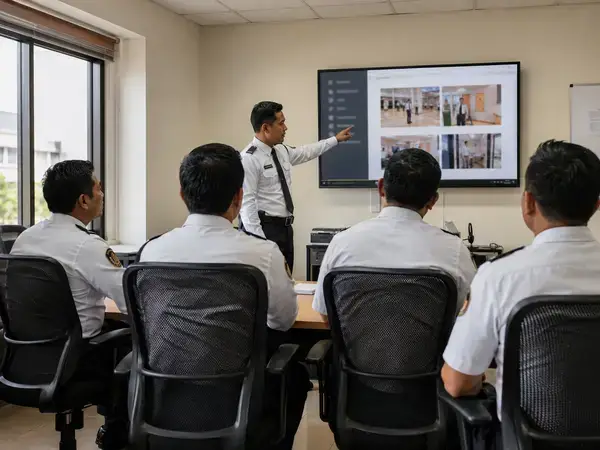
The best system on the market is close to useless if your staff can’t run it. Plenty of hotels install good gear and skip the training. Bake security training into onboarding, run refreshers, and staff posts with trained security guards who know the property cold. And remember the through-line of this whole guide: cameras record, people respond. Don’t buy one and call it both.
Treating security as a one-time setup
A hotel changes. New staff cycle in, a renovation moves a side entrance, a camera drifts out of focus, and the threat picture shifts with the neighborhood. The program you installed three years ago is not the program you have today unless someone checks. Walk the property at least twice a year, confirm every camera still sees what it’s supposed to, test the alarms and panic buttons, and review your guard coverage against the incidents you’ve actually logged. Security is a habit, not a purchase, and the hotels that treat it that way are the ones that stop having the same incident twice.
The bottom line for your Houston hotel
If you take one thing from this, take this: the best hotel security system isn’t a shopping list of gadgets. It’s layers that work together, anchored by people who can act. Cover your highest-risk zones and hours with trained officers, let well-placed cameras and access control handle the rest, keep the whole setup on the right side of Texas law, and review it twice a year. Do that, and you stop most problems at the door instead of reviewing them on a hard drive the next morning.
FAQs
What is a hotel security system?
A hotel security system is the combined setup of surveillance cameras, electronic access control, fire and intrusion alarms, emergency communication, and on-site security guards that protects a hotel’s guests, staff, and property. The strongest systems pair technology with trained people so threats get deterred and handled, not just recorded.
What should a hotel security system include?
At minimum: tiered access control, cameras in high-risk zones, fire and panic alarms, a mass-notification system, and trained guards. Place people and cameras by risk, not evenly. The American Hotel & Lodging Association’s 5-Star Promise, adopted across roughly 20,000 properties, also made staff panic buttons a baseline expectation.
Do hotels need security guards if they already have cameras?
Yes. Cameras record incidents; they don’t stop or respond to them. A licensed guard deters trouble by being visible and handles a situation in person while a camera only documents it. The most effective hotel security uses both together.
Are security cameras allowed in Texas hotel rooms?
No. Recording guests in rooms, bathrooms, or any space where they expect privacy violates Texas Penal Code 21.15. As of September 2025 it’s a state jail felony with up to two years in jail and mandatory sex-offender registration. Cameras belong in public areas only.
How long should a hotel keep security camera footage?
Most hotels keep footage 30 to 90 days, then delete it unless it’s needed for an investigation or claim. Texas sets no fixed legal retention period for general surveillance, but the Texas Data Privacy and Security Act (effective July 2024) expects you to protect that footage and limit who can access it.
Do hotel security guards need a license in Texas?
Yes. In Texas, security guards and the companies that employ them must be licensed through the Texas Department of Public Safety Private Security Bureau. For a hotel, that means using licensed, background-checked officers rather than untrained staff. Confirming a provider’s licensing is the baseline step before any other security decision.
What hotel areas need security cameras most?
Lobbies, entrances and exits, hallways, elevators, stairwells, and the parking lot or garage. Parking is often the weakest point because cars sit unattended for long stretches. Pair cameras in those zones with guard patrols for the strongest coverage.
What is the difference between hotel security cameras and security guards?
Cameras are a passive record. They capture what happened and help you review it later, but they can’t intervene. Security guards are an active layer. They deter trouble by being visible, respond to incidents in person, and make judgment calls a camera can’t. A strong hotel security system uses both: cameras to extend coverage and document events, guards to prevent and respond.
How often should a hotel review its security system?
At least twice a year, plus after any renovation, incident, or major staff change. A walkthrough should confirm every camera still has a clear view, test alarms and panic buttons, recheck access permissions, and compare guard coverage against the incidents you’ve logged. Security drifts out of date quietly, so a scheduled review is what keeps the plan matched to the real risk.


