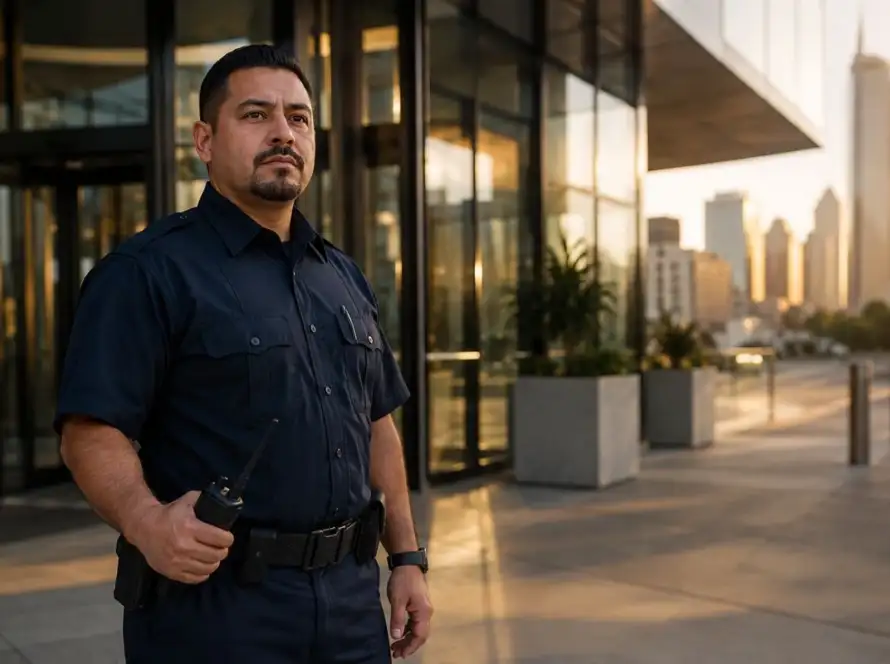
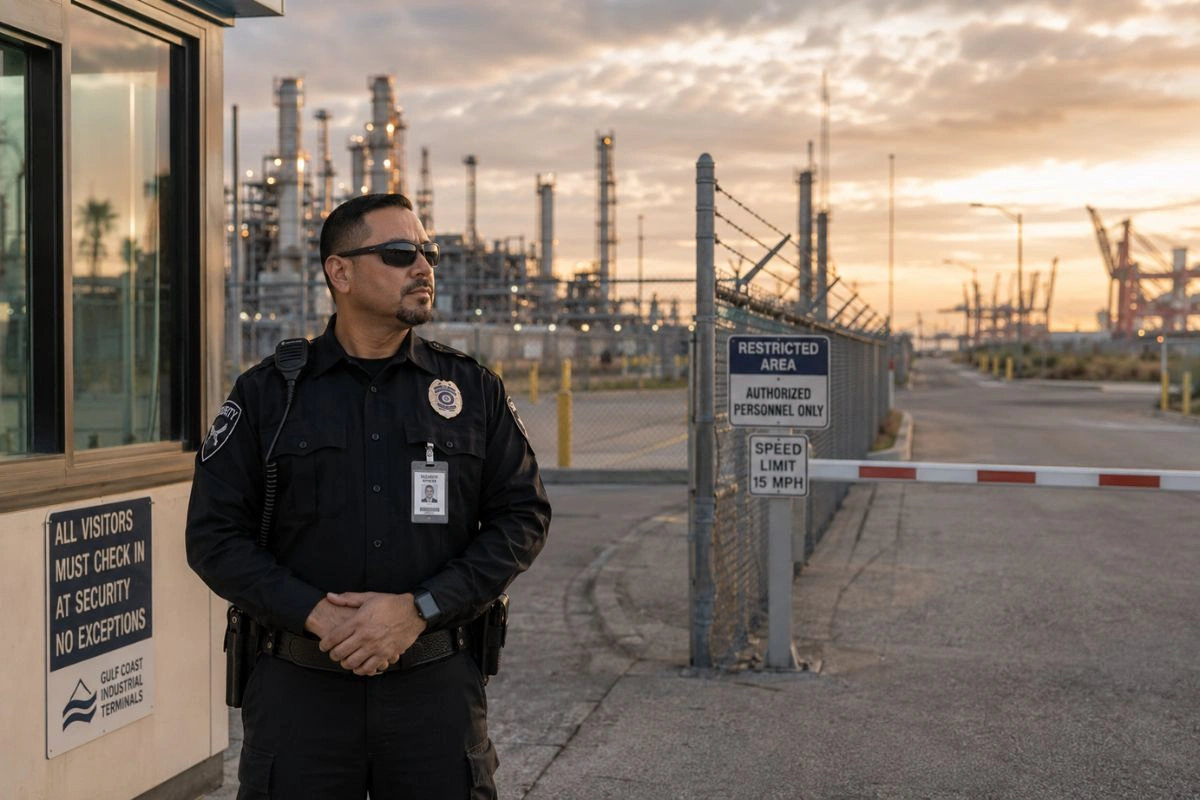
The 5 Ds of perimeter security are Deter, Detect, Deny, Delay, and Defend, five layers running from your fence line inward, each buying time and information before the next is tested. Perimeter security guards live inside that model, not beside it: the uniformed officer is the deterrent, patrols and reporting are detection, the gate post is denial, and response covers delay and defense.
That framing matters in Houston, where ports, refineries, and packed industrial corridors sit close together and one weak boundary risks the whole site. It’s the same layered thinking a serious Houston security guard company brings to any site walk.
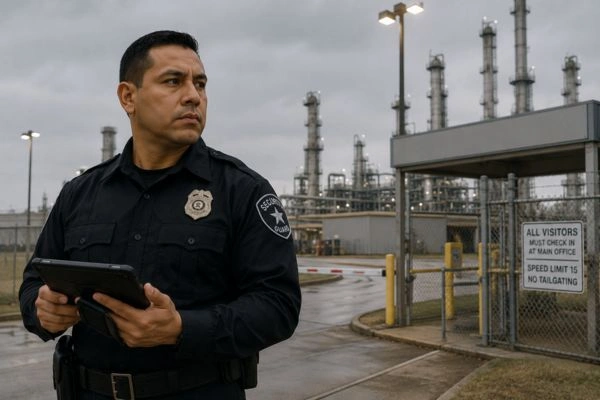
What is perimeter security, and where do guards fit in?
Perimeter security is the mix of barriers, systems, and people that protects a property’s outer boundary before a threat reaches anything of value. It pairs physical measures like fencing and lighting with electronic ones like cameras and sensors, plus trained officers. The aim is to stop trouble at the edge, not the front door.
Guidance on physical security describes a ringed setup, where an organization blocks access first with fences, guards, gates, and locked doors, then stacks more layers behind them. The U.S. Cybersecurity and Infrastructure Security Agency notes that stacking those layers raises the effort an intruder must spend and improves the odds of catching them.
Guards are the part of that ring that thinks. A camera records a fence-jumper; an officer decides whether it’s a lost delivery driver or a real threat, and acts. That judgment separates a layered system from a pile of equipment.
What are the 5 Ds of perimeter security guards?
The 5 Ds of perimeter security guards are those same five layers, seen through what an officer actually does on site. Read that way, a good officer touches four of the five before anyone has to call the police.
Deter
Deterrence is about making your site look like more trouble than it’s worth. Most intruders are opportunists who pick the soft target, so a lit, fenced, signed perimeter with a visible uniform tells them to keep driving.
Here’s where I’ll push back on a common pitch. A guard parked in a booth staring at a phone deters almost nothing after the first week; regulars learn the pattern. Real deterrence is active, an officer who moves, makes eye contact, and pays attention. The uniform is the start, not the whole job.
Detect
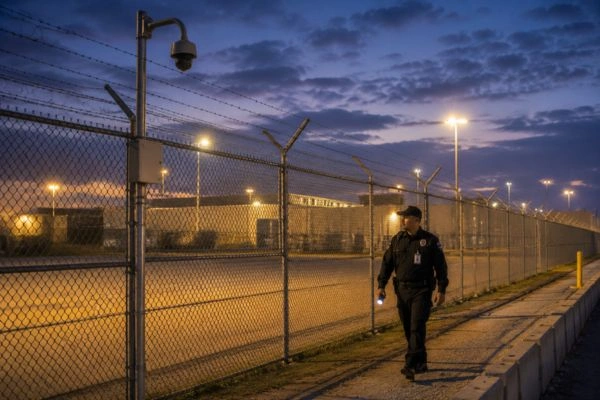
Detection means spotting a problem early enough to act on it. This is the layer guards and technology share most. Cameras and motion sensors see everything, but they don’t interpret what they see. An officer running consistent patrol routines closes the gap between an alert and a decision.
Houston adds a wrinkle national articles skip. Heat, humidity, and storm season throw false alarms by the dozen, and cameras alone in this climate cry wolf until nobody trusts them. A trained officer keeps detection honest when the equipment gets noisy.
Deny
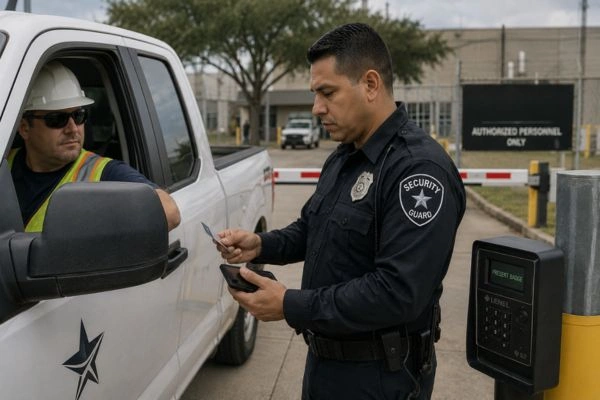
Denial is access control: who gets in, where they can go, and who gets turned away. Gates, badge readers, and locked doors do part of the work. An officer at the entry point does the part machines can’t, which is reading a situation, a tailgating vehicle, a contractor with the wrong paperwork, a visitor a little too interested in the loading dock. Equipment logs those events. A guard stops them.
Delay
Delay buys time. If someone gets past deterrence and detection, every extra minute before they reach the asset buys your response time. Vehicle barriers, bollards, cut-resistant fencing, and interior doors all slow an intruder down.
Guards stretch delay in a way fixed barriers can’t. A roving officer forces an intruder to account for something unpredictable, since you don’t know where the patrol is. At Houston’s port and petrochemical sites, that’s worth more than another foot of fence.
Defend
Defense is the last ring, and the most misunderstood. In practice it means an officer intervenes, contains the situation, and coordinates with police, not that they go hands-on with every intruder. What a guard may legally do is narrower than most clients assume.
Texas regulates private security under Occupations Code Chapter 1702, through the Department of Public Safety. Officers work under roughly the same detention limits as a private citizen, not the broader authority of a police officer. Overstep, and you’ve handed the other side a lawsuit. Before you staff a post, get clear on a guard’s legal limits in Texas.
Whether that officer is armed comes down to the site. Unarmed officers hold a non-commissioned Level II license and handle most low-risk deterrence and access work. Armed officers add Level III firearms training and a commission, for high-value or high-threat sites. Arming a lobby guard at a quiet office park adds liability for no gain; leaving a cash-handling site unarmed is the opposite mistake.
Do you really need all five layers?
Yes, but not in equal measure. The framework is sound; spending evenly across all five is not. The right mix depends on what you’re protecting and who’s after it.
This is the part most pitches skip. Most properties I’ve assessed over-invest in deterrence, which is visible and feels productive, and under-invest in detection and delay, which are boring and only get noticed when they fail. A tall fence and a bright sign look like security; they do nothing once someone decides to climb. A single guard with no detection or delay behind them is the same trap. Pull one layer out and the others stretch thin. That’s the whole reason for stacking them.
How Houston conditions change the 5 Ds
Houston isn’t a generic security market, and the 5 Ds don’t play out here the way they do in milder metros.
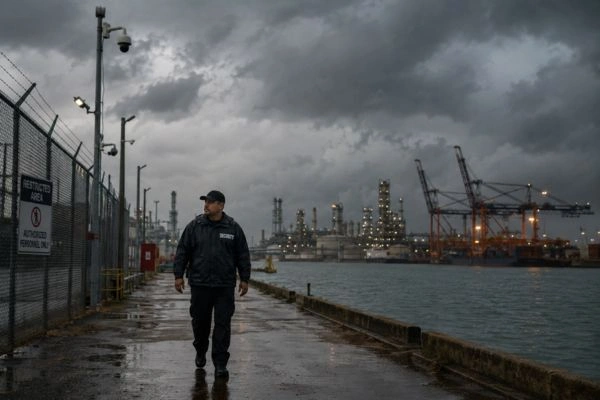
Three things drive it. First, the weather, since humidity corrodes hardware and storms trigger false alerts, so detection leans harder on people than gadgets. Second, the property mix, because ports, refineries, warehouse and distribution sites, and cargo yards face vehicle-ramming, cargo theft, and insider risks a suburban strip mall never sees, so delay and denial carry more weight. Third, the workforce, where a bilingual officer who can de-escalate across a diverse site does more real detection than one who can’t talk to half the people there.
There’s also a labor reality nobody markets. Federal labor data points to about 162,000 security guard openings a year nationally through 2034 with almost no net growth, a polite way of saying the field churns constantly. High turnover means inconsistent site knowledge, which breaks Detect and Deny first. The providers worth hiring train past the state minimum and keep officers long enough to learn your property.
Take one thing from this. The 5 Ds are a system, and a system fails at its weakest link, not its strongest. Buying more of what you already have rarely helps. Finding the gap does.
For most Houston properties, that gap sits in the middle, in detection and delay. The fix is usually not more fences or more cameras but better-connected ones, where camera coverage feeds officers who respond instead of running as a silo.
Frequently Asked Questions
What are the 5 Ds of perimeter security?
The 5 Ds of perimeter security are Deter, Detect, Deny, Delay, and Defend. They form a layered model that works from a property’s outer boundary inward, with each layer slowing an intruder and improving the chance of catching them. Federal physical-security guidance treats this kind of ringed, stacked defense as a baseline for protecting facilities.
How do perimeter security guards support the 5 Ds?
Perimeter security guards carry four of the five layers directly. A uniformed officer is the deterrent, patrols and reporting handle detection, the gate post manages denial, and response covers delay and defense. The layer guards add that equipment cannot is judgment, deciding in the moment whether an alert is a real threat or a false alarm.
Do you need armed or unarmed guards for perimeter security in Houston?
It depends on the site’s risk and value. Unarmed officers, who hold a non-commissioned Level II license in Texas, handle most low-risk deterrence and access control. Armed officers, who complete additional Level III firearms training and a commission, are for high-value assets or real threat exposure such as cash handling or critical infrastructure. Texas DPS regulates both under Occupations Code Chapter 1702.
Can a security guard detain or arrest an intruder in Texas?
Only within narrow limits. In Texas, a private security officer operates under roughly the same detention authority as a private citizen, not the broader powers of a police officer. Misusing that authority exposes the officer, the security company, and the client to legal liability, which is why training and clear post orders matter as much as the badge.
Is one guard enough to secure a property perimeter?
Usually not on its own. A single officer with no detection or delay behind them creates a false sense of security, because a patient intruder can learn the patrol pattern and wait for a gap. The 5 Ds work because the layers cover each other. It also helps to know the field turns over fast: federal data points to about 162,000 security guard openings a year nationally, so consistency depends on a provider that retains and trains its officers.
How does Houston weather affect perimeter security?
More than most national guidance admits. Humidity corrodes cameras, sensors, and fencing, and storm season causes power loss and frequent false alarms. That makes the detection layer lean more on trained officers, who can tell a real intrusion from weather noise, and it raises the value of resilient barriers and storm-ready response plans at exposed industrial sites.